White Rock Elementary 25-26

OUR CONTEXT
OUR LEARNERS
At White Rock Elementary, we recognize the important interconnectedness between academic success and social-emotional well-being. We know that for students to be calm and ready to learn, they must have a solid foundation in Social-Emotional Learning. For that reason, Social-Emotional Learning will continue to be at the heart of the work we do with our learners and within our school community.
Literacy has been a focus for our school since 2023-2024. As defined by the Ministry of Education, literacy encompasses the multifaceted ability to comprehend, critically evaluate, and generate various modes of communication, including oral, written, visual, digital, and multimedia formats, to achieve one's goals. With these skills, learners are able to apply essential reading, writing, speaking, and listening proficiencies across different subject domains. Literacy skills serve as the foundation of lifelong learning, empowering learners to continuously engage with information, think critically, and express themselves effectively in various contexts, thereby fostering ongoing personal and intellectual growth.
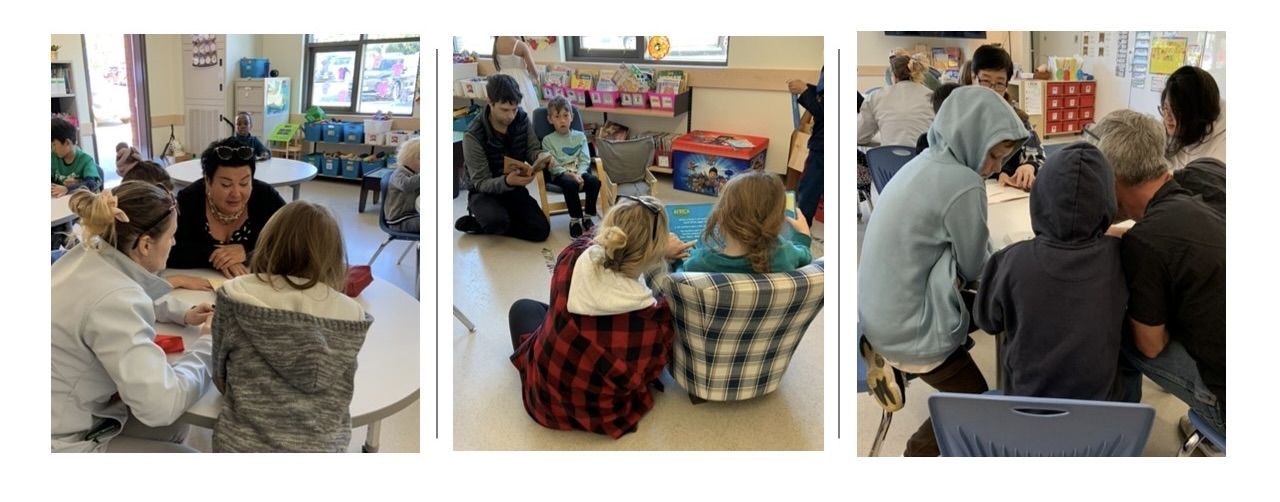
Examples of our learners engaged in literacy activities are highlighted below:
Our learners can use developmentally appropriate reading, listening and viewing strategies to make meaning
Good readers use explicitly taught reading strategies, such as visualization to build pictures in their mind of what they are reading. This helps learners have a deeper understanding of the text and have better recall.
Our learners can engage actively as listeners, viewers, and readers.
Noisy reading
Reading Link Challenge
The Reading Link Challenge is a literacy initiative designed to inspire students to explore a wide range of books while developing a life-long love of reading. Students in Grades 4 and 5 compete in school, library and community challenges that promote critical thinking, inclusivity and strong reading habits. Congratulations to our Book Bananas who won first place this year.

DEAR (Drop Everything and Read)
Twice a year, our entire school community gathers in the gym for Drop Everything and Read. DEAR promotes a school-wide culture of reading by encouraging staff and students to pause their day and engage in reading. This dedicated time reinforces the value of reading for enjoyment, building reading stamina and focus. DEAR helps foster positive reading habits by creating consistent opportunities for all learners to immerse themselves in books they enjoy.


Library Book Creation
Student have been producing their own books on being kind to others. These are created, illustrated and shared by students. They have been circulating in the library and students love reading them.


What About Us - School Production
Our learners can plan and create a variety of communication forms for different purposes and audiences
Firstie production ideas come from good stories. We read many good books together, then we chose one. This year The Firsties engaged in deep conversations about how precious Planet Earth is. This conversation heightened with our focus on the Artemis II Mission; the preparations; the reasons; the future. Seeing the images of Earth taken thousands of kilometres from Earth took our breath away. She really is so precious, we realized. We wondered if we were paying enough attention to all the beauty and caring for her, Earth, the best we could? As we read more books, we discovered ‘the one’. Noticing by Kobi Yamada was just the message we were looking for, and the journey began. We thought that we could show how important it is to be interested, to stay curious, and to let our imaginations guide us to make positive change.

The Firsties learned that to make big things happen they had to start small. They broke down all the parts of this big dramatic production into small manageable pieces, then began choosing meaningful songs – Joni Mitchell was inducted into the Musical Hall of Fame this year. We added two of her songs that enhanced our message. We focused on sustainability and on making things by hand; reusing Amazon boxes and brown paper to create a very large tree for our set; dyeing cloth to make our own costumes for our Earth Song dance; one our dads building a bridge for our set entirely from scraps of wood; creating art to project onto the cyclorama to set the mood – we worked in the style of two master abstract artists: Henri Matisse, and Wassily Kandinsky.

We also worked in our own abstract style. We created a thoughtful art piece to show our growth from 6 years old up to 20 years old as a backdrop to our song Circle Game. This prompted a lot of talk about our futures, and what the planet might look like when we grew into adults. We considered the questions Who Am I; and to the world community What About Us? Which led us to our master pieces, our large self-portraits that will play an important role in our message of being honest with ourselves and hoping that we meet people on our journey who will really see us.
As we learned more about the complex systems that animals and plants use to survive, we learned to value ‘life’ and how very precious each tiny being is. We created a 3-D art project to demonstrate our understanding of the system of photosynthesis, then used it practice our presentation skills. We studied bees and the roles each member plays to serve the whole community. We saw ourselves in that way, and our relationships grew stronger by learning how cooperation and acceptance were important pieces in working together.

We asked: “Have you thought about the consequences of your actions on those of us who will be here far longer than you?” We got a little bit angry. Our dance was beginning to reflect these feelings. We designed our costumes with these feelings in mind: red for the love in our hearts; black for our anger. The Firsties choregraphed movements that showed how they felt. They considered how they might make changes in their own lives, but also how they could lead others by example.
Our focus on sustainability, honest and meaningful interactions, and science, integrated fully into music, dance, drama, and visual art has been an incredible journey. The Firsties have grown up through the three simple rules we stayed accountable to: Show Up; Work Hard; Be Kind to Each Other.

Learning literacy through Indigenous Peoples perspectives:
This year, our learners have incorporated the First Peoples Principles of Learning in subjects such as Science and French. Our intermediate students presented a Science Fair, where many students embraced the principle: Learning is holistic, reflexive, reflective, experiential, and relational (focused on connectedness, on reciprocal relationships, and a sense of place). To connect with our school-wide literacy goals, students researched aspects of Indigenous culture that inspired them and wrote descriptive pieces about their topics and findings. They then reflected on their learning through a written reflection shared in their own classes. Topics included investigating oil spills to discuss environmental responsibility and stewardship, traditional technologies and the impact, relationships and respect for our natural world. Our learners were proud to showcase their knowledge to our students, staff and parent community at White Rock during our Science Fair. We sent six students to the District Science Fair who all won gold this year.

Our intermediate learners also incorporated Indigenous perspectives in French. Through the principle: Learning involves recognizing the consequences of one‘s actions, students designed and created their own towns. They had to make choices about land use, resources, infrastructure and community spaces, and think about how those choices affect people and the environment. Students used sustainable resources and recyclable or low-waste materials to design their towns. Our learners eagerly showcased their final presentations through a French showcase, inviting the whole school for a viewing. They wrote about their towns in both French and English and presented most of their information in French.
At White Rock, we are committed to fostering a deep understanding and appreciation of both literacy and Indigenous education. By integrating the First Peoples Principles of Learning across various subjects, we want our learners to develop. Strong literacy skills but also gain a respect for Indigenous cultures and reconciliation. Our holistic approach to education encourages students to connect their learning to real-world contexts, fostering a sense of community and cultural awareness. We are proud of our learners’ growth and achievements.
Science Fair


French Indigenous Project


OUR FOCUS
Literacy skills are the foundation upon which children not only learn the lifelong skills of reading and writing, but also, life skills that enable them to make sense of their world, build essential critical thinking skills, and effectively communicate with others. Throughout the school day, our learners are engaged in many different rich literacy activities in all subject areas, which reinforce the importance of learning to read. In some classrooms, students could be exploring non-fiction picture books to learn about a topic, engaging in a student-led literature circle discussion about a text or expressing the words of poetry, songs, and stories through drama and movement, showing that there are many ways to develop literacy skills. Integration of literacy across disciplines not only enriches the understanding but also reinforces the importance of developing reading abilities.
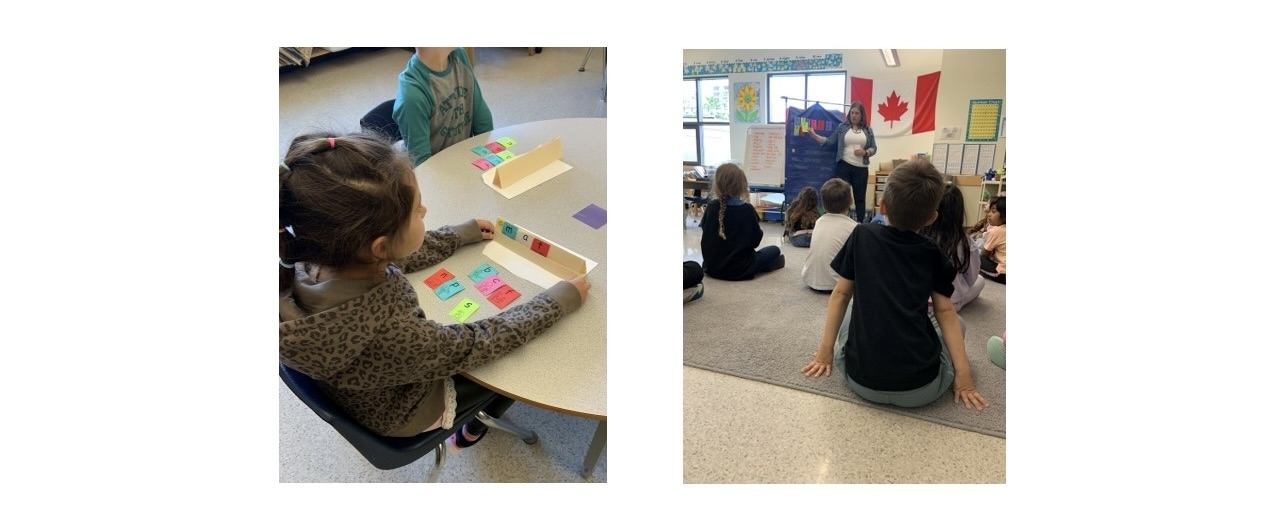
This year we have monitored the literacy journey in a cohort of early learners in two Kindergarten classrooms. This cohort reflects a diverse range of students that are representative of our school population. These learners have been building pre-reading skills, which are basic building blocks for learning to read.
Phonemic awareness is a part of phonological awareness that involves being able to hear and recognize sounds in words. This is a critical component of early reading success and can have a profound impact on a child’s literacy development. The building of phonemic awareness skills in a child’s early years is directly related to reading fluency and a student’s ability to decode text, as well as the skill of understanding and making sense of the words on the page.
Skills involved in phonemic awareness include segmenting, blending, and syllabication. The work with our first cohort of students has focused on developing these skills through specific phonics instruction, group activities and engaging, play-based activities, which all allow for repetition and review and which benefit our more vulnerable learners.
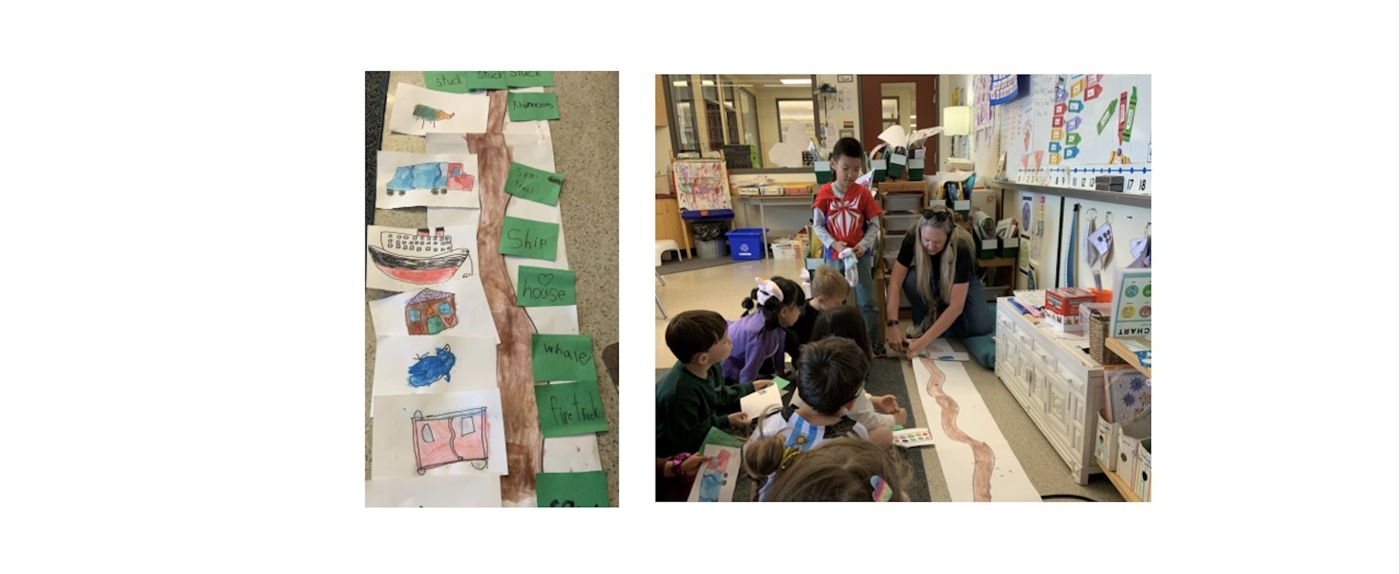
In January our Kindergarten teachers administered the ELPATS (Early Literacy Phonemic Awareness Tool), a district-based oral assessment of phonemic awareness, which helps teachers monitor students’ acquisition. The information gathered through this assessment provided opportunity to guide instruction based on the needs. Then in May, the teachers completed the ELPATS again to measure the students' progress.
Phonemic awareness is a part of phonological awareness that involves being able to hear and recognize sounds in words. This is a critical component of early reading success and can have a profound impact on a child’s literacy development. The building of phonemic awareness skills in a child’s early years is directly related to reading fluency and a student’s ability to decode text, as well as the skill of understanding and making sense of the words on the page.
Skills involved in phonemic awareness include segmenting, blending, and syllabication. The work with our first cohort of students has focused on developing these skills through specific phonics instruction, group activities and engaging, play-based activities, which all allow for repetition and review and which benefit our more vulnerable learners.
Some of the learners have achieved a mastery level of reading skills at the end of kindergarten. Some of our learners take longer to reach mastery level. We will collect information for this and future groups to see if a pattern emerges. This will help us prepare early intervention strategies and targeted support for our learners to close any gaps that may be seen.
OUR NEXT STEPS
Evidence of our students' learning demonstrates that our literacy focus is having a positive impact on our early learners. This data compares the data collected from the May 2026 ELPATS (Early Literacy Phonemic Awareness Tool) to the data collected in January.

These tables compare the May 2026 ELPAT data (from some of the kindergarten classrooms) with May 2025. We attribute part of this growth to a shift in practise resulting in a change of routines in that classroom (including the use of the UFLI phonics resource and participation in the Responding to Readers program). The skills learned in the program and effective use of UFLI from 2024 to present day has helped our staff and students achieve high results in ELPATS reading scores.

Moving Forward Based on evidence of students' progress in relation to our learning goals, our next steps will include:
• Continuing to support the science of reading and actively using strategies to build phonemic awareness in primary classrooms
• Continue to employ strategies learned in the District Responding to Readers project in 2024-2025
• Use tools such as UFLI for reading and literacy.
• Providing opportunities for families to learn about the importance of reading at home
• Exploring opportunities to build capacity in teachers (for example, through Lunch & Learns with our District Helping Teachers)
- Use the new SD36 Kindergarten Screener along with the ELPATS to make sure student assessment drives instructional goals and progress
Surrey Schools
Formed in 1906, the Surrey School District currently has the largest student enrolment in British Columbia and is one of the few growing districts in the province. It is governed by a publicly elected board of seven trustees.
The district serves the cities of Surrey and White Rock and the rural area of Barnston Island.