W.E. Kinvig Elementary 25-26

OUR CONTEXT
W.E. Kinvig is located on the shared, unceded, traditional territories of the Katzie, Semiahmoo, Kwantlen and other Coast Salish Peoples. Our student population of nearly 430 boasts a culturally and linguistically diverse group of learners. We celebrate diversity throughout the school year during annual occurrences like Black History Month, Sikh History Month, Asian Heritage Month and National Indigenous History Month, to name a few.
At W. E. Kinvig Elementary, we promote honesty, caring and leadership. We pride ourselves on providing a welcoming school environment that embraces community involvement. Building leadership skills is a goal which is built into all our academic and social responsibility experiences. We continually work towards creating a culture that embraces the diversity of our students and an understanding of each student’s individual story. For the past two years, staff have been writing a vision statement that resonates with our learners:
At W. E. Kinvig Elementary, we are committed to fostering a safe and nurturing environment, where every child experiences growth, inclusion, equity, and a strong sense of belonging as they reach their full potential and become life long learners.
We work in partnership with Community Schools providing opportunities for our students to participate in several different programs. Students are provided opportunities to participate in dance, soccer, volleyball, basketball, badminton, and track & field. Several of our classes at W. E. Kinvig participate in our Leaders for Change program in which students are encouraged to find ways to give back to their community. They have fundraised and given generously to such places as Surrey Memorial Hospital. In addition, many of our students participate in Games Club and Friendship Friday. Our hope is for our students to engage in a wide range of activities that capture their strengths and interests and nurture their leadership skills.
Our school community finds ways to come together and celebrate the learning happening. Recently, parents, staff and students enjoyed an evening of participating in literacy stations designed to encourage students and parents to read together. In our early primary classes, our learners and their parents spend their Monday mornings reading to each other. Every learner at W.E. Kinvig has been taking part in our monthly DEAR (Drop Everything and Read) sessions. Through out the year, staff organize story walks around the school and classes .
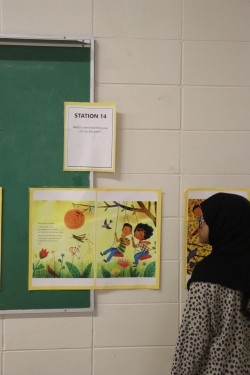
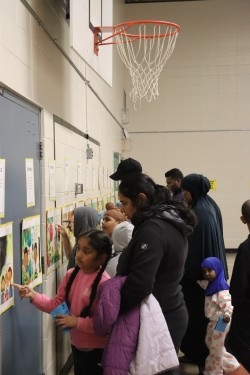
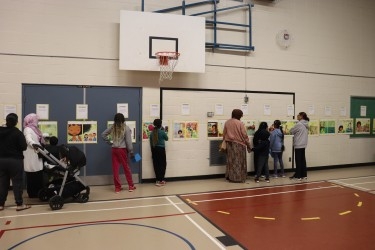
Our story walks from Bannock and Books. Kinvig students have a passion for literacy and love to read.
Our students are inclusive, welcoming, eager to learn, happy at school, inquisitive, imaginative, and energetic. In addition, our students display resiliency and perseverance, and are respectful and supportive of one another.
We take pride in our students’ strengths and their ability to support each other in achieving their personal and academic successes.
OUR LEARNERS
Reading is not only a fundamental academic skill but also a gateway to intellectual, emotional, and social growth for our learners. Encouraging and fostering a love for reading from a young age can have a profound and lasting impact on their overall development and future success. Reading and writing help us to make sense of the world around us and to express our thoughts, ideas, and expressions to others. The BC Curriculum highlights and emphasizes that stories and other texts help our learners learn about themselves, their families and their communities. As such, teaching effective literacy skills is central to supporting our learners as they learn about themselves and the world around them.
Our learners can read fluently at grade level.
Students use reading skills in all subject areas. They can use a variety of strategies to make meaning of letters and words.


Our students playing and learning letter and sound recognition using strategies they have learned.
Our learners can use a variety of comprehension strategies before, during, and after reading, listening, or viewing to deepen understanding of text.


Students using sequencing to comprehend their reading.
OUR FOCUS
Literacy, specifically reading, has been identified as an area to spotlight for student growth. Reading underlies all learning and the skills needed for reading: phonemic awareness, decoding, fluency, and comprehension, are fundamental for students’ language development. While we are proud of the work that is being done and the progress the learners have made, we recognize that there is more to do. The results from the Foundation Skills Assessment confirm this.
| Grade 4 | Grade 7 | |
| Reading and Literacy: Number of Students on Track and Extending | 11/37 | 15/46 |
| % | 30% | 33% |
We also used our ElPAT results to guide our support. The following chart summarizes our results for our grade one students in the 2024-25 and the school year.
| Grade 1 | High Utility | Mid Utility | Low Utility | Short Vowel |
| Fall | 63% | 48% | 13% | 17% |
| Winter | 83% | 74% | 52% | 57% |
| Spring | 85% | 76% | 65% | 67% |
This data also demonstrates that while we are moving in the right direction, a focus on Reading is needed and will be beneficial to our learners.
We set out to work on the following reading goals:
Read fluently at grade level.
Use a variety of comprehension strategies before, during, and after reading, listening, or viewing to deepen understanding of text
Teachers gathered formal and informal information regarding their students' reading levels. Ultimately, our learners will be able to read fluently and use a variety of reading strategies to understand text. We hope our students will be inspired and develop a life-long love for reading.
OUR NEXT STEPS
Goal #1 Read fluently at grade level
Cohort #1 Kindergarten
Kindergarten
| Kindergarten | High Utility | Mid Utility | Low Utility | Short Vowel |
| Winter | 49% | 23% | 9% | 23% |
| Spring | 91% | 77% | 77% | 79% |
The results indicate our kindergarten student made significant gains in their ability to read over the course of the year.
Cohort #2
| Grade 1 | High Utility | Mid Utility | Low Utility | Short Vowel |
| Fall | 25% | 19% | 6% | 15% |
| Winter | 94% | 75% | 31% | 28% |
| Spring | 100% | 100% | 88% | 100% |
Teacher Observations for Cohort #2:
I noticed that some students had not yet fully mastered their letter-sound knowledge and that many students were still segmenting sounds before reading words, even though some were likely capable of reading the words fluently. Moving forward with UFLI instruction, we focused on strengthening letter-sound recognition during the auditory drill, and I explicitly modeled what fluent reading looked and sounded like.
During the blending board portion of UFLI, I changed one letter at a time to create new words. I then gave students the opportunity to read the word fluently in their heads before sounding it out together as a class. This approach allowed students who still needed to sound out words to participate while also encouraging more fluent readers to recognize and read whole words automatically.
After reassessing the students in March, I observed growth in all students’ ability to correctly identify letter sounds in nonsense words. I also noticed greater improvement among students performing in the mid-to-high range compared to students performing in the lower range when it came to reading whole words fluently.
After reassessing the students in June, I also noticed similar growth among students performing in the mid-to-high range compared to students performing in the lower range when it came to reading whole words fluently and the oral reading fluency scores.
Goal #2
Our learners can use a variety of comprehension strategies before, during, and after reading, listening, or viewing to deepen understanding of text.
Teacher Observations:
I focused on three learners representing different performance levels: one lower-performing student, one middle-performing student, and one higher-performing student.
Through the assessments, I noticed that many students were able to decode text fluently; however, when it came to retelling and comprehension, they often struggled (even the ones I thought would be able to). Some students would simply say, “I forgot,” while others would go off on tangents and have difficulty identifying and communicating the important information from the text.
Since returning from Spring Break, my instruction has focused heavily on reading comprehension strategies, including identifying main ideas and supporting details, summarizing, retelling in sequence, and distinguishing between important and less important information.
Throughout our reading, students participated in oral retells, partner discussions, and small-group conversations to practice recounting important events. After completing the first two books and before beginning the third, we revisited the stories and worked on sequencing major events in order and retelling only the most important parts. This required a lot of whole-group practice before students were able to successfully apply these skills in partner work.
Gathering and selecting important information and putting it into their own words has also been a focus in both Science and Language Arts. Students have completed research projects where the emphasis was on retelling information in simplified language rather than copying directly from sources. They are in the process of soon putting that information into writing and retelling their research in written form!
Moving Forward
As students' reading levels increased and their confidence grew, they began to explore practicing reading stories at home and coming to school requesting to have time to read a portion or the whole book to the class. The opportunities created spaces for our learners to enjoy reading and exploring texts more deeply.
Based on evidence of our learning goals, our next steps will include:
Reading comprehension is a focus that will be on-going, and students continue to require support in this skillset. It will remain a priority area for our learners. The identification of where students are at is an important marker for our classroom teachers and it will help guide their next steps for reading instruction.
We want to continue to provide opportunities for reading in the classroom, at school and at home to foster the joy of reading.
Our goal will continue to be for our learners to develop the skills they require to be skilled and confident readers so that they may use these abilities beyond their time at W. E. Kinvig Elementary and become lifelong readers.
Surrey Schools
Formed in 1906, the Surrey School District currently has the largest student enrolment in British Columbia and is one of the few growing districts in the province. It is governed by a publicly elected board of seven trustees.
The district serves the cities of Surrey and White Rock and the rural area of Barnston Island.