T.E. Scott Elementary 25-26

OUR CONTEXT
OUR LEARNERS
At T.E. Scott our learners are developing confidence and curiosity in mathematics. They are learning to think critically, solve problems, and apply their learning in meaningful real-life situations. Rather than simply memorizing formulas or procedures, students are encouraged to understand the “why” behind mathematical ideas, build strong number sense, and communicate their reasoning clearly. Through problem solving, logical thinking, and perseverance, students learn to approach challenges with confidence and flexibility. Our goal is for every student to extend the skills learned in the math classroom to real life scenarios.
Our students can communicate purposefully, using forms and strategies they have practiced.

In this photo, students are working on a regular math routine to build their number sense. Understanding Place value is a fundamental concept to understanding many mathematical concepts, including addition, subtraction, multiplication, and division.
Our students can explore new manipulatives and strategies to help develop understanding of numeracy concepts.

Students are working on building their number sense using different manipulatives.
Our students can create new ideas when problem solving.

Students are working together to solve math problems. They are sharing ideas and testing them out to see if they work.
OUR FOCUS
Students develop their numeracy skills through listening and practice; hands on learning, modelled structures and strategies, and paper-based activities. We strive to ensure that students develop mathematical understanding, fluency, reasoning, and problem solving. We know that math is all around us! The foundational skills we learn at school help us in our daily lives. As students progress in their knowledge of mathematical skills, we move from having teachers instruct and model understanding to having students apply their knowledge to solve equations.
This year we focused on the learning goal of:
Communicate mathematical thinking in many ways
All our teachers, across all grades provide students with learning opportunities aimed at increasing mathematical thinking and communication. We monitored the progress of our cohort that included a mix of primary and intermediate classes (grades K, 2, 3, 6 & 7) to highlight and determine overall successes and gaps.
During the 2025-2026 school year, we explored how starting our math lessons with number sense routines would increase students ability to communicate their learning using grade level math vocabulary. We know building a students number sense helps them realize mathematics is about reaching understanding rather than following a rigid set of rules. In each class, students participated in short daily math warm ups called number sense routines. These routines build flexible thinking, problem solving critical thinking and an opportunity for students to share their learning. Below you will find some examples of the number routines that were implemented in our classes to promote mathematical thinking and communication.
Counting Collections


Counting Collections is a number routine that helps students develop number sense through meaningful experiences with counting and quantity. Children are given a collection of objects (such as buttons, shells, blocks, or natural materials) and are encouraged to count, sort, organize, and represent the quantity in ways that make sense to them, supporting skills such as counting, subitising, comparing and composing numbers, estimating quantities, and representing numbers.
Today’s Number
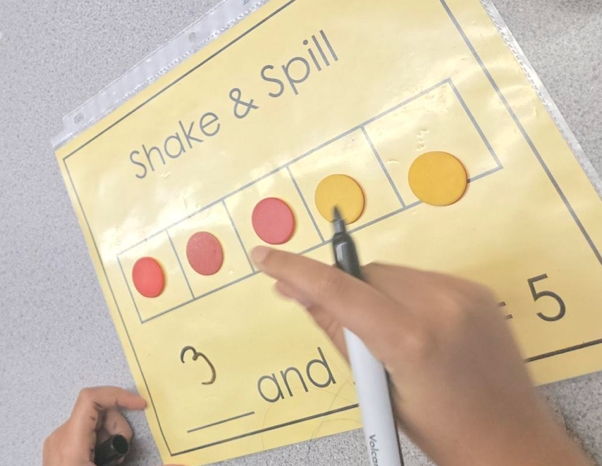
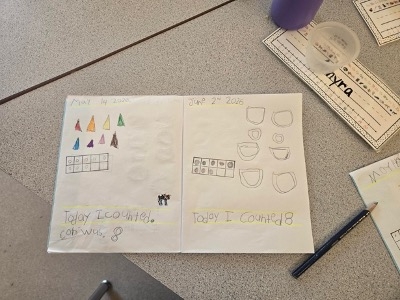
The Today’s Number routine involves presenting a number of the day. The students then generate a variety of representations of the number, including drawings, and equations. Students generate and share their representations of the number which allows them to grow in the ways they think about numbers and operations.
Clothesline Number Lines
 Using the Clothesline Routine builds students reasoning and analyzing skills. Students use reasoning to determine where a number should go or what number is missing based on other provided benchmark numbers. Students also develop their Communicating and Representing skills through their explanation and justification of the placement of numbers and represent understanding concretely with the number cards. Students develop Connecting and Reflecting skills as well - connecting different representations of a number to each other (e.g., ten frames, dots cards, tally marks, numerals, written words, images)
Mystery Number using Esti-Mysteries by Steve Wyborney

When using esti-mysteries for the number routine of the day. The picture is displayed and one clue is given at a time. Students are building number sense because they are moving beyond guessing blindly. They are learning to make logical, reason-based estimates. Each clue uses specific math concepts and vocabulary.
OUR NEXT STEPS
Through evidence provided by our cohort of students and reflected in the larger group, our focus on improving the use of mathematical thinking and communication skills has positively impacting learners. Our teachers tracked the progress of their students’ math learning goal:
Communicate mathematical thinking in many ways
Staff consistently used open questions, discussions, number routines and manipulatives in their math lessons. The cohort used the rubric below to measure the growth of students’ mathematical communication skills.
Students demonstrate growth by:
Contributing to small-group discussions
Explaining their mathematical thinking
Listening to and building on the ideas of others
Using increasingly precise mathematical language
Communication Profile Continuum
Profile 1 | Profile 2 | Profile 3 |
Participates in mathematical discussions with teacher support | Participates in mathematical discussions (partner, small-group, or whole-class) | Contributes to mathematical discussions (pair, small-group, or whole-class) |
Expresses answers ("the what") | Describes the process used to finding answers ("the how") | Explains or backs up (with reasoning) their process for finding the answer ("the why") |
Recognizes when others are talking | Listens the reasoning of others | Adds on to or critiques the reasoning of others |
Uses informal mathematical language | Uses informal but clear language or formal but imprecise math language | Uses formal and precise math language |
Not Yet There | Profile 1 | Profile 2 | Profile 3 | |
October | 5 | 31 | 18 | 11 |
June | 2 | 11 | 29 | 23 |
The results show that the numeracy inquiry and the implementation of number routines had a positive impact on students' ability to communicate their mathematical thinking using precise mathematical language. There was a clear movement away from the lower profiles and into Profiles 2 and 3, demonstrating improved confidence, reasoning, and use of mathematical vocabulary when explaining mathematical ideas.
Before beginning this inquiry, our intermediate teacher noted that many students were timid and hesitant to participate in mathematical discussions. Students were often unsure of which strategies to use and would blurt out answers without providing reasoning or explanation. Through the consistent implementation of number routines, teachers observed a gradual transformation in students' mathematical communication and reasoning skills.
As the year progressed, students became more confident in explaining their thinking and justifying their solutions using mathematical language. They reported enjoying mathematics more and shared that it was fun to hear different perspectives and discuss a variety of strategies. The number routines created opportunities for students to think deeply, communicate their ideas, and learn from one another.
Our primary teachers observed similar growth. At the beginning of the year, only a small group of students regularly participated in discussions. By the end of the year, a much wider range of students were willing to contribute, take risks, and share their thinking. Students became more comfortable making mistakes because classroom discussions focused on exploring and learning from errors rather than simply finding the correct answer. Number routines provided an accessible entry point for all learners and supported students in developing confidence when communicating their mathematical thinking.
The data collected throughout the inquiry supports these observations. In October, 45% of students were performing in Profiles 2 and 3, compared to 80% by June. The number of students demonstrating the highest level of mathematical communication (Profile 3) more than doubled, increasing from 11 to 23 students. At the same time, the number of students in Profile 1 or Not Yet There decreased from 36 students (55%) to 13 students (20%).
While many students experienced success and demonstrated growth in their ability to communicate mathematical thinking, approximately 20% of students still require additional support. Strengthening students’ confidence, mathematical reasoning, and use of precise mathematical language will remain an ongoing area of focus and priority for our school.
Moving Forward;
After seeing the growth our students have made with their mathematical thinking skills and communication, we will continue to use number routines. Learning is social and we have learned that allowing discussion with peers has promoted thinking and the sharing of math vocabulary in our classrooms. Our learners are attempting and persevering with math problems more on their own and waiting less for the teacher to support their thinking. Time is required for students to dive into solving problems with peers and on their own and we will continue to provide that time.
Moving forward, we are going to continue to expand this work beyond the cohort. This will require us to mirror the process and strategies implemented next year.
Surrey Schools
Formed in 1906, the Surrey School District currently has the largest student enrolment in British Columbia and is one of the few growing districts in the province. It is governed by a publicly elected board of seven trustees.
The district serves the cities of Surrey and White Rock and the rural area of Barnston Island.