Sullivan Heights Secondary

OUR CONTEXT
At Sullivan Heights Secondary, we incorporate inquiry research, innovative learning and assessment practices and digital literacy in our professional practice which translates into exciting learning opportunities for our students. We are proud to be committed in our endeavour to nurture and support all students in their learning journey. Our outstanding Performing Arts, Technical Programs and Athletics programs allow for a rich and engaging experience for our students. We are a dynamic school community and believe that every student should be provided with enriching experiences in their personal learning.
Please click on the link to view our video: https://vimeo.com/723412873
OUR LEARNERS
At Sullivan Heights we believe literacy is fundamental to support our students in their growth to become responsible educated citizens. We believe that it is our obligation as educators at Sullivan Heights to provide students every opportunity to follow their passions. Research shows that strong literacy skills open the door in a variety of areas that will positively impact their life opportunities. In developing literary skills our students are engaging in the Core Competencies (Communication, Critical and Creative Thinking, Personal and Social Emotional). We value students' role in the learning process and our teachers use formative assessment, learning rubrics, Standards Based Assessment in their practice to enrich students' understanding of their learning. This also ensures our learners can identify what they know, and what they need to improve on, in their course work.
- Our learners can respectfully share and express their ideas in our shared community
 Students in a Humanities 8 class sharing their brainstorming and research.
Our students are engaging in the creative thinking and communication core competency. Through their communication students are making connections with others to share their ideas, express their individuality, and further their learning. They think critically as they reflect on information they hear to refine their thinking about historical and current events.
- Students in New Media and Urban Studies classes are using Socratic Seminar discussions. While engaging in Socratic Seminars, our learners are immersed in rigorous dialogue with their peers. Through the process of listening, exchanging ideas, and finding common ground, our learners are developing critical thinking and analytical skills.
 Students demonstrating the critical thinking involved before engaging in Socratic Seminars
The conversation map below captures the many connections our learners are making with their peers as they discuss and make sense of texts they are reading.
 Example of the multiple communicative exchanges that take place between students in a Socratic Seminar.
- Our learners can listen actively and respond respectfully to different viewpoints
- Students share their viewpoints on different topics and world issues in all subject areas. Students in our Social Studies, Science, and English classes engage in debates and discussions. For example, in Science students discuss and debate the ethics of genetic modification. Debates build on student's communication and critical thinking skills.
 Students preparing for a Debate in their English Class
- Our learners can be reflective about their work and understand that the core competencies are important life skills
- Students in all their classes are engaging in the core competencies. They understand that life beyond high school will require them to be proficient in the areas of Thinking, Communication, and Personal & Social Awareness
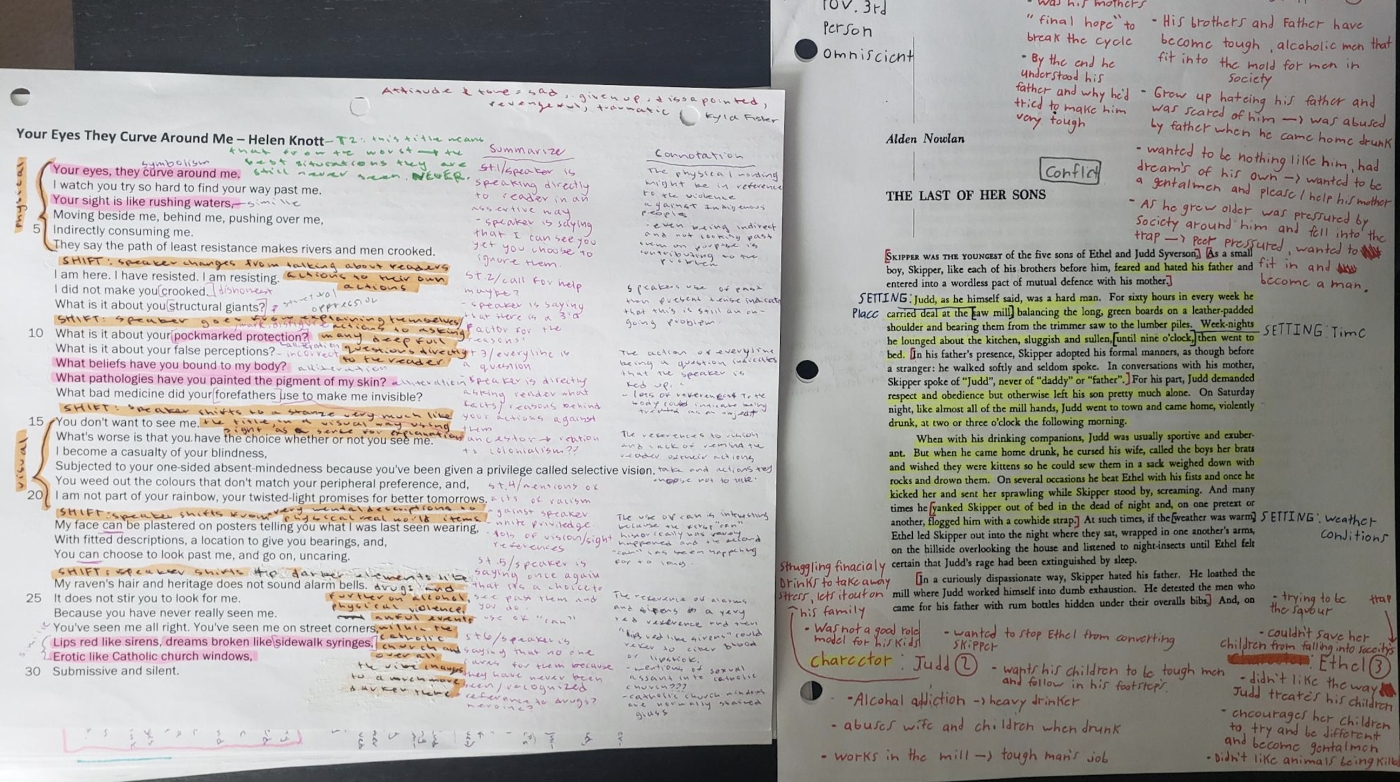
The example below illustrates a student in his Science 9 class reflecting on his Current Events assignment.
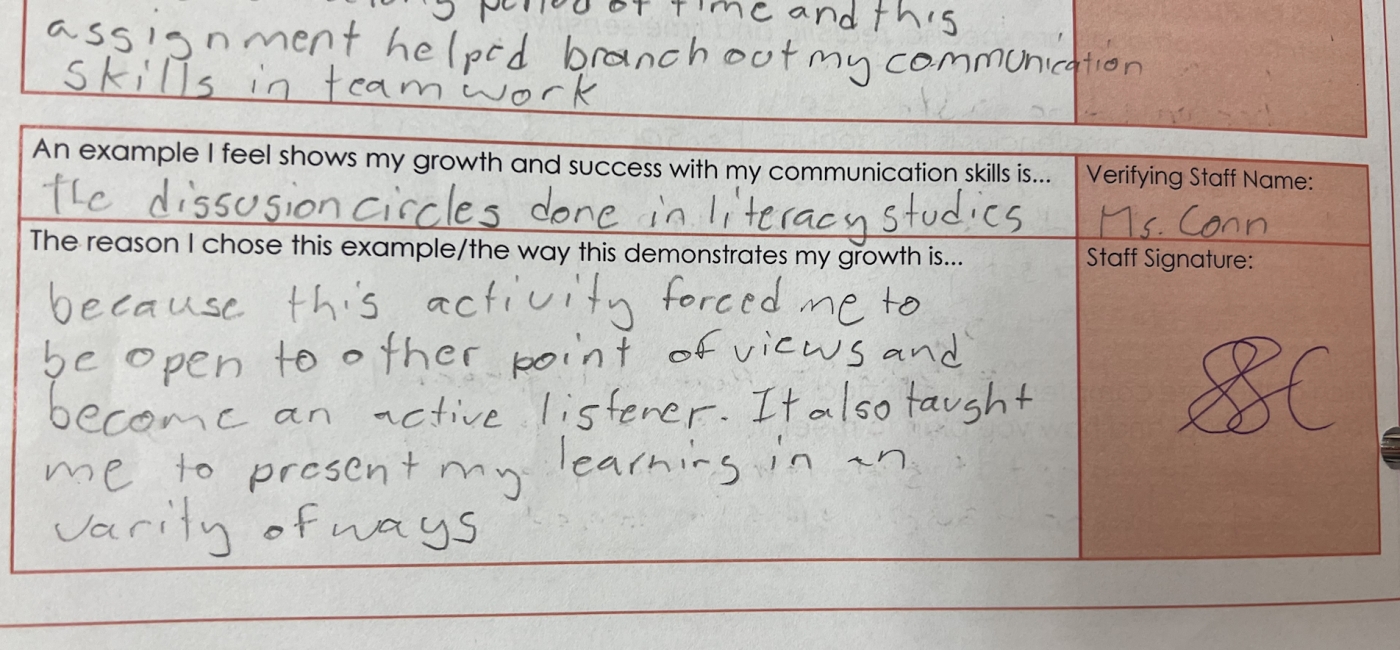
 Below is an example of a student's self-reflection on their work in Literary Studies.
 Our learners recognize, value, and celebrate diversity through a variety of literacy lenses.
- Digital Literacy- Understanding and navigating through digital resources/biases. All our Grade 8 students learn about the validity of online resources in their Infotech classrooms. Digital literacy is an important skill for our students to develop as it crucial for students analyze biases in online resources/research.
- Creative Writing- We run multiple writing contests throughout the year, The compilation of student work is honoured in an annual anthology called the Rebel Poets Society.
 Annual anthology of student writing
- Our learners understand learning about Indigenous Education is an important step in the reconciliation process.
- Our English 10 classes participated in fundraising for the Moosehide Campaign, and the Red Dress Campaign to stand up against violence against women and children. The students raised money and participated in a walk as part of the Red Dress Campaign in Victoria. This learning helped students engage in the creative thinking competency as they developed individual plans to fundraise for the campaign. In addition, students through this process learned about personal identity and learned about Indigenous worldviews.

https://www.instagram.com/moosehidefundraiser/?hl=en
https://www.instagram.com/theredressproject_/?hl=en

OUR FOCUS
Literacy is fundamental to our society as it gives people access to information. Our educators at Sullivan Heights recognize that literacy plays a significant role in closing the equity gap by empowering our learners with critical thinking and communication skills they can apply in their lives. We are committed to incorporating literacy skills in all subject areas.
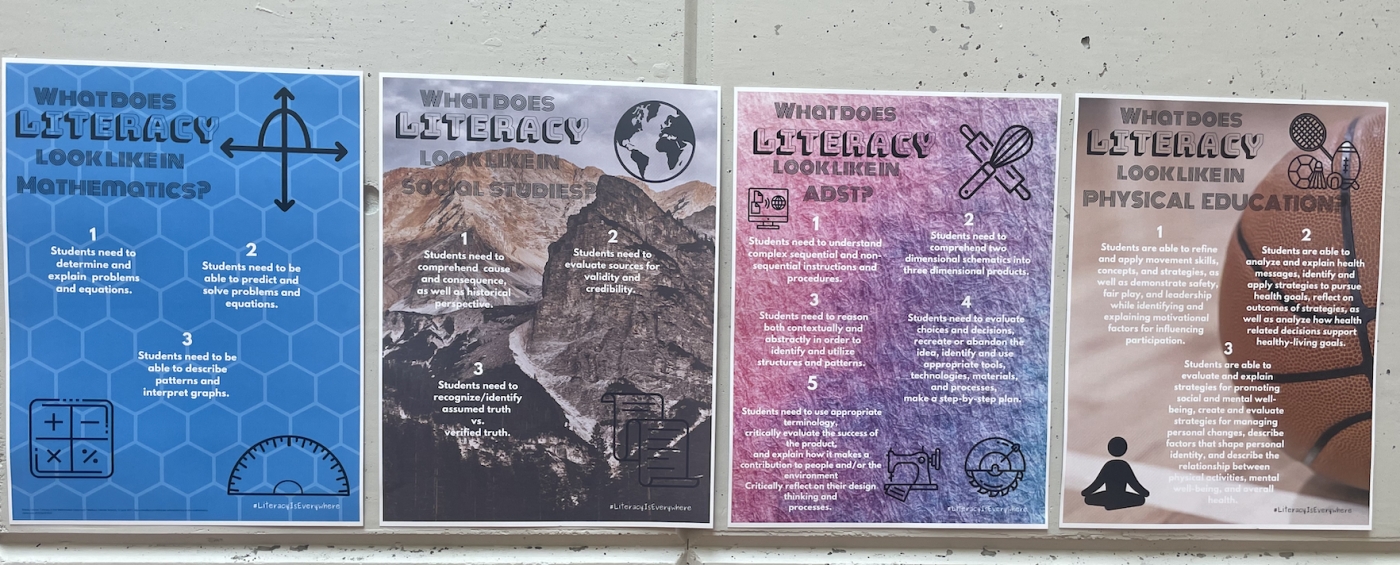
Our focus at Sullivan Heights is to improve students' written communication. These skills are taught and expanded on from Grade 8 to 12. Since instruction and assessment are interconnected our learners engage in reflection and self-assessment to help them understand where they are in their learning process and how they can improve.
Our learning cohort is specifically focussed on the following skills:
- Creating original ideas
- Defending a position
- Communicating their thinking in a well written composition (paragraphs, essays, poetry, personal narratives, and/or short stories).
Our English and Humanities Departments have been collaborating for the past two years on developing consistency in assessment by using shared learning goals and language. This year our learning cohort consists of one Grade 8 English class and one Grade 9 Humanities class. Our Grade 8 English cohort has 24 students, and they have been working together since the beginning of Semester 2, beginning in February 2022. Our Grade 9 Humanities cohort has 23 students, and they have been working together since September 2021.
Our students are introduced to the basic foundations of the writing process. Teachers are explicitly:
- Teaching topic sentence/thesis
- Teaching writing formulas (Point, Evidence, Analysis (PEA)) to defend the topic sentence/thesis
- Teaching how to accurately use, and reference, quotes from text in order to support their topic sentence/thesis
- Focussing on our students ability to create/analyze/identify figurative language (symbolism, metaphors, similes personification)

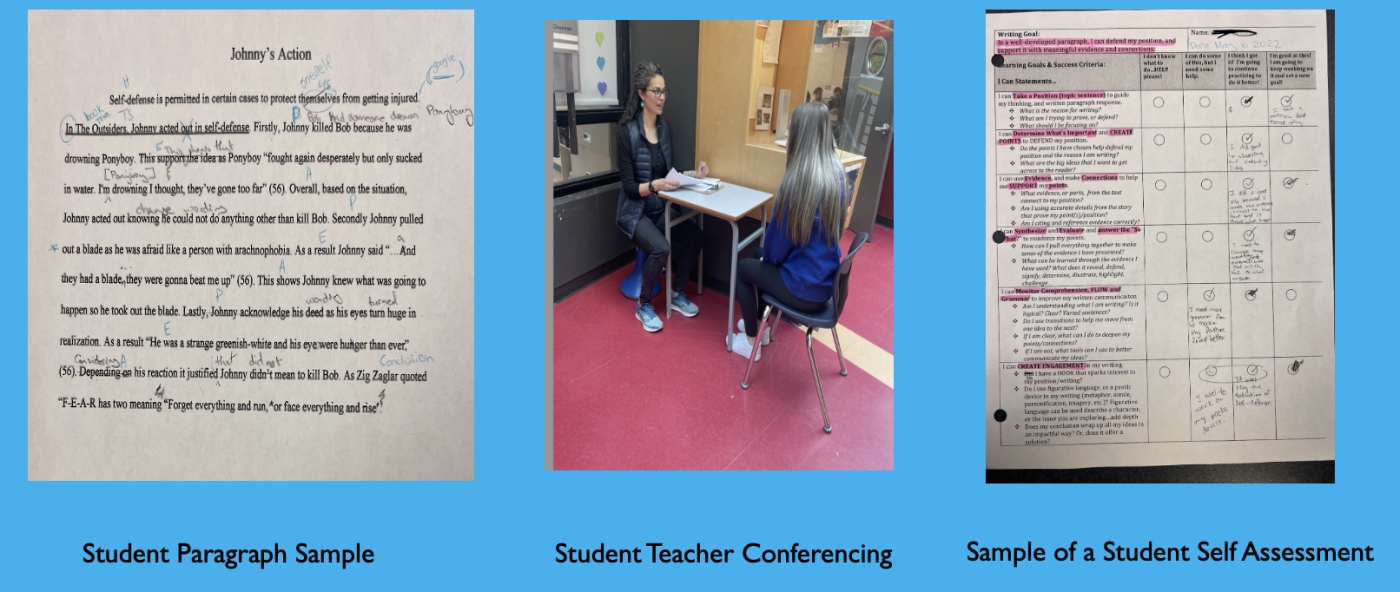 Above are the process and skills students are engaging into develop proficiency in the writing process.
OUR NEXT STEPS
Students in our Grade 8 and Grade 9 cohorts have been working on written communication throughout their courses. In addition, students in these classes have been self-assessing themselves using the ministry proficiency scales.
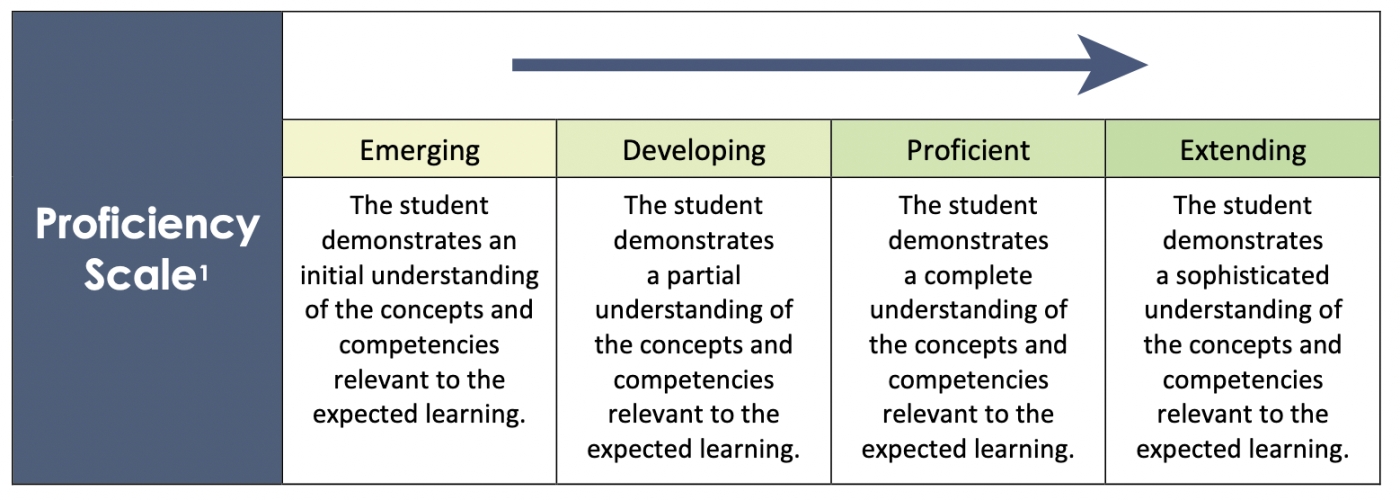
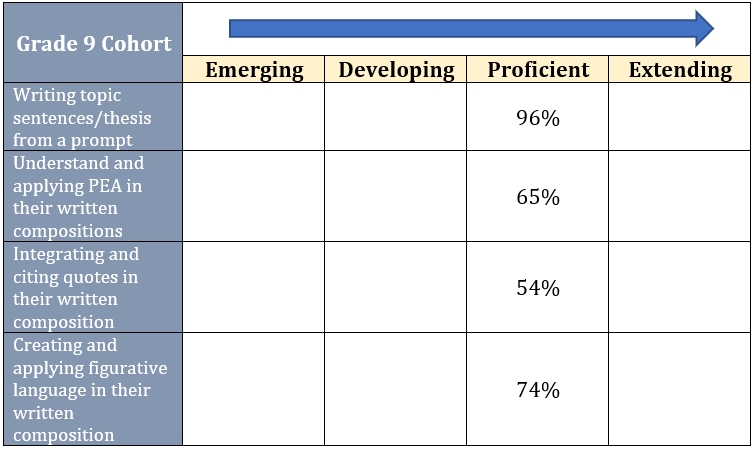
A current snapshot analysis of the evidence at the end of the course:
Grade 8 English Cohort

Grade 9 Humanities Cohort
Snapshot Evidence of a Grade 10 English class with 25 students:
Skills Survey
- 80% of the students said they felt "somewhat" confident to "very" confident writing a structured paragraph
- 23% of all students said they use a specific strategy (like PEA) for structuring their writing
- 19% said they did not feel confident with paragraph writing at all
- 96% of students have had experience writing multi-paragraph responses and/or essays
- All students knew/could define what a thesis statement was, but only 38% felt that they could write a thesis statement without further specific handouts and instructions
- 23% have written more complex analyses, including synthesis and comparing/contrasting multiple texts
The analysis of this evidence indicates our students are trending toward proficiency in the skills area we are teaching. Furthermore, the evidence indicates students are improving in their ability to accurately self-assess. We will continue to monitor evidence at the Grade 10 level to see where students are at in their writing process. We will continue work on literacy in all disciplines next year.
Surrey Schools
Formed in 1906, the Surrey School District currently has the largest student enrolment in British Columbia and is one of the few growing districts in the province. It is governed by a publicly elected board of seven trustees.
The district serves the cities of Surrey and White Rock and the rural area of Barnston Island.