South Meridian Elementary 25-26

OUR CONTEXT
South Meridian Elementary is situated on the unceded traditional territory of the Kwantlen, Katzie, Semiahmoo, and other Coast Salish peoples. It is a privilege to gather on land that has been stewarded since time immemorial, and we are committed to learning about and caring for it in ways that honour this history.
Our learning community is cohesive, connected, and inclusive. We value each other’s strengths, work collaboratively to foster respect, and create opportunities for students to develop their personal and social identities.
At South Meridian, students are encouraged to grow both inside and outside the classroom. Through purposeful instruction, extracurricular opportunities, athletics, fine arts, leadership, and school-wide events, students build skills and knowledge connected to the curriculum while exploring their interests and developing their unique talents.
Together, we grow with curiosity, adapt with courage, and lead with integrity.
OUR LEARNERS
Reading comprehension is foundational to student success across all areas of learning. When students can construct meaning from text, they are better able to explore ideas, engage deeply with content, and apply their understanding in meaningful ways. Strong comprehension supports critical thinking, effective communication, and independence, helping students become confident and curious learners.
A key contributor to reading comprehension is an understanding of morphemes—the meaningful parts of words, such as prefixes, suffixes, and root words. When students recognize these parts, they can break down unfamiliar words, identify clues to meaning, and connect new vocabulary to prior knowledge. This allows them to move beyond word recognition to deeper understanding, increasing both confidence and engagement with increasingly complex texts.
Rather than relying on memorization, students who understand morphemes begin to recognize patterns and relationships among words. This supports vocabulary growth, spelling, and comprehension across subject areas, while also fostering independence as learners.
Morpheme understanding is embedded within the BC ELA Curricular Competencies, as students are demonstrating their ability to:
- Use structural analysis (e.g., prefixes, suffixes, compound words) to support word understanding
- Develop and demonstrate understanding of new and unfamiliar words
- Apply language conventions and vocabulary in reading, writing, and oral language
- Make meaning using word parts to support comprehension
(Language adapted from BC Ministry of Education ELA Curriculum, K–5)
By understanding how prefixes, suffixes, and roots contribute to word meaning, students develop strategies for unlocking unfamiliar words and strengthening overall comprehension.
In alignment with this goal, students are able to:
- Clearly explain what a morpheme is
- Identify and understand developmentally appropriate morphemes
- Apply this knowledge accurately and meaningfully in reading, writing, and spelling
- Use their understanding of morphemes to infer the meaning of new words encountered in texts, as well as through listening and viewing experiences
OUR FOCUS
Learning morphemes supports vocabulary development by giving students tools to understand and generate the meanings of many words, rather than learning each word in isolation. Recognizing common roots, prefixes, and suffixes enables students to unlock unfamiliar words, identify relationships among word families, and expand vocabulary more efficiently. This deeper understanding supports reading comprehension, strengthens writing, and builds confidence when encountering complex language.
At South Meridian, we are intentionally strengthening literacy by focusing on morphemes as a key component of reading comprehension. Teachers collaborate to identify developmentally appropriate morphemes, implement effective instructional strategies, and design meaningful opportunities for students to apply their learning in both reading and writing.
Classes dedicate time to morpheme learning within a comprehensive literacy approach. To monitor growth and celebrate progress, we tracked two student cohorts over time, allowing us to better understand the impact of this focused instruction.
OUR NEXT STEPS
This year at South Meridian, we measured the progress of one primary and one intermediate cohort in relation to our school literacy focus.
Teachers intentionally selected developmentally appropriate morphemes and administered both a pre- and post-assessment. Student learning was evaluated using a rubric aligned with the proficiency scale.
Morpheme Rubric
Proficiency Level | Identifies Morpheme | Morpheme Meaning | Accurately Applies Morpheme |
Extending | Consistently and independently identifies morphemes in familiar and unfamiliar words. | Clearly and accurately explains how individual word parts contribute to the meaning of the whole word. | Accurately and independently applies morphemes in new and unfamiliar contexts across reading and writing. |
Proficient | Accurately identifies taught morphemes independently in familiar contexts. | Uses morphemic knowledge to determine word meaning with minimal support. | Accurately applies taught morphemes in appropriate contexts during reading and writing. |
Developing | Shows partial understanding of morphemes and identifies them with support. | Demonstrates an emerging ability to determine meaning using morphemes, with support. | Applies morphemes with support and may be inconsistent or partially accurate. |
Emerging | Demonstrates limited awareness of morphemes. | Requires significant support to understand word meaning using word parts. | Requires significant support to apply morphemes accurately or meaningfully. |
Between assessments, teachers provided explicit, targeted instruction focused on the selected morphemes. Students were given frequent opportunities to practice applying their understanding in meaningful contexts, with ongoing feedback to support growth and strengthen understanding. Instruction was designed to be engaging and relevant, connecting morpheme learning to students’ interests and offering authentic opportunities to use new knowledge in both oral and written communication.
Ongoing formative assessment strategies—such as exit tickets, word analysis tasks, and reading responses—enabled teachers to monitor student progress and adjust instruction based on emerging evidence of learning.
This intentional and responsive approach supported students in strengthening their overall language and literacy development.
Primary Cohort

Intermediate Cohort
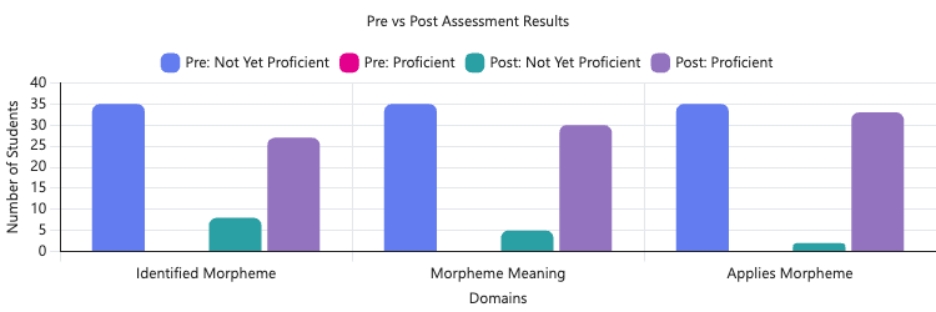
Students across both cohorts demonstrated strong and measurable growth in their understanding of morphemes (word parts such as prefixes, suffixes, and base words). At the beginning of instruction, the Primary Cohort (35 students) had 0 students proficient in all three domains, while the Intermediate Cohort (44 students) also had 0 proficient in identifying morphemes, with only 4 students proficient in understanding meaning and 8 in applying morphemes. This data shows that the majority of students in both groups were at an early stage and required explicit instruction in recognizing, understanding, and using morphemes.
Following targeted teaching and guided practice, students made significant gains across all domains. In the Primary Cohort, 27 students (77%) became proficient in identifying morphemes, 30 students (86%) in understanding meaning, and 33 students (94%) in applying morphemes. In the Intermediate Cohort, 40 students (91%) reached proficiency in both identifying morphemes and understanding meaning, and 38 students (86%) became proficient in applying them.
This growth shows that most students are now able to independently break down unfamiliar words and use their understanding to support reading and writing. Teachers will continue to support the small number of students still developing these skills, while extending learning for those who are ready to apply their knowledge to more complex vocabulary and literacy tasks.
Our next steps are to build on this success by expanding the cohorts to include additional students across the school. We will also begin developing a school-wide framework to support consistent and ongoing morpheme instruction, ensuring that students in the initial cohort continue to deepen and extend their learning while new learners are introduced to these essential literacy skills.
Surrey Schools
Formed in 1906, the Surrey School District currently has the largest student enrolment in British Columbia and is one of the few growing districts in the province. It is governed by a publicly elected board of seven trustees.
The district serves the cities of Surrey and White Rock and the rural area of Barnston Island.