South Meridian Elementary

OUR CONTEXT
South Meridian is an inclusive, dynamic school supporting our learners' academic, social , affective, and behavioural learning. Our classrooms support practices that keep students at the centre of their learning and influence the depth of student opportunities for growth. We know student success is designed through a broad array of skills, experiences, and outcomes across different domains, including social-emotional, creative and critical thinking; the ability to exchange information and ideas to understand and engage with the world around them; and developing students' positive personal and cultural identities and social responsibility. 
We value a safe and caring school, restorative justice practices, the diverse strengths of our learners, and connections with each other and our wider school community. Parents and families play a critical role in student school experiences and helping to develop learning environments where children flourish.

Our school is located on the unceeded, shared traditional territory of the Katzie, Semiahmoo, and other Coast Salish peoples and our work weaves the First Peoples' Principles of Learning throughout. South Meridian has two small urban forest stands of trees including the riparian zone hosting nearby McNally Creek - shrubs, ferns, mosses, lichens and fish. We love to learn outside about this place we call home and take on stewardship to mitigate plastics and litter in the riparian zone and deepen student understanding with authentic, hands on, place-based learning, such as Take the Dip and Salmontracks.

A lot of our learning is inquiry based and rooted in real world problem solving. We participate in Science Fair and the Young Entrepreneurs program which help us build our critical and creative thinking skills. We have a school garden that we cultivate to support bees in some of our garden tubs with bee-friendly flowers. Our vegetables are grown and what we don't use, we share with our animal friends at the local SPCA - we've grown lettuce and carrots for the rabbits there.
We love to learn through play! Our youngest learners are provided opportunities to develop a sense of the world around them through play. Play provides opportunities for children to inquire, explore, interact, problem solve and connect what they already know with new knowledge and developing skills.

Our older students play too! We enjoy cross country and track and field. Our student athletes have opportunities to play on school volleyball, basketball, badminton, and ultimate teams. Everyone loves Sports Day!
Our grade 7's have the exciting opportunity go to camp every year. Camp is always the highlight for our grade 7 students.
 We hope you've enjoyed learning a little about some of what makes South Meridian a great place to work, learn, and play at!
OUR LEARNERS
At South Meridian we know that our learners are diverse and varied. We embrace this diversity and want to prioritize access to the curriculum equitably and ensure that every student has a point at which they can actively participate in the learning community. We believe that numeracy is important and math skills are vital for problem-solving and reasoning strategies important in daily life. Developing mathematical "habits of mind" help us to connect, reason, and communicate the complex problem-solving process. Effectively assessing a problem from a variety of perspectives helps us evaluate the effectiveness of potential solutions throughout our daily lives. Developing mathematical habits of mind is done through intentional classroom and instructional design.
Our learners begin developing these habits of mind from kindergarten. They use concrete materials to communicate mathematical thinking concretely, pictorially, and symbolically.
Students develop, demonstrate, and apply mathematical understanding through play, inquiry, and problem solving
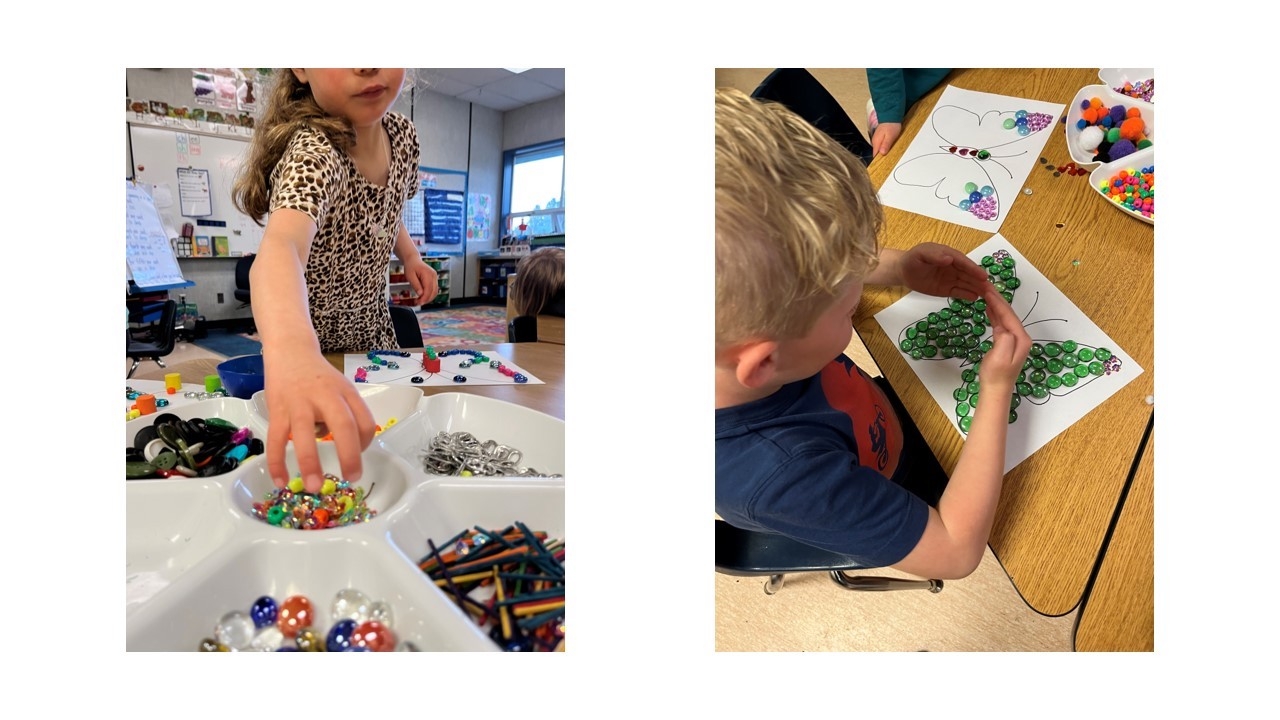
The Kindergarten students above are using loose parts to model their understanding of symmetry. Offering a choice of materials and providing flexibility in the classroom differentiates the learning and allows students to show their understanding through their models.
Engage in problem-solving experiences that are connected to place
In the first photo below, the grade 2's are exploring patterning in our forest by posing and solving problems with found items. They are using local materials gathered outside for concrete representations.
Developing financial literacy skills and making informed decisions on saving and purchasing and developing simple budgeting and consumer math
The grade 6 and 7 students (2nd photo) participate in the PowerPlay Young Entrepreneurs program. Through the PowerPlay program students develop a product and business plan, conduct market research, complete marketing and branding exercises, and launch their products for sale at a final showcase.
At South Meridian our learners actively engage daily in numeracy activities as they learn to see themselves as mathematicians while building mathematical habits of mind.
OUR FOCUS
Although student understanding of mathematics at the same grade level varies widely, differentiating mathematics is relatively new. Generally, to differentiate instruction the following 3 elements are needed (Marion Small, Good Questions, Great Ways to Differentiate Mathematics, 2012):
- The focus of instruction is on the big ideas ensuring they are all addressed and understood
- An aspect of student choice is embedded whether through content, process, or product
- A form of pre-assessment must be done to determine where students are at in their learning
This year, teams of teachers in grade groups collaborated on an inquiry to differentiate mathematics in their classrooms using open questions and parallel tasks. These strategies are designed to meet the needs of students through differentiating instruction effectively. We undertook a book study together as a multi-grade group of teachers and read Marion Small's Good Questions, Great Ways to Differentiate Mathematics Instruction.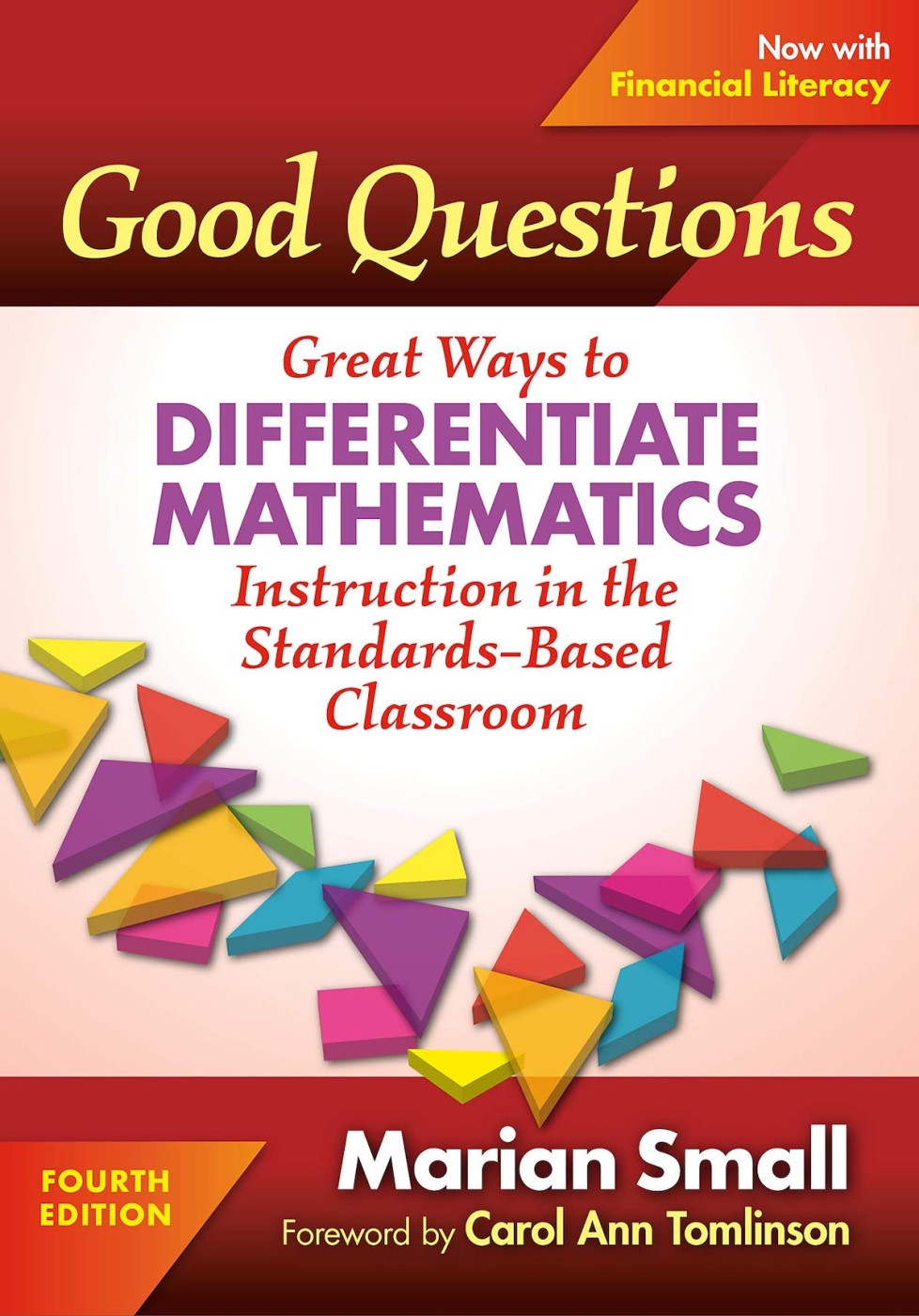 Teachers created safe spaces in their classrooms for learners with a wide range of mathematical knowledge to actively participate in their mathematical communities with their peers.
Using the open questions strategy means the teacher is using one question with multiple access points for students to approach it through varying processes. This strategy allows for student growth even if the students are at differing stages in their mathematical development.
In the example below, a grade 2 teacher posed an open question framed in such a way that a variety of responses or approaches are possible. This approach allows almost all students to posit a response based on their individual understanding - it is psychologically safer and fosters confidence.

Most students can participate in the resulting discussion and the math talk is richer in the classroom. Math concepts can be seen from many perspectives and moves the students away from the narrow thinking that math is one question and one right answer.
 Grade group teachers in cohorts used Open Questions to develop and consolidate math concepts on a daily basis. Teachers provided open questions and parallel tasks for problem-solving at appropriate grade levels.
For example, in grade 1, students use non-standard units to begin developing an understanding of measurement. They use non-standard units such as hands or feet to compare and order objects and relate the size of the unit to the number of units used to measure.
In the task below students are using non-standard units of their choice (in this case, most students chose their feet) to measure distance across the classroom. When students went first one way and then another some noticed that it took the same number of their feet to cross the same distance there and back; others noticed that the number of feet was different for each student despite walking across the same tape lines. Others wondered if there was a better way to measure that made it "the same". The responses from students show the range of ways students answer and develop their mathematical understanding. Students were able to see a myriad of possible solutions for problems and they were able to reflect and connect through math journals and the math talk communities built in their classrooms.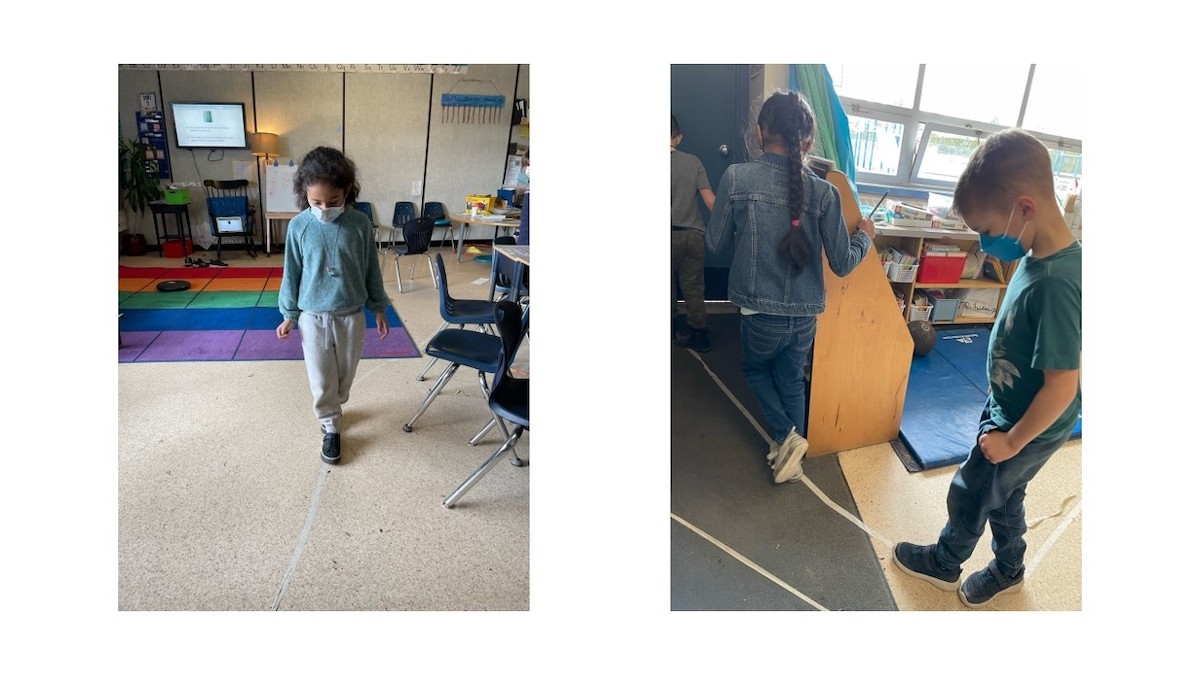
Teachers use mathematically meaningful parallel tasks such as the example above, that are purposefully slightly ambiguous in order to differentiate the problem. This allows for the engagement of students at all levels of numeracy development and helps everyone to experience success.
OUR NEXT STEPS
Teachers reported increased student engagement with the open questions and parallel tasks. Using observation and anecdotal notes, teachers determined that the multi-accessible approaches created safe opportunities for students to participate and take risks in their mathematical development. Students who previously were reluctant to participate were able to offer their thinking and join in the math discussions without fear of being "wrong". The learning design was intentional and differentiated enough to draw students out and into the community of mathematicians.
Offering choices and having flexibility in the numeracy classroom set the stage for communities of learners that have positive mindsets regarding their mathematical abilities. Moving forward, teachers will continue to set the stage with open questions and parallel tasks but are ready to learn more about offering greater choice in math learning. We are moving our inquiry forward as we commit to learning how to teach with learning centres for math development. We are curious to learn how incorporating centres with skill practice, problem-solving, concrete materials, incorporating technology, and increasing writing opportunities will impact our learners.. We will follow our student cohorts throughout the year to determine how the addition of centres to numeracy impacts student outcomes.
We want to create supportive equitable access for all of our learners to develop mathematical habits of mind. Being responsive to students' cultures, backgrounds, perspectives, and experiences requires that we address and acknowledge factors that contribute to outcomes among our students. Being responsive in our active differentiation of math instructional strategies is the start of this work. We want our students to experience high quality math instruction that is differentiated and accessible and holds high standards for all our learners. Attaining math proficiency for our students regardless of background, socioeconomics, culture, and gender is the goal that drives our work forward.
Surrey Schools
Formed in 1906, the Surrey School District currently has the largest student enrolment in British Columbia and is one of the few growing districts in the province. It is governed by a publicly elected board of seven trustees.
The district serves the cities of Surrey and White Rock and the rural area of Barnston Island.