Rosemary Heights Elementary 25-26
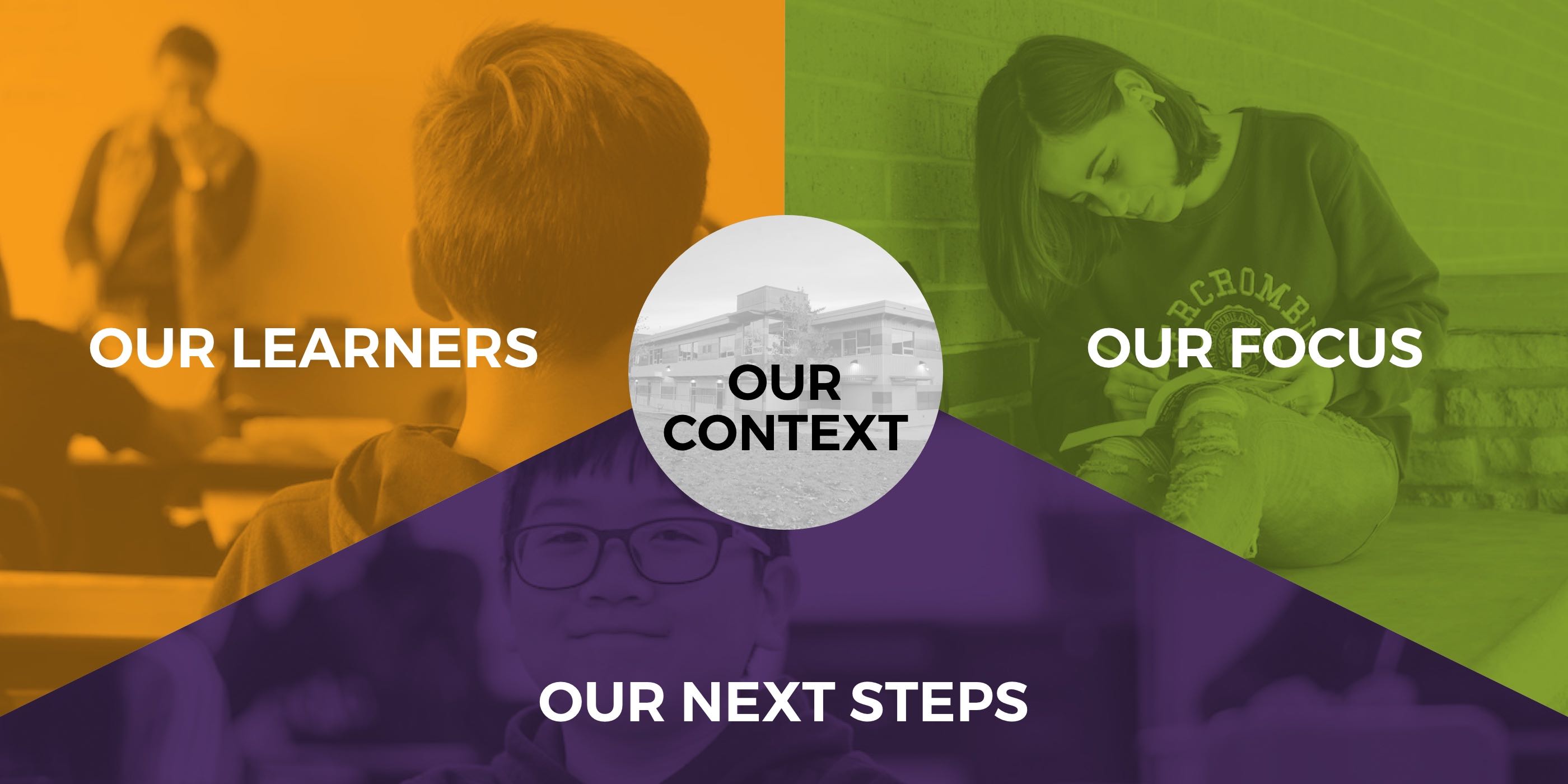

OUR CONTEXT
Rosemary Heights Elementary Vision Statement: Rosemary Rockets: A compassionate, interconnected, inclusive learning community. Always Shooting For The Stars!
Our students are kind, caring, and dedicated learners who come to school loved, supported, and ready to engage in learning. We are excited to see our community continue to grow in diversity. Students take part in many leadership opportunities throughout the school and apply their social emotional learning in both academic and social settings. They benefit from evidence-based programming such as Second Step, Mind-Up, and other universal SEL supports, including the Zones of Regulation.

 The families within our Rosemary Heights community want the very best for their children and are strong advocates for the learning journeys of all students. As a supportive network, families support each other and work alongside staff to provide rich and diverse learning opportunities. Our PAC is highly skilled, dedicated, and engaged. Last year, the PAC funded an Outdoor Classroom capital project, which is now ready for students to enjoy. The PAC also helps provide many opportunities for the school community, including hip-hop, fine arts presentations, a Halloween dance, weekly hot lunches, and special treats. Supporting student learning through technology remains another priority, and all students benefit from these tools. Families also contribute in meaningful ways through committees such as our Lunar New Year committee, which offers learning experiences through assemblies, cultural stations, and parades. Together with staff, families help create a safe and caring space for all.

As a staff, we go beyond the responsibilities of the classroom to support students through extracurricular activities, including leadership and coaching. By caring for and supporting one another, we are better able to support our school community. Four years of participation in the Elementary Mentoring Pilot Program (EMPP) have contributed greatly to our positive and safe learning culture at Rosemary Heights. As a host school for Student Teachers and Integrated Education Support Worker (IESW) practicum students, Rosemary staff use their leadership skills to support early career educators while continuing their own professional growth. Our diverse educational backgrounds allow us to bring a wide range of experiences to our community through a welcoming and inclusive environment where relationships are valued.
OUR LEARNERS
At Rosemary Heights, our students are a compassionate, interconnected, and inclusive, and are developing their both their social-emotional and academic skills. Through professional dialogue, collaboration, observation, and assessment of student learning over time, staff have identified a need to focus on strengthening students’ skills in the area of reading.
According to the BC Ministry of Education, Core Competencies are domains of intellectual, personal, social and emotional proficiencies that all students need in order to engage in deep, lifelong learning. The communication competency encompasses the knowledge, skills, processes and dispositions we associate with interactions with others. Through their communication, students acquire, develop and transform ideas and information and make connections with others to share their ideas, express their individuality, further their learning, and get things done. The Communication competency is fundamental to finding satisfaction, purpose and joy (2023). Incorporating all the competencies, in particular communication, Rosemary students are working towards strengthening their skills in the area of reading.

Our learners have a growing range of background knowledge and are developing the skills to make meaning from a variety of texts. They are beginning to identify the purpose of reading and are increasingly willing to share their thinking orally, make connections, and demonstrate their comprehension in meaningful ways.
Through our work, learners are developing an understanding that reading strategies help us access, interpret, and respond to texts. Reading allows us to learn, imagine, reflect, and better understand ourselves, others, and the world around us.
With direct modelling and explicit teaching of reading strategies, including before, during, and after reading, our learners are becoming more confident in their skills. As they engage with a range of texts, they are showing greater curiosity, growing independence, and a stronger sense of pride in their learning.
OUR FOCUS
At Rosemary Heights, our students are working towards strengthening their skills in literacy. As a whole school, staff decided to focus on using literacy screeners to identify students who are in the targeted instruction area. As per Surrey Schools One,
“Universal screening tools are assessments designed to contribute to a student’s overall literacy profile by suggesting their current reading health or potential possibility of future reading difficulties.”
Once students were identified as targeted learners during the fall screener, teachers created meaningful learning experiences to foster strong literacy skills throughout the year. Data was then taken from and compared to the Spring screener.
Of the tracked 12 classes, 61 students were initially identified as targeted learners after the fall screeners. Some teachers also used further diagnostic assessments to identify the individual needs of their targeted students. Teachers implemented lessons and units in their classes to help improve the literacy skills of their targeted learners. These included following the UFLI program, direct teaching of phonics, small group instruction focused on reading skills. After the spring screener 45 students had moved from targeted to universal support.
In one primary classroom (kindergarten), six students were identified in the targeted (yellow) zone after the fall screener. The teacher focused on foundational literacy skills throughout Term 1 and Term 2, with an emphasis on explicit phonics instruction. This included teaching letter names, letter-sound relationships, and early decoding skills using CVC words. Structured, systematic phonics programs such as UFLI and Heggerty were used to support the development of phonemic awareness and decoding skills. To reinforce learning, the teacher incorporated hands-on activities and engaging games, such as Roll and Read and CVC i-spy, to provide additional practice and build confidence. These opportunities allowed students to apply their skills in meaningful and interactive ways. Anecdotally, the teacher observed improvements in students’ ability to recognize sounds, blend words, and read simple decodable texts. After completing the mid-year screener, three students remained in the targeted zone, demonstrating growth in early reading skills.
In one Grade 2/3 classroom, seven students were identified in the targeted (yellow) zone after the Fall screener. The teacher focused on core literacy skills throughout Term 1 and Term 2, with an emphasis on explicit phonics and word pattern instruction. Weekly explicit phonics instruction and word pattern lessons supported students’ reading development, with CVC words used as a tool for reviewing, assessing, and providing targeted instruction for students working on reading fluency. The guided reading program focused on improving reading accuracy, fluency, and comprehension. These opportunities allowed students to apply their skills through supported reading experiences. Anecdotally, the teacher observed improvements in students’ ability to read simple decodable texts, along with overall gains in fluency and comprehension. By the Spring assessment, five students remained in the targeted zone; however, the teacher observed that all students demonstrated noticeably more fluent oral reading. After completing the mid-year screener, five students remained in the targeted zone, demonstrating continued growth in foundational reading skills.

In another primary classroom (grade 2/3), three students were identified in the targeted (yellow) zone after the fall screener. The teacher focused on reading skills during term one and two with an emphasis on phonics, reading strategies, and decoding skills. This included whole group teaching of vowel sounds and rules, along with structured phonics programs including Heggerty. Students also participated in small group reading once a week, with a greater focus on decoding strategies. At the time of the spring screener, three students were still in the targeted zone; however, the teacher observed greater accuracy in words read.
In one grade 6/7 classroom five students were identified as targeted learners after the Fall screener. The teacher focused on students reading skills throughout term one and two. This included direct instruction with phonics, something that is not usually practiced in the upper grades. This learning was then integrated with reading comprehension. Since learning more about phonics, students also started making connections to the morphology of words. Anecdotally the teacher saw an improvement in students overall reading skills. After completing the spring screener, five students remained in the targeted zone.

In another grade 6/7 class, six students were identified in the targeted zone during the Fall assessment, prompting focused support through direct instruction in phonics and morphology, along with regular choral reading to strengthen expression, attention to punctuation, and overall fluency and comprehension. By the Spring assessment, six students remained in the targeted zone; however, the teacher observed that all students demonstrated noticeably more fluent oral reading, suggesting growth that was not fully captured by the assessment data.
Overall, primary students demonstrated greater growth than intermediate students. This disparity may be influenced by developmental differences, as younger students are still building foundational reading skills, whereas older students often have more firmly established reading habits and attitudes that can impact their responsiveness to intervention.
OUR NEXT STEPS
Throughout this year, teachers identified areas of need in response to the information and data gathered from completing literacy screeners. Through direct instruction and universal learning supports, teachers focused on moving students from the targeted to universal range. Using both quantitative data and anecdotal observations, teachers noticed greater movement and improvements in the skills of our younger learners.
This is not entirely surprising, as younger students tend to demonstrate larger gains as they are still building core skills like phonological awareness, decoding, and word recognition, so targeted teaching can produce faster growth. Next year we would like to focus on students in the upper intermediate grades (5-7). Teachers will investigate how to better reach their targeted learners and hopefully improve overall literacy skills. Our focus question will be: Does explicit teaching of morphology impact students reading ability in the upper intermediate grades?
Surrey Schools
Formed in 1906, the Surrey School District currently has the largest student enrolment in British Columbia and is one of the few growing districts in the province. It is governed by a publicly elected board of seven trustees.
The district serves the cities of Surrey and White Rock and the rural area of Barnston Island.