Queen Elizabeth Secondary 25-26

OUR CONTEXT
Queen Elizabeth Secondary is located on the shared, unceded, traditional territory of the Katzie, Semiahmoo, and Kwantlen First Nations.
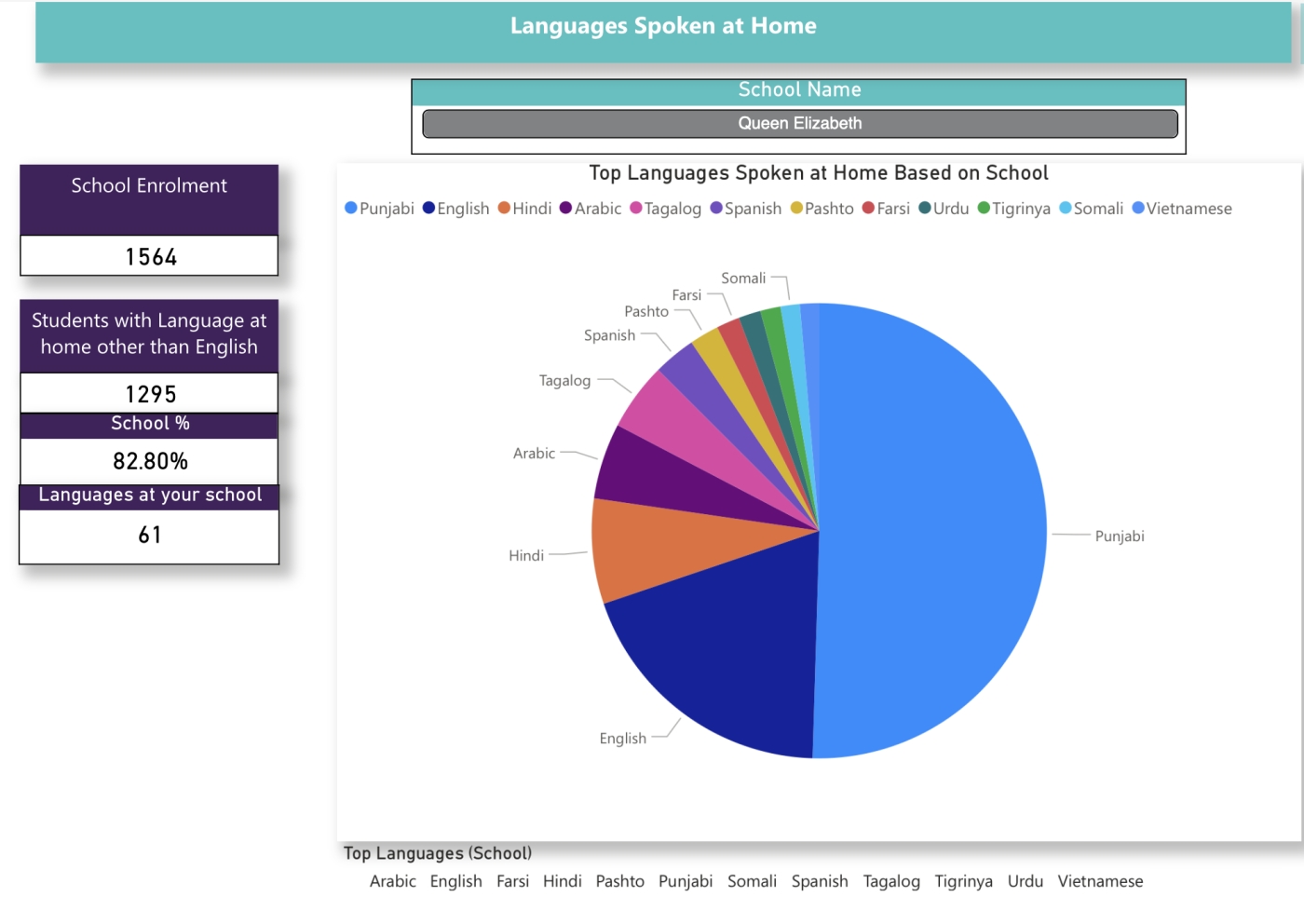
At Queen Elizabeth Secondary School (QESS), we are committed to cultivating a safe, respectful, and inclusive learning environment where every student is supported in their intellectual, social, and emotional growth. As a dynamic and diverse school community, QESS values the rich blend of cultural, socioeconomic, and academic backgrounds that our students bring. This diversity strengthens our learning environment and deepens our collective commitment to inclusion, equity, and mutual respect. Our dedicated staff works with intention and care to ensure that every student feels recognized, valued, and supported.
Central to our approach is an understanding of the unique experiences and perspectives each student contributes. We prioritize authentic relationships, recognizing them as the foundation of a strong and caring school culture. High expectations for all learners are balanced with empathy and individualized support, empowering students to achieve academically while developing confidence, resilience, and a strong sense of belonging.
We place significant emphasis on foundational literacy and numeracy skills, acknowledging their essential role in long-term success. Through targeted supports and thoughtful interventions, we strive to ensure meaningful progress for every student. These efforts prepare learners not only for academic achievement but also for the broader opportunities and challenges they will encounter beyond the classroom.
Our holistic planning framework aligns with district priority practices, including Curriculum Design, Quality Assessment, Instructional Strategies, and Social and Emotional Learning. This comprehensive approach supports all aspects of student development and contributes to a rich, well-rounded educational experience to equip students to thrive in an increasingly complex and interconnected world. At its core is a commitment to the BC Ministry of Education’s Core Competencies which include communication, critical and creative thinking, personal and social responsibility, and cultural awareness.
Grounded in our dedication to diversity, equity, and inclusion, Queen Elizabeth Secondary School inspires engaged, lifelong learners who are prepared to contribute positively to their communities and beyond. Our school culture celebrates individuality, nurtures potential, and upholds equity for all. This year, we continue to focus on building a welcoming and inclusive environment, with a particular emphasis on strengthening communication across our community.


OUR LEARNERS
Through ongoing reflection and meaningful engagement, we have strengthened our understanding of the diverse needs, goals, and values of our learners. Collaboration across departments including English, Fine Arts, French, Science, Social Studies, Math, and Counselling has highlighted that students thrive when they feel genuinely valued, connected, and supported. Their varied learning profiles call for personalized approaches that nurture academic growth while also supporting social and emotional development.
Our students consistently express the importance of strong, reciprocal relationships and a deep sense of belonging within the school community. They appreciate being challenged through high expectations while also having their mental, emotional, and physical well-being recognized and supported. Their feedback reinforces the essential role of an inclusive and caring environment in helping them reach their full potential.
With this understanding, we remain committed to fostering well-being, connection, and a strong sense of place throughout our school. By nurturing meaningful relationships, honouring diverse learning needs, and upholding high expectations, we strive to create a learning environment where students feel motivated, inspired, and empowered to succeed. Our shared vision is to ensure that every learner has the opportunity to achieve, contribute, and thrive.
At Queen Elizabeth Secondary School (QESS), our work continues to be grounded in the First Peoples Principles of Learning, which remind us that learning is holistic, reflexive, experiential, and relational. Last year, our efforts focused on strengthening connectedness, reciprocal relationships, and a sense of place. Through the dedication of our teams, we supported students in building stronger ties to their school community while deepening cultural awareness and celebrating diversity, equity, and inclusion. We also aimed to develop students’ reflective capacities, preparing them to lead meaningful and engaged lives in an increasingly complex world.
This year, we continue to prioritize creating an environment where learners feel valued and genuinely want to be. Our commitment to fostering connectedness, reciprocal relationships, and a sense of place remains central to our work. This year, we are placing particular emphasis on strengthening communication as part of our commitment to an inclusive and supportive learning environment.
OUR FOCUS
Our Driving Question:
How can we support Humanities 8 students in developing their ability to communicate ideas clearly and critically through writing and speaking, while fostering personal engagement and ownership of learning?
Focus for 2025–2026: Strengthening Student Voice through Literacy and Communication in Humanities 8
This focus builds on Queen Elizabeth Secondary’s 2023–2024 and 2024–2025 Learning Plans, which emphasized inclusive literacy practices and strengthening communication across disciplines. For 2025–2026, we aim to empower Humanities 8 students to develop their voice through purposeful writing and speaking, while fostering critical thinking and personal connection to content.
Scan: What do we know about our learners?
Over the past two years, Queen Elizabeth Secondary has prioritized literacy development, particularly in reading comprehension, written expression, and oral communication. Students have shown growth when given structured opportunities to share ideas, collaborate, and reflect. However, many still struggle with organizing complex thoughts, using evidence effectively, and adapting communication for different audiences. Humanities 8 students are at a formative stage in developing these skills, and targeted support can accelerate their growth.
Hunch: What is leading to this situation?
Students benefit from inclusive and scaffolded literacy instruction but may lack consistent opportunities to connect personally with content and express their ideas in meaningful ways. Embedding literacy strategies into Humanities through inquiry, reflection, and dialogue can bridge this gap and promote deeper learning.
Summary of Inquiry Process:
A Humanities 8 class of 24 students engaged in an inquiry focused on strengthening communication skills through structured small group discussions and explicit instruction in key conversational strategies. Students practiced supportive listening, building on peers’ ideas, and disagreeing respectfully. Baseline discussions, whole class feedback, and targeted skills practice were used to monitor growth and identify areas needing support. Data collected across multiple attempts showed that direct instruction and isolated practice of specific skills led to the greatest improvement in students’ ability to engage meaningfully with one another. This process reinforced our commitment to fostering an inclusive, connected learning environment where all students can develop essential communication competencies.
Core Competencies Focus
Communication:
- Connect and engage with others (to share and develop ideas)
- Explain/recount and reflect on experiences and accomplishments
Thinking:
- Generate ideas and build on the ideas of others
- Reflect on thinking and processes
Personal and Social:
- Positive personal and cultural identity
- Social awareness and responsibility
Curricular Competencies (Humanities 8)
- Use writing and oral language to communicate ideas, arguments, and information for a specific audience and purpose
- Recognize and identify different perspectives and evidence in texts
- Make reasoned ethical judgments about events, decisions, or actions
- Assess the significance of people, places, events, or developments
Proficiency Scale
• Language from the provincial assessment scales were used to identify successes and remaining challenges.
Emerging | Developing | Proficient | Extending |
The student demonstrates an initial understanding of the concepts and competencies relevant to the expected learning. | The student demonstrates a partial understanding of the concepts and competencies relevant to the expected learning. | The student demonstrates a complete understanding of the concepts and competencies relevant to the expected learning. | The student demonstrates a sophisticated understanding of the concepts and competencies relevant to the expected learning. |
Summary Data Results: For December 2025
Exchanging ideas respectfully | Emerging | Developing | Proficient | Extending | Total |
Attempt 1 | 2 | 9 | 12 | 1 | 24 |
Attempt 2 (after direct instruction on specific skills) | 1 | 6 | 10 | 5 | 22 |
Attempt 3 (after individual feedback) | 1 | 5 | 11 | 6 | 23 |
Last year, Humanities 8 students demonstrated noticeable improvement in showing respect to their classmates during conversations; however, many were still speaking “past” one another. Only the most confident proficient/extending learners were consistently engaging with the content of their peers’ contributions. To support stronger dialogue, direct instruction and practice of specific conversational skills were introduced this year.
For each attempt, the class was organized into five small groups based on interest or topic to encourage meaningful engagement. Before the first discussion, the class received instruction on open and supportive body language, followed by role-play and tableau activities illustrating body language that signals openness versus body language that does not. Students enjoyed exaggerating “perfect” and “terrible” examples, and the shared laughter helped establish a positive tone for collaborative conversation.
After the first attempt, students received general whole-class feedback (“here’s what was noticed…”). Prior to the second attempt, students were reminded of these observations and then taught two targeted discussion skills:
• Adding to or building on another student’s contribution. A flowchart outlining effective response options was created on the whiteboard. As a class, students generated statements, and various response types were modelled using the flowchart. Students then practiced making statements and building on one another’s ideas in pairs.
• Disagreeing respectfully One branch of the flowchart focused on respectful disagreement. Using sentence stems, the class explored ways to express differing viewpoints while remaining open and supportive. Students practiced these approaches in pairs as well.
Observations For December 2025:
Direct instruction and isolated practice of specific conversational skills separate from a full-class discussion proved to be a highly effective intervention. The most significant increase in student proficiency occurred after this focused skills practice. Although an additional rise in proficiency might have been expected following individual feedback during the third attempt, the data showed that direct skills practice had the greatest impact on improving student conversational proficiency.
Analysis of Data:
The data shows a clear upward trend in students’ ability to exchange ideas respectfully across the three attempts. In the first round, most students were clustered in the Developing and Proficient categories, with very few demonstrating Extending level skills. After direct instruction on specific conversational strategies, the number of students in the Extending category increased noticeably, while the number of Emerging and Developing students decreased. Following individual feedback in the third attempt, this positive shift continued, with more students moving into the Proficient and Extending levels. Overall, the results suggest that explicit instruction and targeted feedback were effective in strengthening students’ respectful communication skills, with the most significant gains occurring after the focused skills practice.
Summary Data Results: For May 2026
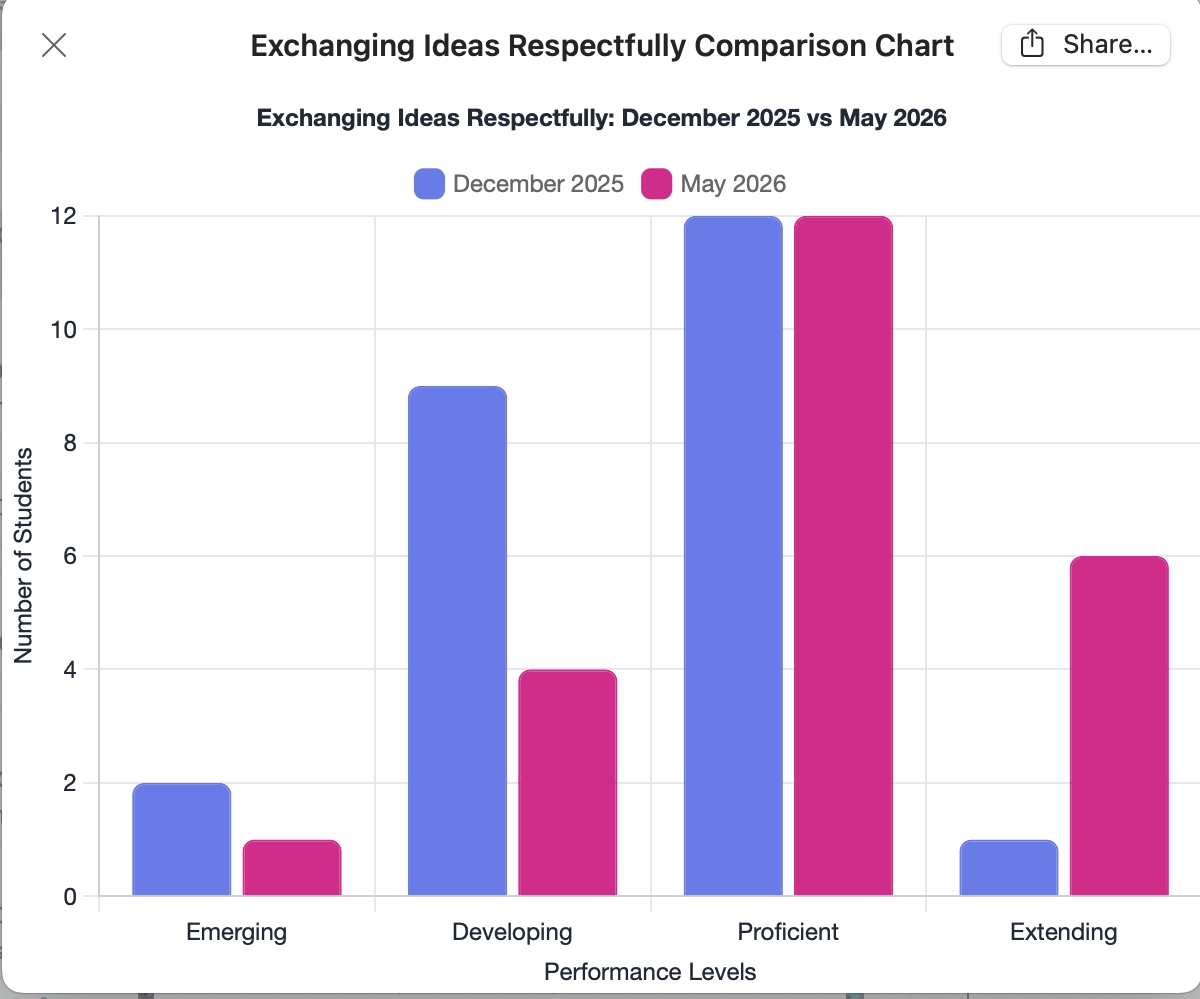
Exchanging ideas respectfully | Emg | Dev | PRF | Ext | Total Students present |
Attempt 1 | 2 (8.3%) | 9 (37.5)% | 12 (50%) | 1 (4.2%) | 24 |
Attempt 2 (after direct instruction on specific skills) | 1 (4.5%) | 6 (27.3%) | 10 (45.5%) | 5 (22.7%) | 22 |
Attempt 3 (after individual feedback) | 1 (4.3%) | 5 (21.7%) | 11 (47.8%) | 6 (26.1%) | 23 |
Attempt 4 | 1 (4.3%) | 4 (17.4%) | 12(52.2%) | 6 (26.1%) | 23 |
Attempt 5 (after peer feedback) | 2 (10%) | 5 (25%) | 11 (55%) | 2 (10%) | 20 |
Observations For May 2026:
During the spring term, direct instruction in specific conversational skills continued, with the addition of structured peer feedback and group reflection following a discussion task (Attempt 4). Students participated in a guided group discussion, followed by a reflection session focused on identifying strengths and areas for improvement. This approach was intended to increase engagement and skill development for students in the developing range by shifting reflection from an individual to a group process. A subsequent discussion (Attempt 5) was held one week later to assess impact.
Analysis of Data
Student achievement in Attempt 4 remained consistent with Attempt 3, with one student moving from developing to proficient. Peer reflection sessions revealed that while students were generally willing to provide positive feedback, they struggled to offer specific, constructive suggestions, often defaulting to kind but vague responses. This indicates a need for explicit modelling and sentence stems to support effective peer feedback. The peer feedback approach did not result in anticipated growth for students in the emerging range; one student shifted from developing to emerging. A decrease in students demonstrating extending-level skills was partially influenced by absences among stronger discussion models. It remains unclear whether reduced peer modelling or the group feedback process affected student performance or motivation.
Strengths
• Continued explicit instruction supported stable student performance across discussion attempts.
• One student demonstrated growth, moving from developing to proficient.
• Students showed willingness to engage in peer reflection and provide positive feedback.
• Group reflection increased participation and awareness of discussion behaviours.
Challenges
• Students had difficulty providing specific, constructive peer feedback, tending toward kind but vague comments.
• Peer feedback did not lead to expected growth for students in the emerging range; one student showed regression.
• Reduced presence of strong discussion models (due to absences) may have impacted overall discussion quality.
• It remains unclear whether group feedback supported engagement for all learners or affected motivation for some students.
Overall Observations Comparison of Student Performance: December 2025 vs. May 2026
• Student performance shifted toward higher proficiency between December 2025 and May 2026. • In December, most students were Developing or Proficient, with minimal Extending representation. • By May, following targeted instruction and feedback, more students demonstrated Proficient and Extending behaviours. • Extending increased from 1 student to 6 students (26.1%), indicating greater independence and confidence. • Overall, targeted instruction reduced Emerging levels and supported movement into higher performance categories.
Conclusion
Classroom evidence shows that while students are increasingly willing to participate in discussion, many require explicit instruction to communicate ideas clearly, critically, and constructively. Targeted modelling of academic language, discussion skills, and differentiated access to texts will support more equitable participation. Emphasizing purposeful speaking, listening, and writing will help students develop confidence, critical thinking, and meaningful connections to content.
Next steps
Continued explicit instruction in discrete conversational skills outside of discussion practice, increased use of differentiated text sets to address varied background knowledge, and integration of literacy screening data to guide targeted interventions.
Literacy Instruction Resources to Support the School Plan • Grand Conversations (2nd Edition) – Faye Brownlie • When Kids Can’t Read: What Teachers Can Do – Kylene Beers • The Vocabulary Playbook: Learning Words That Matter – Douglas Fisher and Nancy Frey
These resources inform literacy circles, screening processes, targeted interventions, and research‑based vocabulary instruction embedded throughout the year.
OUR NEXT STEPS
QESS Learning Plan 2026–2027 Humanities 8
• Communication Focus
Inquiry Question
How can we help Grade 8 students sustain meaningful academic dialogue by strengthening their ability to ask probing questions, summarize peers’ ideas, and connect multiple viewpoints?
Why This Focus?
• Last year’s inquiry showed strong gains in respectful exchanges after explicit instruction.
• Students are now ready to deepen their communication skills through richer, more sustained dialogue.
• This work supports belonging, confidence, and inclusive classroom culture.
Key Competencies (Humanities 8) ELA 8:
• Exchange ideas to build shared understanding
• Communicate clearly and purposefully
• Build on others’ ideas and extend thinking
• Support opinions with evidence
Social Studies 8:
• Ask questions; interpret and analyze ideas
• Consider multiple perspectives
• Communicate interpretations effectively
2026–2027 Actions
• Baseline discussion in September
• Mini lessons on probing questions, summarizing, and connecting ideas
• Structured routines: “Say–Summarize–Connect,” paired practice, small group discussions
• Feedback cycles: whole class + light individual feedback
• Three discussion attempts tracked with a consistent proficiency scale
Success Indicators
• More students demonstrating Proficient/Extending levels
• Students independently using target skills
• Increased confidence and participation
• Evidence of deeper thinking and collaborative meaning making
Surrey Schools
Formed in 1906, the Surrey School District currently has the largest student enrolment in British Columbia and is one of the few growing districts in the province. It is governed by a publicly elected board of seven trustees.
The district serves the cities of Surrey and White Rock and the rural area of Barnston Island.