Panorama Park Elementary 25-26

OUR CONTEXT
Our Panorama Park Community Our school is a vibrant, welcoming, and inclusive community where over 450 students come together to learn, grow, and thrive. We proudly celebrate the rich diversity of our families, where 22 languages are spoken within our community, and nearly 250 of our students are English Language Learners and 8 Indigenous learners. This diversity is one of our greatest strengths, shaping a learning environment that is globally minded, culturally responsive, and deeply connected.
At the heart of our school is a strong sense of belonging. Our students genuinely enjoy being together, forming meaningful friendships, supporting one another, and participating in shared experiences across grade levels. We are intentionally nurturing a culture of kindness, where acts of compassion, empathy, and respect are recognized and celebrated every day.
Our learners are curious, energetic, and engaged. They thrive in hands-on, interactive learning environments that encourage creativity, collaboration, and exploration. Whether they are outdoors, participating in athletics, or working together on projects, movement and social connection are essential parts of their learning journey.
We are proud to offer a wide range of programs that nurture both student learning and well-being. Our offerings include StrongStart, along with empowering initiatives such as Go Girls and Jump Start, supporting students in building confidence, resilience, and healthy lifestyles.
Learning extends far beyond the classroom. Students enrich their experiences through a variety of sports teams, clubs, and leadership opportunities that foster teamwork, creativity, and personal growth. Signature events such as our Annual Art Crawl, Young Entrepreneur Fair, Concert Performances, and Speech Fest provide meaningful opportunities for students to express their ideas, showcase their talents, and develop their voices.
In addition, this year, students benefitted from unique, school-wide experiences such as a school-wide art program, Karate, Floor Ball, and Wheelchair Basketball; opportunities that promote inclusion, skill development, and a strong sense of community.
Equity, diversity, and inclusion are foundational to everything we do. Through initiatives such as the Terry Fox Run, Jump Rope for Heart, Spirit Days, and Cultural Celebrations, we foster a positive and inclusive school culture. These experiences build empathy, honour student identities, and strengthen our sense of community and global citizenship.
Strong partnerships between staff, families, and our broader community are key to our success. Together, we are committed to creating an engaging, supportive environment where every student feels valued, connected, and empowered to reach their full potential, both as learners and as individuals.
OUR LEARNERS
Panorama Park is a diverse and inclusive learning community where students are supported to feel valued, connected, and engaged in meaningful learning. Our learners arrive each day with their own unique identities, strengths, abilities, and lived experiences. Each one brings a distinct perspective to their learning, shaped by creativity and imagination. Their presence reminds us of the importance of equitable access points for all. It is our commitment to equitable, culturally responsive teaching practices that ensure access and success for all learners.
As part of our Student Learning Plan, we have identified English Language Arts (ELA), specifically writing, as a key area of focus. This aligns with the BC Curriculum, with an emphasis on developing curricular competencies such as communicating ideas, organizing thinking, and using language conventions effectively.
Our Learner's Strengths
Evidence from classroom observations, student voice, and assessment data indicates that our learners demonstrate the following strengths:
- A developing sense of identity and the ability to connect their learning to their sense of self
- Ability to orally communicate ideas and opinions in partner and group discussions to support writing
- Creativity and imagination in generating ideas (Creative Thinking Core Competency)
- Willingness to take risks and share their thinking with peers (Personal Awareness & Responsibility)
- Understanding of the writing process, including the role of brainstorming
- Ability to use scaffolds such as:
- Graphic organizers
- Word banks and visuals
- Anchor charts
- Sentence starters and mentor texts
- Picture Books
Our Learners' Areas for Growth
What we noticed about our learners' writing:
- Student writing samples demonstrating strong ideas but limited organization and depth
- Rubric-based assessments highlight a need for growth in conventions and structure
- Student self-reflections identifying challenges in expanding and organizing ideas
Based on student writing samples, formative and summative assessments, and collaborative staff discussions, the following areas for growth have been identified:
- Consistent use of Canadian writing conventions (punctuation, capitalization, grammar)
- Organization of ideas into clear and coherent paragraph structures
- Elaboration of ideas with relevant supporting details and examples
- Increased writing stamina and independence
Goal
Through this focused work, our goal is to support all learners in developing confidence and competence as writers. Students will strengthen their ability to communicate ideas clearly and effectively, applying the skills and strategies needed to be successful across subject areas. Ultimately, we aim for each learner to see themselves as a capable and engaged writer.
OUR FOCUS
Our Focus: A Growing Journey in Writing
Over the past three years, the learners at Panorama Park Elementary have been on a purposeful journey to strengthen student writing. What began as a shared inquiry has grown into a cohesive, school-wide commitment to developing confident, capable writers.
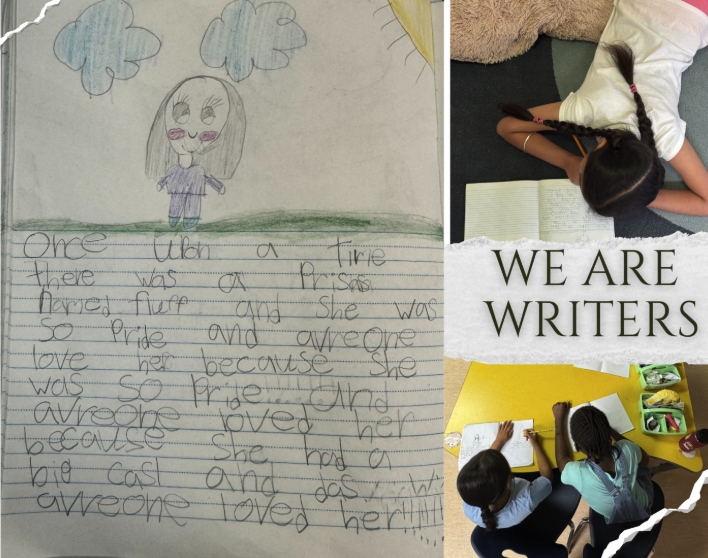
Today, our learners are deeply engaged in the English Language Arts Curricular Competency of Writing, using a variety of strategies to communicate and articulate their ideas with increasing clarity and purpose. Students demonstrate their thinking through oral, written, visual, and digital forms, with a strong emphasis on voice, agency, and authentic expression.
Across the school, students engage in rich literacy experiences: read-alouds, story workshops, morning meetings, journaling, “walk and talk,” imaginative play, and the intentional use of the writing process. Tools such as TouchChat, visuals, and structured supports ensure that all learners can access and engage in writing.
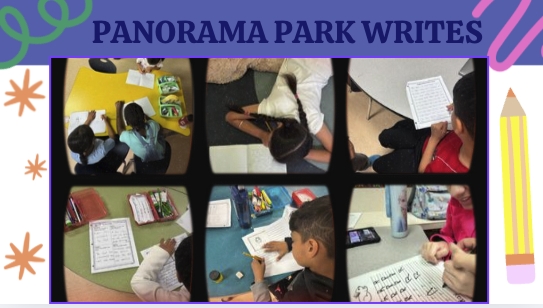
Our Journey (2023–2026)
Our school-wide writing focus began in the 2023–2024 school year with a simple but powerful first step: a baseline writing sample connected to identity during Black History Month. Students explored the contributions of Black Canadians, connecting historical learning to present-day relevance. Through research, reflection, and creative expression, they developed writing that was thoughtful, purposeful, and deeply personal. Classroom displays and student work demonstrated not only improved writing skills, but a stronger sense of voice and identity.
This experience brought staff together to co-create a shared writing rubric aligned with BC Curricular Competencies, establishing consistency in both instruction and assessment as well as engagement in writing resources. More importantly, it created a common language around writing across the school.
These curricular competencies include:
Use writing and design processes to plan, develop, and create texts for a variety of purposes and audiences
Use language in creative and playful ways to develop personal style
Communicate in sentences and paragraphs, applying conventions of Canadian spelling, grammar, and punctuation
In the years since, this work has deepened:
- Writing instruction is now intentionally embedded across all classrooms (K–7)
- A writing cohort with learners from Grades 1-6 has been established to monitor student growth over time
- Staff collaboration has strengthened through shared practices and professional learning
- Learners now engage in authentic writing opportunities that connect to identity, inquiry, and real-world contexts
Evidence of Growth
Over time, multiple sources of evidence show clear and measurable progress:
- Writing Samples (Monthly): Demonstrate growth in organization, idea development, and conventions from baseline to end-of-year
- Rubric-Based Assessments: Show steady improvement in paragraph structure, sentence fluency, and editing
- Speech Fest: Provides an authentic, summative opportunity for students to apply the full writing process (planning, drafting, revising, editing, presenting)
- Student Reflections: Indicate increased confidence and ownership of writing goals
- Conferencing & Observations: Show greater independence in applying feedback and revising work
We can confidently report that student writers across Panorama Park are making meaningful progress. Our growing Indigenous learner population is also demonstrating continued development within an inclusive and responsive learning environment.
Measurable Targets (Current Stage of Our Journey)
As our work has evolved, so have our expectations. We now use the following measurable targets to guide instruction and monitor impact. This year, we also shifted from whole school tracking and began tracking a cohort of 15 learners across Grades 1, 2, 4, 5, and 6, and they will continue to be monitored over the coming years. Our analysis of the data is:
We have measurable growth within:
- Organization of writing (clear paragraph structure)
- Development of ideas (supporting details)
- Use of Canadian conventions
- Writing stamina
- Independent completion of writing tasks
- Setting and monitoring personal writing goals
- Willingness to take risks in writing
- Stronger expression of voice and identity
- Reflection on growth using self-assessment tools
- Greater participation in sharing opportunities
Growth Over Time
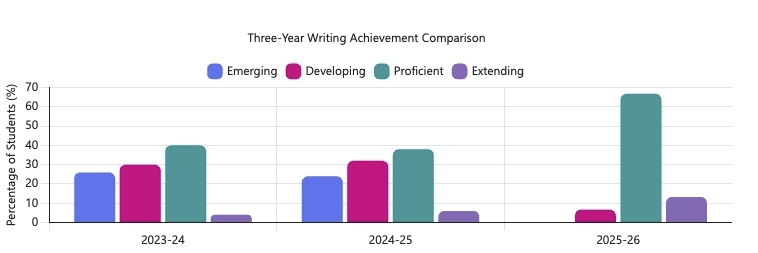
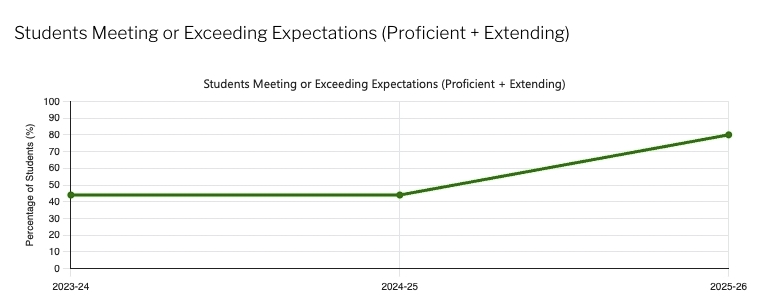
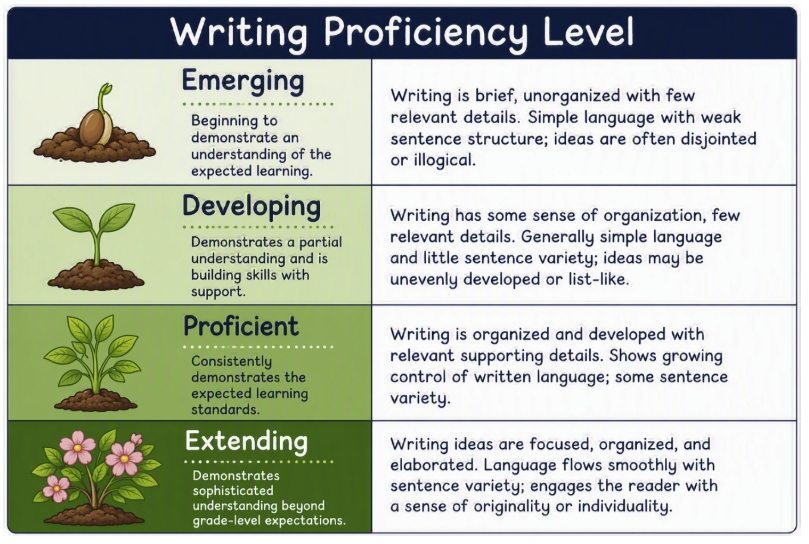
Writing achievement has shown substantial improvement over the past three years. The percentage of students meeting or exceeding expectations (Proficient or Extending) remained stable at 44% in both 2023–2024 and 2024–2025, before increasing dramatically to 80% in 2025–2026 among students receiving targeted writing support.
Important Statistics: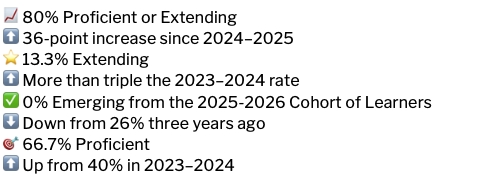 Key Gains Over Three Years
Reduction in Emerging Writers
- Emerging writers decreased from 26% in 2023–2024 to 24% in 2024–2025 and to 0% in 2025–2026.
- This represents a 100% reduction in students performing at the Emerging level among the Writing Plan Cohort of Learners.
Increase in Proficiency
- Learners achieving Proficient increased from 40% to 66.7% over the three years.
- This is a gain of 26.7 percentage points, representing a 67% increase in learners meeting grade-level writing expectations.
Growth in Extending Achievement
- Learners achieving Extending increased from 4% in 2023–2024 to 13.3% in 2025–2026.
- The proportion of learners exceeding expectations has more than tripled over three years.
Students Meeting or Exceeding Expectations
- The percentage of students achieving Proficient or Extending rose from 44% in both previous years to 80% in 2025–2026.
- This represents:
- 36 percentage-point growth
- An 82% increase in learners meeting or exceeding expectations.
Writing Achievement Continues to Rise
Panorama Park's focused writing interventions have resulted in significant improvements in student achievement over the past three years.
- The percentage of students achieving Proficient or Extending increased from 44% in both 2023–2024 and 2024–2025 to 80% in 2025–2026.
- The proportion of students performing at the Extending level more than tripled, increasing from 4% to 13.3%.
- Overall, four out of every five students receiving targeted writing support achieved proficiency or higher, demonstrating the positive impact of ongoing assessment, intervention, and responsive instruction.
Instructional Practice
Within the classroom, educators support and implement:
- The writing process (plan, draft, revise, edit, publish)
- Common instructional language aligned with ELA Curricular Competencies
- Use formative assessment to guide instruction
- Collaborate through professional learning to refine practice
- Monitor a longitudinal cohort to track sustained growth over time
- Communicate ideas clearly and effectively
- Demonstrate writing growth
- Celebrate student voice and learning
Classroom Practice in Action
This growth is reflected in our classrooms, where students engage in intentional and creative writing experiences:
- Descriptive Non-Fiction Writing: Learners research, organize, and present ideas using structured writing and text features
- Creative Writing with Loose Parts: Learners build oral language and imagination, transitioning ideas into structured written narratives
- Narrative Writing: Learners develop stories with a clear structure, supported by mentor texts and guided practice
- Speech Fest: Learners craft and present persuasive writing, strengthening both written and oral communication
Where We Are Now
Three years ago, our focus was on establishing a baseline and a shared understanding of writing. Today, we are a school where:
- Writing instruction is intentional, consistent, and collaborative
- Learners see themselves as writers with voice and purpose
- Evidence of growth is clear, measurable, and ongoing
OUR NEXT STEPS
Next Steps: Deepening Student Writing
Analyzing Student Writing Data & Identifying Strengths
Through the analysis of student writing samples, assessment data, and student voice, several consistent strengths have been identified. Our learners:
- Clearly articulate their ideas when writing is connected to personal identity and lived experiences
- Learn and apply writing strategies with increasing confidence (ELA Curricular Competencies)
- Engage in authentic, school-wide writing opportunities that support communication and idea development
- Demonstrate confidence in sharing their thinking (Personal Awareness & Responsibility)
- Recognize the importance of brainstorming as part of the writing process
- Benefit from scaffolds such as:
- Word banks and visuals
- Multimedia supports (e.g., videos)
- Graphic organizers
- Participate in meaningful peer discussions that foster creative and critical thinking
These strengths form a strong foundation for continued growth in writing.
Next Steps in Our Writing Journey
Based on formative and summative assessment data, Panorama Park will continue to focus on English Language Arts and Writing within the Student Learning Plan.
Student Learning Goals: Our learners will:
- Set personalized writing goals (e.g., improving conventions, expanding vocabulary, strengthening storytelling techniques)
- Engage in regular reading across genres to build awareness of structure, voice, and style (Big Ideas in ELA)
- Write consistently across contexts (journals, creative, and non-fiction writing) to build fluency and stamina
- Strengthen the use of Canadian writing conventions through editing and revision
- Build academic and descriptive vocabulary to communicate ideas clearly and effectively
- Use feedback and self-assessment tools (checklists, peer input, teacher conferencing) to revise and refine their work
School Commitments: To support this work, we will:
- Monitor a cohort of learners over multiple years to track longitudinal growth
- Use ongoing formative assessment to guide instruction and measure progress alongside summative data
- Continue to embed inclusive, culturally responsive teaching practices, including Indigenous perspectives and ways of knowing
- Apply the writing process (planning, drafting, revising, and editing) to complete a summative assessment, using Speech Fest as an authentic platform to present and share learning.
Instructional Response: To support student growth, educators will:
- Provide explicit instruction in paragraph structure, idea development, and writing conventions
- Model effective writing strategies aligned with ELA curricular competencies
- Incorporate frequent opportunities for guided, independent, and collaborative writing
- Use formative assessment and feedback to support continuous improvement
- Integrate inclusive and culturally responsive practices, including Indigenous perspectives and ways of knowing, where appropriate
Targeted Instructional Focus Areas
Descriptive Non-Fiction Writing
Learners will:
- Conduct research and identify key information
- Use tools such as Venn diagrams and graphic organizers to compare and analyze ideas
- Draft writing that clearly organizes and interprets factual information
- Apply the writing process (plan, draft, revise, edit) to produce polished, publishable work
Creative Writing & Literary Paragraphs
Learners will:
- Use writing prompts and hands-on materials (e.g., loose parts) to generate ideas
- Incorporate descriptive language (adjectives, vivid verbs, transitions)
- Use organizational tools such as graphic organizers and brainstorming strategies
- Focus on sentence clarity, structure, and conventions
- Revise writing to improve coherence, detail, and overall impact using editing checklists
Narrative Writing Process
Learners will:
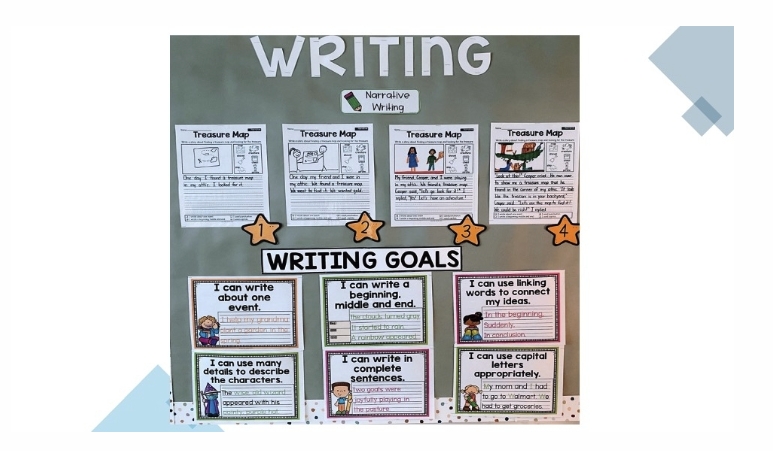
- Plan writing using story maps and outlines
- Draft narratives with clear structure (beginning, middle, end)
- Revise for organization, clarity, and flow of ideas
- Edit for grammar, punctuation, and spelling
- Share, publish, and celebrate their work, strengthening their identity as writers
Goal and Looking Ahead
Through these next steps, Panorama Park is committed to developing confident, capable, and engaged writers. By strengthening students’ ability to communicate ideas with clarity, creativity, and purpose, we support their success across all areas of learning while fostering a strong sense of identity. Grounded in equity, inclusion, and culturally responsive practice, our ongoing journey is not only about improving writing skills but about empowering every learner to express their voice with confidence and make a meaningful impact.
Surrey Schools
Formed in 1906, the Surrey School District currently has the largest student enrolment in British Columbia and is one of the few growing districts in the province. It is governed by a publicly elected board of seven trustees.
The district serves the cities of Surrey and White Rock and the rural area of Barnston Island.