North Surrey Secondary 25-26

OUR CONTEXT
OUR CONTEXT
Welcome to North Surrey Secondary School! I’m Stefan Stipp, the principal.
When you enter our school, you'll immediately sense the warm embrace of a community that thrives on diversity, inclusion, and kindness. 61 different languages are spoken in the homes of our students. Here, every individual is valued, and every heart is welcomed into our community. We strive to create a deep sense of belonging for all Spartans.
Academics matter at North Surrey, reflecting our dedication to nurturing intellectual curiosity and sound thinking. We want students to be able think like historians, writers, scientists, and mathematicians in preparation for their transition into an everchanging world of complexity.
Artistry thrives in our Fine Arts program, where music, dance, visual arts, and drama flourish. This creative haven provides a platform for self-expression, allowing students to explore their passions and talents. Come visit our school to see our students shine through beautiful art displays, engaging concerts, dynamic dance performances, and powerful plays.
In our well-equipped workshops, innovation and craftsmanship come alive. The robust Technology Education program offers hands-on experiences in various fields, from woodwork and metalwork to robotics and automotive technology, empowering students to translate imaginative ideas into tangible realities.
The culinary, foods and textiles programs provide students with opportunities to develop life skills needed to prepare food and create clothing. They help students understand how their choices as consumers can be more sustainable, can contribute positively to the environment and can work to help combat some social issues.
Our business education, information technology, and career programs equip students with vital skills for the professional world. Students learn about computer programming, video game design, economics, and entrepreneurship, while also gaining insights into personal finance, marketing, photography, and video production. Our career education programs guide students in exploring careers, future education opportunities, and developing skills.
Physical activity plays an integral role in promoting well-being and teamwork. At North Surrey, students build skills in a varies athletic pursuits to build life-long habits of staying active. Our many sports teams allow students to engage in healthy competition, develop discipline, and embrace the values of perseverance and collaboration. Come watch our Spartans compete.
Our Modern Languages department offers students the opportunity to count themselves amongst the hundreds of millions of French and Spanish speakers globally. Throughout their years of study, students express themselves verbally and in writing with ever increasing fluency and confidence, all while learning about the world in which these languages are spoken, and finding their place in it.
The Library Learning Commons is a welcoming space for all our learners to embrace and explore their passions, interests, and needs. With a carefully curated collection of diverse resources the LLC strives to engage all members of our school community.
We focus on the Core-Competencies of communication, thinking and personal/social through thoughtfully planned activities and celebrations with subsequent reflections through out the year.
We have four caring counsellors to help students with course planning, and any personal issues that may arise.
We work hard to foster an inclusive learning community that ensures all students have the opportunity to grow and thrive at NSS. We support all students and their unique learning needs by tailoring their educational experience to individual needs.
As you walk through the halls of our diverse high school each student and staff member contributes a unique thread to the tapestry of our collective identity, and together, we form a dynamic and harmonious community.
OUR LEARNERS
Our Learners –
To best serve our learners at NSS, staff at North Surrey engaged in a school wide inquiry process. Four years ago, staff created three goals.
- Make meaning out of text,
- Problem Solving throughout the design process, and
- Nurturing creative expression and participation.
During those five years department have engaged in meaningful inquiries working towards our goals which have evolved into these:
- Nurturing clear, meaningful communication
- Problem solving throughout the design process
- Nurturing creative expression and participation
- Helping students drive their learning
These goals work for us because they’re broad enough so that each department in our school can engage in meaningful inquiry to improve student learning. They are congruent with the core and curricular competencies ensuring that the various inquiries are rooted in the foundational goals of the BC curriculum.
With the goals established, each department worked to create an inquiry question which they have worked on (and in many cases changed) for the past four years. At the start of the 2025 – 2026 school year, each department also developed an equity question. The table below shows the questions our departments worked on during the 2025-2026 school year.

Here are three examples of learning and growth related to these questions:
Fine Arts
This year, our Fine Arts Department has extended its inquiry into how we nurture creative expression within our school community. Their guiding question has been:
How can we explore strategies and develop tools that build, encourage, and support learner independence and engagement in the arts—so that students are willing to take risks, actively participate, and express their feelings, ideas, and experiences through artistic practice?
This inquiry has shaped teaching and learning throughout the year across our studios, classrooms, and performance spaces. The intentional processes fine arts teachers use help guide students toward greater independence, confidence, and engagement in their artistic work.
Much like an iceberg—where the majority of its structure exists beneath the surface—the visible performances and presentations by our dance classes and teams, drama classes and theatre company, band, and choir ensembles represent only a small portion of the learning taking place. These public moments are the culmination of sustained, often unseen work that demonstrates students’ growth, risk-taking, and deep engagement in the arts.
These performances are not endpoints, but milestones in an ongoing learning journey—one that emphasizes process, reflection, and artistic voice. They showcase students who are increasingly confident, independent, and engaged in their creative expression.

Social Studies
Our social studies department continues to work on the following inquiry: “How can we use consistent graphic organizers to help students become more self-regulated learners?” Teachers have collaborated on creating a variety of organizers that engage students in critical thinking through a systematic approach. For example, the organizer below helps students assess the historical significance of events. Using an organizer like this repeatedly has led to significant growth in students’ ability to apply this curricular competency and to do it as a habit of mind, rather than needing to be prompted by a teacher. The accompanying rubric helps students self-assess their progress over time.


Intercultural Fair
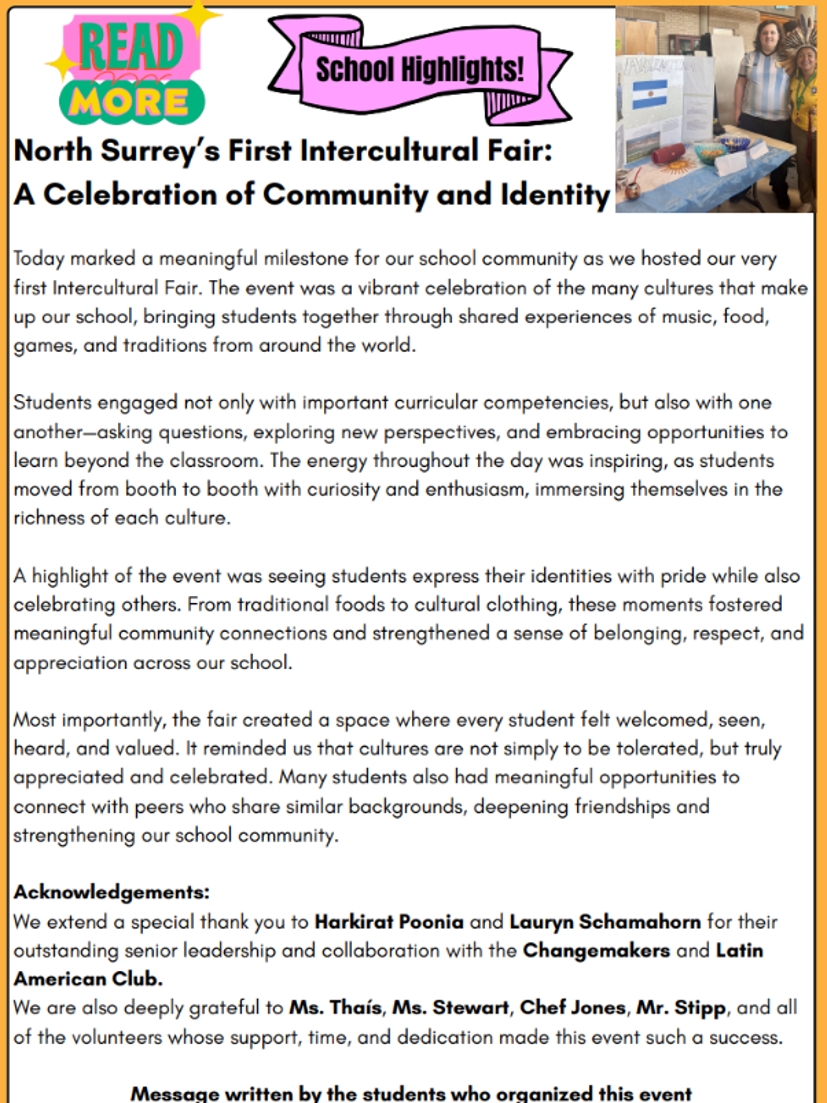
Our newly created Equity Department has been working towards ensuring that every student feels a sense of pride and belonging. To this end they hosted our first annual Intercultural Fair which was profiled in the district’s “Equity in Action” newsletter on May 20, 2026.

 That's a small sampling of the ways our staff are engaged in inquiry to improve student learning.
OUR FOCUS
Our Focus
The previously mentioned goals and inquiry questions represent the big picture of our staff working to improve student learning. Our targeted goal for this Student Learning Plan is helping students drive their own learning.
Students who drive their own learning:
- Motivate themselves to learn
- Set, monitor and assess goals
- Select and use appropriate learning strategies
- Monitor and asses their learning and seek help when needed
This goal is important because it affects all aspects of student learning. Students who independently self-regulate, succeed in school and beyond.
Two years ago, our LST department head began to lead an initiative with the entire staff to help students drive their learning. He and a committee of staff met regularly and designed learning experiences and resources that were shared at professional development days and staff meetings.
Our specific focus this year is working with a group of 15 students receiving LST support to help them drive their own learning.
One LST teacher employed four tools throughout the year to work towards this goal: The Engagement Road Map, Quests, Missions, and Boss Battles.
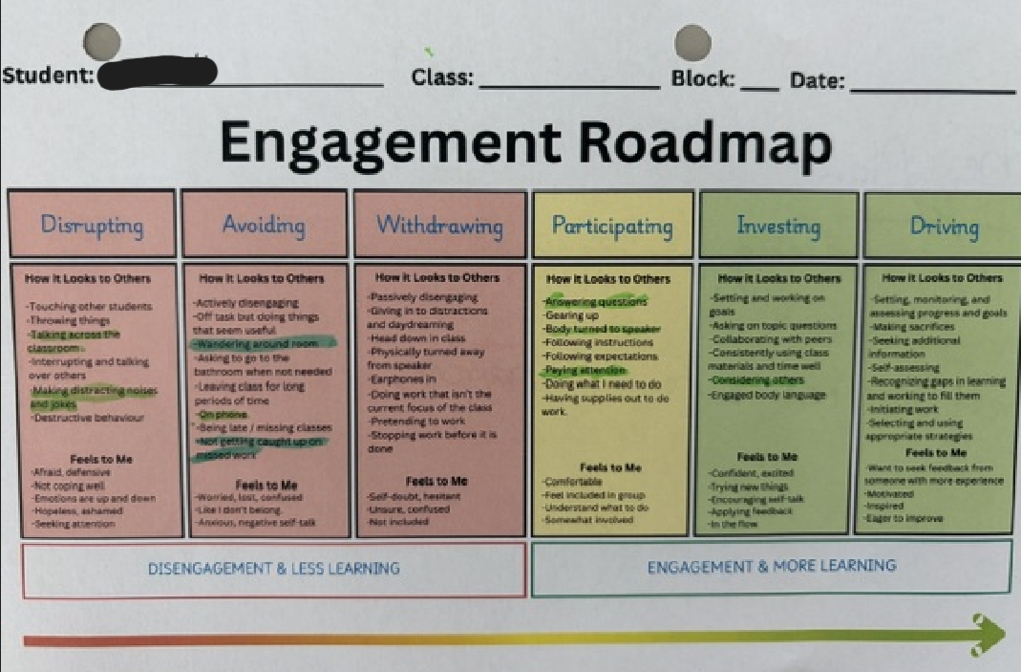
The Engagement Roadmap (adapted from Teaching Students to Drive Their Own Learning by Fisher, Frey, Ortega, and Hattie)
The Engagement Roadmap is a tool to help students reflect on their level of engagement and to help them create a plan to increase it. Our LST teachers used the Roadmap as a reflection tool for student-teacher review and goal setting. Below is a copy of one filled out by the student (light green) and teacher (dark green). The Roadmap allowed the teacher and student to have an objective conversation that was based on helping the student see a path for growth. During the discussion, the Roadmap was linked to work readiness and job skills. This student observed that his efforts were very scattered. Teacher and student discussed that the goal is to reduce the spread of points on the Roadmap and focus on reaching the Investing category more consistently.
The next image shows the plan the student and teacher made together. It focuses on one area of growth the student identified: ‘Reduce talking across the classroom’ and ‘Self-correct when it happens.’ A review and new student reflection is scheduled for the following week.
Throughout this process students have been sincere, honest, and engaged in the process. After the teacher-student conversations, there has been an immediate improvement on student engagement and independence within the LST block.

Quests, Missions, & Boss Battles
The other strategies focused specifically on goal setting (a part of driving your own learning) and used the three tools: f Quests, Missions, and Boss Battles. The sequence is designed to provided heavily structured goal setting that slowly becomes less structured and requires the students to take a more active role.
Quests
The quests are divided into 7 categories: Organization, Emotional Regulation, Time Management, Metacognition, Planning, Home Skills, and Work Skills.
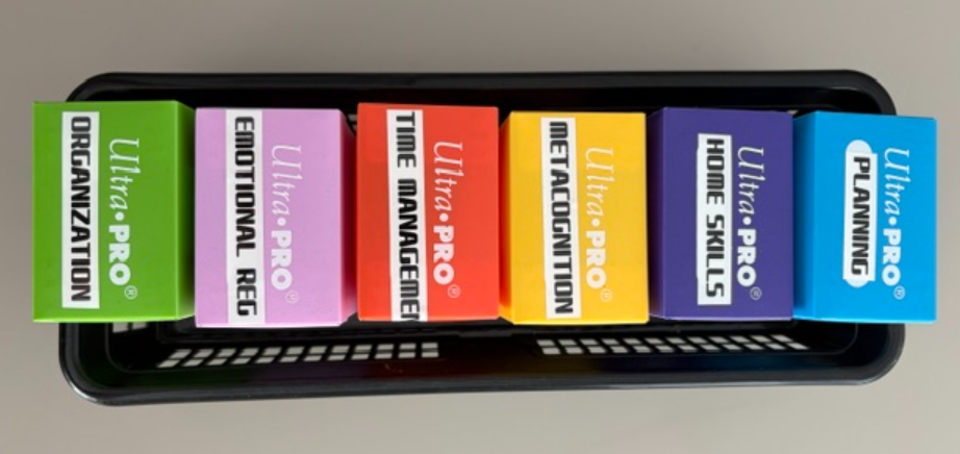
Each box contains individual quests:
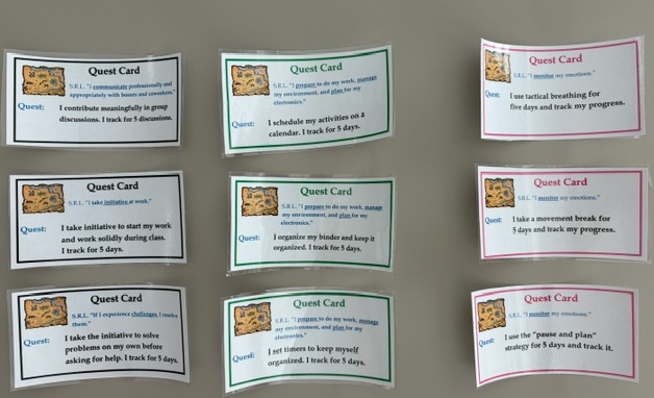
Students choose quests they are interested in. Teacher and student discuss the quests and ensure they are a good fit. Then students track their quests.
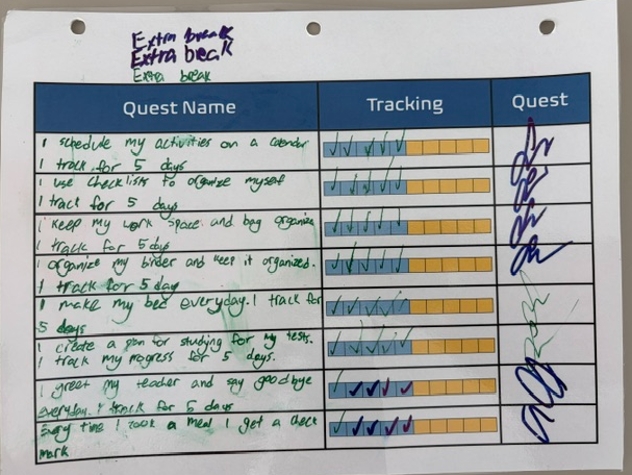
Through the Quests, students are learning the science behind setting strong goals, including the SMART criteria, tracking, and rewarding.
Students have really enjoyed the Quests and are engaged in the process. During one-on-one discussions with students, they have expressed how they enjoy making improvements in their lives and they feel more in control.
Missions
Once students complete 8 quests, they move onto Missions. Missions are designed to provide less structure but some guidance. This process includes a Mission Training Centre where students watch videos about goal setting, rewarding, gamification, and other topics. They also complete a Mission Passport (notes on the videos) and have a Mission Debrief at the end with the teacher which take place as a reflection / conversation.


Through doing the Missions, students have become more independent and self-directed.
Boss Battles
Boss Battles are the final stage in the goal setting cycle. For Boss Battles, students are given a video on how to set and track goals independently and a blank notebook. They are to create and track their own goals and there are teacher check-ins. Having worked through Quests and Missions, students are ready to take charge of their own goal setting.
Using the engagement road map, quests, missions and boss battles has helped students receiving LST support improve ownership of their learning which in turn has improved their achievement. Of the 15 students who engaged with these strategies, all reported increased engagement and improvement setting meaningful goals and reaching them. Furthermore, this improvement was clear when looking at their goals and outcomes.
OUR NEXT STEPS
Evidence
Using the engagement road map, quests, missions and boss battles has helped students receiving LST support improve ownership of their learning which in turn has improved their achievement. Of the 15 students who engaged with these strategies, all reported increased engagement and improvement setting meaningful goals and reaching them. Furthermore, this improvement was clear when looking at their goals and outcomes. By the end of the school year 12 of 15 students were setting goals and following through independently. One example is the student in the previous section. Initially they set goals choosing from a menu with the teacher sitting beside them. They progressed to using the goal setting sheet and culminated by writing them independently in a notebook and following through on their own.
The work on engagement and goals showed up in students' academic achievement as 11 of the 15 students improved in their proficiency/ grades throughout the school year.
Next Steps
While most students getting LST support who worked with these tools improved their engagement and goal setting only 15 of about 80 were introduced to these strategies. We plan to expand their use to all students receiving LST support.
Surrey Schools
Formed in 1906, the Surrey School District currently has the largest student enrolment in British Columbia and is one of the few growing districts in the province. It is governed by a publicly elected board of seven trustees.
The district serves the cities of Surrey and White Rock and the rural area of Barnston Island.