North Surrey Learning Centre 25-26

OUR CONTEXT
The North Surrey Learning Centre is an Alternate School school providing educational opportunities for students who are completing courses in grades 10, 11 and/or 12, in order to meet the requirements necessary for graduation.
Our students are a diverse group with complex backgrounds, and comprise a wide range of abilities, gifts and talents. One commonality amongst the students is that most have not been successful in mainstream schools for myriad of reasons. Our purpose is to nurture these inherent abilities and passions of our students, to reduce stressors and increase self confidence, thereby changing the narrative of their stories, from one of ongoing struggles to one of joy and success.
Education is a “contact” sport; the young brain is designed to develop, grow and “flourish in a social context” (C. Elders, Clinical Psychologist), and establishing positive relationships is a foundational feature of our learning centre. Capture the heart, and it is easier to engage the hands and the brain. Our students need the support of our staff and their peers to help them discover their passions, their voices and build their self confidence. Students work closely with an understanding and flexible staff, who provide our learners with a more student-centred, self -directed program. With support focused on diverse learning, emotional and social needs of each student, pathways are created to achieve their educational goals. The spirit of our school culture is one of hope and belonging where all students feel safe, supported and valued; where equity is woven into the fabric of what we do, and where student voices are activated.
OUR LEARNERS
COVID has had an adverse affect on the educational journey, and the well-being of many youth. With the intake of numerous Grade 10 students across the learning centres, it has become evident that the pandemic has interrupted not only the intellectual development of these youth, but perhaps more importantly, their social emotional development. “Carla Elfers, a Vancouver clinical youth psychologist, said generation Z is struggling just as much from how the pandemic has reduced social contact, volunteer activities and extracurricular events as it has from the disarray in their formal academic studies.” (‘In the Dark’ – Douglas Todd Vancouver Sun, Jan 29, 2022). The last “normal year” for the students in Grade 10, was pre-COVID and data shows that many are deficient in the grade 8 and 9 core courses. According to Elfers, for students who were in grade 8 when COVID hit in March 2020 things “might be the toughest”. COVID interrupted a very critical development period in the lives of these students. “That three-grade period is crucial for developing close friendships, a sense of purpose and resilience, which Elfers said is important to have in place before the big push to figure out your path in higher education and work”.
Students who are personally aware and responsible, recognize how their decisions and actions affect their mental, physical, emotional, social, and cognitive wellness and take increasing responsibility for caring for themselves (Albert Bandura, Psychologist). Students who have strong self-efficacy participate more in class, work harder, persist longer and have fewer adverse emotional reactions when encountering difficulties. They are able to manage stress and express a sense of well-being. Below, we celebrate our learners successes and strengths in the areas of:
- Self awareness
- Self management

We want our learners to understand that their decision and choices affect themselves and others around them. By developing their competencies in the areas of self-awareness and self management, they will be able to approach their goals, tasks and challenges with a positive mindset, and this in turn will lead to a greater engagement in their learning and personal development. This will be demonstrated through their exploration of their personal and cultural identities as they develop their communication skills.
- Our learners can make connections between emotions and learning. They can identify their own emotions, as well as those of others.
- Our learners can recognize their strengths and can use strategies to focus and accomplish their goals.
- Our learners believe in their capabilities to achieve academic, career and/or personal goals.
OUR FOCUS
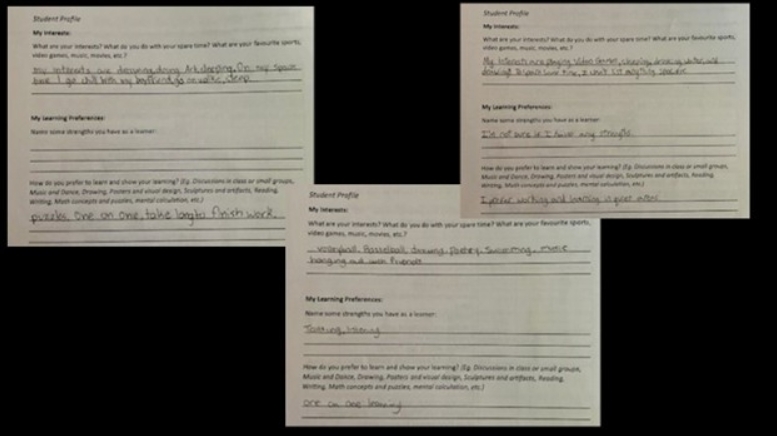
At the Learning Centre, student learning begins right away. All students create a Student Learning Plan for themselves, highlighting their interests, learning preferences and learning profile.
Currently, Human Hour is a weekly voluntary learning opportunity for any student to engage in and is currently not officially attached to a particular course. In September 2025, the structure of Human Hour has continued weekly with the addition of students being able to more intentionally demonstrate the Positive Personal and Cultural Identity Competency through a variety of course options: English First People's 10, English First People's 11, English First People's 12, Social Studies 11, Social Justice 12, Leadership, Contemporary Indigenous Studies 12, World History 12, Visual Arts 11 or Visual Arts 12. With teacher implementation and ongoing support, the goal is for students to earn course credit in 2 or more of the courses listed above through a combination of specific curricular competencies and the Positive Personal and Cultural Identity Competency. We will then measure the overall SEL impact the Human Hour structure has made on the self confidence of our students by having them submit self reflection focusing on the Positive Personal and Cultural Identity Competency and how it relates to their curricular competencies they are demonstrating within the Human Hour courses they've chosen. We predict our students' overall self confidence, through social interactions, will improve through their Positive Personal and Cultural Identity Competency quarterly self reflections and with the number of courses they earn credit for through Human Hour by the end of June 2026.
OUR NEXT STEPS
Teachers have collected student self reflection responses throughout the school year. Teachers have observed and assessed students' level of growth in their self confidence and social interactions by reviewing the level of written responses in those self reflections and by observing student social interactions during Human Hour. Teachers have also collected year student feedback around self confidence and social interactions through a summative tool. That summative tool will be able to allow students to express how they have grown in their self confidence through social interaction within the Human Hour classroom environment. We've realized the ongoing human interactions in Human Hour have increased student self confidence levels and that evidence is shown in their year end self reflections. Furthermore, close to 20 units of coursework were earned from 15 different students who participated in Human Hour from September 2025 to June 2026. Those 20 units contributed to more than an 80% course completion rate for students utilizing the Human Hour opportunity.


Surrey Schools
Formed in 1906, the Surrey School District currently has the largest student enrolment in British Columbia and is one of the few growing districts in the province. It is governed by a publicly elected board of seven trustees.
The district serves the cities of Surrey and White Rock and the rural area of Barnston Island.