Newton Elementary

OUR CONTEXT

Newton Elementary is a vibrant community of of diverse learners made up of students who are responsible, demonstrate strong character, show excitement for learning, display pride in sharing their learning and have a strong desire for success. Our students are helpful, kind and energetic. The senior students embrace opportunities to build school spirit and participate in leadership opportunities to benefit the entire school community. When presented with learning opportunities our students work hard to display their understanding of curricular concepts and competencies and along with their parents and guardians have a high level of respect for education.
From the minute students and their families walk through our doors starting at the age of 3 and 4 in the StrongStart program, they become part of a learning community that continues until the end of Grade 7. Their individual learning strengths and stretches are well supported through our targeted early literacy intervention with the support of the Early Literacy Teacher, the Learning Support Team, and opportunities to participate in challenge programs in Grades 4, 5, 6 and 7.
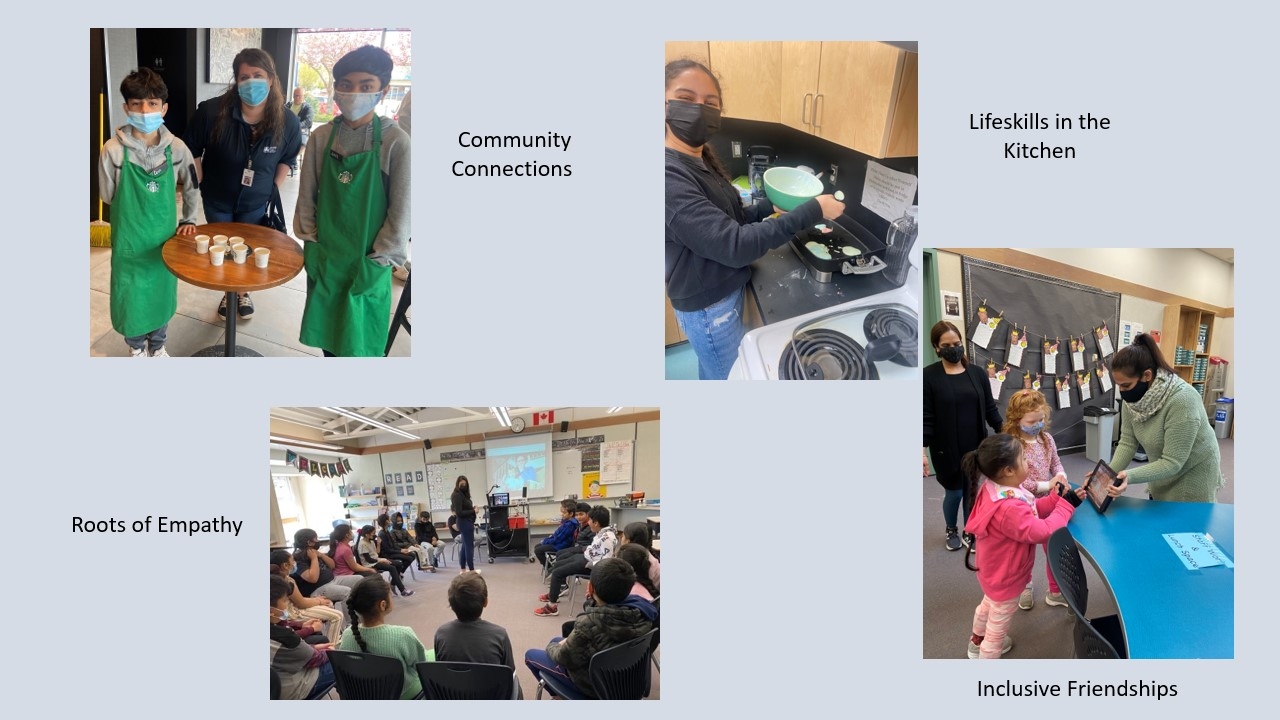
In our school, students have opportunities to show leadership through being crosswalk monitors, helping with the lunch program, being big buddies, and connecting with the community through work experience at a local business. Students also make community connections through programs such as KidsPlay, Yo Bro/Yo Girl, Racing Readers, Blast, and others.

OUR LEARNERS
Reading is an essential skill for a fulfilling life that helps us connect with others and their ideas and moves us to action. It helps us to gain an understanding of our own and others’ identities and helps our students to make sense of the world we live in. The Core Competency of Communication is fundamental to finding satisfaction, purpose and joy. Because “exploring stories and other texts helps us understand ourselves and make connections to others and to the world,” (BC ELA - BC English Language Arts Curriculum), our primary aim is to:
- foster our students’ love of reading and to guide our students to see themselves as readers which is part of the Big Idea: Language and Text can be a source of creativity and joy
- have students use personal experience and knowledge to connect to text and deepen an understanding of self, community, and the world which is a Curricular Competency in the English Language Arts Curriculum.
exchange ideas and perspectives to build shared understanding which is another Curricular Competency in the English Language Arts Curriculum
Our students are able to do the following for each of the Big Ideas and Curricular Competencies

Our students can:
use personal experience and knowledge to connect to text and deepen an understanding of self, community, and the world.
exchange ideas and perspectives to build shared understanding
Our students engage in listening to books being read to them and explain what they would like to read. Our learners are curious about the world and ask good questions and make connections. They work together in small groups and whole class discussions to share their ideas. Our learners can engage in a variety of texts. In the following picture they have the opportunity to read to self, with a partner or in a group using physical books, audiobooks and ebooks.

Our students recognize that language and text can be a source of creativity and joy.
Part of being students who enjoy engaging with text is being able to understand themselves as readers. Our learners can explain their reading preferences and their growth as readers. In the following video students share their understanding of themselves as readers, how they share their ideas with their peers and reflect on how they have changed as readers.
OUR FOCUS
Literacy allows individuals to be active citizens who can expand and deepen an understanding of both real and imagined worlds in order to gain insight into our own identity, the lives of others, and the world we live in. Our specific focus is:
- to have students read and view a variety of texts and respond to them through oral discussions
- instilling the love of reading
The cohort of students are grades 5 through 7. They have been learning about and exploring different genres of texts alongside their teachers. Some students listen to audio books while others buddy read or read independently. They have been working on building their reading stamina and have been exploring texts with characters of diverse identities and life experiences. Students have been working on learning about themselves as readers, choosing texts thoughtfully and engaging in conversations with their peers about what they are reading.
Our learners have been considering different purposes, audiences, and perspectives in exploring texts and learning about themselves and what engages them. By exploring different genres of books in the library and in their classroom, students are building their reading identity.
OUR NEXT STEPS
Students have been talking about reading materials, what interests them, and connecting with their peers with reading recommendations. Our focus goal has been to instill a love of reading and to have students show their thinking in class discussions. The curricular competence in the English Language Arts Curriculum is: Exchange ideas and perspectives to build shared understanding
Students worked on learning about themselves and then choosing texts intentionally suited to their interests. Because they were able to have a choice in their reading material, students showed an enjoyment of reading and participated in conversations with their peers about what they were reading. Using the following scale, the teacher assessed whether students were able to read, listen to or view a piece of text of their choice and participate in a class discussion.

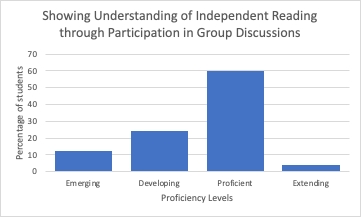
12% of students were Emerging in being able to independently read, listen to or view a piece of text and participate meaningfully in a class discussion. 24% were in the Developing range, 60% were Proficient and 4% were Extending.
Students also self assessed their learning at two points in the school year around the Curricular Competency of Exchange ideas and perspectives to build shared understanding.

In September, students were surveyed about the statement, " I talk to my classmates about what I read." At the start of the school year, 46% of students in the cohort stated that they did not like to talk about what they read, 54% stated that they liked to talk "a little bit" about what they read with their peers, and 0% fully agreed with the statement that they liked to talk about what they read with their peers. In June, the numbers had changed. 4% said that they did not like to talk about what they had read with their peers, 42% stated that they liked to talk "a little bit" about what they read with their peers, and 54% now enjoyed reading and discussing what they had read with their peers.
In addition, we've worked hard to instill a love of literature and text in our students connected to the Big Idea of Language and Text can be a source of joy and creativity. Our school library, a hub of learning and collaboration in our school, has been a busy place. The teacher-librarian has seen a shift in enthusiasm and a thirst for reading. She has found students to be clamouring for new diverse texts, placing holds on titles and waiting patiently for their turn to read the coveted selections. The teacher of the cohort has said, “The students are now excited to go to the library to exchange their books. The kids are asking for books by genre. Many of them want to read biographies.”
Students completed an inventory assessing their attitude and behaviour in engaging in reading in September and in June. The following graph summarizes the responses.
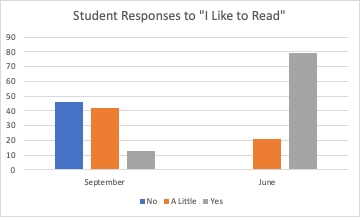
In September, in response to the statement, "I like to read," 46% said no, 42% said "a little" and 12% said yes. The numbers changed in June. In response to the same statement in June, 0% responded no, 21% responded "a little" and 79% said yes.
For Further Exploration
Oral language skills are at the heart of and provide the foundation for word reading and comprehension. We will be continuing to build a community of readers as a school, with teachers modelling a positive reading identity by sharing their reading preferences and by fostering rich conversations about text.
It is essential for our students’ social, emotional and academic success to have a proficient understanding of how to meaningfully use language to express themselves in conversations that share, listen, and build on each other’s ideas. By viewing themselves as active participants in the construction of knowledge through deep conversations, students will know that they and their ideas matter, their ideas are valued and that they belong.
Our focus will remain on the Communication Competency and we will further explore
- students engaging in informal and structured conversations across all disciplines in which they listen, contribute, develop understanding and relationships, and learn to consider diverse perspective
- developing conversations across all disciplines which affect the building and sustaining of relationships peer to peer and across the greater school community
Surrey Schools
Formed in 1906, the Surrey School District currently has the largest student enrolment in British Columbia and is one of the few growing districts in the province. It is governed by a publicly elected board of seven trustees.
The district serves the cities of Surrey and White Rock and the rural area of Barnston Island.