Mountainview Montessori 25-26

OUR CONTEXT

In our Montessori school we learn together peacefully and responsibly by caring for each other and the world
At Mountainview Montessori, we value Maria Montessori’s view of education as a process of involving the whole child, and one that respects each child's uniqueness. The aim of the Montessori philosophy is to provide a learning environment that enhances the development of intellectually reflective individuals who are caring and ethical members of the community. Additionally, we teach the importance of leadership, freedom and independence that is bound by respect for others and responsibility towards the environment. Solving problems in peaceful ways is encouraged daily at our school, in the classroom, on the playground, and in all aspects of our lives. Grace and courtesy are key components of the Montessori approach, and children have many opportunities to demonstrate this both in their classrooms and out in the school community.
The role that parents play is key in our Montessori community. The relationship and partnership between home and school is vital to the success of every child.
Maria Montessori: A Pedagogical Anthropology
Maria Montessori’s philosophy of education, with all its vitality and vision, is the foundation of our Surrey program, founded in 1981. Maria Montessori viewed education as a process involving the whole child, respecting their uniqueness and ability to shape their own future.
It is the task of the teacher to create an environment which is most favourable to the enhancement of concentration, and to provide the child with the means with which to educate themselves. Any unneeded help can be considered a hindrance to the student’s learning. This requires that the teacher get to know each child and assist them at their own rate of progress. For this reason, children usually spend three years with the same teacher although both class size numbers and grade groupings can look different as we work within the public school system.
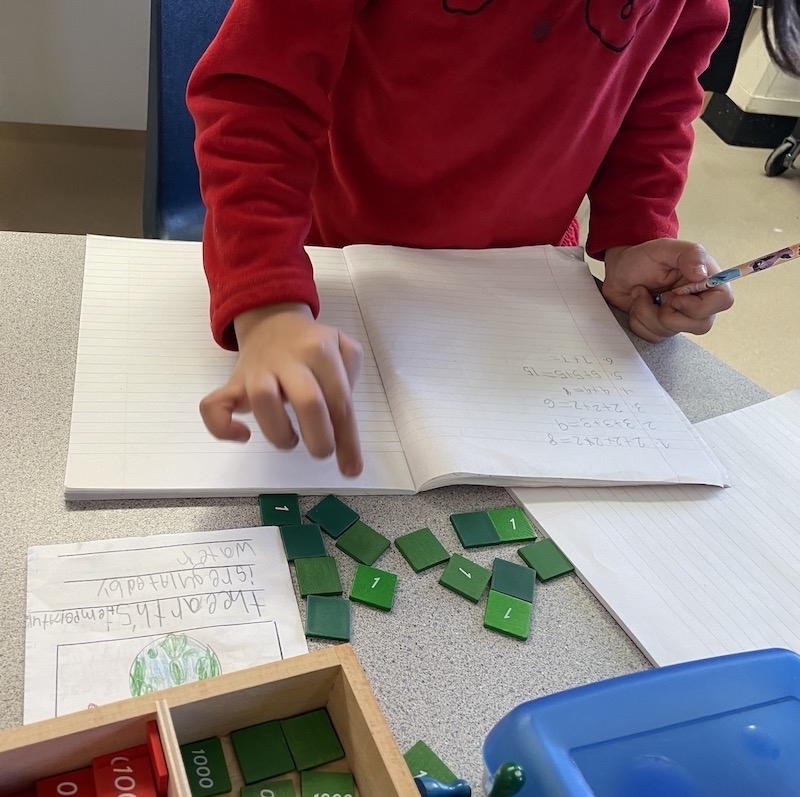
The Montessori materials in the classroom enable the child to take advantage of sensitive periods for the acquisition of skills and knowledge. Classroom materials stimulate the child’s reasoning and imagination, prompting them to connect the concrete, sensory world to the realm of the abstract. Once the child has mastered a particular task, they are guided to a new area of learning to explore in further depth through independent study. This new learning follows the interests of the child and activities are based through their wonders.
The curriculum has an integrated approach, with the child learning first about the unity of the universe and then focusing on its constituent parts. Teachers follow Maria Montessori’s guidance to, “follow the child” in curriculum design and implementation. We are a hybrid of Montessori and public education and ensure the requirements of B.C. curriculum are reached.
Although freedom and independence are cultivated, the child learns that their liberty is bounded by respect for others and responsibility towards their environment. The child’s integration in a multi-age group fosters an interdependent disposition which leads to the goal of becoming peaceful people.
The Montessori program places an emphasis on respecting and caring for the environment. A global viewpoint is encouraged, and Montessori teachings support an appreciation of diversity and interdependence of people and the natural world.
OUR LEARNERS

At Mountainview Montessori our learners feel safe and supported. We build connections, trusting relationships, and safe learning environments in order to engage in deep, reflective learning. We care and respect our environment, and each other with an appreciation of diversity and the interdependence between people and the natural world.

Our school has identified numeracy as an area of growth for our students.
FSA results at both the grade 4 and 7 level, have seen a decline in students on track or extending over a period of three years. While overall results are above district and provincial averages, we determined this an area of growth for students.

Through a Spirals of Inquiry process in the Spring of 2026, our staff began to look deeply at the areas of strength and areas for growth of our students in numeracy.
Primary teachers identified areas of strength in numeracy as:
- using hands on materials to solve problems
- growth mindset and curiosity
- love for math
- group work
- teaching others
- accessing and applying prior knowledge
Intermediate teachers identified areas of strength in numeracy as:
- place value
- patterning
- graphing
- number sense
- using hands on materials to solve problems
Primary teachers identified areas for growth in numeracy as:
- not checking work/rushing
- number formation
- multi-step problems
- language barriers/lack of math vocabulary
Intermediate teachers identified areas for growth in numeracy as:
- showing their thinking
- multi-step, language based problems
- recall of basic math facts
- lack of math vocabulary
- mental math strategies
In addition, through observation and the results of a school wide assessment in understanding of math vocabulary, we identified our focus areas moving forward.
Math Vocabulary Assessment- Spring 2026
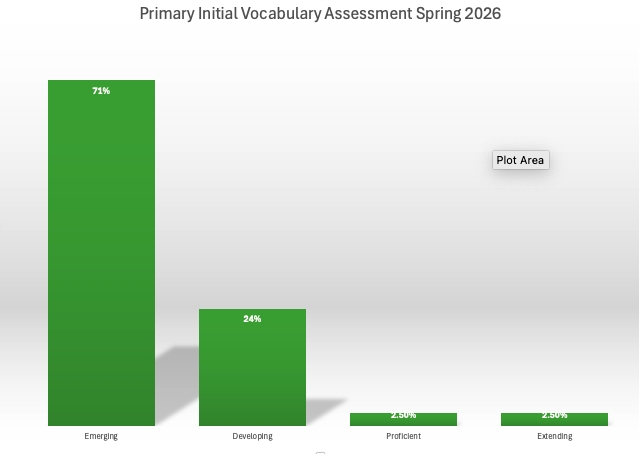
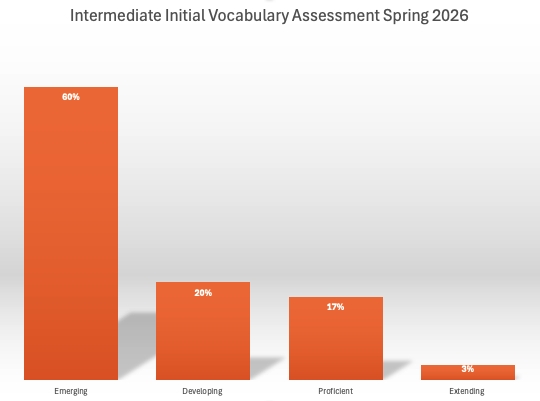
The results of the vocabulary assessments indicate that students have a limited understanding of mathematical vocabulary, highlighting this as a key area for growth.
OUR FOCUS
OUR FOCUS
At Mountainview we have both a core competency focus on our student's Social Emotional Learning (SEL), specifically in the area of Social Awareness and Responsibility and a curricular focus in numeracy. This work is paired with work around Racial Equity as our SEL and Racial Equity leads work together.
As a small school community, both our SEL and Numeracy cohorts are school-wide.
1. Social Awareness and Responsibility
Social Awareness and Responsibility involves the awareness, understanding, and appreciation of connections among people, including between people and the natural environment. Social Awareness and Responsibility focuses on interacting with others and the natural world in respectful and caring ways. People who are socially aware and responsible contribute to the well-being of their social and physical environments. They support the development of welcoming and inclusive communities, where people feel safe and have a sense of belonging.
A socially aware and responsible individual contributes positively to their family, community, and environment; empathizes with others and appreciates their perspectives; resolves problems peacefully; and develops and sustains healthy relationships.
In order to develop personal awareness and responsibility in our students, we are focused on developing the following areas:
- identifying student personal values and strengths and abilities to determine ways they can contribute to their communities and care for the environment
- demonstrating curiosity about their natural world by experiencing and interpreting the local environment
- recognizing our shared responsibility for the local environment
- caring for self, others and neighbourhood through personal or collective approaches
- self-regulating to resolve problems
- developing understanding of how relationships and cultural contexts shape who we are and how we build relationships with others
To support our SEL goals, we implemented the following during the 2025-2026 school year:
- continuing to support the use of 7 Sacred Teachings language school wide. This year, divisions have paired up and create/invite all classes to participate in a school wide activity or assembly focusing on a specific teaching.
- continued implementation of Second Step in all classrooms grade K-7.
- SEL lead implemented a picture book share and rotating discussion series for all K–7 classes, featuring books that explore both social-emotional learning and racial equity themes.
- SEL and Equity lead work together on common themes, holding regular meetings inviting all staff to participate.
- Applied for and awarded BC Parks grant to enhance the biodiversity of our school grounds. As part of the grant, adding 4 additional garden boxes planted with pollinator plants to attract bees and birds. We now have a total of six vegetable garden boxes, six Indigenous plant boxes, and 4 pollinator plant boxes. Students are engaged in learning about the traditional indigenous uses of plants, deepening their understanding of local ecosystems and cultural knowledge.
- Invited parents to take part in Family Wednesdays and other classroom or out‑of‑class events.
- Explored ways to use the district’s loose‑parts materials to support SEL and Racial Equity activities
- establish a partnership with our secondary school by inviting secondary students to visit our classrooms to deliver lessons and presentations on racial equity issues.

2. Numeracy
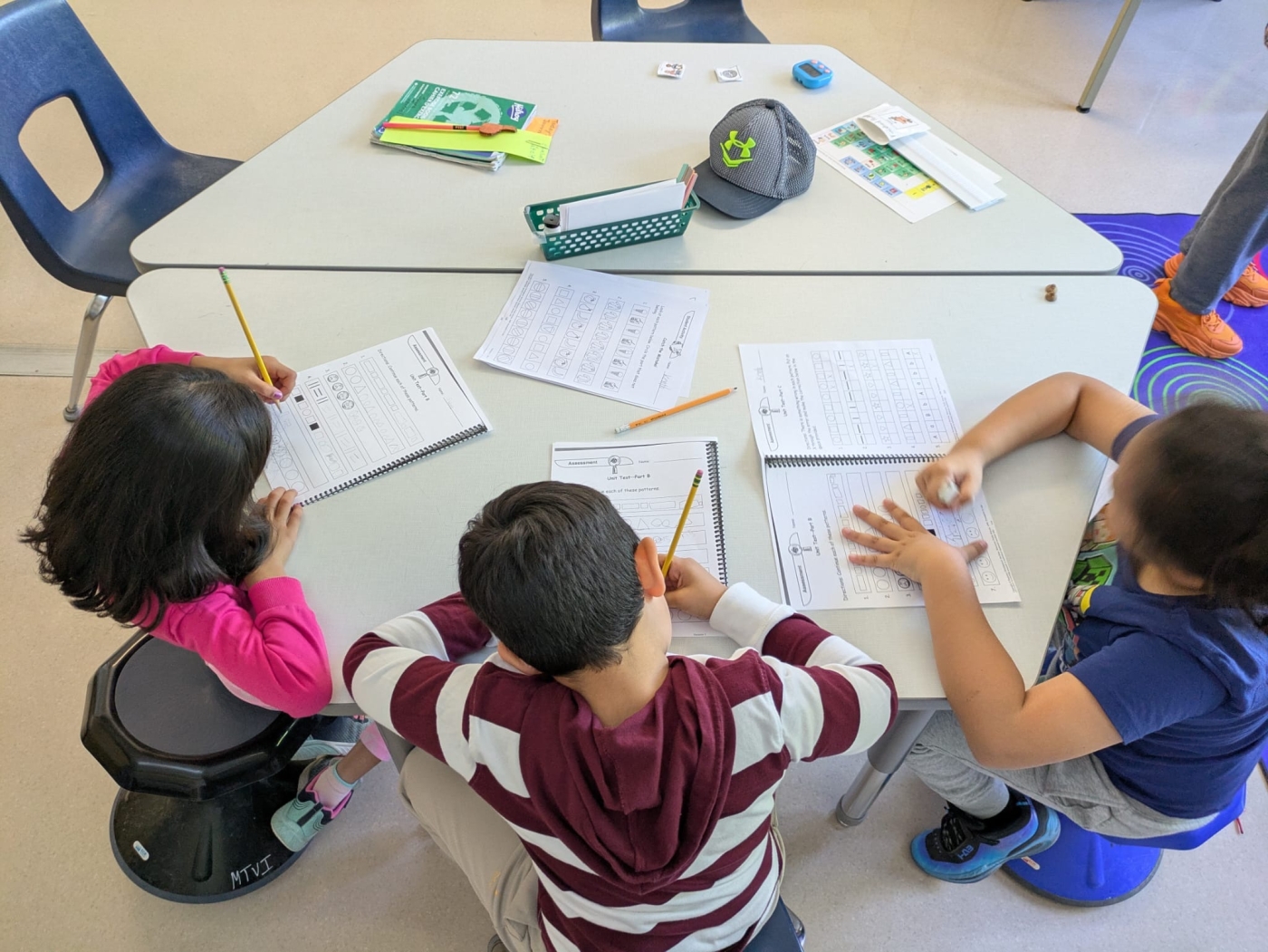
The BC Numeracy Competencies emphasize students’ ability to interpret, apply, and communicate mathematical concepts in order to solve real-world problems.
Research shows that a strong understanding of math vocabulary is essential for solving word problems. When students understand key terms, they can connect language directly to mathematical operations, reducing cognitive load and allowing them to focus on problem-solving strategies. A strong vocabulary also helps students interpret context, select appropriate approaches, and clearly explain their thinking. As a result, math vocabulary development is a critical factor in improving both problem-solving ability and overall mathematical understanding.
Inquiry Question:
How can students develop and use multiple strategies to solve mathematical problems while also building mathematical vocabulary and language to explain their thinking?
OUR NEXT STEPS
SEL Focus:
Our work in social-emotional learning (SEL) will continue into the 2026-27 school year, as we recognize that this is a long-term commitment essential to student well-being and success.
We will:
- amplify our Seven Grandfather's Teachings principles work and deepen student engagement, by continuing with student-led assemblies and/or activities to ensure that key messages are reinforced consistently across both school-wide and classroom settings, fostering a stronger and more cohesive learning community.
- continue with the support of our SEL and Racial Equity Leads.
- continue to develop our school Peace Garden as a place for reflection, quiet and gardening.
- expand our classroom SEL book rotations to include inclusive literature, facilitating classroom discussions around identity and justice, and providing professional development to support staff in creating equitable and emotionally supportive learning environments for all students.
- continue the collaborative work with Johnston Heights Secondary staff and students to deliver lessons and presentations on racial equity issues and strength this relationship moving forward, as part of our ongoing commitment to equity and inclusive education.
- expand our use of the district Belonging Calendar by creating a bulletin board that will display all upcoming celebrations, significant holidays for all our students. This work will be a partnership between our Child Care Worker, SEL and Racial Equity Leads, primary students and the intermediate student leadership team.
- continue to develop our school garden and our work to increase biodiversity in the space by introducing features that actively attract and support native pollinators.
Numeracy:
We have identified problem solving as our key focus and with that the development of student math vocabulary. To support this goal over the coming year, we will:
- provide each class with a word wall of math vocabulary.
- in classrooms, purposefully introduce words to add to a math word wall in coordination with the units they are currently studying.
- assess students in the Spring to monitor progress.
- introduce a primary and intermediate work problem challenge each week.
- provide lunch and learn opportunities for staff in the area of numeracy by enlisting the help of our District helping teachers and our school Montessori trained teachers.
- apply for the Math Matters district initiative for the 26-27 school year.

Surrey Schools
Formed in 1906, the Surrey School District currently has the largest student enrolment in British Columbia and is one of the few growing districts in the province. It is governed by a publicly elected board of seven trustees.
The district serves the cities of Surrey and White Rock and the rural area of Barnston Island.