McLeod Road Traditional

OUR CONTEXT
WHAT IS OUR LEARNING CONTEXT?
McLeod Road Traditional Elementary School is proud to sit on the unceded, traditional territory of the Katzie, Kwantlen, and Semiahmoo First Nations and other Coast Salish Peoples. We are grateful to come to school each day to work and learn in this beautiful place. We are committed to learning about this place and we are learning to be stewards of the land.
McLeod Road Traditional, commonly referred to as MRT, is a choice program in the Surrey School District. We offer a unique learning experience to our students. Parents choice this "traditional" program for their children. We are a small school that is located in one of the largest school districts in Canada. The smaller size of our school contributes to it's unique culture. At MRT, students feel a sense of community and belonging. This is also due to the fact that we wear a school uniform. Many students love wearing their uniform and feel a sense of pride when wearing it. Our community is very stable with most staff and families returning to MRT year after year. This creates a strong, trusting relationship between students, staff, and parents.
The parent community at MRT is very supportive and respectful of the work we do at school. Even though students come from all over Surrey to attend our school... we feel like a family!
OUR LEARNERS
WHO ARE OUR LEARNERS?
Social Emotional Learning is an integral part student learning success. The well being of our students is important for focus and self regulation. Self-awareness, self-management, responsible decision-making, relationship skills, and social awareness are the skills that students are developing to ensure success in school, work, and life. Our students have demonstrated success in the areas of Social Awareness and Responsibility and Personal Awareness and Responsibility both under the Personal and Social Core Competency.

Our Learners understand and demonstrate the skills of Social Awareness to ensure that the learning environment is orderly and respectful to all learners and people within our building.
These skills transfer into life outside of school where appropriate behaviours for various settings are acceptable.

This chart was co-created by staff. .....Why? These behaviours were explicitly taught in all classrooms and reviewed at school wide assemblies through role plays and discussions. Students themselves have commented on how it is "easier to focus in the assemblies"and "I can hear better what the person is saying" Time spent on behaviour management has decreased and assemblies are more efficient and and run smoother. The hallways are more orderly and students have learned to be respectful to other learners and have been observed reminding others of what is appropriate. Our learners have increased their awareness of appropriate expectations in the washrooms and are reporting behaviours that they know are not acceptable. During recess and lunch, students are observed being responsible with the equipment both inside and outside. Staff have also commented on the positive effect of this school wide initiative.
Our Learners can demonstrate personal awareness by describing their emotions in many ways.
Students have been learning and expanding their vocabulary to express their emotions and feelings. All classrooms have been working through The Zones of Self-Regulation, by Leah Kuypers. Children are learning to recognize when they are feeling disregulated (in the yellow or red zone) and they are learning strategies to become regulated so that they are calm and ready to learn.
Why is self-regulation important for academic success?
Research tells us that regulated children are ready to learn. Children who are struggling with their social and emotional well-being are also going to struggle with academic learning. We are explicitly teaching SEL skills so that our students can experience academic success.
Why we are focusing on literacy as our school goal.
We want every child who attends MRT to be working at a proficient level for their grade in reading and writing. Literacy skills are foundational for all students to experience continued academic success in elementary school and beyond. Our goal is to ensure that every student leaves MRT ready to face the challenges that lie before them; in their education and their lives.
We know that out of our total school population of 209 students, 170 students speak a language other than English at home. Our students are lucky to be proficient speaker of more than one language but we do wonder how, if at all, this affects their learning. Our recent FSA (Foundation Skills Assessment) results show us that our students are generally doing well in numeracy but they find the literacy portion of the assessment more challenging. We would like to see if this focus on literacy skills will help to improve our FSA results over the next three years.
Languages Spoken at home other than English:

OUR FOCUS
WHAT IS OUR FOCUS?
Within each classroom at MRT, SEL is incorporated into different areas of the curriculum on daily basis. Students are involved in classroom discussions, problem solving, exploring literature, writing, role playing, and art. Read alouds of SEL themed books start the discussion with related activities. Some classes have a daily student check-in of the zones, morning soft starts, or a space to calm down. The Zones of Regulation, by Leah Kuypers, is a resource used in all classrooms to learn about self-regulation and emotion control. Lessons in this resource introduce the zones of regulation with the associated feeling/emotions, provide role-playing opportunities and scenarios, build understanding of different perspectives, explore sensory support tools for calming, and create individual tool boxes.
Now that our students have the ability to regulate their feelings and emotions, we want to understand how this affects our students' academic success. We have chosen to gather data on literacy skills in term one and again in term three so that we can measure learning over time.
Literacy is a fundamental skill which supports meaningful interaction with learning across the curriculum. It is the ability to read, write, speak, and think in a way that lets us communicate effectively and engage with the world around us.
What are the literacy goals at MRT?
- Students will demonstrate the ability to decode and comprehend grade level texts (both fiction and non-fiction).
- Students will demonstrate the ability to communicate ideas orally and in writing for different audiences and for various purposes.
A First Peoples Principle of Learning connection:
We believe that our literacy goal connects with two first peoples principles of learning.
1. Learning is embedded in memory, history and story. This principle connects to our reading goal. We learn about the world and our history through reading fiction and non-fiction texts.
2. Learning requires exploration of one's identity. This principle connects to our writing goal; particularly personal writing which helps our students learn about themselves and their identity.
OUR NEXT STEPS
WHAT ARE OUR NEXT STEPS?
MRT students will continue to develop their Social Emotional Learning skills and capacities More specifically, our students will continue to build on the Personal and Social Core Competency: sub-competencies of Personal Awareness and Responsibility; and Social Awareness and Responsibility.
As we continue with this work, we will build on it in the following ways. Self-Regulation lessons will continue throughout all classrooms, and this learning will extend into the facets of Self Advocating and Well-being, as well as Building Relationships and Resolving Problems.
- Self advocating
- Well-being
- Building positive relationships
- Resolve problems peacefully
In order to determine if our SEL skills are helping us with our school literacy goal, we are collecting data on reading and writing for each student. Students will be assessed using a proficiency scale.

Literacy Goal #1
We will assess reading skills using the Fountas and Pinnell reading assessment to measure our first literacy goal:
- Students will demonstrate the ability to decode and comprehend grade level texts (both fiction and non-fiction).
Fall Reading Assessment:
Cohort 1
In this intermediate class, 28 student were assessed in reading. The students were given a mark on a proficiency scale.
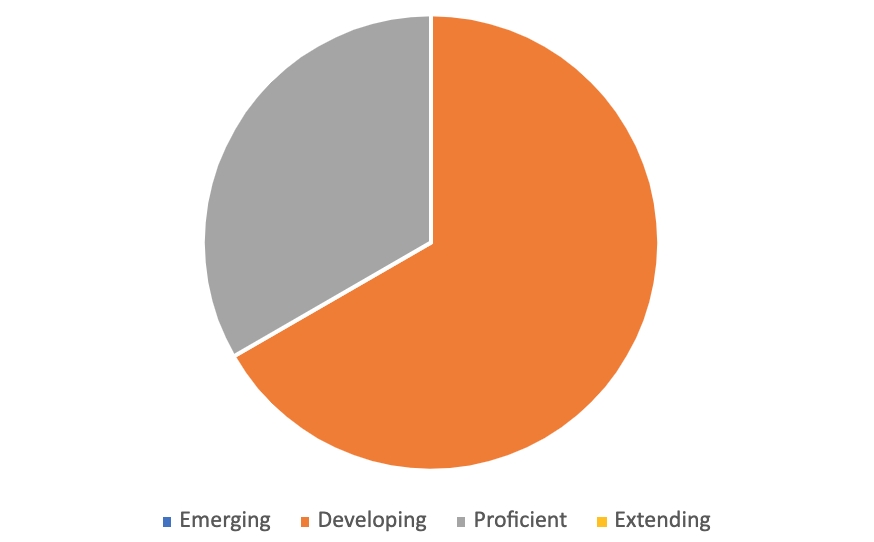
You can see that in this intermediate class, most of the students (18) are developing in their reading ability in term one while 9 students are proficient in their reading. In order to reach proficiency at this grade level, abstract thinking skills need to be strongly developed. Due to the fact that many of our learners are ELL students, we notice that it becomes more difficult to reach proficiency at this level.
Cohort 2

In this primary class, many students are extending in their reading ability for the beginning of the year. There are a number of students who are proficient but many students are still in the emerging or developing categories. This class of learners is well on their way to reading success!
Literacy Goal #2
Our school has also made a commitment to measuring our second literacy goal (see below) by completing a "school-wide write" twice a year. This writing sample will be assessed using the BC Performance Standards.
- Students will demonstrate the ability to communicate ideas orally and in writing for different audiences and for various purposes.
Fall Writing Assessment:
Cohort 3
In this class, 20 students were assessed using the BC Performance Standards rubric. The students participated in a school-wide writing activity that was designed to collect data on personal writing skills.
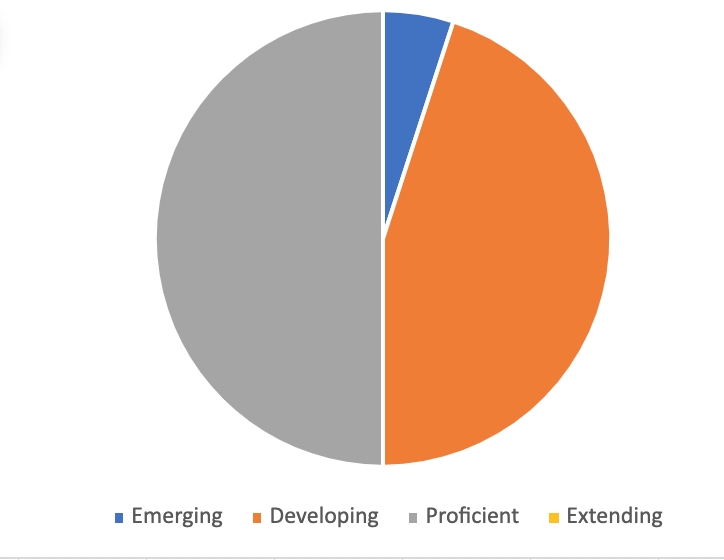
The data tells us that half of the class is proficient in writing for their grade level. One student is at an emerging level and almost half of the class is at a developing level for their grade level at this time of year. This data guides our teaching. As educators, we regularly ask ourselves:
"What do they know?"
" What do they understand?"
"What can they do"
"Where do I need to go next in my teaching?"
The staff at MRT strive to ensure that every learner is working to the best of their ability.
As our school mission statement states... "Children are our future."
.
Surrey Schools
Formed in 1906, the Surrey School District currently has the largest student enrolment in British Columbia and is one of the few growing districts in the province. It is governed by a publicly elected board of seven trustees.
The district serves the cities of Surrey and White Rock and the rural area of Barnston Island.