M.B. Sanford Elementary 22-23

OUR CONTEXT
OUR LEARNERS
Numeracy is a universal language that allows for exploration and interaction with the world. We use quantifiers, shapes, and patterns to make sense of the world and we apply mathematic skills to solve problems and communicate ideas. At MB Sanford, we believe that students develop confidence when they successfully engage with their world and so students are supported to find mathematic concepts in their everyday life and share their observations.
Students are challenged to communicate their mathematical observations and thinking when solving problems. Our students recognize that math is more than numbers, symbols and calculations. These concepts are tools providing them agency, to engage in their world and with each other by solving problems and communicating solutions.
Our learners can connect math concepts to the environment.
Our learners can apply their mathematical thinking and skills across the curriculum.
Our learners can apply their mathematical reasoning in play.
OUR FOCUS
Student communication in numeracy is essential in assessing their understanding of the concepts. Students were engaged in structured learning experiences that scaffolded their ability to communicate their learning with spoken language in order to express, describe, and explain their mathematic ideas.
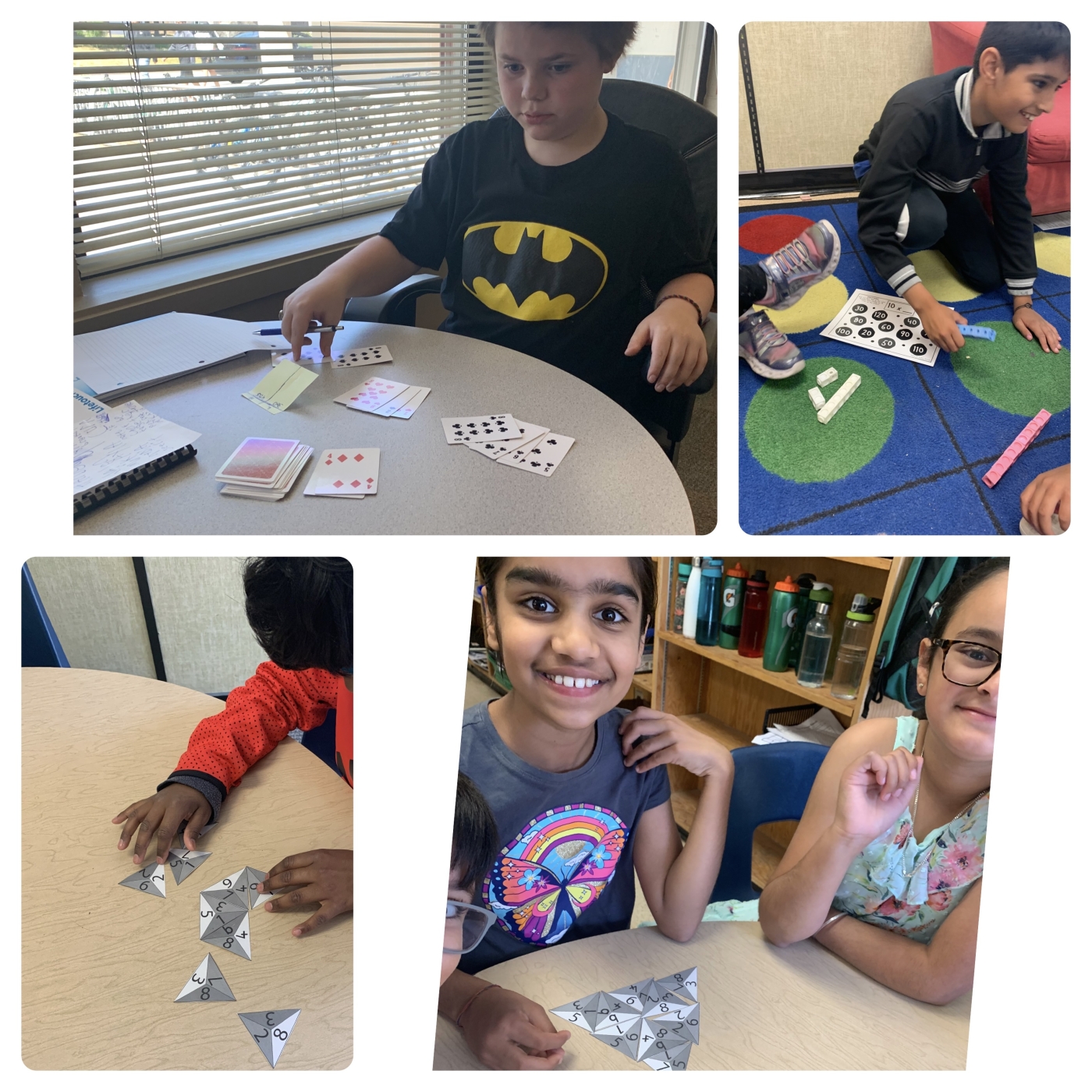
Early intermediate students were engaged in daily routines that provided ample opportunity for students to socialize and collaborate with their mathematic learning. Dialogue was increased by participation in small group instruction, math games, puzzles, technology, and collaborative problem solving were instructional strategies used to encourage dialogue. Math concepts became conversation topics and students participated in daily math talks where they were supported in how to analyze problems, describe their observations, explain estimation strategies, and challenge solutions. The social nature of the learning experiences enhanced skill development because students were learning from each other as well as from the teacher.
OUR NEXT STEPS
All of the students experienced success with their ability to communicate their ideas and observations in numeracy. A common response of “I don’t know” became replaced with observations of what students did know. Students were not willing to participate in class discussion unless they were confident they had the “right” answer. Now students recognize that they don’t need the final answer to participate and are willing share any observation or question. The two or three regular hands raised were replaced by the majority of class confidently signally they had an idea or question to contribute.
Students demonstrated Proficiency in the Curricular Competency of communication by:
- asking relevant questions connected to the concept being explored.
- identifying relevant observations required to make sense of the problem at hand.
- articulating math ideas with complete explanations
- influencing the direction of lessons and contributing to the ideas of others.
At the beginning of the year all students required structured scaffolding and modelling by the teacher. Our most recent assessment shows that the student independence and proficiency in communication has progressed by the following percent:
Questioning | All students demonstrated a grade level ability to ask questions, with 29% making a significant shift in their proficiency. |
Providing Observations | All students demonstrated a grade level ability to communicate mathematic observations connected to content being explored. |
Explanation and Justify ideas | 79% of students demonstrated the ability to provide explanations to their thinking when problem solving. |
Connecting mathematical concepts to each other | Growth was made in every students' ability to contribute mathematic ideas when problem solving, 54% of our cohort demonstrated grade level proficiency with this competency |
One student with an Individualize Education Plan made significant personal growth both with his Curricular goals and those for Communication and Socialization. In previous years this student worked independently and relatively in isolation by completing a workbook pages at his own pace. His answers were marked and he was rewarded for effort and his corrections. When interviewed early in the year, he shared how much he hated math. “It’s boring. It’s just the same thing over and over.” His learning previous to this year had been simplified to written responses where he demonstrated an acquired skill multiple times. Because of this rewards were used to bribe him to participate and complete his learning.
Since the beginning of this year’s use of social games and collaboration very few rewards have been needed. He was hesitant at the beginning to believe that the observations he made were helpful. He was reluctant to join in and participate and preferred watching his peers before getting involved. While he is still working on different level of concepts, he is now participating daily in all the numeracy routines. He is able to describe mathematic observations and communicate the concepts he has mastered.
While he would like me to report, he still doesn’t like puzzles because they feel like tricks, he finds math fun cause he can do it with his friends. Seeing him interact, laugh, and smile during instructional time is a substantial success.
Another student who shared she loves math, but also finds it boring when the work is easy. “I don’t like having to do lots of the same question over and over.” Confident with the math skills being taught, she often completed her work and then socialized with others, getting off task and often reprimanded. Math became a time that was difficult to stay out of trouble. With the new math routines, the desired social interaction is embedded into the activity. She was able to engage with peers, but in a productive manner. She was observed coaching other students along as a means of communicated her own understanding. This higher level of mathematic communication is not available with independent paper and pencil tasks.
Moving forward we will:
- continue to provide learning opportunities that allow students to engage socially with mathematic concepts and share their thinking verbally.
- develop students’ mathematical vocabulary to enhance their discussions and questions.
Surrey Schools
Formed in 1906, the Surrey School District currently has the largest student enrolment in British Columbia and is one of the few growing districts in the province. It is governed by a publicly elected board of seven trustees.
The district serves the cities of Surrey and White Rock and the rural area of Barnston Island.