Maple Green Elementary 25-26

OUR CONTEXT

At Maple Green, we take pride in building a strong sense of school culture that includes the greater community to provide authentic and meaningful learning opportunities for our students. We engage in collaboration in a variety of ways, and seek participation from our families and the greater community.
At Maple Green, we understand that learning happens within a social context, and that there is a cultural component of knowledge. With the support of our PAC, we continue to seek ways to highlight cultural celebrations, and honor cultural knowledge from those within our community. We acknowledge that there is no one way to do anything, and the more opportunities we have to learn from people who are different than us, the more we will learn about the world, and ultimately ourselves.
Please see the following highlights of our learning community...
SOCIAL EMOTIONAL LEARNING
We are proud of our focus on social and emotional learning and how we integrate these concepts into our daily routines, curriculum, and school goals. Some examples of our focus on Social Emotional Learning include: our positive behavioural support plan, evidence-based SEL programming, and monthly virtues with .

IDENTITY AND SENSE OF BELONGING
Our identity as grizzlies is used as a tangible metaphor for the qualities we want to celebrate within our community.

MONTHLY ASSEMBLIES
We gather as a learning community at the end of each month to highlight learning, cultivate student voice, focus on SEL themes, and celebrate student successes. Students are the focus!

ENCOURAGING POSITIVE BEHAVIOUR
Our goals for positive student behaviour are rooted in RESPECT: respect for ourselves, respect for one another, and respect for our environment. Guided by the district’s Racial Equity Strategic Plan, we are committed to creating a school where every child and family feels valued, included, and supported. Our motto, “Where Everyone Belongs,” reflects our belief that belonging should be more than words — it should be something every student experiences each day through caring relationships and meaningful support systems.
Students are acknowledged with a "Maple Green Award" slip by a staff member when they are noticed demonstrating this positive behaviour. Students then enter these feathers into a draw box for a chance to win gift cards on the last day of each week. Thank you to our PAC for supporting this initiative by providing the gifts cards each week!

STUDENT LEADERSHIP
Our school offers multiple access points for all students to contribute based on interests and strengths (social responsibility). Student leadership opportunities include: lunch monitors, tech helpers, fundraising, communication team, big buddies and recycling team.

EQUITY, DIVERSITY, & BELONGING COMMITTEE
At Maple Green, we celebrate our diversity and encourage conversations that promote and discuss equity and inclusion. Staff meet to plan ways to integrate the district's Equity, Diversity, and Belonging calendar, and to ensure students see themselves in the learning and celebrations happening in the school.

OUTDOOR LEARNING
Outdoor learning opportunities have beecome heavily embedded in our educational programming here at Maple Green. We are fortunate to have some pockets of natural space including Maple Park which is adjacent to our property. Classes utilize natural spaces around and on our school property to engage in hands-on, place-based learning. Our classes also participate in off-campus excursions to our neighbouring beaches, forests, and even to further destinations like Galiano Island.

INDIGENOUS LEARNING
The First Peoples Principles of Learning are embedded in announcements, assemblies, and classroom activities. At Maple Green, we acknowledge that learning happens in a social setting, is based in relationship, and should reflect the history of the land and its original peoples. All staff are encouraged to explore Indigenous ways of knowing, and to learn alongside their students, inviting authentic resources and voices in to support their work in the classroom as necessary.
Our school is also supported by the District's Indigenous department. We have an Indigenous Youth and Childcare Worker who checks in on students and their academic learning goals. These staff members help to facilitate culturally sensitive and responsive conversations that aim to support our family's needs.
Through participation in a program called Sacred Ties: Indigenous Mentorship & Connection, our grade 4-7 Indigenous students collaborate with fellow peers from Green Timbers, Brookside and Janice Churchill as well as the Indigenous students from Enver Creek Secondary. The goal of Sacred Ties is to create a sense of belonging and inclusion for Indigenous students who will be attending Enver Creek Secondary in the coming years. Students will have the opportunity to participate in activities and recognize the pivotal role of education in fostering their success.

PAC
Our dedicated and involved parent community actively fundraise to support learning opportunities for students throughout the school year. Without the support of our PAC, many of our amazing learning opportunities would not be possible.

OUR LEARNERS
Our school's focus is: Increasing literacy rates through regular screening assessments and targeted instruction.
We acknowledge that strong literacy skills are essential to student success across all areas of learning, and play a critical role in building confidence, communication, and lifelong learning skills.
Furthermore, we understand that by looking at the science of reading, prevention of reading difficulties is more effective than intervention strategies.
Many of our learners are identified as English Language Learners (ELL) and come to school speaking a language other than English at home. These students bring valuable cultural and linguistic diversity to our school community while also requiring intentional, tiered support to develop English language proficiency. Through targeted instruction, scaffolded learning opportunities, and collaborative support structures, we work to help students strengthen their listening, speaking, reading, and writing skills so they can fully access the curriculum and experience success across all areas of learning.
 Guided by our reading assessment data (FSA and Dibels) we as a school understand the importance of our school’s current literacy focus. Continued emphasis on performing regular screening assessments and evidence-based literacy instruction will likely remain important priorities as the school works toward increasing the number of students achieving “On Track” and “Extending” outcomes in reading.
Evidence-based literacy instruction includes: performing regular reading screeners, decoding and comprehension strategies (UFLI), and collaborative support structures (collaboration with LST, classroom teachers, and home).
Direct Evidence:
1) Explicit and Systematic Instruction using UFLI (Inviting students to look at the structure of words)

2) Heart Words (The blue heart indicates what you can expect to sound out. The red hearts indicates what needs to be memorized in these irregular words).

3) Morphology (Looking at chunks of meaning through a morphological lens).

4) Decodable Readers (Building success in early readers).
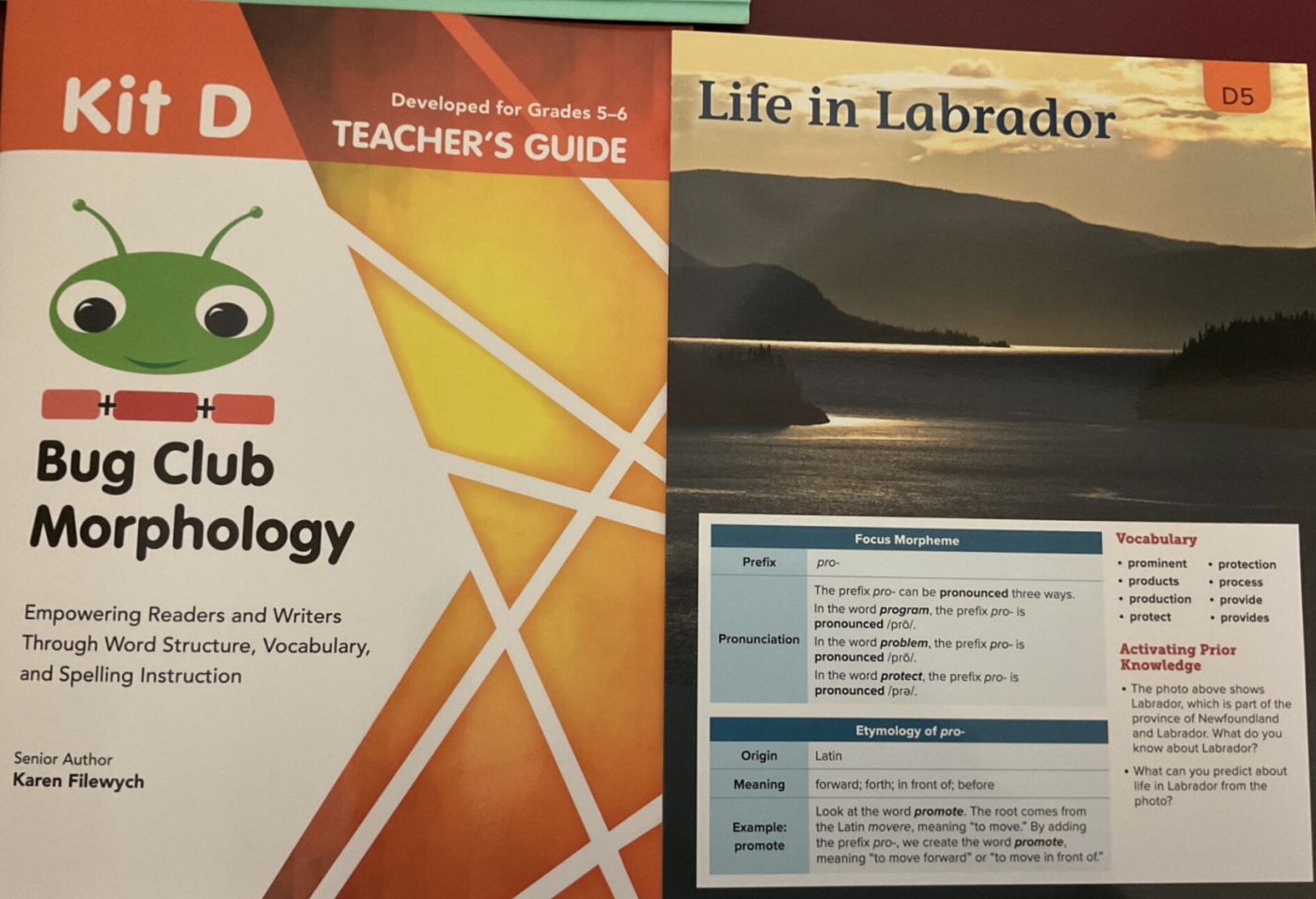
6) DIBELS Grade 4: Progression of Reading

DIBELS Grade 5: Progression of Reading

Overall, the above data suggests that structured literacy instruction and targeted reading support are contributing positively to student growth. Continued focus on evidence-based literacy practices, early intervention, and responsive instruction will remain important to support students in reaching grade-level expectations and strengthening long-term reading success.
Indirect Evidence:

Students in Grades 4 and 7 engaged in a "Student Reading Engagement Survey" which helped us to collect valuable indirect evidence related to literacy development and reading culture at Maple Green.
Overall, the results suggest that Grade 4 students demonstrate stronger engagement, confidence, and participation in reading-related activities than Grade 7 students. This pattern aligns with broader educational trends showing that reading enjoyment and engagement often decline as students move into the intermediate years.
One of the strongest findings is that Grade 4 students report high levels of enjoyment and participation in reading at school. Their responses suggest that many younger students see themselves as readers, participate actively in school reading programs, and feel positively about their growth in literacy skills. High ratings in areas such as “Enjoy Reading at School,” “Participate in School Reading Programs,” and “Feel Reading Skills Have Improved” indicate that primary and early intermediate literacy experiences are helping students develop confidence and positive reading identities.
In comparison, Grade 7 students reported lower levels of engagement across nearly all survey categories. The most noticeable declines appear in areas connected to reading motivation and reading habits outside of school, such as “Read at Home Regularly” and “Talk About Books with Others.” This may suggest that while many intermediate students continue to develop reading skills academically, fewer are engaging with reading as a personally meaningful or enjoyable activity.
OUR FOCUS
Our school's focus is: Increasing literacy rates through regular screening assessments and targeted instruction.
We acknowledge that strong literacy skills are essential to student success across all areas of learning, and play a critical role in building confidence, communication, and lifelong learning skills.
Furthermore, we understand that by looking at the science of reading, prevention of reading difficulties is more effective than intervention strategies.


Looking at historical Literacy data of the Foundational Skills Assessment (FSA) for Maple Green, our scores suggests that our school experienced a significant decline in reading performance following the pandemic years, followed by a gradual recovery trend over the past three years. While there are encouraging signs of improvement, the data also shows that a substantial proportion of students continue to perform in the “Emerging” category, indicating the need for continued focus on foundational literacy instruction and targeted intervention.

Grade 4 students - Reading achievement was very strong in 2020/2021, with 85.71% of students identified as “On Track” and only 14.29% in the “Emerging” category. However, the following two years show a dramatic shift, with the percentage of students in “Emerging” rising sharply to 48% in 2021/2022 and peaking at 61.11% in 2022/2023. This pattern likely reflects the widespread impact of interrupted learning experiences during and following the pandemic. Since that peak, the data shows gradual improvement. The percentage of students “On Track” increased from 38.89% in 2022/2023 to 75.76% in 2023/2024, before stabilizing at 60.71% in 2024/2025 and 41.18% in 2025/2026. Although the trend has fluctuated, the school appears to be recovering from the most significant learning loss period.
For Grade 7 students - Reading acheivement data shows a very similar trend. In 2020/2021, 92.31% of students were “On Track,” with very few students identified as “Emerging.” In 2021/2022, however, the percentage of students in the “Emerging” category rose dramatically to 69.23%. Although the following years show improvement, the data suggests that reading achievement at the intermediate level has remained inconsistent. Encouragingly, the percentage of students “On Track” increased from 30.77% in 2021/2022 to 70.21% in 2025/2026, representing meaningful recovery over time.
Overall - The data supports the importance of our school’s current literacy focus. Continued emphasis on evidence-based literacy instruction, early intervention, decoding and comprehension strategies, and collaborative support structures will likely remain important priorities as the school works toward increasing the number of students achieving “On Track” and “Extending” outcomes in reading.
OUR NEXT STEPS
Moving Forward
- Equip staff with the knowledge of assessment tools to be confident in implementing them
- Educate staff with the ability to identify patterns in student understandings so that areas can be targeted
- Students have the opportunity to build their decoding skills through sequential phonics instruction and access to decodable texts.
- Students have the opportunity to build phonemic awareness skills through explicit practice and frequent instruction.
- Students have the opportunity to practice emergent writing skills through frequent opportunities to draw, write and tell stories through a variety of media.
- Students have the opportunity to build effective writing skills and habits through coordinated school wide writing activities.
- Collaborate with Literacy Helping Teachers to support integrated support for classroom teachers
- Continue involvement in Responding to Readers district program
- Host Lunch & Learns to engage staff in professional learning related to literacy goals

Literacy Framework K-12
Following the Surrey School district's Literacy Framework, we will aim to:
- ensure instruction is responsive to need
- equip classrooms to become literacy-rich environments
- triangulate assessments using a variety of approaches
- embed Indigenous ways of knowing in learning
- place a value on cutivating the joy of reading

Surrey Schools
Formed in 1906, the Surrey School District currently has the largest student enrolment in British Columbia and is one of the few growing districts in the province. It is governed by a publicly elected board of seven trustees.
The district serves the cities of Surrey and White Rock and the rural area of Barnston Island.