Maddaugh Elementary 25-26

OUR CONTEXT
We respectfully acknowledge that Maddaugh Elementary is located on the traditional, unceded, and shared territory of the Coast Salish Peoples, including the q̓ic̓əy̓ (Katzie), qʼʷa:n̓ƛʼən̓ (Kwantlen), and SEMYOME (Semiahmoo) First Nations. We honour the enduring presence, knowledge, and contributions of Indigenous Peoples and recognize the deep histories held within this land. As a learning community, we acknowledge our shared responsibility to listen, learn, and walk with respect. Truth and reconciliation are an ongoing journey, and together we are committed to building meaningful relationships, honouring Indigenous knowledge, and moving forward with care, curiosity, kindness, and a shared commitment to a better future.
At Maddaugh, we are stqéyeʔ—wolf. Being part of the wolf pack means knowing that we belong, that we care for one another, and that we are stronger together than alone. This strong sense of connection and collective responsibility is reflected in our vibrant and diverse school community in the Cloverdale–Clayton area of Surrey, where nearly 600 students bring a wide range of languages, cultures, and lived experiences to our shared learning environment. With more than 38 languages spoken in students’ homes, over 25% of learners designated as English Language Learners, and 5.5% of students self-identifying as Indigenous, our diversity is a defining strength. It informs our deep commitment to equity, inclusion, and culturally responsive teaching, as we strive to honour each student’s identity, language, and culture while fostering a true sense of belonging where every member of our pack is valued and supported to thrive.
Our purpose is to provide a caring and inclusive environment where every learner feels valued and supported to grow academically, socially, and emotionally. Guided by our shared values—Work Hard, Be Kind, Be Your Best You—we cultivate curiosity, perseverance, empathy, and self-reflection in daily practice. Through this, students develop confidence, competence, and a strong sense of identity as learners.
Well-being and belonging are foundational to our work. Using a strengths-based approach informed by positive psychology and the PERMA framework (Positive Emotion, Engagement, Relationships, Meaning, and Achievement), we intentionally nurture students’ capacity to flourish through meaningful relationships, engagement, and a sense of purpose. Social-emotional learning is embedded across the school, supporting both well-being and academic success.

Professional learning at Maddaugh is collaborative and ongoing, with a strong focus on improving student outcomes in Numeracy and Literacy through Math Matters, the Science of Reading, and Responding to Writers. Instruction is guided by Surrey’s Priority Practices and is responsive, inclusive, and student-centered. In the primary years, students participate in UFLI lessons. Across the grades, students use loose parts to expand their imagination and develop their story telling skills.

We value strong partnerships with families and recognize their essential role in student success. Ongoing communication, digital portfolios, and collaborative problem-solving strengthen shared understanding and reinforces a connected school community. Technology is thoughtfully integrated to enhance accessibility and provide meaningful opportunities for students to demonstrate their learning.
Learning at Maddaugh extends beyond the classroom. Students participate in athletics, leadership, the arts, cultural celebrations, and extracurricular opportunities such as Running Club, Chess Club, Knitting Club and student-led initiatives. Students also enjoy a wide range of enrichment opportunities, including student leadership, the Reading Link Challenge, Young Entrepreneurs’ Fair, Be a Giant Program, Junior Canucks Floor Hockey, Hip Hop Dance, Talent Show, Gauss Math Contest for Grade 7 students.


Cultural diversity is a strength of our community, with many languages and backgrounds enriching learning through varied perspectives and experiences. We value and honour the diverse cultures and identities represented within our school and see them as meaningful opportunities to build understanding, connection, and a strong sense of belonging. Learners bring a wide range of cultural and linguistic backgrounds, and we are committed to fostering inclusive environments where every student feels valued, respected, and able to fully engage in learning. Maddaugh is a vibrant mosaic of cultures, identities, and unique strengths; each student contributes important perspectives that enrich our classrooms and strengthen our community.

Students reflect a wide range of languages, including English, Punjabi, Urdu, Hindi, Pashto, Tagalog, Somali, Arabic, Bengali, Dari, Sinhala, Spanish, and Swahili to name a few. Students take pride in sharing their languages and cultural identities, contributing to dynamic discussions that reflect multiple perspectives and deepen learning for all.

Our Indigenous student population has continued to grow, reflecting both demographic changes and increased engagement within our school community. This growth brings important opportunities to deepen culturally responsive teaching practices and expand learning experiences that honour Indigenous perspectives, knowledge, and ways of knowing and being. We are committed to fostering inclusive, meaningful learning that supports the success and well-being of all Indigenous learners while advancing understanding and respect across the school community.
Our connection to the land is an essential part of learning, enriching students’ experiences through outdoor and place-based opportunities. We are fortunate to have access to a forested area behind our school, which provides a natural setting for exploration, curiosity, and connection to the environment. Through our lunchtime Outdoor Learning Club, students engage in hands-on, land-based experiences that foster well-being, environmental stewardship, and a respect for the natural world. These opportunities help students develop observation skills, collaboration, and meaningful relationships with the land.

Learning is further deepened through engagement with Indigenous knowledge holders and community partners, strengthening students’ understanding of place and diverse perspectives. In addition, we are expanding experiential learning opportunities through the creation of a school garden with planter boxes. This initiative will provide hands-on learning connected to science, sustainability, and Indigenous perspectives, further supporting students’ connection to nature and real-world learning.
"I LOVE OUTDOOR LEARNING CLUB! I want them to know you will have a lot of fun your with friends and you get to learn how nature grows and you will find a lot of cool things you might not see in the playground or soccer field. You will also learn how to take care of our environment." - Grade 4 Student.
Environmental and land-based learning are reflected in student-led initiatives such as How to Fall in Love with the Forest, a film festival fundraiser focused on caring for forests, wildlife, and salmon habitats. Supported by Ms. Neva Whintors of Maddaugh and Dr. Cher Hill of Simon Fraser University, students aged 9 to 12 collaborated to create and screen short films inspired by their learning with Elder Rick Bailey from Katzie First Nation partners about restoring waterways and caring for salmon “like family.” Through storytelling, art, and collective action, students were supported by Neva and Cher to organize the event, How to Love a Forest film festival raised $1100 to support creek restoration demonstrating Maddaugh's commitment to environmental stewardship, Indigenous knowledge, and caring for the land. This was accomplished in part by selling t-shirts featuring the designs of Snuneymuxw artist, Ryan Hughes. Viewers can watch the video—particularly at 3:32—to hear about the award Maddaugh received.
The Outdoor Learning Club continues to play an important role in helping students build meaningful connections with the land, water, and one another. Through hands-on experiences and creative projects—like becoming "Keepers of the River," students are developing a deeper sense of responsibility for caring for the environment. This work not only supports environmental stewardship but also strengthens relationships with community partners, including Elder Rick Bailey and Ryan Hughes. By sharing their learning and raising funds to support watershed restoration, students are showing that their voices and actions can make a real difference, both locally and beyond.
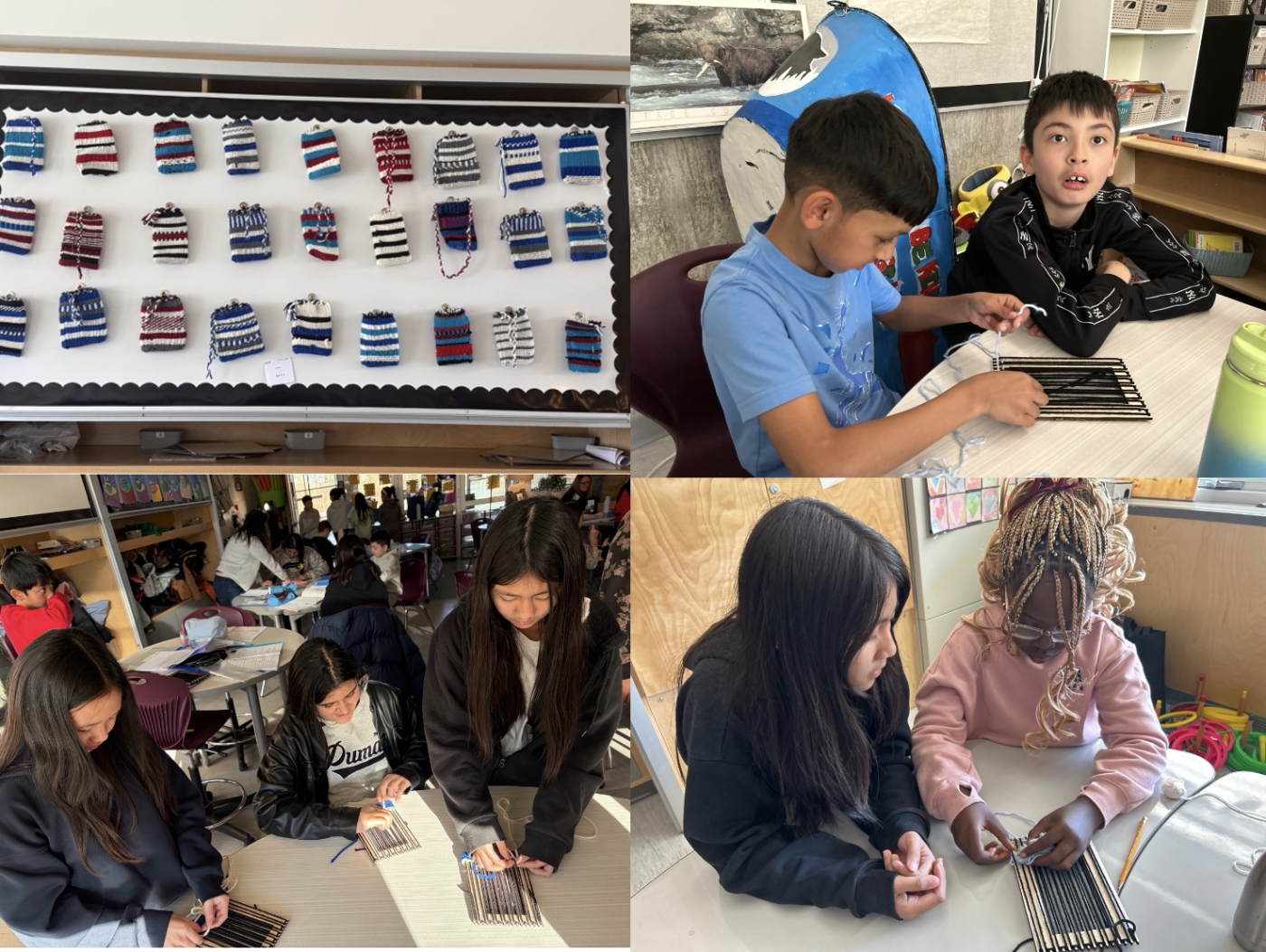
Opportunities to learn from Indigenous knowledge holders are an important part of our community learning. Students took part in hands-on weaving experiences, deepening their appreciation for Indigenous knowledge, craftsmanship, and the importance of honouring traditional practices. Maddaugh Indigenous families, along with others from our neighbouring schools also participated in family weaving session at Maddaugh with Nadine McSpadden from the Secwépemc Nation, creating meaningful opportunities for shared, intergenerational learning.
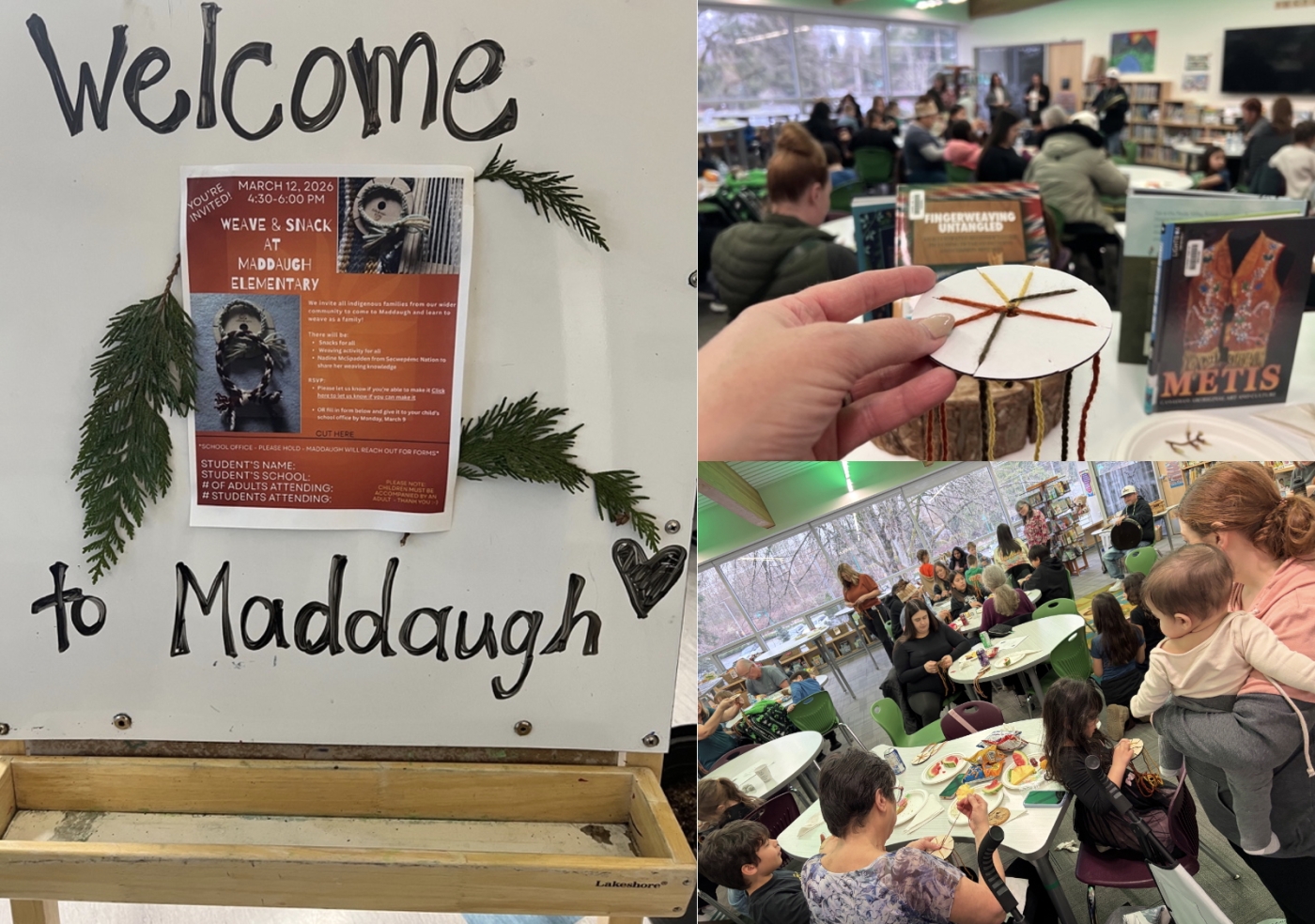
Families are essential partners in our shared learning journey at Maddaugh Elementary. Parents and caregivers are invited to engage through volunteer opportunities, celebrations of learning, sharing cultural knowledge and strengths, and active participation in the Parent Advisory Council (PAC). These opportunities are made possible through strong partnerships between staff, families, and the PAC, which plays an important role in supporting cultural events and fundraising initiatives that enhance student experiences and contribute to our shared school priorities.
Grounded in strong relationships and the belief that everyone has something valuable to contribute, Maddaugh continues to grow as a caring, inclusive, and supportive learning community where all voices are welcomed and respected, and all learners are supported to thrive.

OUR LEARNERS
Maddaugh Elementary is a vibrant and diverse school community where students bring a wide range of languages, cultures, and lived experiences to our learning environment. Our families come from across the globe, with more than 38 languages spoken in students’ homes. Over 25% of our learners are designated English Language Learners, and 5.5% of our student’s self‑identify as Indigenous, including First Nations and Métis. This diversity is a defining strength of our school and informs our ongoing commitment to equity, inclusion, and culturally responsive teaching. We strive to honour students’ identities, languages, and cultures, and to create learning environments where every student feels valued, respected, and supported to thrive.
At Maddaugh, we are stqéyeʔ—wolf. Being part of the wolf pack means understanding that we belong, that we look out for one another, and that we are stronger together than alone. Maddaugh learners value community, teamwork, caring for others, and taking pride in being connected as part of the wolf pack - where everyone matters.
One student said,
“Anybody who is in our school or used to be a part of it will always be stqéyeʔ like here is a saying that I made up “any lone wolves will always be invited to the pack” it means that if there is a new student then they will be welcome at our school.”
At Maddaugh Elementary, our goal is to develop confident, capable learners who demonstrate strong literacy and numeracy skills while flourishing socially and emotionally. Our learners are curious, creative, and active participants in their learning. They are encouraged to ask questions, take risks, and persevere through challenges, developing their strengths, discovering their passions, and learning to use their voices with kindness and confidence. Guided by our shared values—Work Hard, Be Kind, Be Your Best You—students grow both as learners and as individuals, supporting one another and learning together as proud members of the Maddaugh wolf pack.
Students shared,
“Being part of the wolf pack is special because I feel like I have a second family”
“Being part of the wolf pack is that you matter a lot.”
“Being part of the wolf pack is special because I feel like I have a second family.”
“I want others to know that Maddaugh is welcoming and we are all kind and we always persevere.”
Grounded in the BC Curriculum’s vision of developing thoughtful, engaged citizens, we are committed to fostering communication, thinking, and personal and social competencies. We believe students learn best when they feel safe, connected, and empowered to take risks, and when they can make sense of their world through language, number, and relationships. Strong numeracy learning is essential in this work, enabling students to confidently access the curriculum, engage in meaningful problem-solving, and apply mathematical thinking in real-world contexts.
A review of multiple data sources including, FSA results, classroom assessments, and student reflections revealed a consistent pattern: a gap between students’ ability to perform mathematical procedures and their ability to apply those skills in meaningful ways. Staff observations during the FSA supported this pattern: while students were generally successful with straightforward computation, many experienced difficulties with multi-step, real-world problems requiring sustained reasoning. Students also demonstrated limited stamina and hesitancy to take risks without clear procedures.
These findings were reinforced through classroom observations, student voice, and assessment evidence, which showed that students were less likely to persist when tasks required flexible thinking, multiple strategies, and sustained engagement. While students are showing growing confidence and pride in their learning, this evidence highlights the need to further strengthen conceptual understanding, computational fluency, stamina, and flexibility in mathematics.
Literacy data shows a strong and consistent pattern of growth from Grade 4 to Grade 7, with most students already meeting expectations in Grade 4 and an even greater percentage achieving “on track” by Grade 7. This reflects solid foundational skills, growing confidence, and the ability to engage with grade-level texts, as illustrated in the data below.

Numeracy (Grade 4 → Grade 7)
In numeracy, Grade 4 FSA data shows a strong foundation, with a large number of students on track (~59–73%), emerging (12–36%), and extending generally lower (~4–15%). Students are developing their ability to work accurately and flexibly with numbers while beginning to understand underlying concepts; however, they are still building confidence and consistency, particularly when applying these skills to more complex or multi-step problems.
By Grade 7, the data becomes more varied and reveals a broader distribution of strengths. While a significant percentage of students remain on track in earlier results (about 59–73%), more recent data shows a wider spread (approximately 34–63% on track), alongside an increase in both emerging (about 26–49%) and extending (up to 39%) categories. This reflects the increasing complexity of Grade 7 numeracy tasks, particularly those requiring multi-step thinking, sustained reasoning, and application of multiple strategies.
In numeracy, this same cohort highlights an important shift over time. In Grade 4 (2022/2023), approximately 12% of students were in the emerging category; by Grade 7 (2025/2026), this group increases significantly to approximately 49%. While there is also growth in students reaching the extending category and continued strengths in on-track achievement, this increase in emerging learners reflects the growing complexity of numeracy tasks in later grades—particularly those requiring multi-step problem solving, sustained reasoning, and flexible strategy use.
Students are demonstrating growing depth in numeracy, with an increasing number achieving at extending levels in Grade 7. The wider range of results reflects both the increased rigor of mathematical thinking and the opportunity to further support learners in connecting computational fluency with multi-step problem solving and sustained engagement, as illustrated in the data below.

These findings have informed our focus on mathematics, with an emphasis on strengthening students’ critical thinking, reasoning, and ability to apply learning in real-world contexts.
In response, we are developing students’ computational fluency and problem-solving skills through inclusive, strategy-based instruction that values student voice and supports diverse learners. Classrooms emphasize engaging numeracy experiences that promote reasoning, communication, and perseverance. Students actively participate in collaborative learning, discuss strategies, and use tools such as number lines, drawings, and manipulatives to deepen their understanding.
Learning experiences are intentionally designed with multiple entry points, ensuring all students can engage meaningfully, explore a variety of approaches, and build confidence as capable mathematicians.
Mathematical Learning at Maddaugh:
At Maddaugh Elementary, our learners are developing as confident, capable mathematicians who can communicate their thinking, persevere through challenges, and collaborate with others.
Through the Communication Core Competency, students demonstrate that “I can explain my mathematical thinking using a variety of strategies and tools” and “I can connect my ideas with others.”
Through the Thinking Core Competency, students show that “I can make sense of problems and persevere in solving them” and “I can use multiple strategies and approaches.”
Through the Personal and Social Core Competency, students demonstrate that “I can collaborate with others to achieve a common goal” and “I can reflect on my learning and build on my strengths.”
This learning reflects the First Peoples Principles of Learning, where learning is relational, collaborative, and supports the well-being of the community.
Math Matters at Maddaugh: Learn, Think, Grow — Family Challenge:
The Family Math Challenge extends learning beyond the classroom and reinforces that mathematics is a meaningful life skill. Families support learning through weekly challenges that encourage real-world application and discussion. Through open-ended, real-world challenges, students engage in tasks such as estimating grocery costs, determining measurements and soil needed for garden boxes, measuring ingredients for a recipe, and planning and calculating time for special events.
Through the Thinking Core Competency, students demonstrate that “I can connect concepts to real-world contexts” and “I can think creatively and critically to solve problems.”
Through the Communication Core Competency, students show that “I can share my thinking and listen to others.”
Through the Personal and Social Core Competency, students demonstrate that “I can take responsibility for my learning” and “I can persevere when learning is challenging.”
As students collaborate with family members, they experience that learning is relational and a shared responsibility, building confidence, resilience, and deeper conceptual understanding. Students focus not just on answers, but on the thinking and processes behind them, fostering pride, motivation, and self-efficacy.
This work reflects the First Peoples Principles of Learning, where learning is connected to everyday experiences and strengthened through family and community.

“Doing the math challenge is really good and it is so quick and fun way to spend time with your family and to understand math.”
“The math challenge is fun and the question are not hard but also not easy.”
“I want others to know I made good use of my time to participate in the math challenge it was very fun and got me really thinking.” - Students at Maddaugh.
The comments on blue ribbon in the middle of the photos are from parents.

“I would tell them that it challenges your brain which improves your problem solving ability and that you can win prizes and rewards.” - Grade 5 Student.
“I want others to know that it’s kind of fun experience and that you can get used to it and to not be afraid.” - Grade 4 Student.

“I want others to know that participating in the math challenge increases your knowledge and for the hard work you could win a prize!” - Grade 4 Student
"I want them to know it was hard and I worked hard for it." - Grade 7 Student.
"It was a fun and cool way to expand our learning and boost our competitive skills." - Grade 7 Student.
I like it because it’s a bit challenging that’s fun.” - Grade 3 Student.

“I liked doing it with my family.” - Grade 2 Student.
Maddaugh Elementary: Collaborative Learning in the Classroom:
Students engage in rich collaborative learning opportunities as teachers work alongside them to explore Family Math Challenge questions, in addition to other in-class math investigations. This shared approach reinforces that learning is social, connected, and strengthened through discussion and collective problem-solving.
Influenced by the Communication Core Competency, students demonstrate, “I can listen respectfully and build on the ideas of others” and “I can share my thinking clearly.”
The Thinking Core Competency is evident as students show, “I can explore multiple strategies and consider different perspectives” and “I can make sense of problems and persevere in solving them.”
The Personal and Social Core Competency is strengthened as students demonstrate, “I can work respectfully with others and contribute to a group” and “I can reflect on my learning and build on my strengths.”
This work reflects the First Peoples Principles of Learning, where learning is relational, collaborative, and supported through shared experiences. As teachers and students learn together, students develop flexibility in thinking, perseverance, and a strong sense of belonging, while building confidence and self-efficacy as capable mathematicians.
Students were asked to share how their attitude towards math have changed:

“At the beginning of the school year I thought math was hard and I hatted it soooooo much but now, I learned I can do harder things because I keep learning how to do it more easily by learning a new method and now I loooooove math.” - Grade 4 Student.

“My attitude towards math has changed overtime because I have started to feel more confident with my learning and answering my questions.” - Grade 6 Student.

"I got more interested in more locked in when I am learning." - Grade 4 Student.

"It hasn’t really I still love it but making mistakes isn’t as scary any more." - Grade 3 Student.

Math in Weaving:
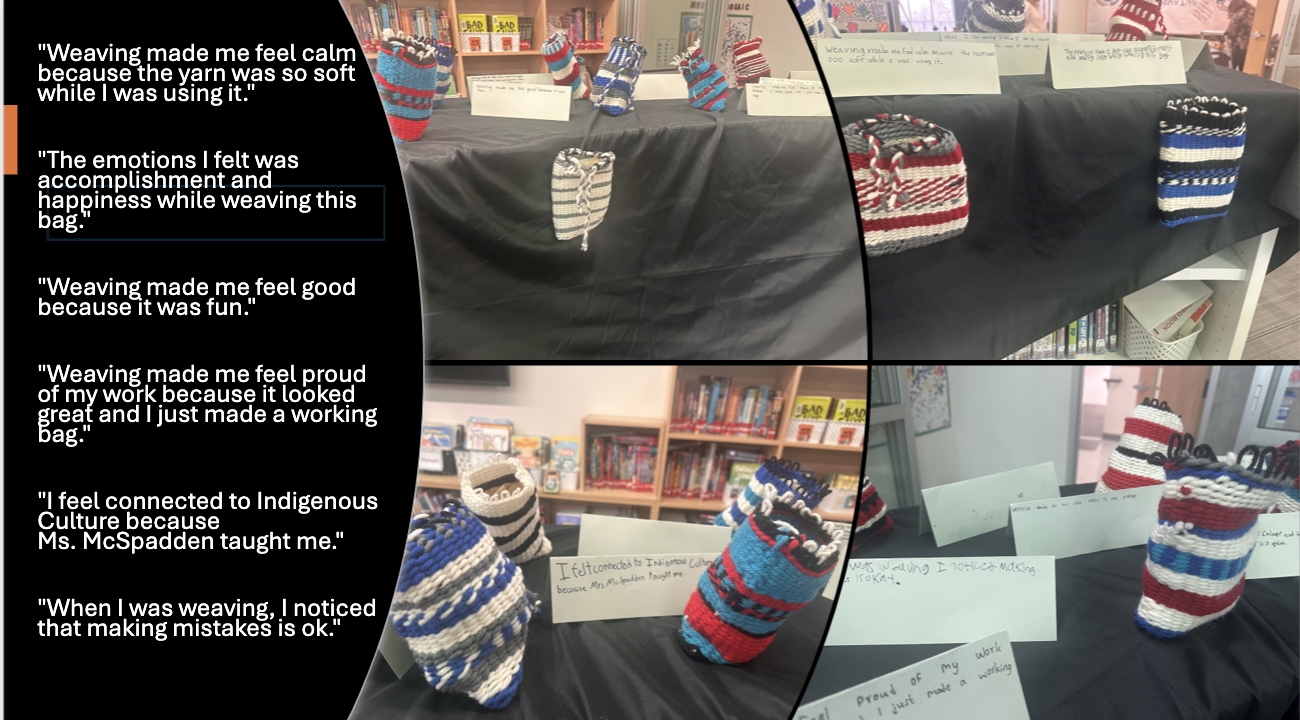
Students had the opportunity to explore mathematical thinking through hands-on weaving experiences, engaging with patterns, sequencing, symmetry, and spatial reasoning in meaningful and culturally grounded ways. This learning was enriched through the guidance of an Indigenous Elder, who shared knowledge, stories, and traditional practices, emphasizing that learning is holistic, relational, and rooted in connection to culture and community. Students then extended this learning by teaching and supporting peers in other classes, reflecting the reciprocal nature of Indigenous ways of knowing and being, where knowledge is shared, relationships are honoured, and learning is a collective responsibility.
Influenced by the Communication Core Competency, students demonstrate, “I can share my ideas and connect them with others’ ideas.”
The Thinking Core Competency is evident as students show, “I can explore and build on ideas” and “I can use patterns and relationships to solve problems.”
The Personal and Social Core Competency is strengthened as students demonstrate, “I can persevere over time to develop my abilities” and “I can work collaboratively with others to achieve a goal.”
This reflects the First Peoples Principles of Learning, where learning is holistic, relational, and embedded in story, memory, and time.
Maddaugh students shared,
Math in Measuring for Garden Boxes:
Students applied mathematical thinking through measuring and planning garden boxes, working with length, area, volume, and estimation in a real-world context connected to the land. This learning was deeply connected to the land, reflecting the understanding that learning is holistic and rooted in place. Through hands-on, experiential learning, students explored how mathematics can be used to care for and interact with the natural environment in purposeful ways.
Guided by the Communication Core Competency, students demonstrate, “I can communicate my thinking and listen to others.”
In the Thinking Core Competency, students show, “I can make sense of problems and persevere in solving them.”
In the Personal and Social Core Competency, students demonstrate, “I can work with others to achieve a goal” and “I can take responsibility for my learning.”
This experience reflects the First Peoples Principles of Learning, where learning is connected to place, time, and shared responsibility.

Math in Cribbage and Designing Their Own Boards:
Students engaged in mathematical thinking through cribbage and board design, applying number sense, patterning, and strategic reasoning in collaborative and hands-on context. Learning through gameplay and design reflects experiential and relational ways of learning, where understanding is developed through doing, observing, and interacting with others.
Building the Communication Core Competency, students demonstrate that “I can explain and support my thinking.”
In the Thinking Core Competency, students show that “I can analyze and solve problems in multiple ways.”
In the Personal and Social Core Competency, students demonstrate that “I can reflect on my learning” and “I can work collaboratively and respectfully with others.”
This reflects the First Peoples Principles of Learning, where learning is experiential, relational, and shared.

“I want them to know that crib club is a fun math game.”
“The crib club was great, I like crib because it is a game of math so I liked it very much it is great!”
“I loved being a part of crib club because it was really fun to play crib and is also great way to learn math and strategy.” - Grade 4 & 5 Maddaugh Students.
School-Wide Math Matter Survey:
This school-wide survey is designed to gather student voice and evidence about attitudes, confidence, and experiences in mathematics across all grade levels. It helps us understand how students perceive their growth, their willingness to take risks, and the strategies and supports that are most effective in their learning. By collecting this data at multiple points throughout the year, the survey allows staff to identify trends, celebrate growth, and respond intentionally to areas of need. The results are used to guide instructional practices, strengthen a positive math mindset, and ensure that all students feel supported, capable, and engaged in their mathematical learning.
Primary (Grades 1–3)
Across Grades 1–3, there is clear and consistent growth over the course of the year, with most students shifting to “Yes, definitely” responses by year-end. This reflects strong gains in confidence, independence, and enjoyment of mathematics. A positive growth mindset is evident early and becomes nearly universal, as students increasingly believe that making mistakes supports learning. Perseverance is also a notable strength, with students consistently demonstrating a willingness to keep trying even when math is challenging. Overall, the data indicates a highly effective learning environment in which students increasingly see themselves as capable and engaged math learners.
While overall trends are very positive, a few areas present opportunities for growth. Students show more variability in their use of tools such as manipulatives and drawings, suggesting that they may not yet fully understand when and how to use these strategies independently. Collaboration is another area with mixed responses, indicating that some students may feel less comfortable working with peers or may prefer independent work. Additionally, a small number of students continue to report lower confidence and engagement in math, highlighting the need for targeted support.
Next steps:
- Teachers can strengthen students’ use of tools by explicitly teaching when and why to apply specific strategies, while also encouraging student choice.
- Collaboration can be improved through structured partner work, clearly defined roles, and consistent routines that build both comfort and accountability.
- Teacher will continue to identify and support the small group of less engaged learners through small-group instruction and confidence-building opportunities.

Intermediate (Grades 4–7):
Across Grades 4–7, there is a clear and consistent upward trend from baseline to spring to year end data. Students demonstrated significant growth in confidence and independence when solving math problems, with a strong shift toward “Yes, definitely” responses by the end of the year. Perseverance and a growth mindset were evident early on and remained steady, showing that students value effort and learning through mistakes. Students increasingly felt that they were improving in math, representing one of the most notable areas of growth. In addition, there was gradual progress in students’ ability to explain their thinking, reflecting developing mathematical communication skills.
While overall progress is positive, several areas remain less developed. Enjoyment and engagement in mathematics, including looking forward to math class and working with peers, improved slightly. Understanding what to do when stuck continues to be inconsistent, suggesting that not all learners have strong independent problem-solving strategies. Collaboration and the effective use of mathematical tools emerged as the weakest areas throughout the year, showing minimal improvement. These trends highlight the need for an increased focus on deeper understanding, student engagement, and meaningful interaction.
Next Steps:
- Teachers can plan and implement strategies to strengthen both engagement and collaborative learning experiences, making math more interactive and enjoyable.
- Teachers can model problem-solving strategies while creating support to help students know what to do when they encounter challenges.
- Teacher will continue to increase opportunities for structured peer discussion and consistent use of mathematical tools to help build both confidence and competence.

Tools our students find helpful:
“I’m starting to appreciate how much math really helps and matters.” - Grade 3 Student.
Together, these experiences in weaving, garden design, and crib building—alongside the Math Matters Family Challenge and collaborative in-class math challenges—demonstrate how mathematics becomes meaningful when grounded in real-world, culturally connected, and shared learning. By engaging students, families, and peers in collaborative experiences, this work reflects Indigenous ways of knowing and being while strengthening students’ confidence, competence, and sense of belonging as capable and connected mathematicians.
OUR FOCUS
Our focus is on a cohort of Grade 5–7 students across three classes. Insights from Foundation Skills Assessment (FSA) experiences, classroom observations, and student reflections highlighted a consistent pattern: while students were generally able to complete straightforward computational tasks, they often experienced difficulty applying these skills in multi-step, real-world contexts requiring sustained reasoning. Students also showed a tendency to rely on standard algorithms, demonstrated limited stamina when working independently for extended periods, and were sometimes hesitant to take risks without clear strategies.
The data trends reinforce this need. Literacy data shows strong and consistent achievement across grades, while numeracy data reveals increasing variability and complexity over time. In Grade 4, many students are on track, demonstrating developing confidence with number concepts; however, by Grade 7, there is a broader range of achievement, with an increase in students needing support as tasks require multi-step thinking, sustained reasoning, and flexible strategy use. This shift highlights a gap between students’ ability to perform procedures and their ability to apply their learning in meaningful ways, emphasizing the need to focus on computational fluency, problem solving, and stamina as interconnected priorities.
This work is grounded in our inquiry: How does focusing on flexible strategies (rather than algorithms) for addition, subtraction, multiplication, and division improve students’ computational fluency, problem-solving ability, and confidence in Mathematics over a two-year period?
Student learning experiences are designed to engage learners in solving meaningful, open-ended problems that require reasoning, persistence, and the use of multiple strategies. Students are learning to move beyond algorithms by representing their thinking with models, number lines, and drawings; decomposing numbers; estimating and checking for reasonableness; recognizing patterns and relationships; and selecting flexible strategies based on the task. Through these experiences, students demonstrate that “I can make sense of problems and persevere in solving them” and “I can use multiple strategies and approaches.”
Students are also strengthening their ability to communicate and reflect on their thinking through discussion and collaboration. They explain and justify their reasoning, consider different perspectives, and make connections between ideas, demonstrating that “I can explain my mathematical thinking using a variety of strategies and tools” and “I can connect my ideas with others.” As they engage in increasingly complex and sustained tasks, students are building stamina and perseverance, demonstrating that “I can stick with challenging problems over time” and “I can take responsibility for my learning, even when it is difficult.” They also continue to develop collaboration skills, showing that “I can work with others to achieve a goal.”
Our student learning goals are:
Students will demonstrate, “I can make sense of problems, use multiple strategies, and explain my thinking.”
Students will demonstrate, “I can connect my learning to real-world contexts and persevere through complex tasks with increasing stamina and independence.”
The change we are seeking is for students to move beyond a focus on algorithms and correct answers toward deeper understanding, flexible thinking, and sustained engagement in problem solving. We aim to see students increasingly confident in selecting and applying strategies, more willing to take risks, and more persistent when faced with complex tasks. The intended impact is improved confidence, stronger reasoning and communication, increased stamina, and greater independence as students apply their mathematical thinking in a variety of contexts.
OUR NEXT STEPS
The focus of this work has been on a cohort of students in Grades 5–7 who are developing confidence in mathematics, particularly when engaging with challenging tasks, and who benefit from opportunities to explain their thinking and apply flexible strategies. This focus was informed by student voice, classroom observations, and assessment evidence.
This year, we intentionally prioritized the development of computational fluency—students’ ability to solve mathematical problems accurately, efficiently, and flexibly through rich, strategy-based instruction. This included number routines, open-ended tasks, and regular opportunities for students to represent and explain their thinking in multiple ways.
Our guiding question was:
“How does focusing on flexible strategies—rather than relying solely on algorithms—improve students’ computational fluency, problem-solving ability, and confidence in mathematics over time?”
Student learning goals centred on building confidence and independence through selecting, applying, and explaining flexible strategies, as well as developing perseverance by engaging in challenging tasks and learning from mistakes. These approaches created collaborative, co-learning environments sharing ideas, asking questions, and exploring mathematical concepts together. Through open-ended tasks and discussion, students deepened their number sense and developed flexible thinking.
Our goal was to see increased confidence when approaching unfamiliar tasks, greater independence in problem solving, stronger mathematical communication, and a shift from avoidance to persistence. The data indicates that these outcomes were achieved.
As shown in the comparison below, the computational fluency assessment data provides clear, cohort-specific evidence of meaningful growth from fall to spring. In the fall, proficiency levels were more evenly distributed, with 36.9% of students at the proficient level, 20% at developing, and a significant 43.1% at the emerging level. By the spring, the distribution changed dramatically: 63.1% of students reached proficiency, while developing remained relatively stable at 27.7%, and emerging dropped sharply to just 9.2%.
This shift reflects substantial growth in students’ ability to apply strategies, recall mathematical facts, and approach calculations with increased accuracy, efficiency, and confidence. The targeted, strategy-based instructional approach supported students tin building automaticity, flexibility, and confidence in their mathematical thinking.

Overall, students demonstrated strong progress toward the learning goals of developing computational fluency, strategic flexibility, and mathematical confidence. They increasingly showed the ability to select appropriate strategies, represent and justify their thinking, and persist through challenging problems. Students used multiple strategies to solve problems, engaged in open-ended, real-world tasks, reflected on mistakes, and monitoring their own progress demonstrating greater ownership of their learning. Growth was especially evident for students who began at earlier stages, many of whom made significant gains toward proficiency and developed a stronger sense of themselves as confident and competent mathematicians.
"My attitude towards math has changed in the aspect of not only using the default algorithm but now I am able to use other strategies too." - Grade 5 Student.
"My attitude towards math has changed because I can now show multiple ways to show how to solve a difficult question." - Grade 6 Student.
Student survey data further supports these findings, showing a clear upward shift from “Kind of / Sometimes” to “Yes, definitely,” indicating increased confidence, greater engagement with challenging tasks, and a stronger belief in the ability to improve. Growth was also evident in collaboration, the use of strategies and tools, and the ability to explain mathematical thinking, with fewer negative responses and increased movement toward more positive categories. However, the continued presence of mid-range responses suggests that these skills are still emerging and not yet consistently demonstrated across all learners, indicating a need for continued focus and support.
Classroom evidence reinforced these trends, highlighting increased participation, risk-taking, and collaboration. Students who were previously hesitant are now more willing to share ideas, engage with peers, and persevere through challenges. Improvements in computational fluency have been accompanied by noticeable gains in confidence, communication, and independence.
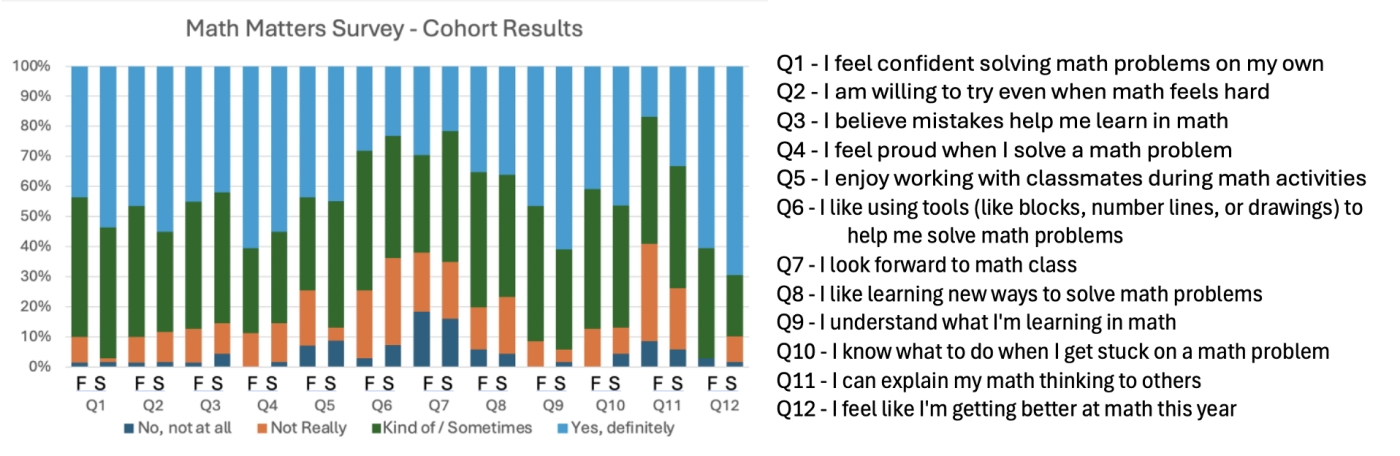
Despite these positive trends, the data highlights ongoing areas for development, especially in students’ ability to independently problem-solve when they encounter challenges, as well as in overall engagement. While fewer students selected negative responses, many remain in the middle range, suggesting a need for continued focus on building independence, strengthening strategy use, and supporting sustained confidence.
These findings point to important next steps in instruction to help students move from developing skills to consistent, confident application by supporting students in building independence, strengthening their problem-solving approaches, and increasing their confidence in taking risks in mathematics. This can be achieved through explicit strategy instruction, modeled problem-solving, and structured opportunities to practice independence, ultimately supporting all learners in becoming more capable, resilient, and confident mathematicians.
In addition to the quantitative data, qualitative classroom evidence highlights shifts in student behaviour and engagement, reinforcing the overall trend of increased confidence, participation, and willingness to take risks in mathematics learning.
One teacher shared, "over the course of this year, a student has shown significant growth in mathematics, particularly in his confidence, computational fluency, and willingness to communicate his thinking. At the beginning of the year, he was often quiet and reserved during math activities, preferring to work independently and keeping his strategies to himself. Through activities such as ‘Math Around the Room’ task cards and problem-solving at vertical surfaces, he has become increasingly comfortable sharing his ideas and explaining his reasoning. He now participates more actively in mathematical discussions and is more willing to articulate the strategies he uses to solve problems.
One area of notable growth has been his collaboration with peers. During task card activities and while working at whiteboards, he has transitioned from working on his own to engaging in meaningful mathematical conversations with classmates. He now discusses possible solutions, compares strategies, and works collaboratively to solve equations and justify answers. This increased confidence has been reflected in his overall mathematical achievement. His computational fluency assessment results showed clear growth from September to June, demonstrating improved accuracy, efficiency, and automaticity with mathematical operations. It has been rewarding to see him develop confidence in his abilities, take greater risks in his learning, and recognize himself as a capable and successful mathematician."
Another teacher shared, “this year, I have noticed many improvements in my Grade 6 students’ mathematical learning, but one student’s growth has particularly stood out. At the beginning of the year, this student often lacked confidence in math and would sometimes disengage when tasks felt challenging. Because her multiplication facts were not yet automatic, many math concepts were difficult for her to access. Over the course of the year, she worked hard to strengthen her multiplication fluency, which helped build both her confidence and her understanding.
One of her greatest areas of growth has been her willingness to take risks. Rather than giving up when something feels difficult, she is now more likely to persevere, ask questions, and try different approaches. She has become more engaged during lessons and is increasingly comfortable sharing her thinking. As her confidence has grown, she has also begun taking on more challenging tasks and has often chosen to complete bonus activities to extend her learning. While she is still developing her understanding of some concepts, the growth she has shown in confidence, perseverance, and self-advocacy has been remarkable. She should be very proud of how far she has come this year."
Where we are now reflects meaningful and measurable progress. The strategies implemented—open-ended tasks, collaborative problem-solving, explicit instruction in computational fluency, and opportunities for student voice have made a clear difference. Students are increasingly using multiple strategies, explaining and justifying their thinking, and persisting through challenges. Classroom observations show greater engagement, discussion, and collaboration, while assessment data confirms improved fluency outcomes. These results align with our intended impact: increased confidence, greater independence, stronger communication, and a shift from avoidance to persistence.
We aimed to develop confident, independent problem-solvers who can flexibly apply strategies and communicate their thinking. The evidence shows this is occurring. Students who once hesitated are now taking risks, trying multiple approaches, and engaging more deeply with mathematics. The decline in the emerging category, alongside the growth in proficiency, demonstrates that students are becoming both more confident and more capable.
Overall, student progress in relation to the learning goals has been strong. Students have made gains in computational fluency while also developing perseverance, communication, and confidence. They are increasingly able to select and apply strategies, reflect on their learning, and engage in meaningful problem-solving experiences reflecting a shift toward a more collaborative, student-centred learning environment.
Moving Forward:
Building on this progress, the next phase of this work will focus on strengthening and extending student learning across the school to ensure consistency and continued growth for all learners.
Instruction will begin with early assessment of computational fluency to guide responsive teaching. Learning will continue to emphasize rich, open-ended tasks that promote flexible strategy use, collaboration, and meaningful mathematical communication. Ongoing monitoring, using both quantitative and qualitative evidence will ensure instruction remains targeted and responsive to student needs.
Key priorities include:
- Supporting students in developing independence and resilience by engaging in complex problem-solving and reflecting on their learning
- Strengthening consistent use of flexible strategies through explicit instruction and modelling
- Increasing student confidence in taking risks and persisting through challenging tasks
- Expanding opportunities for students to explain, justify, and communicate their thinking
Students will:
- Develop as confident problem-solvers by flexibly applying strategies in real-world contexts and clearly explain their reasoning
- Strengthen independence and perseverance by engaging in increasingly complex tasks and reflecting on their progress
Monitoring Impact: How We Know We Are Making a Difference
Indicators of impact will include:
- Increased student confidence and engagement (survey data)
- Greater use of flexible strategies in student work
- Increased perseverance, risk-taking, and ability to explain thinking
- Stronger mathematical discourse and collaboration (teacher observations)
Data will be reviewed regularly to refine instructional practice, including analysis of trends in strategy use, mathematical communication, and student confidence.
In closing, Maddaugh learners remain at the center of everything we do. We are committed to creating learning environments where students are not only successful but confident and capable problem solvers. By focusing on flexible strategies, rather than relying solely on algorithms, we are intentionally building students’ computational fluency, deepening their problem-solving abilities, and strengthening their confidence in mathematics over time. This work reflects our belief that when students understand multiple approaches and can think flexibly, they become more resilient, independent learners. Together, we will continue to refine our practice to ensure every student is supported, challenged, and empowered to reach their full potential.
Surrey Schools
Formed in 1906, the Surrey School District currently has the largest student enrolment in British Columbia and is one of the few growing districts in the province. It is governed by a publicly elected board of seven trustees.
The district serves the cities of Surrey and White Rock and the rural area of Barnston Island.