Latimer Road Elementary

OUR CONTEXT
OUR LEARNERS
Literacy is a fundamental life skill. Through writing and the English Language Arts Curriculum, students are equipped with the language and literacy skills they will need for success in school, the community, career, and life. It provides students with the opportunity to become effective communicators, to develop and express their own ideas, and to think deeply and critically about the ideas of others. As they explore and create written, oral, and visual texts, students expand and deepen their understanding of both real and imaginary worlds, gaining insight into their own lives and the lives of others.
Our learners connect and engage with others in informal and structured conversations in which they listen, contribute, develop understanding and relationships, and learn to consider diverse perspectives.
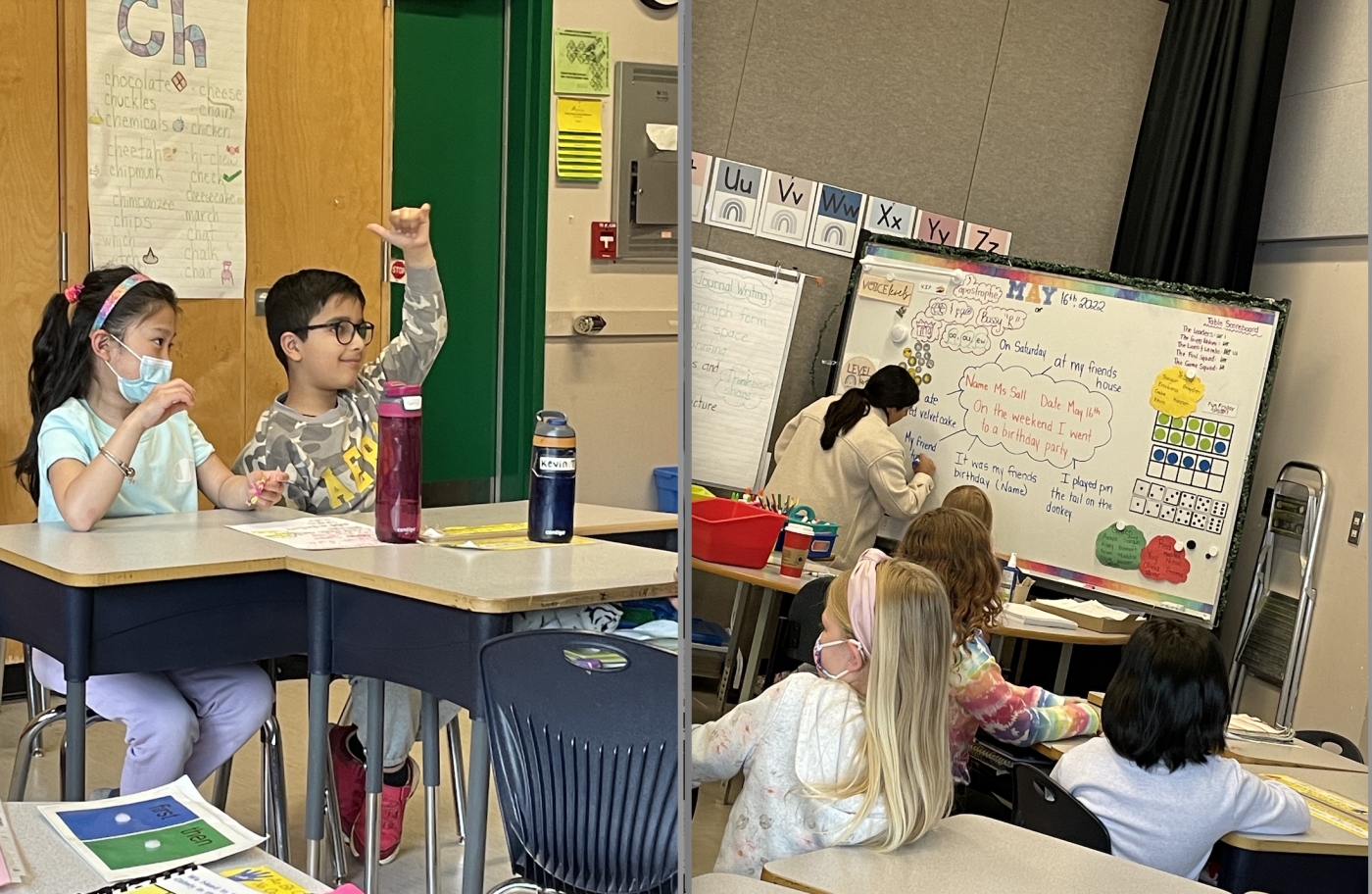
Our young learners can talk about their weekend. The teacher began with a simple sentence of her weekend and the students insisted there was a lot of information missing. The boy on the left can show with his hand symbol that he has a connection to add. The students then do a think/pair/share before beginning their journal write. When asked about this writing activity the students said, "I can share my ideas with my friends." "It's fun to hear what my friends do on their weekend. Sometimes we do the same thing." "It helps me with my ideas." "Ms. Sall needed help with her journal!"
These two Montessori students are sharing the autobiographies they wrote about students in their class. They can learn to create interesting writing by asking probing questions. The students enjoyed learning new things about their classmates. One student said, "Wow, I didn't know she wanted to be a lawyer!" This scaffolding activity will then lead them into an autobiography write about a famous athlete or explorer.

Our learners communicate with intention and purpose. They understand that communication can influence, entertain, teach, inspire, and help us make sense of the world and our experiences. They recognize the role the audience plays in constructing meaning, and they make strategic choices to help convey their messages and create their intended impact. They draw from a range of forms, media, and techniques, monitoring and adjusting their approaches and assessing their effects.
(Replace this with Kate's poetry slam) Below, one of our students demonstrates how delivery helps to engage, entertain and ultimately sell her product. She can engage with her audience and knows how to deliver her message in the most impactful way possible.
Our learners can participate in conversations and communicate their ideas in their writing confidently about topics they know and understand.
(Share a journal) Our youngest learners always enjoy sharing their learning. In this video sample, this kindergarten student can tells us what she likes to do in spring. It ended up being the focal point for several conversations that happened on the playground with the principal. Her journal demonstrates her ability to use visuals and expressive language to talk about what she likes. It also demonstrates her sense of self-awareness, and identity. Such a good representation of what we hear from our early learners!
Our learners can make connections to the real world and communicate their learning beyond the classroom.
(Jack's class Minecraft) Students practice essential 21st century communication skills through media and technology. This school year, students from 6/7 participated in the Minecraft Challenge, where they recreated our school. Through this ADST learning experience, students worked collaboratively to design, plan, build and reimagine our school, Latimer Road. This video sample of learning demonstrates that our students can plan, write and create for a specific audience in mind, and present their learning to others.
Our learners communicate orally first and then using sentences. They focus on conventions of Canadian spelling, grammar and punctuation.
(Lomax Heggerty) These students are participating in a Heggerty lesson. The students love these lessons that are quick, fun, & multisensory!" Watch the journey to reading and writing that begins through phonemic awareness. They can follow a pattern, understand beginning and end sounds and combine sounds to make work
OUR FOCUS
Every day, among the variety of learning experiences presented to our learners, our team of educators focus on thinking, writing, and communicating in all curricular areas. Our aim is to build strong literacy foundations that are fundamental for students’ participation in today’s world.
Our students’ learning goals include:
- Exchanging ideas and perspectives to build a shared understanding in order to transform ideas and information to create original texts
- Make writing interesting for your reader by using a variety of tools
- Use the writing process to plan, develop and create texts for a variety of purposes
- Communicate ideas clearly using the conventions effectively in a variety of written forms
All teachers, across all grades, provide students with learning opportunities aimed at increasing the literacy success rates of our learners. To highlight and determine overall successes and gaps, we monitored the progress of one cohort across different subject areas. This cohort was comprised of Montessori 4/5/6 students. It was chosen because we felt it provided a sampling of our school and was a good indicator of school performance as a whole.
Our learners can exchange ideas and perspectives to build shared understanding.
In this Grade 7 class, the students use current events to promote critical thinking. It helps our learners understand an issue or event, they then either inference, predict what might happen next, or give their opinion on a topic and support it with evidence. These current event activities have become a great way for the students to pursue a passion or just have them look outside of themselves.
Our learners can transform ideas and information to create original texts.
These students used the writing process to plan, develop and create texts for a variety of purposes.
In the examples below, students used the mind map or web planning tool to complete research to demonstrate that they can transform information to create original texts. They worked on communicating in sentences and paragraphs applying the conventions of spelling, grammar, organization and punctuation.

Our learners understand that it is important to make writing interesting for the reader.
The teacher noted, "The students work on recognizing how sensory details can strengthen writing to enhance the meaning for the reader. As a class we went on a sensory walk around the school grounds to take notes of sounds, smells, textures, temperature, and sights. The students were challenged to identify what emotions they felt or were triggered by in our surroundings. Then the groups rotated through the senses jotting down different words that they associated with each one. The mini-posters were used to create a unique piece of sensory writing about our class walk. "

Our learners can communicate their ideas clearly using the conventions effectively in a variety of written forms.
 When asked, one student said, "I decided to write a postcard to share what I was learning in science about mixtures and solutions. I like that I can share my learning in different ways."
OUR NEXT STEPS
Evidence of our students’ learning demonstrates that our literacy focus is positively impacting our cohort of learners and our school as a whole. The cohort we chose was a Montessori grade 4/5/6 class. We feel this class is a good representation of students in our school and demonstrates our schools trend as a whole.
When the cohort teacher was asked to communicate her students’ progress using the provincial assessment scale the teacher indicated that all students demonstrated growth in relation to our four literacy goals:
Our school writing goals are as follows:
- Exchanging ideas and perspectives to build a shared understanding in order to transform ideas and information to create original texts
- Make writing interesting for your reader by using a variety of tools
- Use the writing process to plan, develop and create texts for a variety of purposes
- Communicate ideas clearly using the conventions effectively in a variety of written forms


As indicated in the table above, our students demonstrated growth in both informational and personal writing over time. We see a significant increase in the percentage of students that are proficient in personal writing from October 2020 to October 2021 (+31%). Additionally, we see a more modest improvement in informational writing between May 2021 and March of 2022 (+10%)
Evidence of student learning demonstrates their ability to use the writing process to write and communicate for a specific purpose and audience. In this cohort, students have utilized a variety of planning tools and evaluated their efficacy across different genres. Genres of writing that have been explored include: informational, letter format, personal writing, story writing, poetry forms, descriptive, and biographical.
In addition we see evidence in many other ways.
Looking at students digital portfolios and their self-reflections we see they are able to self-reflect as well as identify elements that make their writing clearer and more interesting.

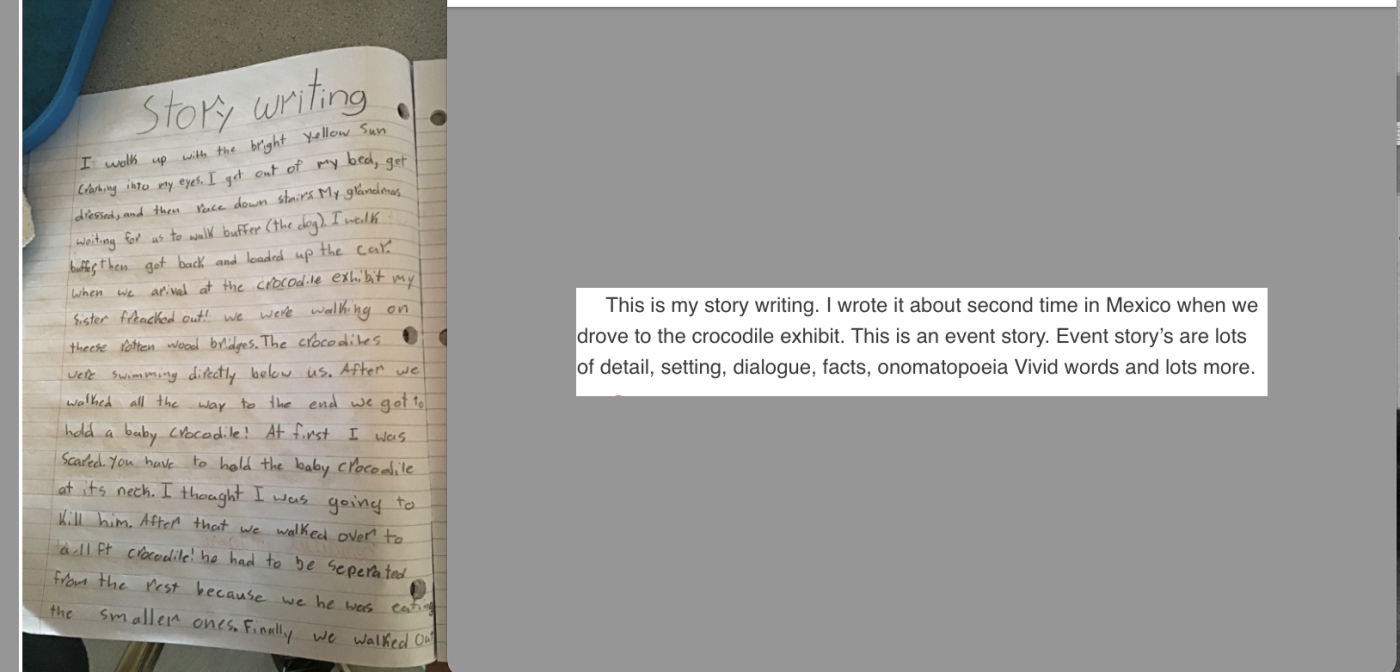
Based on teacher reflection, 61% of students can communicate their ideas clearly using conventions effectively in a variety of written forms. This is a continued area of focus where learning activities will be provided.
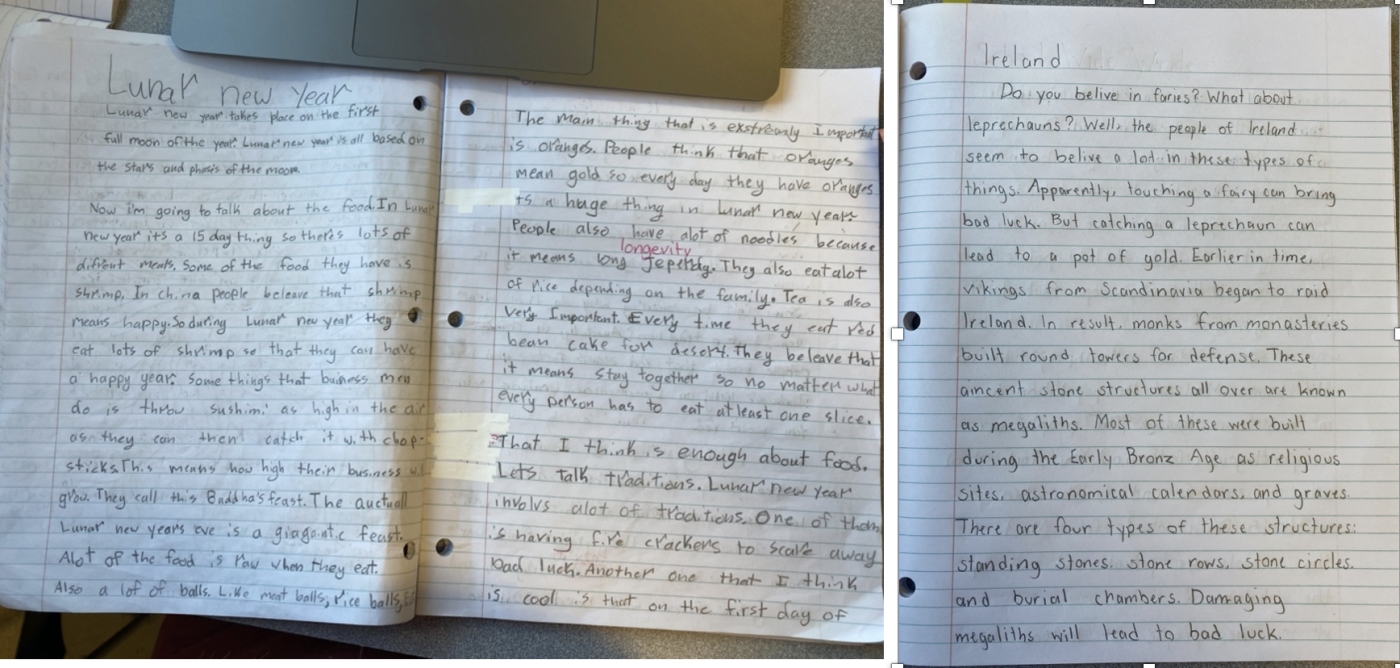
Looking at their writing on Lunar New Year we see that 72% of students are able to transform ideas and information to create original texts. While 28% are still developing or emerging in this area.

Moving Forward
Based on the progress we have seen thus far in our goals; our next steps are:
Transform ideas and information to create original texts
- Continue to expose children to a variety of texts and text structures in order to increase familiarity and comfortability
- Give more choice for topics of writing when possible
Make writing interesting for your reader by using a variety of tools
- Use creative lesson design to expand on and review the lessons that have already been taught using Adrienne Gear’s Powerful Writing Structures
- Expand on the strategy of using words playfully and teach figurative language such as metaphors, similes, hyperboles etc.
Use the writing process to plan, develop and create texts for a variety of purposes
- Work to develop more cross-curricular writing opportunities to create authentic texts that are meaningful in a number of ways
- Give opportunities for teachers to expand their own knowledge and seek professional development for Adrienne Gear’s new poetry book
Communicate ideas clearly using the conventions effectively in a variety of written forms
- Continue to develop instructional strategies that allow students to learn and practice their use of conventions in their writing in a manner that allows them to be successful and maintain interest in their writing
Going forward, our students will continue to collaborate, learn and self-assess their writing. As a community we will continue to use the inquiry principles of review, revise and refocus when planning, teaching and learning in order to continue to support the diverse learners in our school. The writing folders that were created two years ago will continue to follow our students as they move through the grades. Looking back at the 3 yearly samples of their writing as well as the rubrics will help them see growth as well as create goals. We look forward to seeing how far our students come as we track their progress from year to year. Supporting each other in developing literacy proficiencies that cultivate cognitive skills and “thinking habits” will prepare them for future success.
Surrey Schools
Formed in 1906, the Surrey School District currently has the largest student enrolment in British Columbia and is one of the few growing districts in the province. It is governed by a publicly elected board of seven trustees.
The district serves the cities of Surrey and White Rock and the rural area of Barnston Island.