Katzie Elementary

OUR CONTEXT
What do we want people to know about our school?

We would like to start by acknowledging that we come to school to work and learn on the traditional, unceded territory of the Katzie, Kwantlen, Semiahmoo, and other Coast Salish Peoples. We are grateful for this land and our beautiful school. We are humbled to have our school named after the Katzie First Nation and we are learning to be stewards of this place.
Katzie Elementary is driven by a dedication to lifelong education and strong community ties. Our school is comprised of both eager new educators as well as highly experienced professionals. This creates the opportunity for an organic sharing of ideas and a balanced blend of perspectives. Katzie staff have identified literacy as our school goal that is embedded in the rich learning experiences that our students engage in every day.
Katzie teachers are involved in a diverse range of professional development from pursuing advanced university education to participation in various district and provincial initiatives in all areas. Our teachers love being part of the Katzie community. We have many staff members who have chosen to remain at Katzie for many years because they feel so connected to our students and to each other.
Our community is a very connected population drawn from the Clayton area of Surrey. Our parents are highly involved in supporting field trips, in-class volunteering, hot lunches, Run Club, PAC, and social community building events. The families of Katzie believe in actively supporting a strong school-home connection. We are so excited that parents feel welcome in our school and that they are active partners in their children's education.
Our community is the heart of our school!

OUR LEARNERS
What do we know about our learners?
Our learners live in an exciting, yet rapidly changing world filled with challenges and opportunities. To help prepare them, we are targeting the development of several literacy specific skills and mindsets.

The qualities we want to foster in our learners include:
- A lifelong love of reading, writing, and learning!
- The skills and drive to think both creatively and critically.
- A strong command of reading comprehension strategies.
With these capacities, our students will be prepared to not only communicate effectively though a variety of media, but also gain insight into their own identity, the lives of others, and the world in which we live. This enables our students to demonstrate care for themselves and others, consider innovative ideas, and multiple perspectives.
The Katzie learner understands their role as a responsible citizen and has the literacy skills to embrace, enjoy, and contribute to their community.

OUR FOCUS
Why does this goal matter?
Literacy is a fundamental skill which supports meaningful interaction with learning across the curriculum. It is the ability to read, write, speak, and think in a way that lets us communicate effectively and engage with the world around us.
What are the "big ideas" that drive our literacy instruction?
We believe that language, story, and text can be a source of creativity and joy. Reading different types of texts becomes foundational for learning through the years. We also believe that learning is holistic, reflexive, reflective, experiential and relational.
Through these capacities, we are able to build self-confidence and rely on motivation, hope, self-efficacy and a growth mindset. We strive to empower students to view all texts as accessible and meaningful, supporting them to communicate effectively in an ever-changing world.

What are the literacy goals at Katzie Elementary?
- Students will demonstrate the ability to decode and comprehend grade level texts (both fiction and non-fiction).
- Students will demonstrate the ability to communicate ideas orally and in writing for different audiences and for various purposes.
Who is our cohort?
Our school chose a grade one and a grade five class to gather evidence from this year. These classes are representative of all of the amazing learning that is happening at Katzie Elementary.
When these teachers looked at the intentions the school committee outlined, they decided to break the components into two manageable concrete objectives that could be woven into the big goals through student examples and assessment samples. The goals created were:
- Students are able to decode (sound-out words) and comprehend grade level texts
- Students are able to communicate ideas in many ways (e.g., orally, loose parts, and in writing).
The logic behind these two measurable goals was that, by bringing joy and creativity to language, story, and text, both comprehension and communication would increase.
What does this look like in practice?
What does this look like in grade 1?
In grade one, the teachers has been engaged in work to learn about the science of reading. New research has given us insight into the skills and strategies that young children need to develop in order to become proficient readers. The grade one cohort class engaged in learning phonemic awareness through the Heggerty resource. This work was complimented by work using:
- word families
- word walls
- explicit phonics instruction
- choral reading
- guided reading groups,
- class poems
- joyful read-aloud
The teacher engaged her class in writing instruction using:
- story response
- journal writing
- word work
- sentence frames to scaffold writing
- loose parts
- story workshop
What does this look like in grade 5?
In the grade five context, different types of learning activities targeted literacy skills. There are twenty-eight students in the cohort class with various needs and backgrounds. The teacher noticed that after two disrupted years of school due to Covid-19, there was a high level of reading reluctance and challenges with communicating ideas. Significant spelling issues, incorrect letter formations/reversals, and large writing (multiple lines/ignoring lines) were common early in the year. Even with all of the learning challenges and needs, the kids were willing to try new activities and they grew significantly throughout the year.
In September, the teacher completed several assessments to get baseline data. Once she had the data, she was able to start thinking about class needs so that she could begin planning lessons and units that would support these needs. Similar assessments were done in January and May/June to explore growth and next steps. The teacher designed rubrics based on I-can statements and positive language that I used throughout the year with different highlighter colours to show growth and development.

The three initial observations made based on these assessments were:
- Many students read word-by-word and did not attend to punctuation when they read aloud.
- Summarizing main points and pulling relevant information from the text was challenging.
- Students could extend their thinking verbally, but written answers were minimal.
A few explicit ways that were tried to support students to address the observations were:
- Modelling fluency by reading out loud picture books, nonfiction texts, and novels. Providing extensive opportunities to connect to and reflect on texts verbally, using loose parts, visually, and in writing.
- Playing with language and punctuation through strategies like explode the sentence and group edits. These activities helped students learn how to break down challenging words and concepts while also modelling processes that seem elusive like revision.
- A picture book cross-age reading unit which involved explicitly learning how to read fluently to younger students and how to design questions to improve comprehension in their little buddies.
- A storytelling unit where students learned explicitly how to use nonverbal communication and oral language strategies to perform folktales in a storytelling festival. Students learned about story structure and compared many forms of communication throughout the unit.
- A Social Justice Symposium where students used mixed bins of literature (picture books, novels, and nonfiction) as well as explicit lessons and technology to explore different social justice topics such as homophobia, racism, and ableism. The unit made many connections between fine arts and literature and gave students the opportunity to communicate their ideas visually, verbally (small group discussions/video PSA/Symposium Day), and in writing.

OUR NEXT STEPS
What have we learned?
Through this experience of looking deeply into the learning of two cohort classes, we have learned that powerful literacy experiences are already happening at Katzie Elementary. We have learned the importance of looking deeply and carefully at what we do and how this affects our learners. Our students are amazing and have an immense capacity for learning. It is critical that we offer the rich learning experiences necessary to allow our Katzie students to become the best learners that they can be.
What is our evidence of learning in our grade one cohort?
In the grade one cohort, most students began the year at the beginning stages of reading and writing. In October, the majority of students scored below level 10 on the DRA Assessment, which would be consistent with early grade one reading levels. By May, most students were able to decode and comprehend texts at or near end-of-grade-one level (DRA levels 12-16). Several students were reading beyond grade level expectations. Similarly, in the fall, most students were beginning writers, scoring “developing” according to the Writing Performance Standards for March/April. By May, most students scored as “proficient” according to the Performance Standards descriptors.

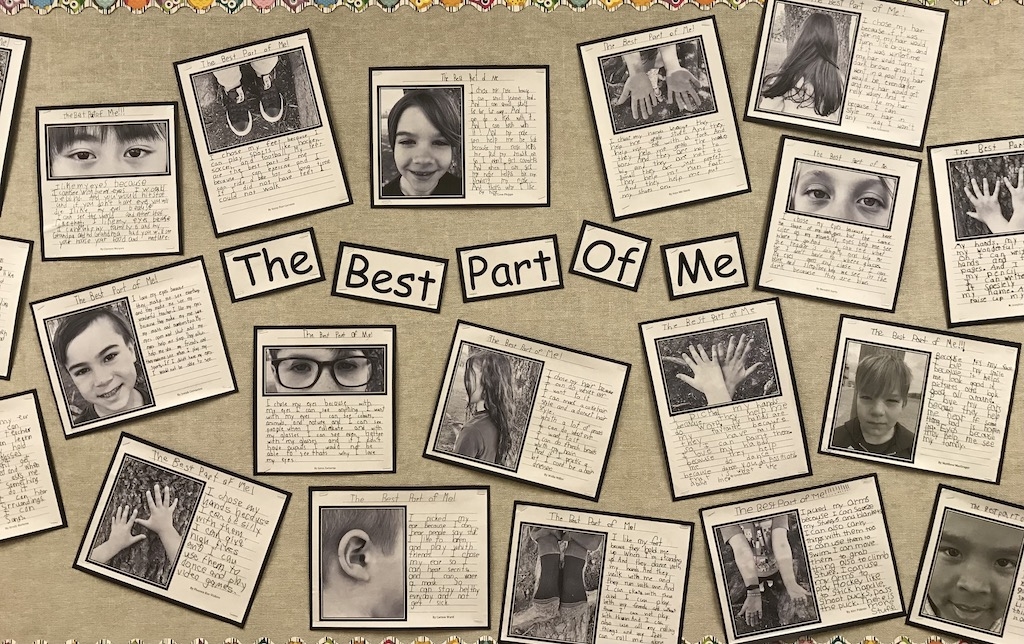
In this first journal writing example, you can see how the student was able to write one short sentence in September. There are also a number of letter reversals. In the end of the year sample, there is a full page of writing. The student is no longer reversing letters. They are using a combination of standard spelling as well as invented spelling to spell unknown words.

In this second writing sample, you can also see how this child has increased in their confidence as a writer. They are using many conventions of print and they feel confident to tell their story without needing a picture to support their words.

What do these graphs tell us?
When compared to the widely held expectations for what grade one children can do in reading and writing by the end of the school year, we can track growth over time. In reading (Figure 1), we can see how the students were reading at the beginning of the year based on early grade one goals and where they were at the end of grade one based on end of grade one reading goals. In writing (figure 2), we would not expect children to be fully meeting expectations in October based on the end of the year goals, so the results in green were not surprising. What is exciting for us to see is how much our cohort class progressed over the school year.
What is our evidence of learning in our grade five cohort?
In the grade five cohort, students all demonstrated growth in fluency, reading comprehension (Figures 1 and 3), and in their ability to communicate ideas both in writing and verbally (Figure 2). This was measured using the PM Benchmark reading assessment. For writing, the teacher used a rubric written in student friendly "I can" language. Using the same rubric throughout the year and highlighting it with different colours allowed the teacher to see growth and determine what supports were needed for all as well as targeted supports that might help specific students. This information is essential for universal planning in a diverse classroom.
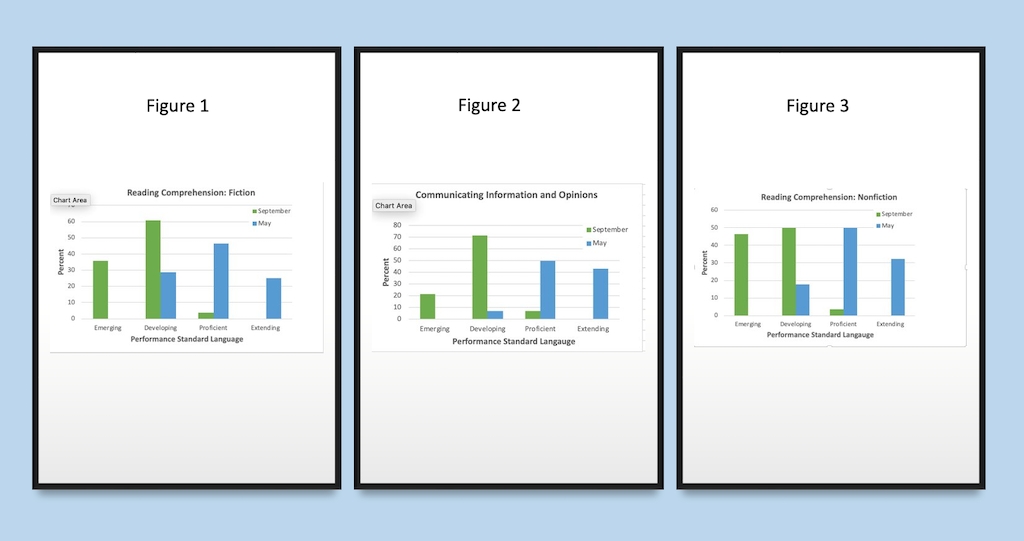
The graphs above show the same type of learning over time. Students in the grade five cohort class were assessed in September for formative assessment purposes. We want to know where children are at in their learning so that we know what we need to teach them. This sets our students up to be meeting grade level expectations by the end of the year. By the end of the year, you can see that none of these cohort students are at the emerging level. Most students are proficient with a significant number of the class extending compared to the widely held standards for this age group.
 For writing data, the grade five teacher had the students do a quick write about themselves (personal write) and about the patterns they found in data we collect about our class (communicating ideas and information). Once she had the data, she was able to start thinking about class needs so that the teacher could then plan lessons and units that would support these needs. The teacher repeated similar assessments in January and in May/June to explore growth and next steps. She designed rubrics based on I-can statements and positive language that were used throughout the year with different highlighter colours to show growth and observations. Three samples of this completed rubric are shown above.
Where do we go next with our learners?
We came up with three concrete ideas for moving our teaching and learning forward.
Idea 1: Knowing where your students are and identifying goals for their learning is important for designing an effective literacy program .
Our students benefitted from continuous modelling of strategies using different types of texts (picture books, novels, articles, poems...). Pausing a lesson to break apart a complex word, explore some cool punctuation, or analyze text features were a few of the strategies used throughout the year to build vocabulary, decoding, and text structure skills. These strategies help us move toward our end of the year learning goals.
Idea 2: A simple strategy used multiple times per year can have a significant impact on student understanding.
Children need an opportunity to do the same activity over and over again. Some children will learn new skills and concepts quickly while others will need multiple exposures before it starts to make sense for them. As educators, we know that we don't just "cover" the curriculum. It is not a checklist! We learn new things, we practice, we improve our skills. In both reading and writing, it takes lots of practice to become an expert. At Katzie, we hope that we will inspire our students to develop a growth mindset. This means that when they understand that if they cannot do something, it just means that they can't do it 'yet'. We are able to keep an open mind and keep practicing.
Idea 3: Don’t be afraid to unpack challenging texts, talk about hard things, and find authentic audiences.
In order to engage students, we use powerful multi-modal texts (visual, text-based, video, audio...), we talk about hard things, and we find authentic audiences. These pieces keep our students wanting to push themselves to do their best, which means they are the ones doing the thinking. We focus on process instead of product because this is what our learners need to be successful in our ever-changing world.
When we bring joy and creativity to language, story, and text, we put the students at the centre of the learning. Joy can be found not only in the content and engagement in the activity, but in the perseverance and achievement in doing hard things—which is the joy that the teacher has seen so much of this year! Our students can use their literacy skills to engage with hard topics such as equity and reconciliation. They are finding their voices and learning how to be heard in the world.
The Student Learning Plan Committee has come up with some two goals for our staff to ensure that our literacy goals continue to be a focus.
- We will implement school wide "writes" and "reads" in order to collect baseline data for all students. These school wide assessments will be conducted three times during the school year in order to track student progress and to adjust our teaching if or when necessary.
- We will hold regular primary and intermediate meetings where staff can share ideas and successes. We know that we are better when we put our minds together.
Surrey Schools
Formed in 1906, the Surrey School District currently has the largest student enrolment in British Columbia and is one of the few growing districts in the province. It is governed by a publicly elected board of seven trustees.
The district serves the cities of Surrey and White Rock and the rural area of Barnston Island.