Johnston Heights Secondary

OUR CONTEXT
Walking with the Eagles - Tour
Who are we?
Johnston Heights Secondary School is a public school in Surrey and welcomes all students. Students begin in the International Baccalaureate Middle Years Programme (MYP). In Grade 11, students can decide to continue into the International Baccalaureate Diploma Programme (DP) or the BC graduation program (BCED). We, as a learning community, believe all students can find success within the MYP, DP and the BC Graduation Program.
Our students come from a variety of backgrounds and cultures with many different languages spoken at home.

What does student life look like?
At Johnston Heights, the BCED Curriculum is delivered through the lens of the IB. Our students work on a balanced scheduled that is follows a linear timetable. Students explore the BCED curriculum through key concepts, global contexts and explorations while also building approaches to learning (ATL) skills and developing the learner profile (LP) traits. These elements enhance the learning experience and the delivery of the BCED Curriculum while also giving students a well-rounded experience.
Approaches to Learning (ATL) are the building blocks for all lessons. Approaches to learning skills are most powerful when students engage with them in connection with significant and relevant content knowledge in order to develop transferable understanding. Through approaches to learning in IB programmes, students develop skills that have relevance across the curriculum that help them “learn how to learn”. Approaches to learning skills can be learned and taught, improved with practice and developed incrementally. They provide a solid foundation for learning independently and with others. ATL skills help students prepare for, and demonstrate learning through, meaningful assessment. They provide a common language that students and teachers can use to authentically develop learning skills and reflect on the process of learning.
Our students care deeply about the world around them and engage with various cultures within the school respectfully. Our staff and students engage in ongoing self-reflection and service to our community to ensure we build a strong world together. In their classes, students often engage in inquiry-based activities that blend academic rigour with personal interest. To show how student learning connect, students create Personal Projects in Grade 10, Creativity, Activity and Service projects, and a Capstone. It is common to see students working collaboratively in the hallways, designing community service projects, mentoring new students while actively participating in Athletics and the Arts.
Why do we do what we do?
Johnston Heights is a caring school that embraces service and inclusion and that seeks to ensure students can be accommodated comfortably within the school. The school respects and supports diversity as part of its mission. We welcome students with learning differences and offer support provided by our Inclusion, B.A.S.E.S. and counselling team.
Taking into account the beliefs, customs, practices, languages and differences of individuals and groups, our students will:
- Work and learn by a set of cross-cultural expectations of behavior.
- Respectfully challenge behaviors which counter these expectations when they occur and to do so with a spirit of inquiry and a desire for learning and understanding.
- Accept and respect diversity having empathy, understanding, open-mindedness and curiosity about those whose lives and opinions might be different than our own.
- Teach and learn by a set of philosophical principles and a body of knowledge that helps our school community to understand: our role and responsibilities as Canadians within an international community, the values that give priority to ecological sustainability, global interdependence, social justice for all the world’s people, peace, human rights, and mutually beneficial processes of economic, social and cultural development (CIDA 1994), and practice our understanding locally, nationally and internationally through service projects.
OUR LEARNERS
Our Student Learning Focus
The focus of our student learning plan is examining how students use the IB Learner profile and specific Approaches to Learning. (ATL) skills into our school, and within our school between programs.
The aim of all Johnston Heights students is to develop as internationally minded people who, recognizing their common humanity and shared guardianship of the planet, help to create a better and more peaceful world

The IB learner profile aims for students to be inquirers, balanced, caring, communicators, knowledgeable, thinker, risk-taker, reflective, principled and open-minded. We believe these attributes, and others like them, help our students become responsible members of local, national and global communities.
What can our students do?
Students show understanding by demonstrating their skills in learning activities.

Students practice self management and balance by understanding the importance of balancing different aspects of our lives including intellectual, physical, and emotional well-being. Additionally, they reflect by thoughtfully considering the world and our own ideas and experience.

Students practice the ATL communications skills when they express themselves confidently and creatively in their learning.

Our students appreciate our own cultures and personal histories, as well as use critical and creative thinking skills to analyze and take responsible action on complex problems.


Additionally, we see what our Learners can do through their actions.
They
- Actively participate in classroom learning.
- Actively work to make the school a better place for each other through care and empathy.
- Work with peers and teachers to develop knowledge and skills.
- Perform their best efforts to demonstrate their skills and growth.
- Ensure work is of their own creation and they use academic honesty.
- Understand the Criterion and Learning Objectives for each subject.
- Ask for assistance when needed.
- Stay informed about their progress.
- Reflect on their learning to foster growth.
OUR FOCUS
Setting the development of ATL skills as the focus of our student learning plan will help build strong collaboration, communication and curricular competencies and lead our students to develop strong foundational skills for independent learning.
Our Focus Question:
How can we explicitly teach ATL Skills across all grades to connect MYP, DP and BC Grad Program?
Our Student Learning Goals
The goal of our student learning plan is to ensure the students know and understand which ATL skills they are working on. At the end of every lesson, students should be able to give examples of the ATL skills they have learned and transfer those skills into other classes as they transition throughout the programs.
The Learning Goals are:
Students will gather and organize relevant information to formulate an argument and draw reasonable conclusions and generalizations and consider ideas from multiple perspectives in classroom activities.
Students will practice visible thinking strategies and create original works and ideas, using existing works and ideas in new ways.
Students will communicate to give and receive feedback. As well as use a variety of speaking techniques to communicate with a variety of audiences.
Who is our Cohort?
Our Cohort is a group of 8 students that focus on English Language Arts and Service.
What are they learning currently in this class?
Students develop and learn new skills guided by:
- Action: collaborative with sustainable impact both inside and outside the school by using thinking skills to identify needs.
- Voice: promote intercultural awareness and mindedness while being responsive and ethical creative thinkers.
- Care: demonstrate compassion and empathy for self, peers and larger community.
- Communication: principled decision makers that effectively build confidence in written and spoken skills including the ability to give and receive feedback and use communication skills to come up with creative solutions.
Students practice their ATL skills in various activities such as a Service Walk, Persuasive Speeches, Letters to Elementary students, Short Story Design, Various Community Service projects among many other activities.
How will we measure our success?
Students will:
- gather and organize relevant information to formulate an argument and draw reasonable conclusions and generalizations and consider ideas from multiple perspectives in classroom activities
- reflect on their skill development using ATL language in cohort, and other classes.
- show their thought process (visible thinking) in class reflections as well in semi - annual holistic ATL reflection.
- use the communication ATL skills to give and receive feedback
OUR NEXT STEPS
Impact
In class time, it was clear that students were responding to the above identified Approaches to Learning (ATL) skills. Students repeatedly found success in their learning in this cohort, especially when working with their peers in their regular programming. These students were impactful by demonstrating compassionate action and empathy towards the needs of the school and larger community. However, as we reflected on the evidence we noticed that although students were successful in the classroom context, they still needed support to transfer the skills into other areas.
Evidence
The grade 8s completed a Service Walk to critically analyze what service needs were present in the community.
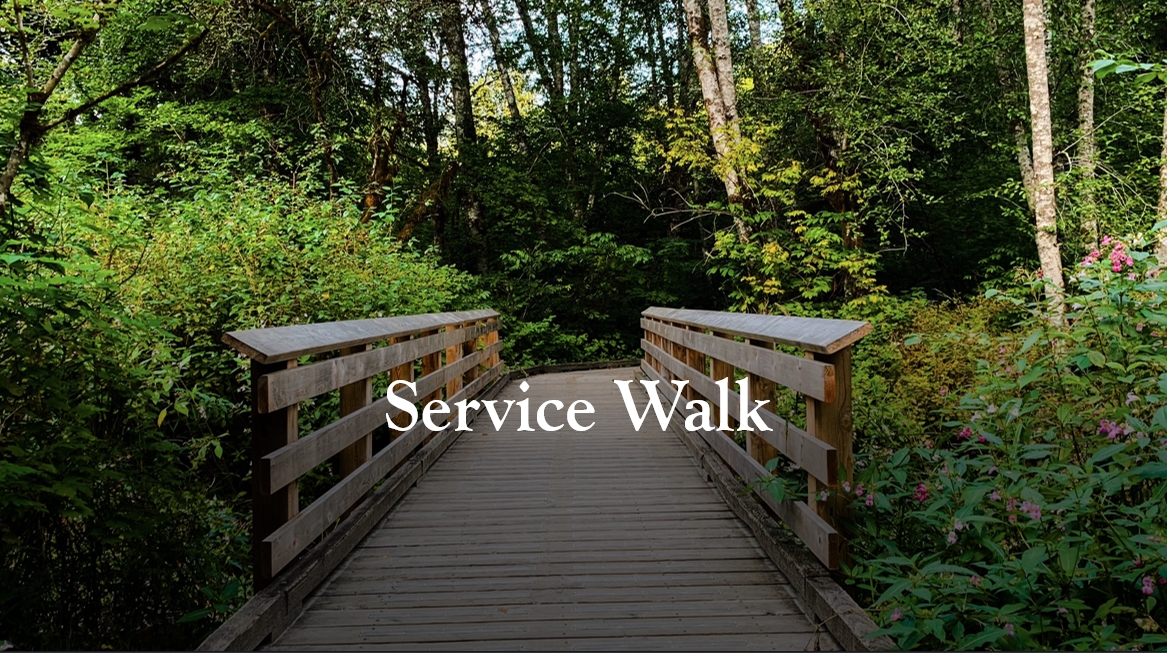
They prepared presentations to give to their peers in order to communicate the needs they discovered. The presentations were open for questions and at the end of each presentation, the class had an open dialogue where they could collectively brainstorm creative solutions to the issues they identified. Example 1: Service-Walk-2.pptxExample 2: Final-Service-Walk.pptx
As part of the Johnston Heights Wellness Expo "Wexpo". Students created a "How-To" speech that they turned into a video that could be shared with other classes as part of the wellness expo.
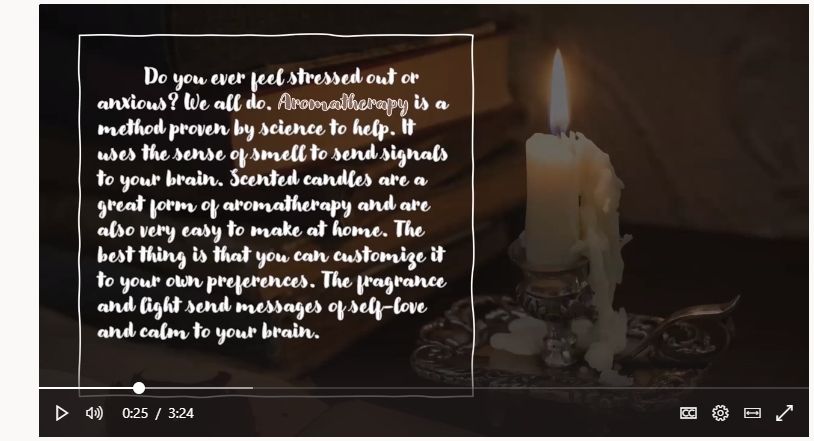
Full video speech:How To Speech
The topics varied from physical heath to mental health and well-being.
The grade 8 Cohort completed an inter-disciplinary unit with design where they used short stories that they wrote in their English class as the basis for their visual imagery using photoshop in their digital design class to compliment their stories. Students read a variety of suspenseful short stories, then analyzed which techniques were the most effective in creating suspense. Students used a planning booklet ( short-story-booklet.docx) to come up with ideas of how they could use these techniques in their own work. They spent time outdoors in a park participating in sensory activities to improve their descriptive writing skills. They also photographed various objects and scenes in the park to use for their photoshop unit. Once students had a draft completed, they shared the draft with other students and completed peer-edits to give and receive feedback before completing the final version(Short-Story-peer-edit-sheet.docx). Once they were completed, the students added their photos to their stories and shared their stories with their peers.
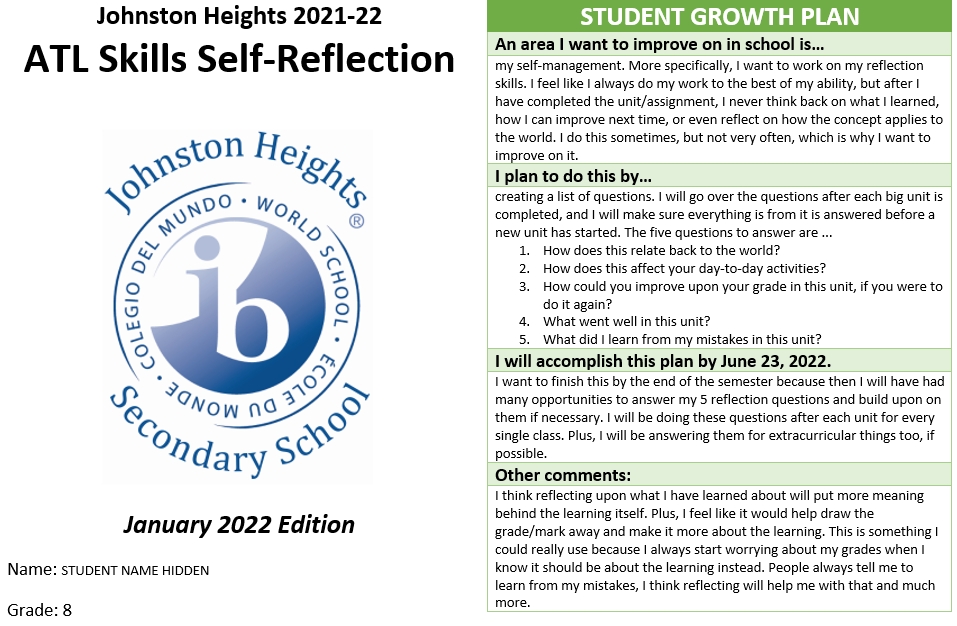
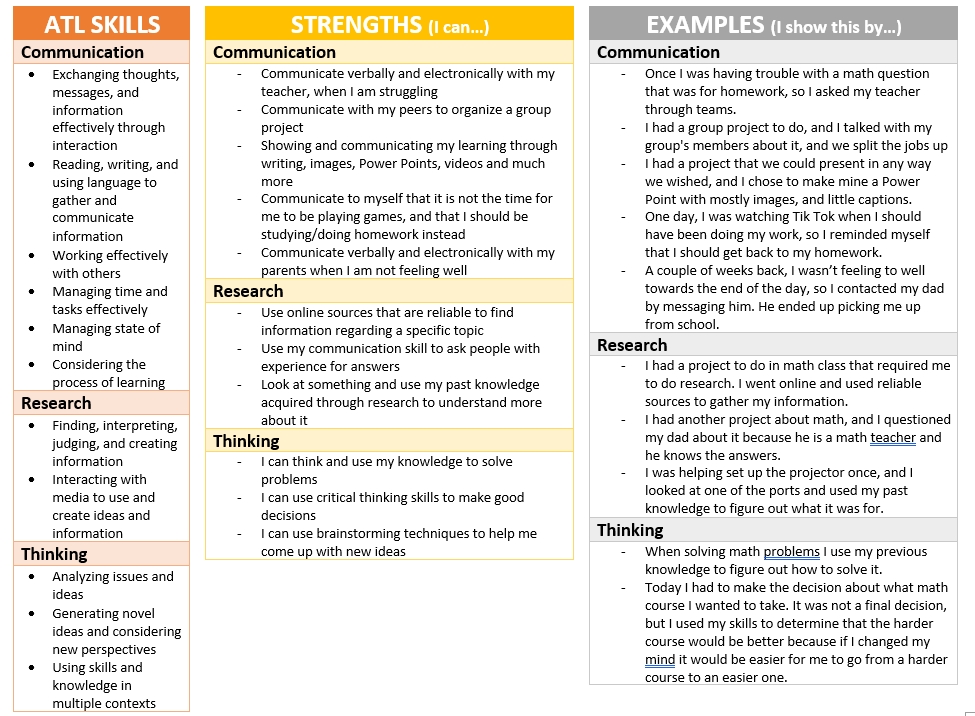
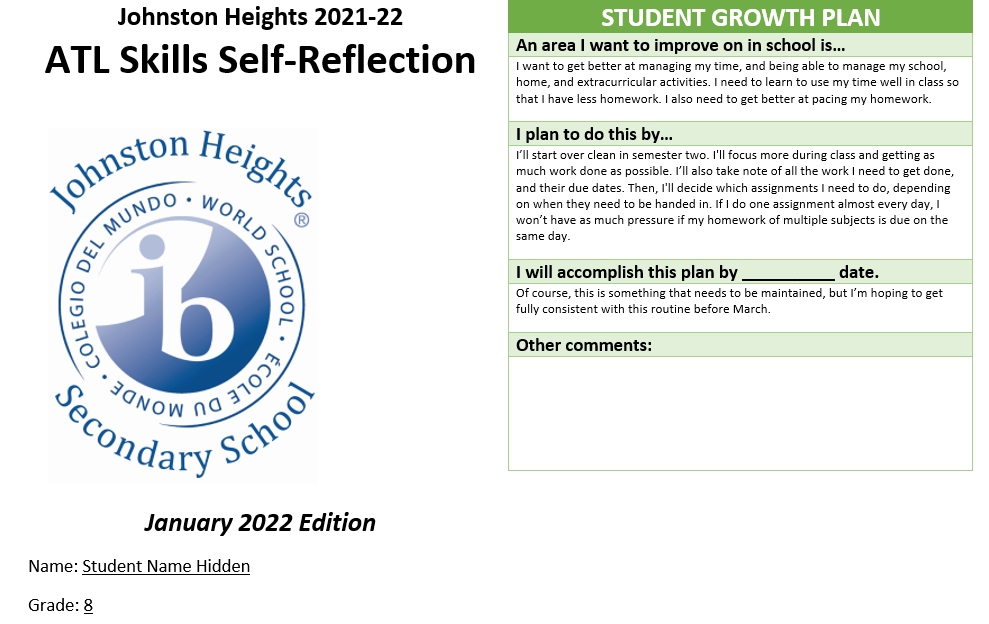
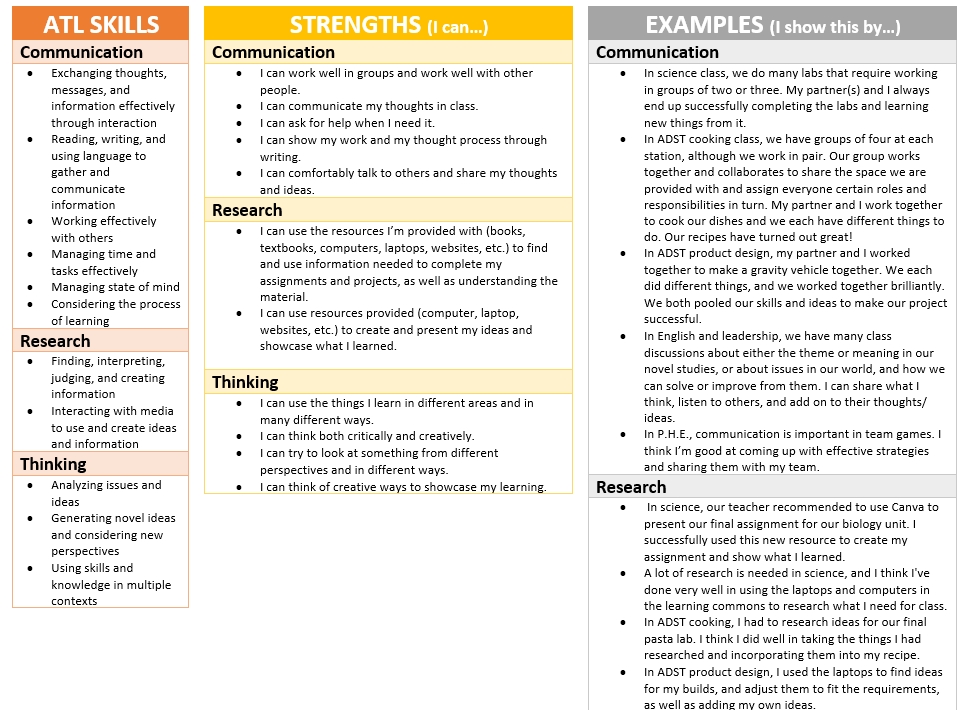
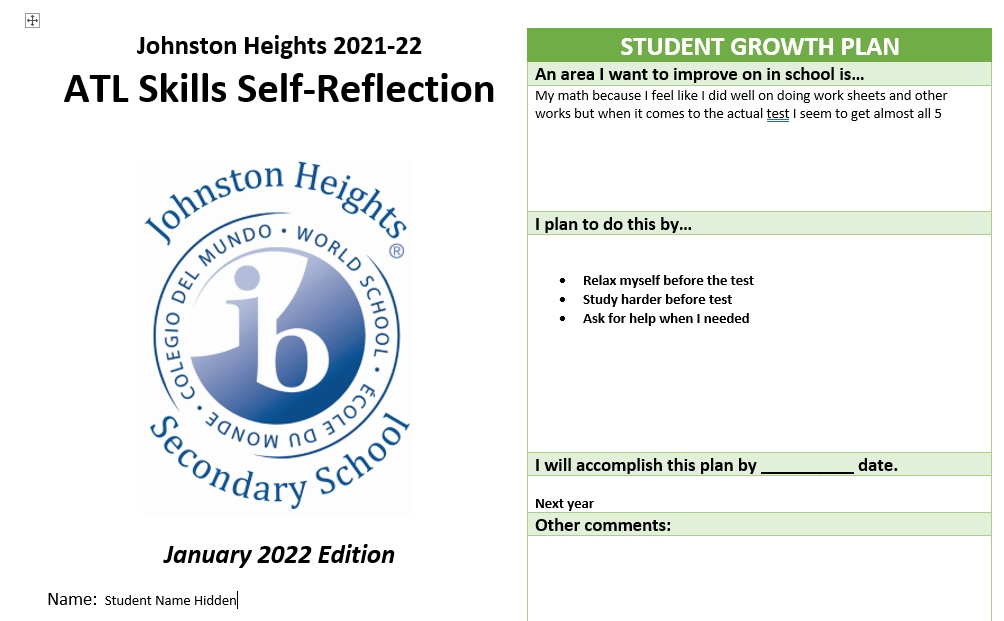
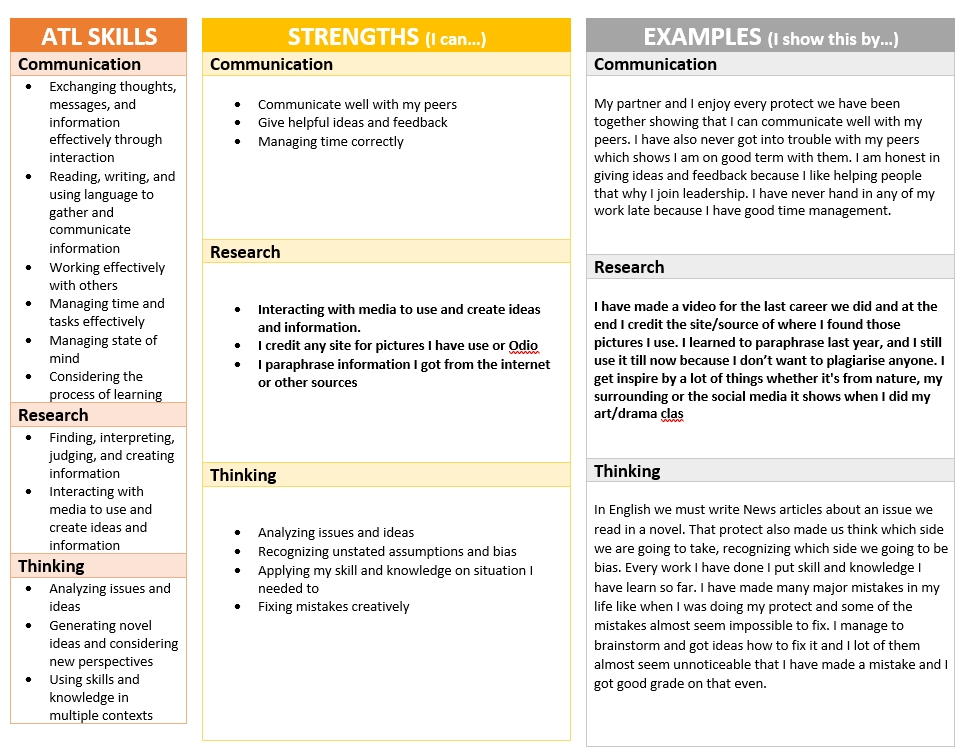
These students also participated in grade-wide ATL reflections which allowed for them to measure their success in the above noted skills as well as other ATL skills. Samples from cohort students.
Student A from Siyam Cohort
Student B from Siyam Cohort
Student C from Siyam Cohort
To continue this exploration
- Students need further instruction and assistance with identifying of their skills when reflecting on class activities
- Further feedback between teacher and student on skills development for reflecting
- Students need to show their work in all their classes to demonstrate giving and receiving feedback that is put into action
- Further exploration on how students can gather and organize relevant information to formulate an argument and draw reasonable conclusions and generalizations
Surrey Schools
Formed in 1906, the Surrey School District currently has the largest student enrolment in British Columbia and is one of the few growing districts in the province. It is governed by a publicly elected board of seven trustees.
The district serves the cities of Surrey and White Rock and the rural area of Barnston Island.