James Ardiel Elementary 25-26

OUR CONTEXT
OUR LEARNERS
OUR LEARNERS
At James Ardiel, we understand that every learner arrives with their own set of strengths, lived experiences, and perspectives. We value these differences and intentionally design learning so all students can access mathematics in ways that feel welcoming and achievable. Our goal is to ensure each student can engage meaningfully with numeracy and feel a strong sense of belonging within our learning community.
We believe that learning mathematics is rooted in curiosity and sense-making. When students are given opportunities to explore ideas, ask questions, and try different strategies, they develop deeper understanding and confidence in their thinking. Through rich tasks and purposeful dialogue, students learn to justify their reasoning, learn from mistakes, and build resilience as mathematicians.
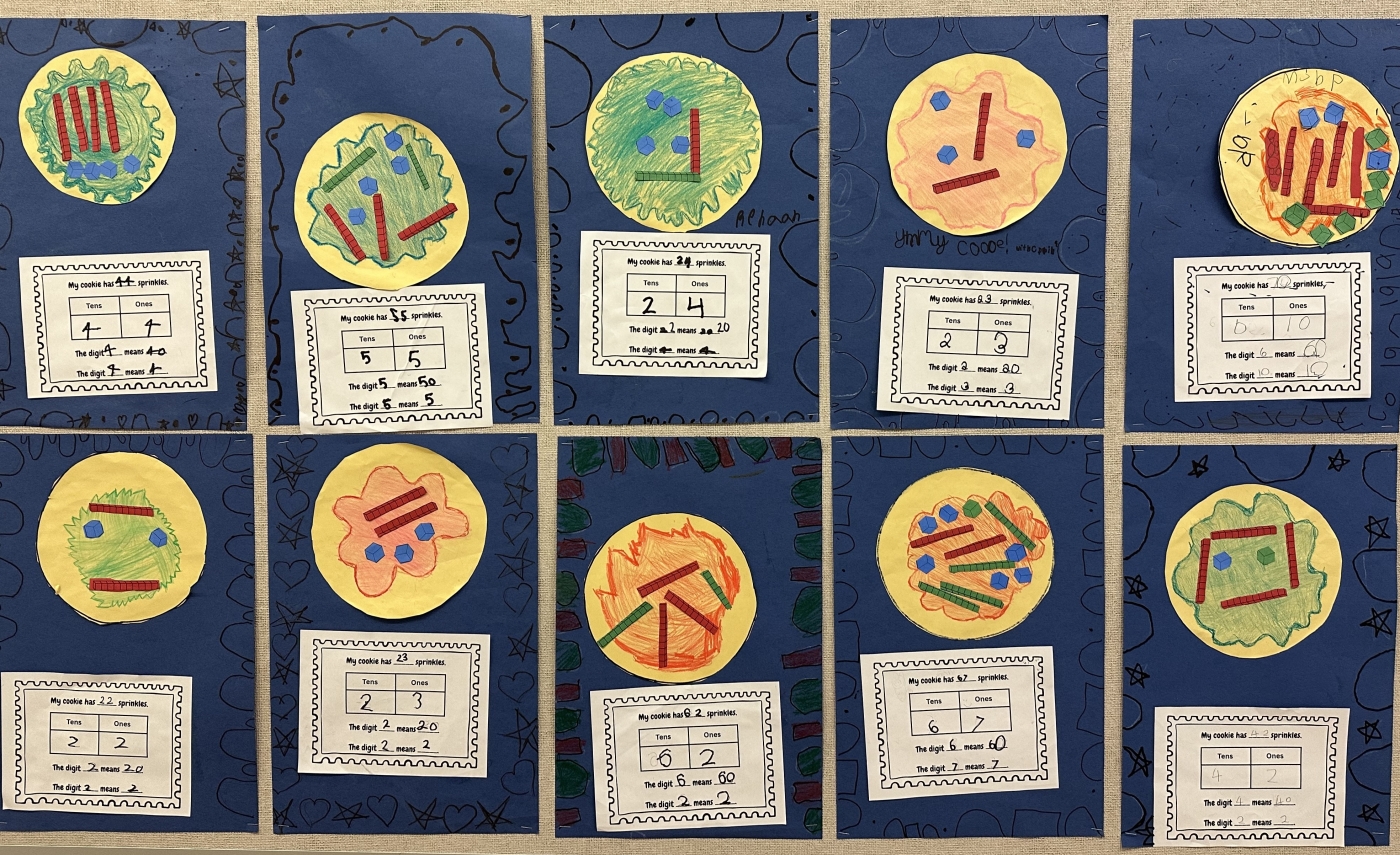
Our learners use base ten block to help them visualize place value and break numbers into manageable parts, allowing them to understand how numbers can be composed and decomposed when adding.
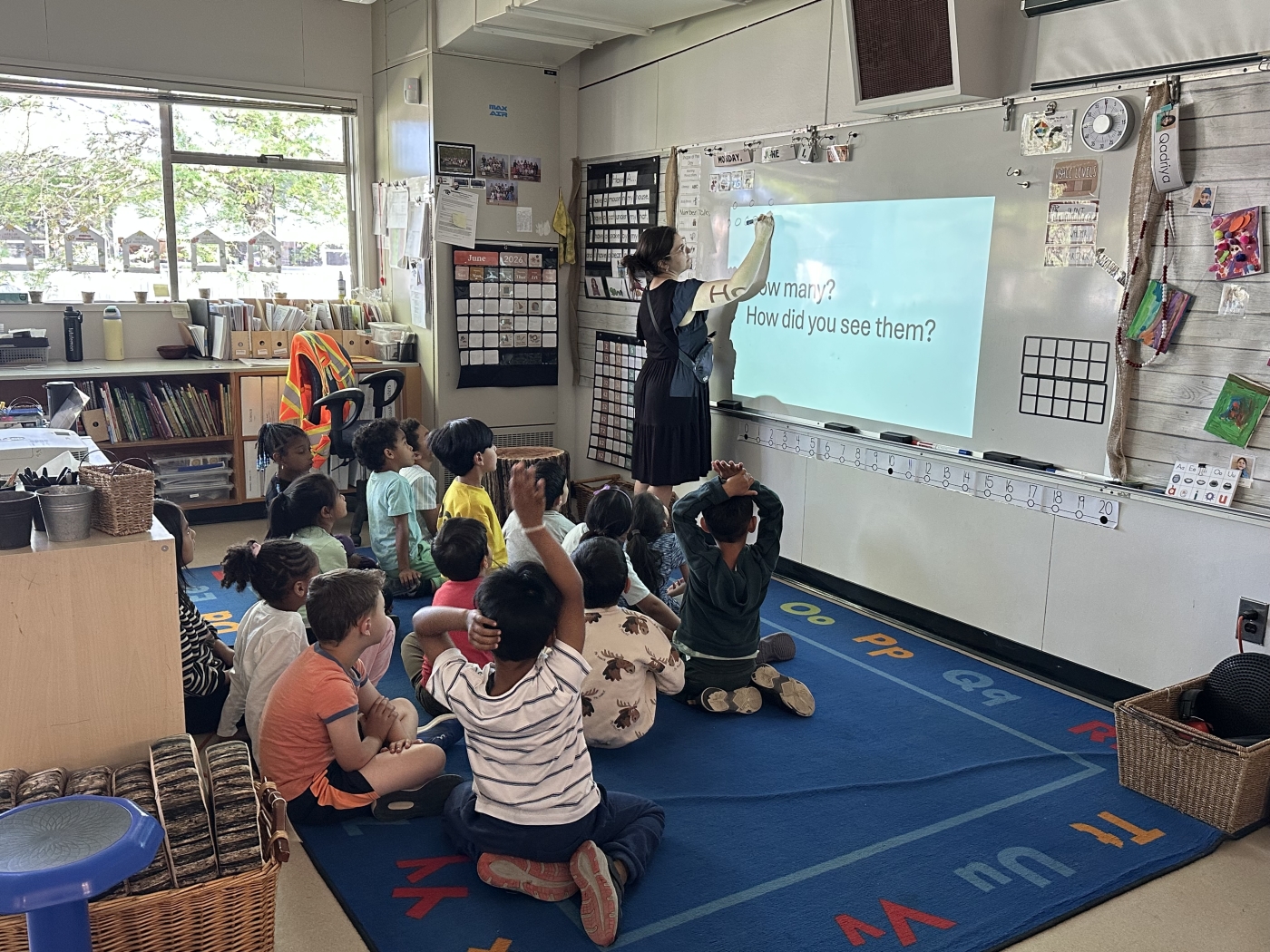
Through regular practice, our learners develop the ability to hold mental images of quantities and describe their thinking while listening to others to deepen their understanding of numbers.
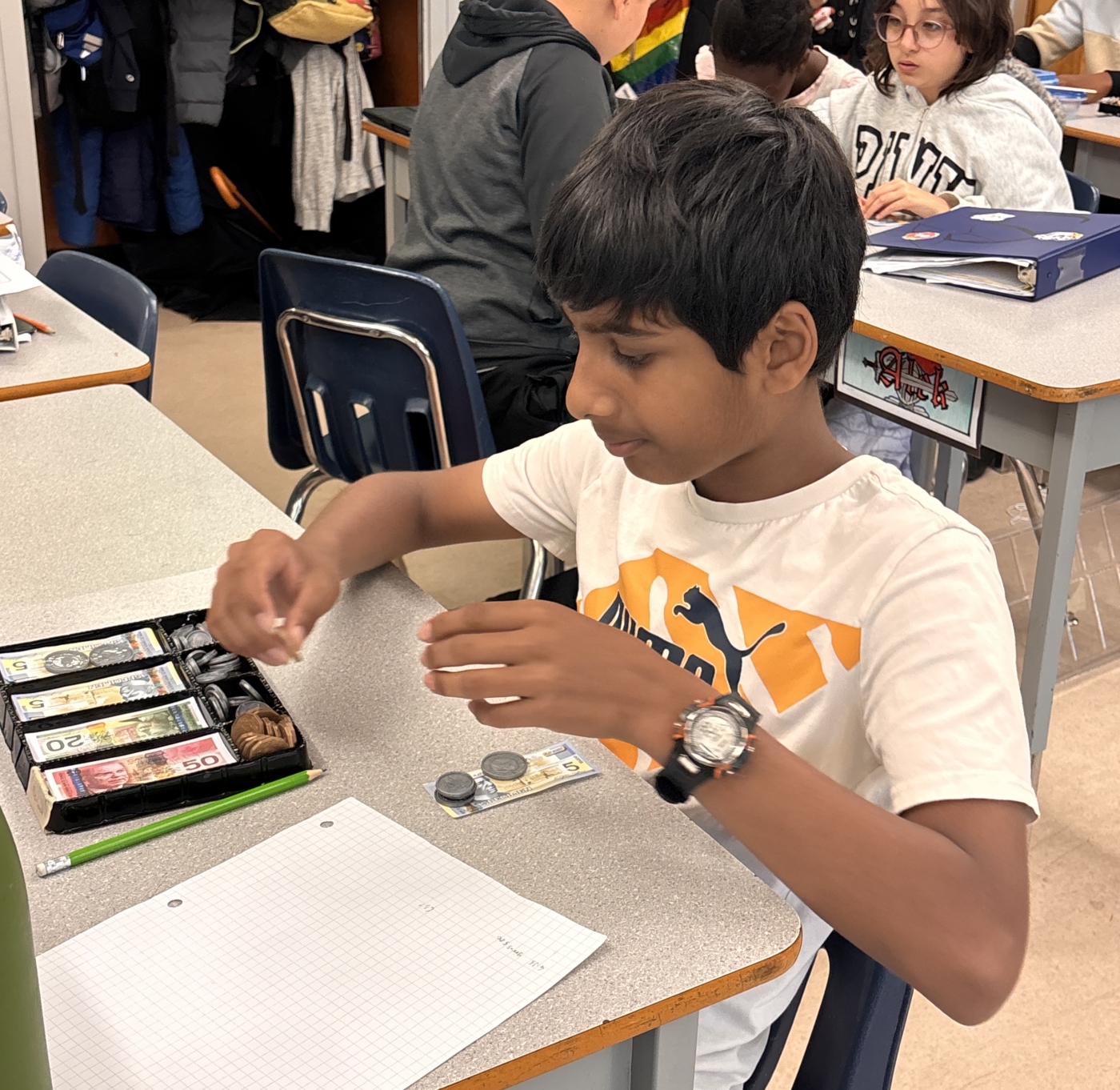
Our learners demonstrate their ability to use and communicate mental math strategies for addition by counting money.
From the early years, our learners begin to understand that mathematics is a way to share and make sense of their thinking. At James Ardiel, students participate in daily learning experiences that focus on communicating, connecting, and reflecting on their mental math strategies. They are encouraged to explain how they solve problems, listen to others’ ideas, and make connections between different strategies and numbers appropriate to their grade level.
Our learners recognize that mathematical understanding grows through practice, reflection, and meaningful conversations. As they work with a variety of addition tasks, they build confidence in using and adapting mental math strategies. They know that talking about their thinking, making connections, and reflecting on what works best helps them deepen their understanding and become more flexible and capable mathematicians.
OUR FOCUS
OUR FOCUS
Educators at James Ardiel provide daily experiences for learners to develop strong, foundational number sense that students will use throughout their lives. Students who have number sense have computational fluency in addition, subtraction, multiplication, and division of whole numbers. Computational fluency refers to having efficient and accurate methods for computing. Students exhibit computational fluency when they demonstrate flexibility in the computational methods they choose, understand and can explain these methods, and produce accurate answers efficiently.
Fluency is a necessary skill in everyday life. For example, mathematical fluency is useful for:
- using mental math to decide the best value while shopping at a grocery store
- estimating a percent when determining a tip
- being able to efficiently solve challenging multistep mathematical problems
Our student’s learning goal:
In Mathematics, students can communicate AND connect and reflect on their mental math strategies for addition to different numbers based on grade level.
NOTE: Mental math involves looking at numbers and knowing how to manipulate them in order to make an equation easier to solve.
All teachers, across all grades provide students with learning opportunities aimed at increasing the numeracy success rates of our learners. To identify overall strengths and areas of growth, we tracked a cohort of learners, including three classes. This cohort included a diverse range of learners that are representative of our school's population.
What did this look like for the cohorts?
Communicating Mental Math Strategies
We have 9 cohort classes and 2 LST teachers participating. Each cohort class of students and small LST groups focused on communicating mental math strategies by engaging in Number Talks three times a week. A Number Talk is a short, on-going daily routine that provides students with meaningful practice with computation. Teachers intentionally selected problems for students to solve. During number talks, students are asked to communicate their thinking when presenting and justifying solutions to problems they solve mentally. Our goal is not to necessarily “teach” the strategies, but rather to foster an environment where students can construct their own understanding. We are careful that we don’t teach the strategies as pieces of information to memorize; instead, we want students to be able to think flexibly when solving problems.
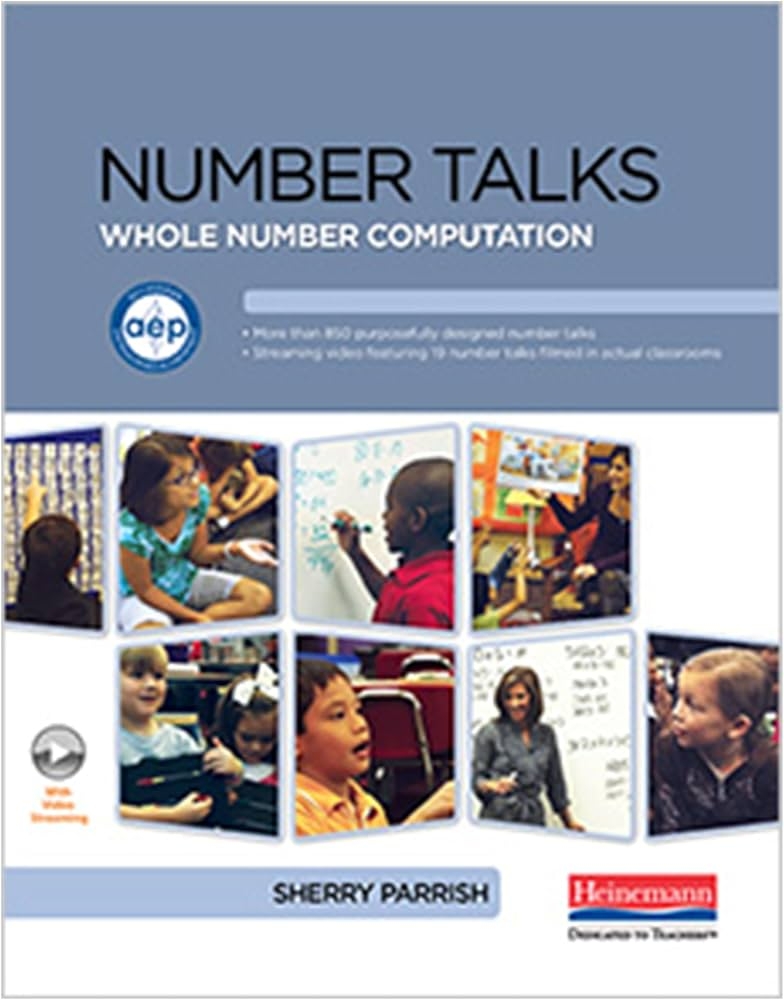
The practice of Number Talks was new to these staff. In August, the James Ardiel Teachers participated in a morning professional development session focussed on Number Talks. Our cohort teachers delved more specifically into Number Talks using Sherry Parrish's book Number Talks to guide their practice.
In the image below you can see one of our cohort classes engaged in a number talk.
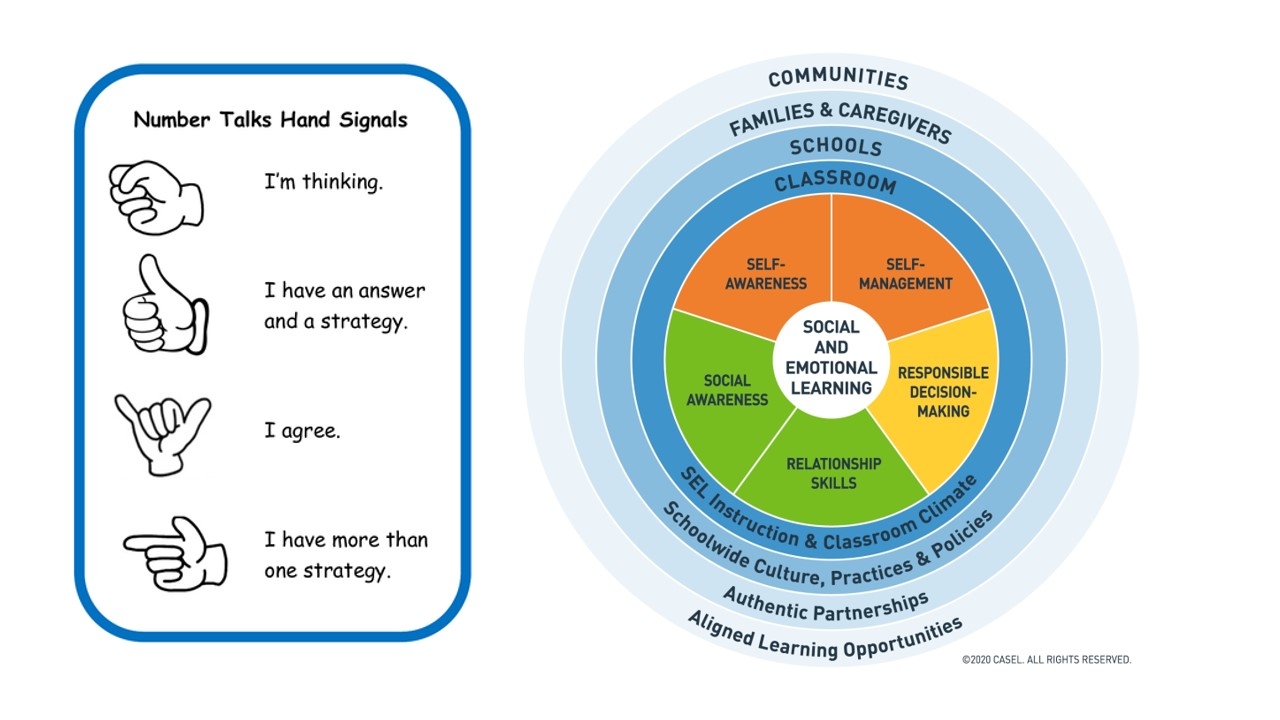
Our educator's created safe learning spaces for students to engage in communicating mathematical thinking. Teachers ensure that they provide significant wait time after posing a question and many of our staff request that students use "secret signals" to communicate with them. By using silent signals (e.g., placing their hands at their chests), teachers hope to decrease potential anxiety that can occur when students see that other's have an answer and they are still thinking.
Connecting and Reflecting on mental math strategies
All our students are provided opportunities to reflect upon their mathematical thinking. When students engage in math experiences that include time to reflect on their reasoning and the thinking of others they are more likely to become self-reflective. They become better at thinking and making connections to other mathematical concepts and contexts.
The teachers of our cohort classes specifically use "Talk Moves" to help them facilitate reflective conversations.

Through these reflective discussions, the cohort teachers provide opportunities for students to:
- Clarify their thinking
- Investigate and apply mathematical relationships
- Build a repertoire of efficient strategies
- Make decisions about choosing efficient strategies for specific problems
- Consider and test other strategies
OUR NEXT STEPS
OUR NEXT STEPS
Evidence of Student Learning
This year at James Ardiel, our focus is on strengthening students’ ability to communicate, reason, and make connections, with an emphasis on developing flexible and efficient mental math strategies.
This work will be supported through explicit instruction and meaningful opportunities for students to engage in collaborative mathematical thinking. Our goal is for every student to build mathematical understanding by communicating and representing their thinking, using precise mathematical vocabulary, and engaging in mental math strategies through Number Talks. During these routines, students reason and analyse different approaches, make connections between strategies, and reflect on the efficiency of their thinking. Students are encouraged to visualize mathematical concepts in multiple ways and justify their solutions with clear and logical reasoning.
Evidence gathered from our 8 cohort classes, demonstrates that our numeracy focus is positively impacting student learning. Using Number Talks routines has helped educators foster classroom communities where student voice is valued, thinking is made visible, and multiple strategies are explored and compared. Students are increasingly willing to take risks, communicate their reasoning, and learn from one another.
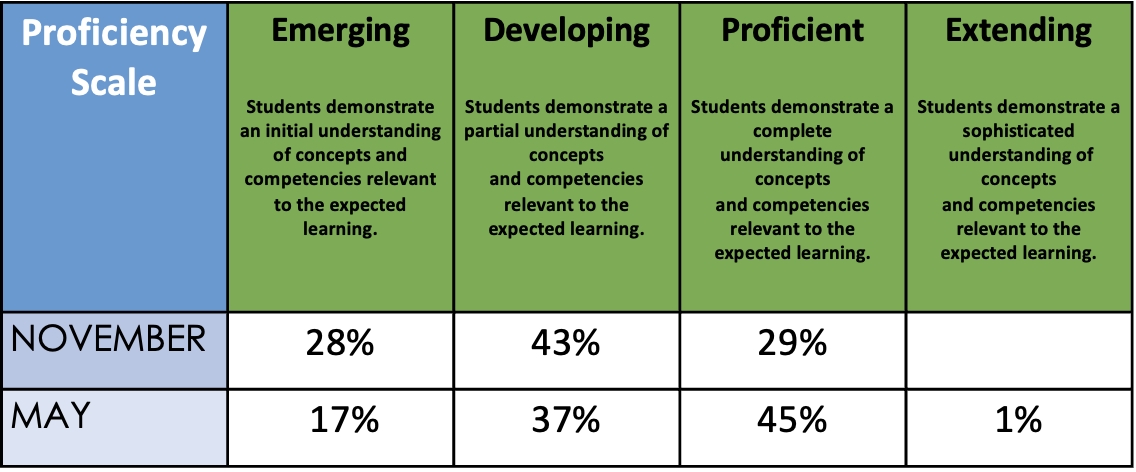
The following chart illustrates this growth. In the competency of communicating, connecting and reflecting on their mental mathematical understanding of Mental Math Addition Strategies at their grade level, we observed a 16% increase in the number of students identified as “proficient,” rising from 29% in November to 45% in May. There was also a steady reduction in the number of students working at the “emerging” level (11% decrease) and “developing” level (6% decrease).
Moving Forward
Educators will continue to embed Number Talks routines within mathematics instruction, extending beyond mental math addition to include subtraction, and in the intermediate grades, multiplication and division.
We will also intentionally create more opportunities for students to develop and use precise mathematical vocabulary so they can communicate and represent their thinking with clarity and confidence.
Areas for continued growth. Students will:
- Continue to apply and compare multiple strategies to solve problems
- Explore more ways to represent their thinking using manipulatives, models, and visual supports
- Develop increasingly efficient and accurate mental math strategies
- Select strategies that are appropriate and effective for the context of the problem
Surrey Schools
Formed in 1906, the Surrey School District currently has the largest student enrolment in British Columbia and is one of the few growing districts in the province. It is governed by a publicly elected board of seven trustees.
The district serves the cities of Surrey and White Rock and the rural area of Barnston Island.