Hjorth Road Elementary 25-26

OUR CONTEXT
OUR LEARNERS
At Hjorth, our school-wide focus is on reading, because we believe that strong reading skills open doors to every other area of learning and full participation in society. In our wonderfully diverse community—where 86% of students speak a language other than English at home—literacy is more than just learning to read; it’s about building confidence, connecting cultures, and empowering every child to thrive academically and socially. By prioritizing reading, we ensure that all students have the tools they need to succeed in English while honouring the rich linguistic and cultural backgrounds that make our school so unique.
Our students are encouraged to connect and engage with others, express themselves clearly, and collaborate effectively.
Creating opportunities for students to connect, express themselves, and collaborate is essential for building a positive classroom community and developing lifelong communication skills. Daily activities that promote interaction help children learn to listen actively, share ideas clearly, and work together toward common goals. By incorporating structured routines and engaging tasks, educators foster an environment where every student feels valued, confident, and ready to contribute. The following strategies provide practical ways to encourage meaningful connections and teamwork in the elementary classroom.
Triangle Talk: Estimation in Action
Students gathered around the Black History Month display in a semi-circle, engaging in a collaborative estimation activity that encouraged both mathematical thinking and meaningful conversation. As they considered how many triangles were on the board, students shared their strategies, explained their reasoning, and listened to different perspectives from their peers. This interactive approach fostered curiosity and collective problem-solving, as learners practiced expressing their ideas clearly while building on one another’s thinking. The activity not only strengthened numeracy skills but also created an inclusive space where all voices could be heard and valued.

Collaborative Numeracy Through Partner Games
In a Grade 3 classroom, students engaged in a numeracy game called Race to 1000, where they rolled a die and chose values of 1, 10, or 100 to build toward a target number. After each turn, students stated their running total, supporting one another in reading and expressing numbers correctly using place value language. As students developed confidence, they extended the game by using subtraction to count back to zero. This example highlights how structured math games provide opportunities for students to strengthen their understanding of place value while building communication skills, collaboration, and peer support.

Our students are encouraged to build positive personal and cultural identity by understanding themselves and respecting diversity.
At Hjorth Road, we believe that understanding oneself and appreciating the richness of diversity are essential foundations for personal growth and community well-being. We encourage students to explore their own identities—recognizing their strengths, values, and cultural heritage—while learning to respect and celebrate the unique perspectives of others. By fostering empathy, inclusivity, and a sense of belonging, we help students develop positive personal and cultural identities that prepare them to thrive in a diverse and interconnected world.
First Peoples in Residence: Building Cultural Understanding
The following images highlight learning from the First Peoples in Residence program, where cultural facilitators worked alongside students to provide meaningful, hands-on experiences grounded in First Peoples’ knowledge and traditions. Through these opportunities, students deepened their understanding of Indigenous culture, perspectives, and ways of knowing in an authentic and respectful context. The learning culminated in a closing ceremony, where classes shared their experiences and reflections, demonstrating their growing awareness, appreciation, and connection to First Peoples’ culture and community.

Sacred Ties: Strengthening Indigenous Identity and Belonging
Sacred Ties provides an opportunity for Indigenous students in Grades 6 and 7 who will be attending Guildford Park Secondary to connect with one another and learn more about Indigenous culture. As part of the Guildford Park family of schools, different schools host gatherings, giving students opportunities to build relationships across sites while engaging in meaningful cultural learning experiences. The program supports students in strengthening their sense of identity, developing a sense of belonging, and building confidence as they prepare for their transition to secondary
Our students practice social responsibility by building empathy, contributing to community, and resolving conflicts constructively.
At our school, students actively practice social responsibility by developing empathy, engaging in meaningful contributions to their community, and learning to resolve conflicts in constructive ways. These skills not only foster a positive and inclusive environment but also prepare students to become thoughtful, responsible citizens who value collaboration and respect. Through these practices, we empower learners to make a difference both within and beyond the classroom.
Morning Meetings
Morning Meetings are daily gatherings where students greet each other, share ideas, and build connections. They foster empathy by encouraging listening and understanding, strengthen community through collaboration, and provide a safe space to practice respectful conflict resolution—helping students grow as responsible, caring members of the classroom.
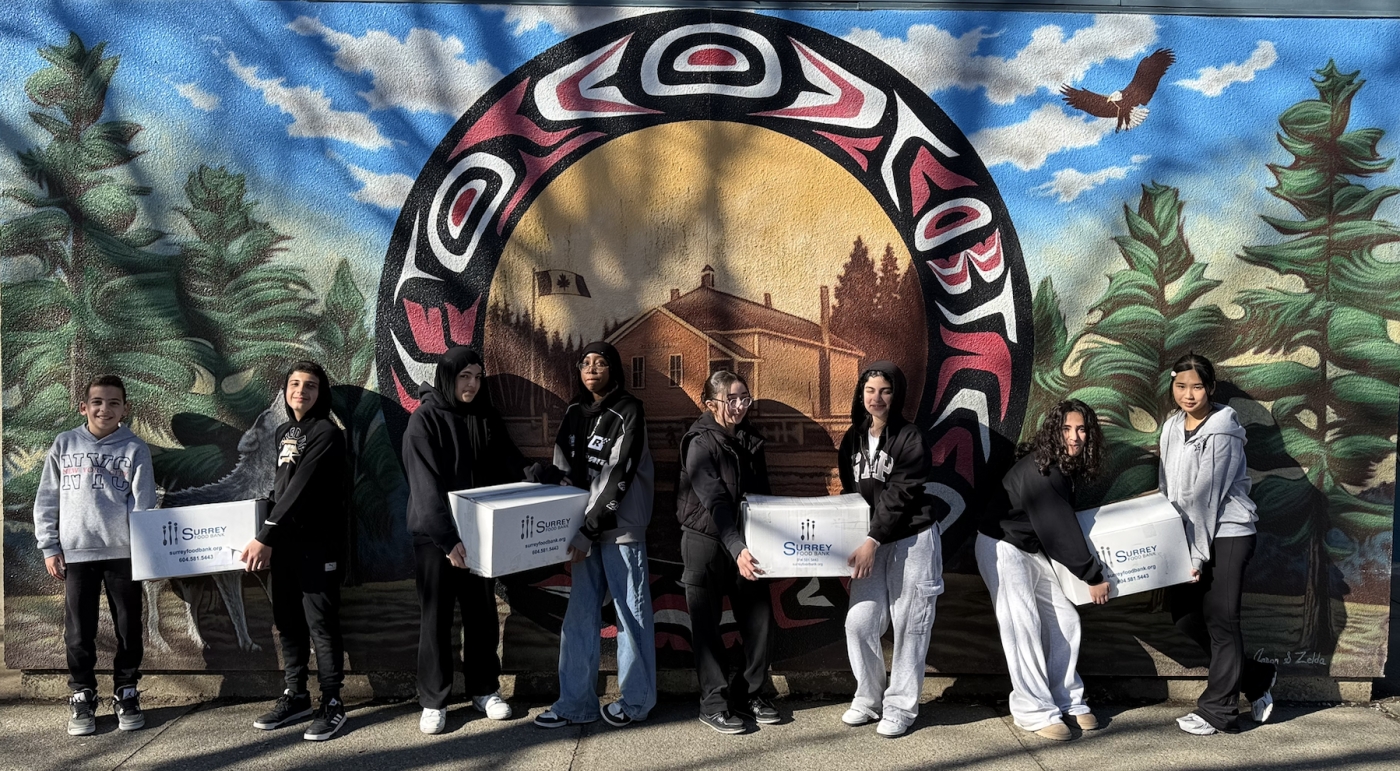
Collecting for Surrey Food Bank
Collecting for the food bank teaches students the value of helping others and strengthens their sense of community. By working together to support families in need, students practice empathy and learn that their actions can make a positive difference. This shared effort also encourages cooperation and responsibility, key skills for resolving challenges constructively.
Student Leadership Through Environmental Stewardship
During ADST learning connected to Earth Day, students worked collaboratively in small groups to design and create windchimes and other decorative pieces using recycled materials. Through this hands-on project, students demonstrated social responsibility by repurposing materials, contributing to the beautification of shared school spaces, the breezeway, and working together to achieve a common goal. This experience fostered a sense of pride, environmental awareness, and community contribution, while also strengthening their ability to cooperate, problem-solve, and consider the impact of their actions on others.

Buddy Classes
Buddy Classes pair older and younger students to learn and work together. These partnerships build empathy as students support and understand each other, strengthen community through shared activities, and teach cooperation and problem-solving—key skills for resolving conflicts respectfully.

School Garden
Our new school garden gives students hands-on opportunities to care for living things and work together toward a shared goal. This initiative builds empathy through understanding nature and each other, strengthens community by fostering teamwork, and teaches cooperation and problem-solving—skills essential for resolving conflicts constructively.

As we reflect on the many opportunities our students have had this year—from collaborative math games and meaningful morning meetings to learning alongside First Peoples in Residence, participating in Sacred Ties, and supporting the Surrey Food Bank—we are proud of the growth they have shown as communicators, community members, and learners. These experiences have helped students strengthen their ability to connect with others, develop a positive sense of identity, appreciate diverse perspectives, and contribute responsibly to their school and community. By continuing to nurture these core competencies, we are helping students build the skills, confidence, and understanding they need to thrive both in school and beyond.
OUR FOCUS
This year, we are continuing the important work we began last year—strengthening the foundation of reading for all our students. Our focus remains on mastering the basics—developing fluency, comprehension, and confidence—while expanding vocabulary to support deeper understanding. By prioritizing these essential skills, we aim to empower students to become lifelong readers who can access, interpret, and enjoy a wide range of texts. Through intentional practice and engaging activities, we are creating a learning environment where every child can grow as a reader.
Effective reading instruction is built on five essential components: phonemic awareness, phonics, fluency, vocabulary, and comprehension. While each area plays a critical role in developing strong readers, this year we are choosing to monitor fluency as a key indicator of student progress. By tracking fluency, we can better understand where our students are in their reading journey and evaluate how instruction in all five components is contributing to improved overall reading skills across our school.
Our focus aligns with the following Big Ideas that guide K–7 instruction in the BC Curriculum:
K - 3
4 - 7
Our goals are for the students to:
- Increasing reading fluency at grade level (look at curricular competencies

- phonemic and phonological awareness
- Phonological refers to the sounds of words (as opposed to their meanings):
- Phonemic awareness is a specific aspect of a learner’s phonological awareness: a child’s ability to segment spoken words into phonemes (e.g., c / a / t) and to blend phonemes into words indicates a developing phonemic awareness.
- Phonological awareness involves the abilities to hear and create rhyming words, segment the flow of speech into separate words, and hear syllables as “chunks” in spoken words.

What do the patterns in the data tell us about which students need us to change our practices the most
- reading strategies
using illustrations and prior knowledge to predict meaning; rereading; retelling in own words; locating the main idea and details; using knowledge of language patterns and phonics to decode words; identifying familiar and “sight” words; monitoring (asking: Does it look right? Sound right? Make sense?); self-correcting errors consistently using three cueing systems: meaning, structure, and visual
OUR NEXT STEPS
what will be the new normal in September - ( what will we be doing by the end of the year the reflects our learning this year and will be become our new normal in September. (talk about this in June but then also in Sept -
are we considering all learners-
Surrey Schools
Formed in 1906, the Surrey School District currently has the largest student enrolment in British Columbia and is one of the few growing districts in the province. It is governed by a publicly elected board of seven trustees.
The district serves the cities of Surrey and White Rock and the rural area of Barnston Island.