Hillcrest Elementary 25-26

OUR CONTEXT
Hillcrest Elementary is located in the Clayton/Cloverdale area of Surrey on the shared traditional territories of the q̓ic̓əy̓ (Katzie), q̓ʷa:n̓ƛ̓ən̓ (Kwantlen), and SEMYOME (Semiahmoo) First Nations. We recognize and honour the enduring connection Indigenous Peoples have to this land, water, and community. We are grateful to come to Hillcrest each day to work, learn, and play.
At Hillcrest, we believe that a strong sense of belonging is foundational to learning. We are committed to creating a safe, inclusive, and welcoming environment where every student feels seen, valued, and supported. We strive to nurture the social, emotional, and academic growth of all learners while supporting student voice, identity, and well-being.
Our school community values collaboration, inclusion, and strong relationships between home and school. Our learners benefit from a variety of opportunities such as athletics, leadership initiatives, social-emotional learning and inclusive classroom practices. At Hillcrest, every student is encouraged to develop confidence, curiosity, and responsibility as learners and citizens.
Highlights of our learning community include:
Belonging and Identity
At Hillcrest, we are all “Titans.” This shared identity helps us cultivate a sense of belonging and reflects the qualities we aim to nurture and celebrate within our school community. Our goals for positive student behaviour are embedded in our “Titan Shield." Titans strive to be Kind, show Respect, take Ownership, and Persevere, which are rooted in Indigenous ways of being.

Monthly Assemblies
Students are the stars of our monthly assemblies. Our assemblies are a special opportunity for students to lead, share their learning and voices, celebrate one another, and build a strong sense of community together.
Student Leadership
Our school strives to offer a variety of ways to foster leadership and social responsibility in our students. Student leadership opportunities include Technology Team, Public Speaking, Intramurals Team, Equipment Room, Spirit Team, School Improvement, Student Voice, Photos/Slideshow/Year Book Team, Peer Monitors, Odd Jobs, and Lunch Monitors.
Student Teams and Clubs
We provide students with a variety of opportunities to connect with peers, explore their interests, and get involved in school life. These experiences help students build friendships, develop new skills, and strengthen their sense of belonging within our school community. We offer Intramurals, Crochet Club, Volleyball, Cross-country, Basketball, Badminton, Track and Field, Primary Choir, the Bike Bus, Learning Coaches.
Equity, Diversity, Belonging
At Hillcrest, we value the diversity of our school community. Staff collaborate to bring the district Equity, Diversity, and Belonging calendar into our learning and celebrations. We aim for our students to see their identities, cultures, and experiences reflected in their learning and throughout the school year.
Indigenous Learning
Our school is committed to deepening Indigenous learning through meaningful experiences that build relationships and honour the First Peoples of these lands. Throughout the year, students have engaged in learning that celebrates Indigenous voices, cultures, and ways of knowing. Initiatives such as Bannock and Books brought students together through storytelling and shared food, fostering connection and a sense of belonging. Students also had the opportunity to meet an Indigenous author, experiencing authentic stories and perspectives firsthand. In addition, our entire school recognized National Indigenous Peoples Day and invited to learn about and celebrate the rich cultures, histories, languages, and contributions of First Nations, Inuit, and Métis Peoples, with students also enjoying bannock as part of the day's learning and celebration.
PAC
Hillcrest's Parent Advisory Committee (PAC) is a valued partner in supporting our school community. Through fundraising initiatives such as school community events and fun lunch programs, the PAC helps provide enhanced learning opportunities and experiences that enrich school life for all students.
OUR LEARNERS
Our learners
Strong literacy skills are essential for success in school and in life. Writing is a powerful tool for communication, critical and creative thinking, and personal growth. Through writing, students learn to communicate their ideas, reflect on their experiences, and deepen their understanding of themselves, their families, and their communities. As students grow in confidence as writers, they become more engaged learners who are better able to take ownership of their learning and communicate their thinking in meaningful ways.
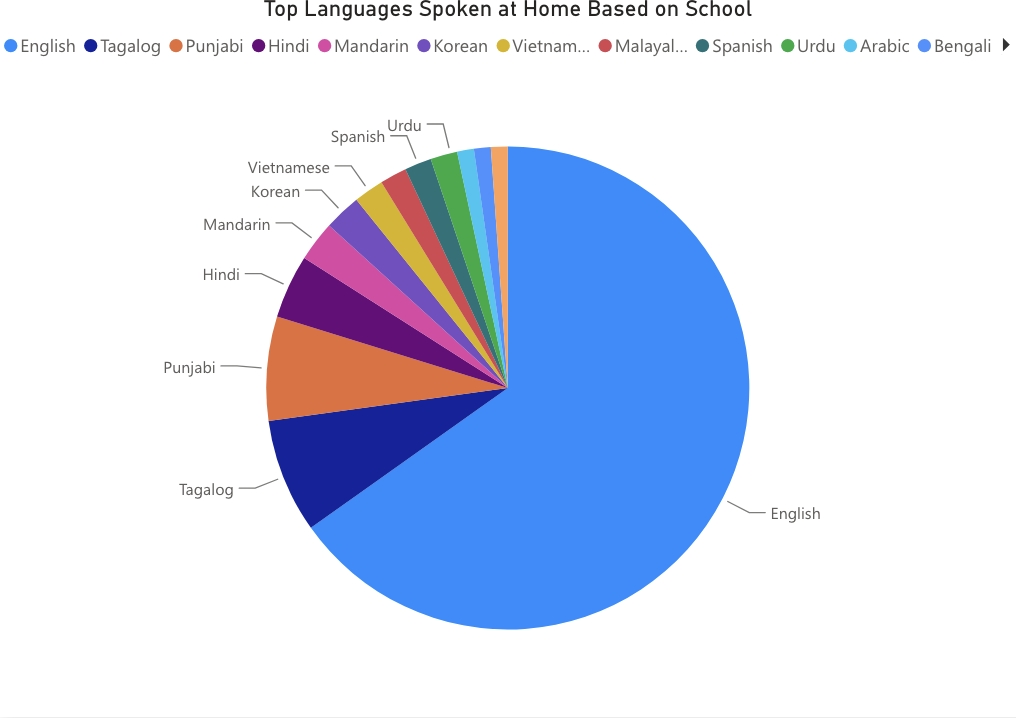
Hillcrest Elementary is a diverse and inclusive learning community that is part of the Surrey School District. We serve approximately 500 diverse learners from Kindergarten to Grade 7 with 39% of our students speaking a language at home other than English, bringing rich cultural and linguistic diversity to our school community. Supporting students in developing strong writing skills is an important part of helping all learners access the curriculum and communicate their thinking with confidence.
In the fall, teachers administered a school-wide writing assessment and used the BC Performance Standards to assess student writing. Analysis of the data indicated a continued focus on writing was needed across the school.
Furthermore, our teachers know and understand that assessment, instruction, and environment are interconnected. This lead our teachers to wonder...
How can we empower our students to be motivated, take greater ownership, and persevere in the area of writing?
OUR FOCUS
Our Focus - Empowering Writers
We know and understand that assessment, instruction, and environment are interconnected. Accordingly, teachers learned and implemented instructional strategies to build on existing writing practices, support student learning and growth, and strengthen clarity and consistency in assessment.

Proficiency Scales:
Some of our teachers worked to develop proficiency scales in the area of writing alongside district helping teachers to deepen their understanding of meaningful assessment and writing instruction.
Proficiency scales based on a single curricular competency establish a common understanding of quality writing by making learning goals and success criteria clear for students.
They support teachers in planning targeted writing instruction, providing consistent feedback, identifying next instructional steps, and making consistent, evidence-based assessment judgments.
For students, they unpack what "proficient" means, make learning visible so that students understand what they are working toward , fostering greater ownership throughout the writing process.
In grade groups, teachers collaborated and developed proficiency scales in the area of writing.


Teacher Reflection - When we break down the curricular competencies for students and really clarify what "Proficient" means at their level and in their language, you see that students are more motivated to get started, they know what they need to do, you start to hear questions like "did I do this right?" or comments like "I've got 4 transitions words in my paragraph!" makes a difference for sure.
 Responding to Writers
Another group of teachers took part in a book club using the text, "How to become a better writing teacher" by Carl Anderson and Matt Glover. Teachers learned about and implemented a variety of research based responsive writing practices.
Key practices such as "conferencing" were implemented. For example, a grade 3/4 teacher met with students one to one throughout the year, providing descriptive feedback to help students reflect and build awareness
Teacher Reflection - “I have loved the opportunity to conference one-on-one with my students. It has helped me take a more strengths-based approach to their writing, and it allows me to offer them encouragement and specific feedback both on what they are doing well, and what they can continue to work on.”
Teacher Reflection - “Conferencing is how I give my best feedback. I think they get the most out of it when they hear it out loud.”

Student Reflection - “I think teacher feedback is pretty helpful because it will tell me things that are good in my writing so I can use it more. I’ve started using way bigger words and sophisticated sentences. The teacher gave me really good recommendations for what I could add to my TED talk when she sat down and talked to me. She suggested another study I could use and how I could connect it to my essay.” A- Gr 7
Student Reflection - “I’m working on making the conclusion stronger and organizing into sections. I have improved on organization but not to the point I want to improve. Next steps are letting my peers read through my work and give suggestions and definitely listening to my teacher’s feedback.” B Gr 7
Mentor texts
“One way people learn is by studying what more skilled people do… one of the best ways for students to learn writing is to study what more experienced writers do.”
— Anderson & Glover, How to Become a Better Writing Teacher, p. 6
Teachers select or curate mentor texts as models for writing. Students analyze high-quality texts to identify writing strategies such as voice, structure, and word choice to develop their writing craft.
Teacher reflection - “Using a variety of mentor texts as examples has been incredibly helpful in highlighting what good writing sounds like. It also gives them ideas and inspiration for their own writing. Students have begun to incorporate the tools and techniques used by the authors into their own writing.”
 "I Am Every Good Thing" by
Derrick Barnes and Gordon C. James
Student Reflection - “Getting taught by my teacher helps me. I like when she reads stories and points stuff out in the stories. It helps me by knowing what is right to do because I know what our goal is and then I do the goal.” A-Grade 4
 "I Talk Like A River" by Jordan Scott and Sydney Smith

Student Reflection - “I just enjoy reading and when I write my brain connects to what I’ve read to get different ideas and words to use…Getting examples gives me an idea of the standard and I can use them to figure out what more I can do or how to make my writing match well.” A- Gr 7

Explicit Instruction - Several of our other teachers used explicit instruction to teach students writing strategies such as organizing ideas, using descriptive language, varying sentence structure, and revising for clarify. Small group instruction, guided practice have become essential practices. Responding to text tasks is students will respond to literature through narrative, persuasive, reflective or information writing, drawing on their reading to inform their ideas and style. Grade 3/4 students find joy in sharing about their learning to their parents in weekly "learning letters."
OUR NEXT STEPS
Focus: Empowering Writers
Our focus has been empowering writers to be motivated, take greater ownership, and persevere in the area of writing. This goal matters because we are providing our students with learning experiences and helping our students to build skills that will serve them in school and in life beyond school.
Evidence of student learning relating to the curricular competencies identified below is gathered through School-Wide Writes. The writes were conducted in 17 classes in the Fall and again in the Spring. The writing theme, family, had been provided as a guideline as teachers know their learners best and were welcome to use a more topic that suited their learners best.
Curricular competencies:
- Our students can create stories and other texts to help us understand/deepen awareness of ourselves, family, and community
- Our students can communicate using sentences and most conventions of Canadian spelling and grammar
Direct Evidence of Growth Over Time - School-Wide Writes
School-Wide Write data provides direct evidence of student learning across grades and helps us identify areas of strength and next steps for instruction. We use this data because it is consistent across all classes, is assessed using BC Performance Standards, and provides a clear way to track growth in writing from fall to spring. It also supports teachers in identifying specific areas of focus, such as meaning, style, form, conventions, for their students and helps ensure instruction is responsive to student need.
The table below reflects the growth demonstrated and the positive impact of our intentional focus on writing instruction across grades.

School Wide Write Data
The Surrey School District proficiency scale is included below and provides clarity around the criteria for each performance level.


When examining the data across grade levels from above, we see:
- Emerging proficiency decreased consistently
- Strong movement toward Proficient across all grades, particularly in grades 1 - 4
- More modest Proficient growth in intermediate grades 5–7
- Developing proficiency decreased across most grades
Extending proficiency increased notably in Gr 2 and Gr 5
Direct Evidence of Growth Over Time - Writing Samples
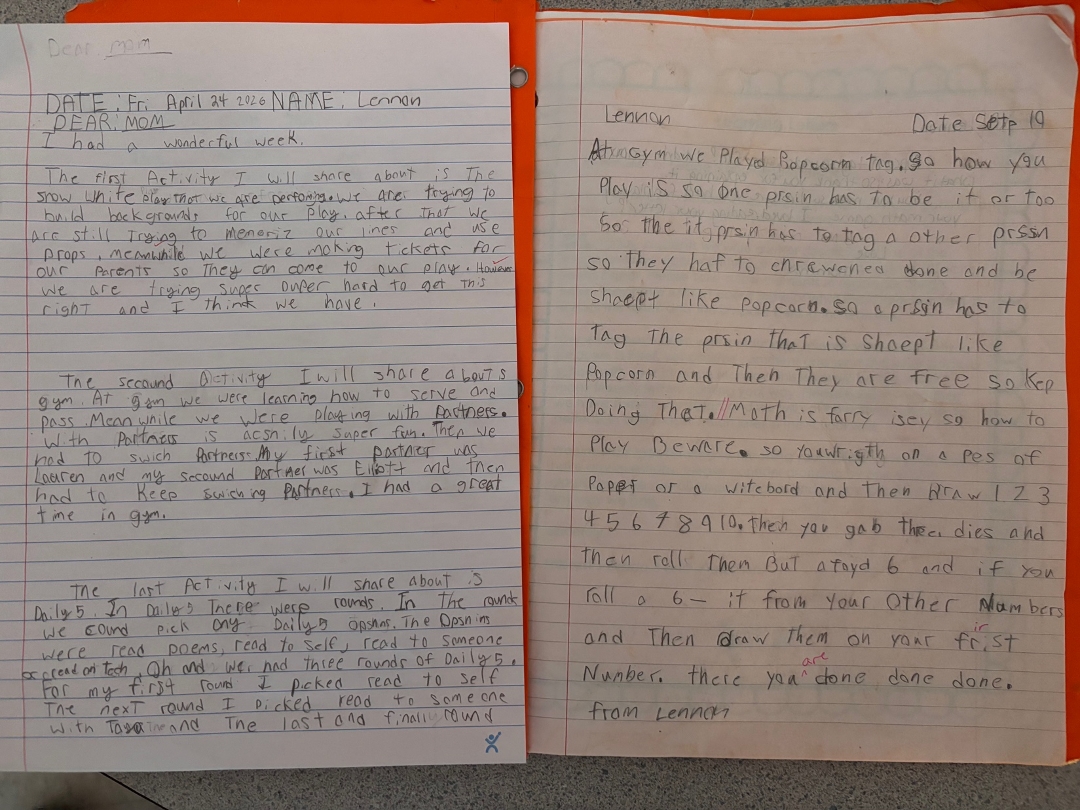
This Grade 3 student has gone from writing everything in one paragraph, to using multiple paragraphs with topic sentences. She is also now using transition words (a focus for her this year), and improved capitalization and spelling.

This Grade 4 student has improved his fluency in writing, and is now able to produce a multi-paragraph, detailed Learning Letter in the allotted time. He is making good use of transition words (a focus for him this year), and adding his opinions to his detailed recounting of his learning.
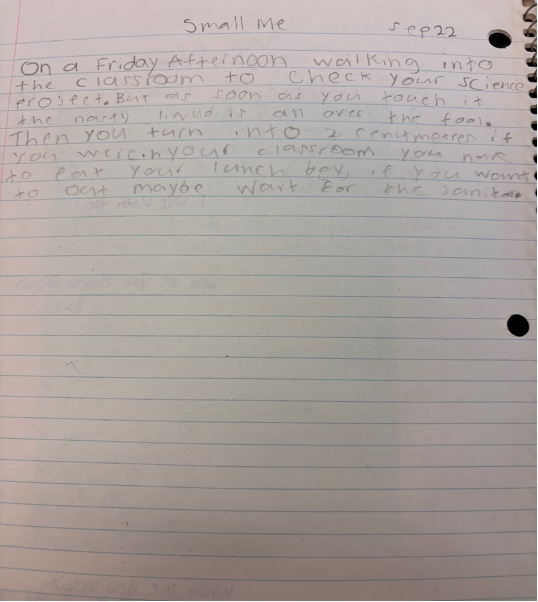 Grade 7- September
 Grade 7- April
Next Steps:
This year’s focus on writing led to encouraging growth across classes. Next year, we will continue to build on this momentum.
The following actions will guide our work:
We will continue to strengthen students writing skills through the use of proficiency scales with student-friendly language, targeting specific aspects (style, form, meaning, conventions) of writing, and using instructional strategies such as conferencing, mentor texts, and explicit instruction. Growth will be measured using the BC Writing Performance Standards.
We will deepen our focus on student motivation by fostering student voice (e.g., Learning Letters) and supporting students in developing their identity as writers through topics and experiences that connect and reflect students unique identities and interests.
We will explore the use of AI to support the development of mentor texts and proficiency scales.
Through these actions, we will continue strengthening writing instruction and creating learning experiences that foster student motivation, ownership, and perseverance as writers.
Surrey Schools
Formed in 1906, the Surrey School District currently has the largest student enrolment in British Columbia and is one of the few growing districts in the province. It is governed by a publicly elected board of seven trustees.
The district serves the cities of Surrey and White Rock and the rural area of Barnston Island.