Hillcrest Elementary

OUR CONTEXT
Those at Hillcrest believe in the importance of developing a sense of belonging alongside a love of learning, with staff and students alike. Having had a focused inquiry on strong assessment practices, Hillcrest staff strive to maintain a collaborative culture reflective of pedagogical practices that nurture and support student learning. Moving forward, Hillcrest staff recognize the priority social emotional wellness and resiliency have in preparing both staff and students for learning and life.
Foundational to cultivating a sense of belonging at Hillcrest is a listening culture that values the perspective, voice and and ideas of many. Building on the Titan qualities, Hillcrest aspires to reflect:
~ Collaboration
~ Meaningful dialogue
~ Restorative practice
~ A trauma informed lens
OUR LEARNERS
Hillcrest Elementary is in the Cloverdale area of Surrey and enrols approximately 515 students from K – 7. The parents at Hillcrest work tirelessly, helping to build a positive school community with special events and fundraising to support the school. Many parents volunteer on a regular basis both in classrooms and on field trips. The staff, students and parents work together to establish a strong collaborative and caring culture.
Hillcrest is a learning environment where students and staff willingly and regularly involve themselves in a multitude of activities to inspire and encourage the values of ownership, perseverance, kindness and respect.
The students of Hillcrest Elementary consistently work towards maintaining a sense of ownership and belonging. The school community has had a meaningful focus on social emotional well-being and the wellness of our learners. With this focus we have the hope that it will increase a sense of belonging and the ability to self-regulate both in and out of the classroom. The goal of this focus is to improve student learning and accountability.
OUR FOCUS
With the support of our Social Emotional Lead teacher and classroom teachers, we have cultivated a focus in and around the needs of a specific grade 5 class at Hillcrest Elementary. As a team we developed the following question that we have chosen to do some work around:
"To what extent will the explicit teaching of individual social emotional learning skills enhance the students' abilities to relate to each other and to their environment in a positive way?"
This particular group of students demonstrate significant gaps in their social and emotional needs. They have difficulties with self-regulation and maintaining positive peer and adult interactions. They are working towards learning how to self-manage their behaviours in order to be successful learners. These students have the capacity to articulate their rights and responsibilities and can make connections to how this should look in the classroom: how they and their peers can and should react in a variety of situations. Through continued practice and perseverance, they are learning to overcome challenges in order to cultivate an environment of learning for themselves and that of their peers.
Our student Learning Goals:
- Students' can demonstrate increased self-regulation and exchange their ideas in their writing and through oral language.
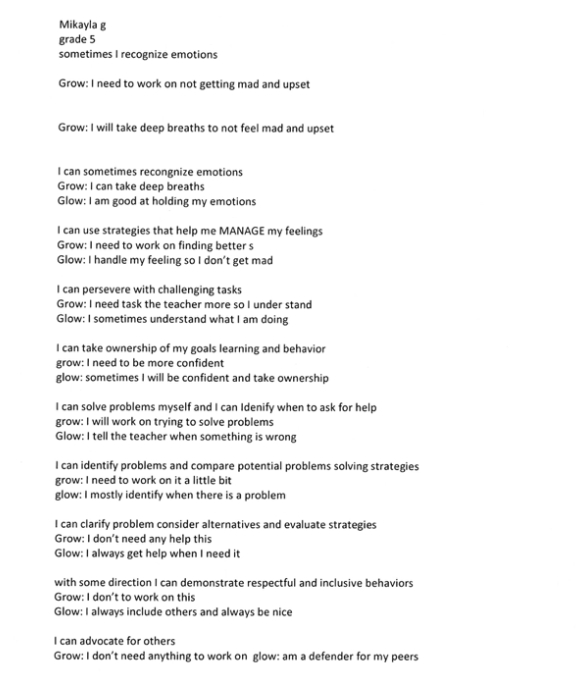
- They can sometimes recognize emotions
- They can use strategies that help me manage my feelings and emotions
- They can persevere with challenging tasks
- They can take ownership of their goals, learning and behaviour
- Students can solve problems in peaceful ways and share this in their writing.
- They can solve problems themselves and can identify when to ask for help
- They can identify problems and compare potential problem solving strategies
- They can clarify problems, consider alternatives and evaluate strategies
- Student can value diversity by exchanging ideas and perspectives with oral language.
- They can demonstrate respectful and inclusive behaviours
- They can advocate for others
- They can take action to support diversity in my school
Our students are provided with learning opportunities aimed at creating a focus on social emotional well-being and to increase a sense of belonging, self-regulation and improve student learning. The purpose of this goal is activate student ownership, perseverance, respect and kindness in their learning environment to promote a positive learning environment.
Subquestions:
- What impact will this have on creating spaces for alternative suspensions towards student learning?
- What impact with this have towards responding and reflecting on direct teaching related to social skills fostering expected interaction with peers and student learning?
- How will this impact the teaching of how students are feeling and the current climate for individuals, classes, groups and the school?
To highlight and demonstrate overall successes and gaps, we monitored a grade five classroom that had various degrees of social emotional needs. With the classroom teacher and the social emotional helping teacher working closely together to create a learning environment where students felt as though they could preserve, navigate feelings and emotions and increase a sense of belonging, self-regulation and improve student learning in a collaborative way. The hopes of this goal is to cultivate a safe community of learners and create a culture and climate that is equitable for all.
Strategic Interventions:
- EASE training for all staff
- Open Parachute training with a focus on completing the staff section individually to better facilitate discussion and lessons for students
- District Behaviour Specialist support
- District Resource Counsellor support
- Social Emotional Learning Lead Teacher
- Lunch and Learns
- Restorative and Trauma informed practice development led by the admin team
- Staff meeting sharing of school goals
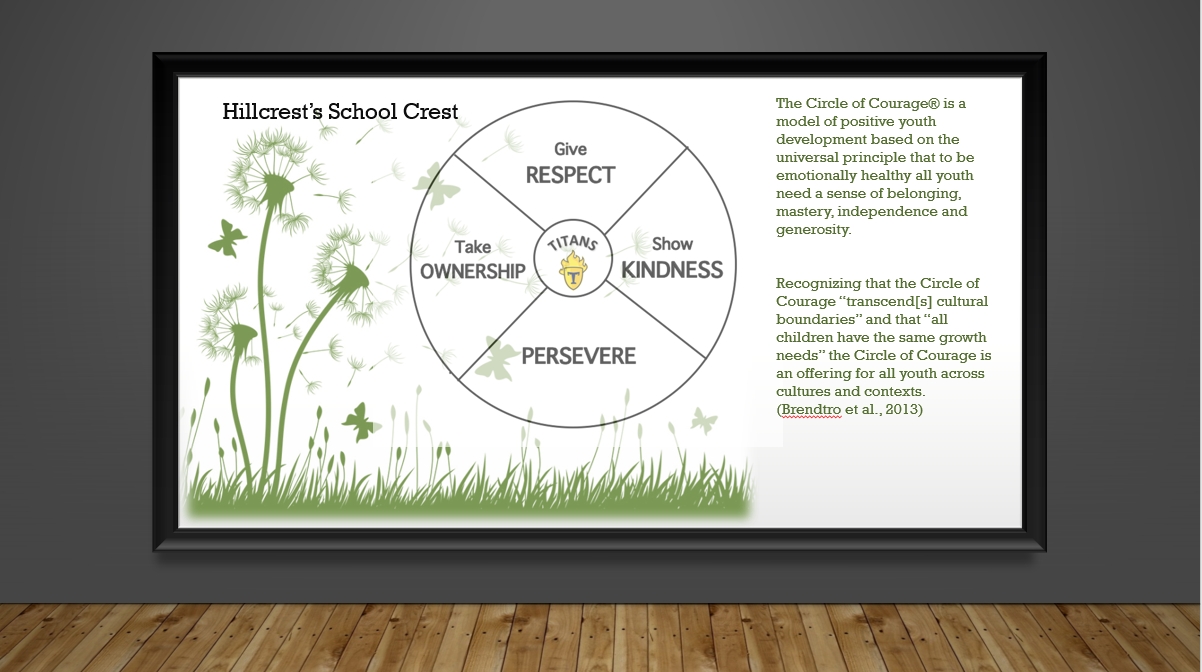
- Monthly Themes: The team will develop monthly SEL themes for school-wide focus based on our newly developed Titan Crest, in order to provide schoolwide norms that are present in meaningful and creative ways.
- Our teacher librarian will pull supportive picture books around each theme and we will facilitate the gathering and co-creation of lessons around each theme.
- On our SEL lead teacher days, we will co-teach some of these lessons with teachers, while others can teach the lessons independently.
- Quotes will be shared on the morning announcements revolving around the theme.
- Activities, displays and announcements will be co-planned and executed with various student groups, such as the Pride Group or the Student Leadership Team to infuse student voice.
- Each month will be wrapped-up with a student-lead assembly. Grade groups will be able to sign-up to lead the assembly. Students will be our MC’s and classes will be welcomed to share their learning from the month.
- January – Respect
- February – Kindness
- April – Ownership
- May – Perseverance
- June – Love Yourself (Self-Acceptance)
OUR NEXT STEPS
As a school, we have committed to focusing on Social and Emotional Learning for the coming years. We will continue with the SEL Lead program, dedicating teacher time to planning school-wide SEL initiatives that build common language and community in our school. We will continue to use our professional development time to build teacher capacity in the teaching of SEL as well as to build and maintain our personal Social and Emotional Learning in order to be able to put forth our best selves in the classroom. As a school, we will continue to build the capacity of all of our staff and learners to understand how Respect, Perseverance, Ownership and Kindness are fundamental to maintaining a strong learning community. We will model these attributes for our students, and practice them daily. It is through this daily practice that our students will gain the skills needed to be strong Social and Emotional Learners.
Evidence of Student Learning:
Using "I can" statements, several of our grade 5 students demonstrate their ability to use SEL strategies such as recognizing their emotions, deep breathing, going for walks. They demonstrate the importance of taking ownership of their actions and their learning, problem-solving, and valuing diversity. Using the "Glow and Grow" idea, students identify their growth, areas in which they have improved from explicit teaching of SEL strategies, as well as a "glow," or something in which they have become proficient.




Showcasing their learning of pointillism in the images below, grade 7 Titans also demonstrate their reflective capacity and how persevering with challenging tasks can promote a sense of pride and accomplishment in our learners.


Below, some of our younger Titans demonstrate growth mindset, the power of "yet," and the importance of perseverance:


What some of our students are saying:
"I can show kindness by helping my friend on the monkey bars."
"I can show perseverance by trying really hard on the brainteasers we do in class, and not giving up when I don't get it right the first, second, or even the third time."
"I show kindness when I share my lunch with someone who is still hungry."
"I show respect when I I listen to my teacher during circle time."
"I show kindness by giving my friend the glitter jar when they're sad."
"I show kindness when I include someone on the playground or invite someone to play with me during centre time."
"I take ownership when I use the Fin's Friends program to work out a problem with a peer."
"I show respect when I say please and thank you to others."
"I take ownership when I share my work with others and am proud of the work I have done."
"I show respect when I work quietly and cooperate with others so that we can have a positive learning environment in our classroom."
Instructional Practice - What we are learning about at Hillcrest
- how to build connection
- establishing classroom community
- working together to co-create criteria in our work
- classroom discussions
- differentiated instruction for all learners
- direct instruction
- co-operative learning
- clear expectations
- morning meetings
- role play
- book studies
- universal design
- experiential learning
- tiered learning targets
- journals and reflective work
- storytelling
- direct teaching of social skills
- facilitate intentional lessons and discussions related to mental health and relationships
- presentations
- peace walks
- affective statements
- restorative conferences
- talking circles
- circle of courage
Teacher's Voice: Our SEL Leads shares insight into how teaching explicit SEL strategies to a group of students has impacted their social emotional wellbeing
"Social and Emotional Learning is the cornerstone of our classrooms. Focusing on each student's ability to navigate the various challenges that they face each day empowers them to be strong, independent, confident members of the community. As we have targeted specific aspects of SEL throughout the school year through discussions, activities, role plays and continuous modelling and practice, I have seen students find confidence to advocate for themselves. We learn through targeted lessons, but predominately by building mini-lessons into everyday situations that arise. We stop and discuss challenges as a class, in small groups and one-on-one. After nine months they are learning to recognize what tools they need to use in order to focus during class and use them consistently. They talk about their own strengths and challenges and set small, realistic goals that they work towards on a daily basis. They are learning to communicate through conflicts with their peers, sometimes with adult support and sometimes independently. They are learning to stand up for what is right and to defend themselves and their peers in an assertive way. They are able to persevere through increasingly challenging tasks without giving up. Each student is on their own personal journey, and no two students are in the same place but they have a better understanding of each others' journeys and are more understanding of each other. Making SEL central to our classroom community is a fundamental tool for helping the students to feel ready to learn and engage in a safe and supportive environment."
Teacher Voice:
"This year we have focused on informal and formal ways of teaching social and emotional learning. We have been working on managing big feelings, creating a safe classroom community and building resilience and compassion in our students. We have used formal programs such as Second Step, Classroom Champions, Open Parachute and Superflex to explicitly teach strategies to self-regulate and make more positive choices. We also have done more informal teaching by having ongoing class discussions and daily class meetings. At the beginning of the school year it was very difficult for the students to patiently wait for their turn and they were quick to interrupt each other or reluctant to participate at all. Now they can attentively listen to all their peers, show respect by waiting until their turn to talk and sharing more thoughtfully. Class meetings have been a great way for students to build empathy and understanding for each other. It has been helpful for them to hear more about what their classmates carry with them everyday from outside of school in the form of worries, fears or obstacles at home they are facing. Students can now consistently advocate for themselves and use strategies to regulate when they are overly energized or unfocused by choosing action breaks, Just Dance or going for a run outside. We are noticing that students are still struggling to consistently use strategies independently when it comes to regulating big emotions socially with their peers. With support they are able to use strategies such as box breathing, taking a break, asking for support from an adult or removing themselves from the situation. We also continue to work on identifying the size of the problem and what an expected, or appropriate, size reaction would be."
Success Criteria - How this has impacted student learning.
- Learning letters allow for students to share what they have learned, what they are proud of and what they feel should be an area of growth and discovery
- Core competency reflections an opportunity for students to take ownership of their learning and persevere towards a specific goal or outcome
- Learning Journals with and without prompts
- Identity Day along with “how do I exemplify Titan qualities of giving respect, showing kindness, perseverance and taking ownership
- Elder’s Day - students are proud to share their learning community with their elders
- Discussions related to novel studies about identity, equity and inclusion
- Observation during structured and unstructured time
Surrey Schools
Formed in 1906, the Surrey School District currently has the largest student enrolment in British Columbia and is one of the few growing districts in the province. It is governed by a publicly elected board of seven trustees.
The district serves the cities of Surrey and White Rock and the rural area of Barnston Island.