Guildford Park Secondary 25-26

OUR CONTEXT
Guildford Park Secondary is a diverse and inclusive school community located on the traditional, unceded territory of the Katzie, Kwantlen, and Semiahmoo First Nations. At the heart of all we do is one simple belief: Everyone Matters. We believe that everyone has something to offer and that we learn better together. We value showing up, building good habits, and creating opportunities for growth. We treat one another with kindness and respect, celebrate progress over perfection, and believe that students should have voice, choice, and agency in their learning. We know our students bring a wide range of cultural, linguistic, social, and educational experiences and are committed to creating equitable opportunities for all learners, and to ensuring that every student develops the literacy, competencies, confidence, and sense of belonging needed to thrive in school and beyond.
At Guildford Park, school doesn't end when the bell rings. Our halls, classrooms, and gyms are busy places where students gather for clubs, sports, activities, studying, reading, and connecting with one another. With a vibrant library and a diverse range of opportunities beyond the classroom, our students are encouraged to find their place, pursue their interests, and be part of a community that feels alive throughout the day.
Guildford Park is also entering an exciting period of growth and renewal. A new school addition will provide additional space for our growing school community, while a new Cmolik Innovation Lab will create opportunities for students to collaborate, design, create, and engage in interdisciplinary learning. The flexible space will support exploration of emerging technologies, including 3D printing, robotics, and digital media, while helping students develop the skills and confidence to thrive in a rapidly changing world.
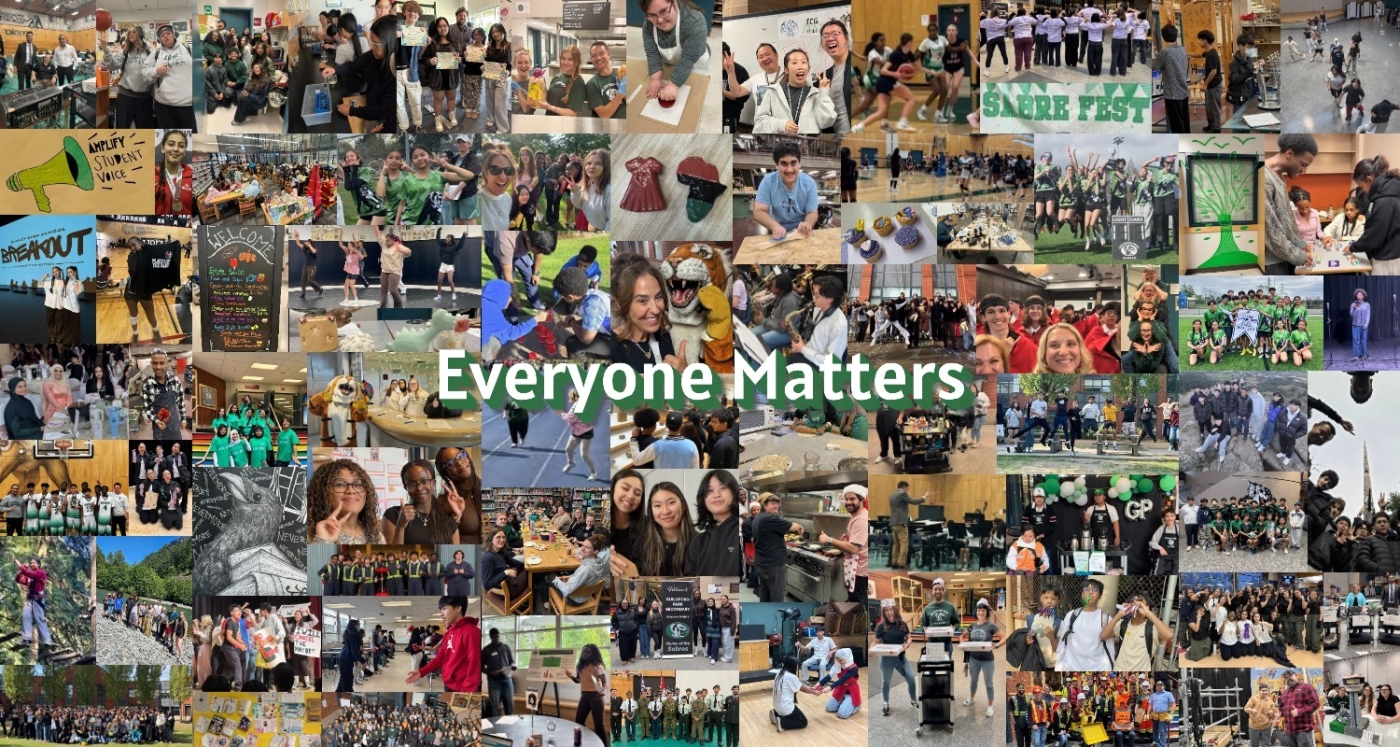
The true spirit of Guildford Park can be found in the everyday moments that happen throughout our school. Together, these snapshots reflect the energy, connection, and sense of belonging that make GP a vibrant place to learn and work.
OUR LEARNERS
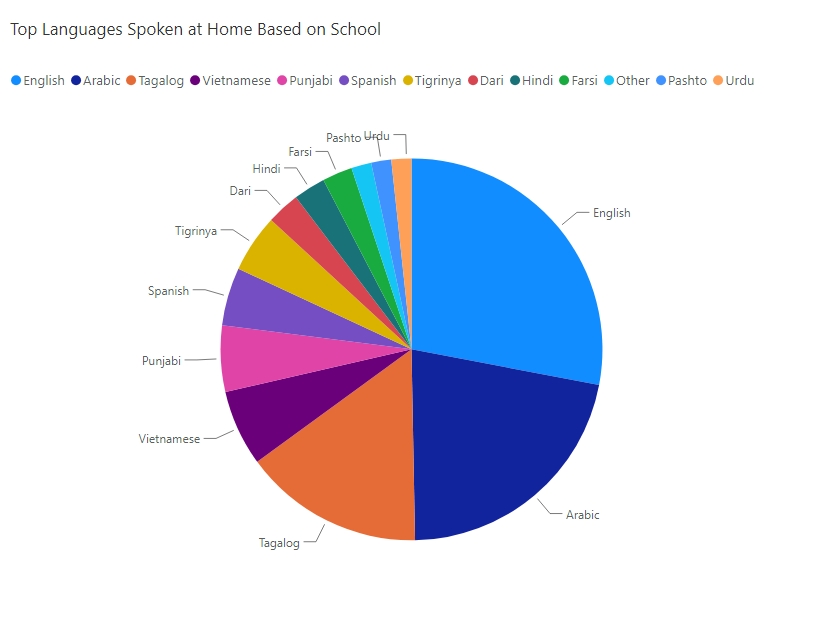
At Guildford Park Secondary, we have a beautifully diverse student population. Over 15% of our student population are English Language Learners, 6% identify as Indigenous, 20% are students with diverse abilities, and over 75% of our students speak a language other than English at home. In fact, there are 80+ different languages spoken at home among our student population. As such, focusing on literacy skills will be very important for our learners as they prepare for adulthood. Using knowledge of our learners - their strengths, stories, and passions - will help us determine their capacities and needs.
OUR FOCUS
Empowering Learners Through Literacy
Building on our understanding of our learners and their diverse needs, we have identified literacy as a key area of focus. Literacy is also a priority area for the Surrey School District, and for good reason. Literacy is essential to student learning and cognitive development, and is foundational to ensuring equity and opportunity. It empowers students to understand, engage, and be successful in an increasingly complex world. It plays a central role in career opportunities, as most jobs require strong reading and writing abilities. In today’s digital world, literacy extends to navigating and understanding online content, further enhancing employability. Additionally, literacy empowers individuals to make informed decisions, engage in society, and pursue lifelong learning. Ultimately, literacy is key to economic mobility, social inclusion, and personal growth, making it an essential tool for success in all areas of life.
Reading Comprehension as a Focus
Within literacy, our school's focus is on improving reading comprehension. Our vision is that every student becomes a confident, capable reader who can understand and engage with a wide range of texts. Specifically, our goal for the 2025-2026 school year is to improve reading comprehension for all students through accessing prior knowledge and vocabulary acquisition.
In all areas of learning, students read. Reading connects them to the world and introduces them to new learning. Through examining a variety of text forms, reading helps students make sense of everyday experiences and feelings, exposes them to different worldviews, identities and perspectives, and encourages them to be engaged, educated citizens.
Specifically, we want our students to demonstrate proficiency in the following competencies from the BC English Language Arts curriculum:
- Apply appropriate strategies to comprehend written and visual texts, guide inquiry, and extend thinking
- Recognize and appreciate how different features, forms, and genres of texts reflect different purposes, audiences, and messages
- Think critically, creatively, and reflectively to explore ideas within, between, and beyond texts
- Recognize and identify the role of personal, social, and cultural contexts, values, and perspectives in texts
- Construct meaningful personal connections between self, text, and world
- Recognize an increasing range of text structures and how they contribute to meaning
We also want our work to be grounded in Indigenous Ways of Knowing, represented in the district's K-12 Literacy Framework:
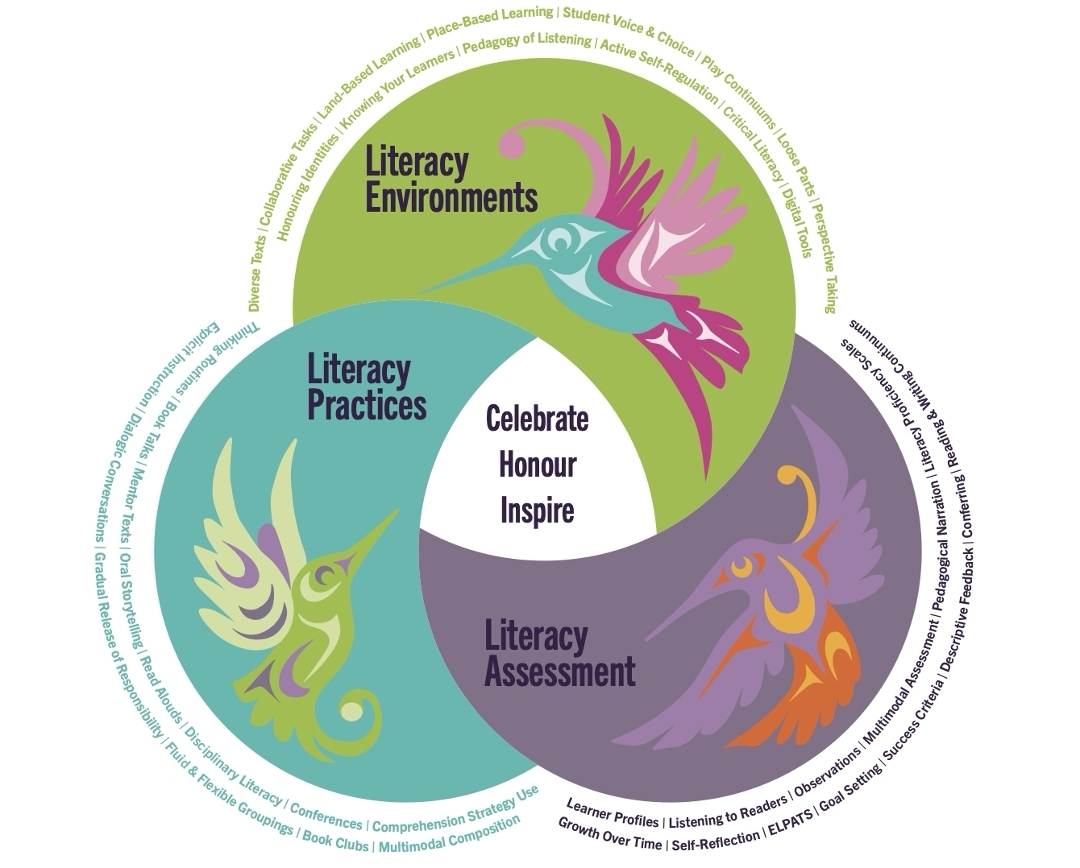
We strive to honour student identities through accessing their prior knowledge and experiences (Literacy Environments), building vocabulary acquisition through developing disciplinary literacy and the intentional teaching of reading comprehension strategies (Literacy Practices), and evaluating impact on student learning through triangulation of evidence that goes beyond formal diagnostic tools to include anecdotal evidence, conversations, stories, and artifacts of learning (Literacy Assessment).
Our Strategies for Success
A key part of our approach was making a school-wide commitment to provide all students with opportunities to develop reading comprehension strategies, focusing on teaching specific strategies for accessing prior knowledge and vocabulary acquisition. To highlight successes and identify areas for growth, we gathered and examined evidence of learning throughout the year from our focus group of grade 8 Humanities students.
In Humanities 8, teachers focused on vocabulary acquisition by pre-teaching vocabulary and analyzing text features in advance of a novel study, having students maintain vocabulary trackers, highlighting key words, creating flashcards, and other visual representations of vocabulary. To help students access prior knowledge, they provided time for students to make connections between text-to-self, text-to-text, and text-to-world throughout novel studies. For example, during read-alouds, pauses were incorporated in between sections to allow students to make connections with the text by discussing with their peers. To foster enjoyment of reading, “First Chapter Fridays” encouraged students to explore a range of genres and find books that interested them by exposing them to the first chapter of a sampling of books.
Students in the Humanities 8 focus groups demonstrated growing confidence and independence as readers, with many students showing improved reading comprehension over the course of the year based on the results of formal diagnostic tools. Through student-teacher conferences and reflection, students became increasingly able to identify and articulate the specific reading strategies they used to support their understanding of texts. While some students experienced challenges with formal assessments due to outside factors, or by rushing their work, classroom observations suggested that students were becoming more intentional and self-aware in their approach to reading. This growing engagement was also reflected in students’ interest in independent reading, with Grade 8 students signing out more library books than any other grade level.
Reading comprehension strategies were also implemented across all curricular areas and here are some examples of strategies teachers used with their students:
- Mathematics - using GRASP (Given, Required, Analyze, Solve, Ponder) strategy to decode complex problems collaboratively. Also having students preview a practice assessment booklet at the beginning of a unit so they become familiar with key vocabulary ahead of time.
- English Language Learners (ELL) - using digital resources and images along with reading passages to enhance connection between vocabulary and prior knowledge, within the context of a familiar problem (e.g. litter in the school community).
- Modern Languages - connecting readings to familiar places, cultural traditions, and personal experiences by having students share what they already know, make geographic and cultural connections, and discuss their ideas and questions with peers to build context.
- Building Academic, Social, and Employability Skills (BASES) - highlighting important vocabulary by underlining key words and using collaborative strategies such as Think-Pair-Share to brainstorm what students already know about a topic.
- Home Economics - reviewing instructions for working with textiles and make connections between the images and texts to make meaning and give them the skills to work more independently on garment production.
- Science - activating students’ prior knowledge of lab skills and vocabulary to support independent reading and interpretation of procedural flow charts during lab experiments.
- Learning Support Team (LST) - explicitly teaching word-analysis strategies, including prefixes, suffixes, root words, and parts of speech, to help students decode unfamiliar vocabulary.
- Visual Arts - pre-teaching key art vocabulary and concepts through an artist visit which helped students build background knowledge and vocabulary before engaging with artwork at the Vancouver Art Gallery, and by using multiple modes of reading and interpretation to help students explore mood, emotion, plot, and themes in visual representation of text while comparing different adaptations of the same text.
- English - activating prior knowledge and expanding students’ vocabulary through collaborative discussion and review, helping students use increasingly precise language and textual evidence to analyze character traits.
- Business Education - building students’ digital literacy vocabulary and activating prior knowledge by connecting key concepts such as reliable sources, misinformation, plagiarism, digital footprints, and AI-generated content to familiar online examples that students see everyday.
- Social Studies - pre-teaching key vocabulary and background knowledge before using a “Big Paper Silent Conversation” to support students in processing complex historical topics. To do this, students rotate between chart papers featuring quotes, images, questions, and historical perspectives, responding in writing and building on their peers’ ideas before participating in larger group discussions.
- Counselling - activating prior knowledge by connecting the Summer Learning registration process to familiar tasks such as online shopping, course selection, and completing surveys. Also using visual scaffolds, including an anonymized report card, to help students practice locating and interpreting specific information within a text.
- Physical Health Education (PHE) - intentionally integrated subject-specific vocabulary into daily instruction, using body and muscle terminology in workout scenarios, peer practice, and knowledge checks. Students identify vocabulary using classroom equipment, posters, and diagrams, gradually moving from recall without a word bank to supported identification using a word bank.
As part of our focus on developing reading comprehension, we also felt it was important to provide students with scheduled opportunities to read and create space for students to discover the joy of reading. This was something we focused on near the end of the school year and hope to continue into the 2026-2027 school year.
To further support these school-wide literacy initiatives, the GP library has served as a central hub for cross-departmental collaboration and initiatives designed to increase student readership. During the 2025-2026 school year, a record-setting 11,000 books were signed out by students! And, as mentioned previously, grade 8 students accounted for the majority of our most active readers. To support students in becoming more engaged readers, the GP Library prioritized student choice by empowering students to select books they could connect with personally and emotionally, while providing access to a range of texts at appropriate reading levels to ensure that all students could find books that were both meaningful and accessible. Moving forward, the GP Library will continue to pay a central role in supporting literacy by fostering innovation, expanding access, and inspiring every student to discover the joy, relevance, and power of reading.
OUR NEXT STEPS
Continuing Our Literacy Journey
Our commitment to literacy will continue to focus on reading comprehension, with our vision remaining the same: to ensure that every student becomes a confident, capable reader who can understand and engage with a wide range of texts. While our Student Learning Plan takes a universal approach to developing and monitoring literacy across our school, our next steps will include a more intentional focus on students who may experience additional barriers to literacy development, including Indigenous Learners, English Language Learners, Children and Youth in Care, and students with disabilities and diverse abilities. We will continue to explore ways to increase accessibility, remove barriers, and ensure that every student has meaningful opportunities to experience success as a reader.
We also see an opportunity to strengthen our partnership with our feeder elementary schools, particularly as literacy remains a shared priority across our schools. We will explore opportunities for greater collaboration and mentorship between GP students and elementary students, with the GP Library already beginning to consider ways to build this connection and create authentic opportunities for students to learn from and support one another.
Finally, we will continue to nurture the joy of reading and increase student readership, with particular attention to ensuring that all of our learners see themselves reflected in the books, resources, and opportunities available to them. We are inspired by the hummingbird, a symbol featured in the K–12 Literacy Framework and long associated by Coast Salish Peoples with joy, curiosity, and wonder. These qualities capture the spirit of our next steps: creating a school community where students are curious about the world, empowered to explore it through reading, and supported in becoming confident readers who discover that there is a place for them in every story.
Surrey Schools
Formed in 1906, the Surrey School District currently has the largest student enrolment in British Columbia and is one of the few growing districts in the province. It is governed by a publicly elected board of seven trustees.
The district serves the cities of Surrey and White Rock and the rural area of Barnston Island.