Grandview Heights Secondary 24-25

OUR CONTEXT

Grandview Heights is the newest secondary school in the Surrey School District which opened its door to our community September 7, 2021. We are proud to acknowledge that we come to school to work and learn on the traditional and unceded territory of the Katzie, Kwantlen, Semiahmoo, and other Cost Salish Peoples.
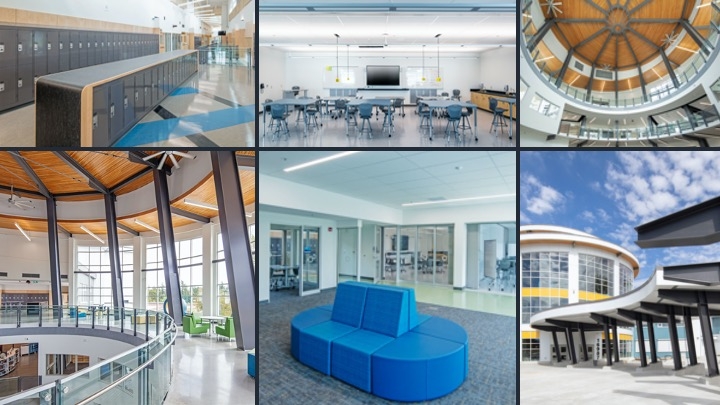
Our 1600 + amazing students love their new school, as do our staff and parent community. The features of this new state-of-the-art school are numerous, and include over 60 classrooms , a purpose-built black-box theatre, Grand Atrium that resembles a Coast Salish Longhouse , open concept learning commons, two gymnasiums, along with maker spaces with cutting-edge applied design classroom technologies.
Our teachers understand the importance of innovative learning spaces and that learning occurs every where in our building, not just inside classrooms.
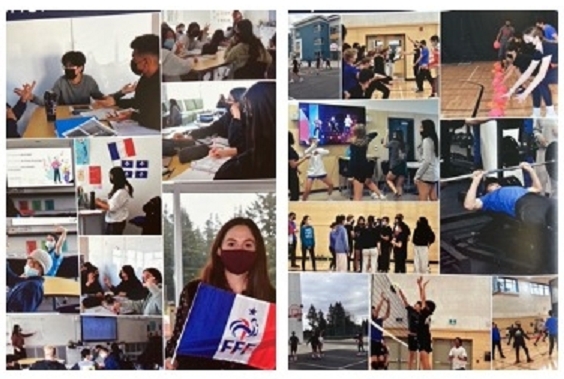
The Beginning of a GRIZZLY Legacy
Our Grandview Heights students have joined us from a variety of local secondary and elementary schools; these include Elgin Park, Semiahmoo and Earl Marriott, Sunnyside, Morgan, Pacific Heights, Edgewood and Rosemary Heights. Very few students get the chance to create a new school community and culture from the ground up, and have an opportunity to learn and work in a truly modern and state-of-the-art secondary school.
SCHOOL VISION & FOCUS
Grandview Heights Secondary students have come from many places and represent many ethnicities, cultures and languages. Over the past year our students, staff, and parent community had a chance to tell us what they valued in our school, and through this process we have collaboratively developed our school vision:
"As Grizzlies we come to Grandview Heights seeking safe and respectful connections to our land, community, and one another. We value kindness, curiosity, resiliency, and personal growth."
Our diversity is what makes us great! Who we are and where we come from contribute to our vibrant and inclusive school culture.
OUR LEARNERS
Understanding Our Students at Grandview Heights
At Grandview Heights, we recognize that learning is a lifelong journey. Our students are aware that they need to develop a diverse set of skills to navigate the world effectively. One of the most crucial skills they focus on is the ability to communicate clearly and thoughtfully.
Communication Skills:
- Exchanging Ideas: Our students share information, experiences, and ideas to explore their surroundings and understand various communication forms, strategies, and technologies. This exchange acts as a bridge between their learning, personal and social identity, and the world they interact with.
- Respectful Expression: They confidently and respectfully express their experiences and ideas to their peers, understanding the importance of sharing and communicating with one another.
Collaborative Learning:
- Brainstorming: Using vertical whiteboard surfaces, students brainstorm and demonstrate their knowledge on various topics, seeing how their ideas connect. This collaborative effort helps them communicate effectively within their class.

Diverse Communication Methods:
- Multimodal Communication: Our students use words, pictures, videos, and other forms of communication to share their knowledge and ideas.
- Innovative Technologies: Tools like Minecraft Education allow students to showcase their understanding of specific content and competencies in a flexible format. For instance, Grade 8 Humanities students created museum exhibits on the theme “Power: Bringing Societies Together and Keeping Them Apart,” using various methods such as drawing floorplans, building models, and even using Minecraft Education Edition.

Cultural Connections:
- First Peoples' Knowledge: Through connections with First Peoples, students communicate their mathematical understanding of patterns and relationships. They use paper to create cedar weaving art, illustrating the linear relationships found in this traditional art form.

Our students understand the importance of communication as a tool to connect their learning to themselves, others, and the world around them.
OUR FOCUS
Why This Focus Matters
We believe that in the classroom, those who are actively talking are the ones truly engaging in learning. Communication is a vital tool that enables students to delve into higher-order thinking in numeracy. Through effective communication, students can explain and justify their mathematical ideas and decisions.
By emphasizing the importance of students' ability to communicate their mathematical thinking, we empower them to become critical thinkers and problem solvers. This focus enhances their understanding of how mathematics helps us comprehend ourselves and the world around us.
Student Learning Goals:
- Communicate mathematical thinking in many ways
- Represent mathematical ideas with concrete, pictorial, and symbolic forms
- Use mathematical vocabulary and language to contribute to mathematical discussions
- Explain and justify mathematical ideas and decisions
Our Cohort:
The Grandview Heights staff equip all our students with opportunities for improving and developing their communication skills. To monitor and improve our student's success and to understand any areas for improvement we are following one cohort across one subject area.
Numeracy Tasks: Enhancing Communication Skills
Our students engage in numeracy tasks that apply real-life contexts to mathematical concepts. These tasks offer opportunities for students to work in groups and communicate with each other as they navigate the challenges. They are encouraged to share and test their ideas within these real-life mathematical scenarios.
Using vertical whiteboard surfaces, students start their work by generating ideas collaboratively. This setup allows them to see how other groups approach the tasks, fostering a shared learning environment. Throughout the process, students apply communication competencies as they brainstorm, refine, validate, and summarize their work.
Communication Competency Rubric: Helping Students Assess Their Communication Skills
At Grandview Heights, our students communicate daily. To capture and assess this learning, we created a communication competency rubric. This rubric helps us understand where students are excelling and where there may be gaps in their communication skills.
Teachers use the rubric to assess student learning, while students use it to self-assess their own skills. The "I can" statements in the rubric provide students with clear, understandable language to gauge their progress and identify areas for improvement. This focused approach allows teachers to better support students in becoming more proficient communicators.

OUR NEXT STEPS
Evidence of Growth in Communication Competency
After analyzing data from the completed numeracy tasks and the Numeracy Assessment 10, we observed significant growth in our students' communication skills.
Student Results Using Proficiency Scales on Numeracy Tasks:
Students completed two numeracy tasks: one at the beginning of the semester and one at the end. The first task served as a baseline to gauge their initial understanding. Throughout the semester, students participated in learning activities aimed at enhancing their communication skills, receiving continuous feedback on their progress. These interventions included:
- continued practice with other engaging numeracy tasks
- consistent use of the communication rubric and feedback
- modelling of what communication looks like at the different levels and consistent use of mathematical language
- focus on the 'how' and 'why' behind each step and not just a focus on the final solution
- using activities such as Estimation 180, Visual Patterns, Desmos Activities, etc. to provide opportunities for the student to engage in fun math with a focus on communicating their ideas, solutions, etc.
- group work in combination with whiteboards (both vertical and horizontal) to have student work on more complex problems and be able to see others work to help them self assess how their doing
At the end of the semester, they completed a second numeracy task to assess their updated learning and growth.
Learning Activity | % of Students who are Emerging | % of Students who are Developing | % of Students who are Proficient | % of Students who are Extending |
Numeracy Task [Feb 2025] |
|
|
|
|
Numeracy Task [May 2025] |
|
|
|
|


Numeracy 10 Assessment Results for June 2024 and January 2025
| Proficiency Level 1 | Proficiency Level 2 | Proficiency Level 3 | Proficiency Level 4 |
School Results June 2024 | 7.33% | 32.98% | 43.46% | 16.23% |
School Results January 2025 | 3.06% | 16.33% | 51.53% | 29.08% |
Provincial Results June 2024 | 14.32% | 40.46% | 34.12% | 10.65% |
Provincial Results January 2025 | 10.53% | 32.94% | 41.30% | 14.88% |
Summary of Results:
Both school and provincial results show a trend of improvement in higher proficiency levels (Levels 3 and 4) and a reduction in lower proficiency levels (Levels 1 and 2). This indicates that students are progressing towards higher proficiency in their numeracy tasks over time. The school results show a more significant improvement in Proficiency Level 4 compared to the provincial results, suggesting that the focused efforts at the school level are yielding positive outcomes.
Evidence of Positive Impact on Communication Skills
The data clearly indicates that our emphasis on communication within cohort classes has significantly benefited our students. Teachers observed notable improvements in several key areas:
- Communicating Mathematical Thinking: Students are able to express their mathematical ideas through various methods (graphs, tables, written solutions etc. ), showcasing their understanding in diverse ways.
- Representing Mathematical Ideas: They more effectively use concrete, pictorial, and symbolic forms to illustrate their mathematical concepts, enhancing their ability to convey complex ideas.
- Using Mathematical Vocabulary: Students contribute more meaningfully to discussions by using more precise mathematical vocabulary and language.
- Explaining and Justifying: They have developed the ability to explain and justify their mathematical ideas and decisions, demonstrating deeper understanding and critical thinking.
This growth not only reflects the success of our communication-focused approach but also highlights the importance of fostering these skills. By continuing to prioritize communication, we can further empower our students to become confident, articulate, and proficient in their mathematical endeavors. This foundation will serve them well in all areas of learning and beyond, as they navigate the complexities of the world around them.
Moving Forward with the Student Learning Plan at Grandview Heights Secondary School
Here’s a look at how to approach expanding the work done with the cohort to include the entire school and staff, and to build communication skills in other departments.
1. School-Wide Professional Development:
- Workshops and Training: Organize professional development workshops focused on enhancing communication skills. These sessions can include strategies for effective communication, collaborative learning techniques, and the use of innovative technologies like Minecraft Education.
- Peer Learning: Encourage teachers to share best practices and successful strategies from the cohort classes with colleagues in other departments.
2. Integration Across Departments:
- Cross-Departmental Projects: Develop interdisciplinary projects that require students to communicate and collaborate across different subjects. For example, a project combining mathematics and art could involve creating visual representations of mathematical concepts.
- Unified Communication Rubric: Implement a school-wide communication competency rubric to ensure consistency in assessing and developing students' communication skills across all subjects.
3. Community and Cultural Connections:
- First Peoples' Knowledge: Integrate First Peoples' knowledge and communication practices into various subjects. This can include projects that explore cultural patterns and relationships, fostering a deeper understanding and respect for diverse communication methods.
- Community Involvement: Engage with the local community to bring real-world contexts into the classroom, enhancing students' communication skills through practical applications.
By taking these steps, we can build on the successes of the cohort classes and foster a school-wide culture of effective communication, collaboration, and continuous learning. This holistic approach will empower all students to become confident communicators and critical thinkers, ready to navigate the complexities of the world around them.
Surrey Schools
Formed in 1906, the Surrey School District currently has the largest student enrolment in British Columbia and is one of the few growing districts in the province. It is governed by a publicly elected board of seven trustees.
The district serves the cities of Surrey and White Rock and the rural area of Barnston Island.