Goldstone Park Elementary 25-26

OUR CONTEXT


OUR LEARNERS


OUR FOCUS
Primary Reading Inquiry:
RATIONALE:
We focused on strengthening students’ reading fluency, accuracy, and confidence. Beginning-of-year assessment data showed that some students were struggling to read accurately and automatically. We also observed that some students relied on guessing words or using picture clues rather than applying decoding strategies.
Our goal was to improve students’ word recognition and decoding skills so they could use more of their cognitive energy for comprehension and meaning making. As students became more familiar with letter-sound patterns, we also hoped they would apply this understanding to their spelling and writing.
Through focused and effective practice opportunities, we aimed to increase the number of students meeting reading expectations.
GUIDING QUESTION:
How does explicit, systematic instruction with support of small group interventions impact reading fluency of students over time?
INSTRUCTIONAL APPROACH:
We used small-group instruction to give students more targeted reading practice, alongside regular whole-class lessons four times a week. Each Friday, we monitored progress using written assessment. We also monitored progress using short one-minute reading fluency checks with decodable texts connected to skills already taught every 2 weeks. This helped us track growth and provide support based on student needs.
SMALL GROUP INSTRUCTIONAL STRATEGIES:
- Targeted practice with specific skills and phonic patterns
- Roll and Reads
 Students playing Connect 4 using Roll and Read
 - Word Sorts- to recognize and review phonic patterns taught
 Students practicing sorting words with plural endings (-s and -es)
 - Word chains- to strengthen the connection between letters and sounds when reading (decoding)and writing (encoding)

- Sound Hunt Cards- to target new phonic patterns and to help students build their vocabulary
 Student practicing finding words with short vowel sound using Sound Hunt Cards.
 - Decodable texts- to choral and partner read, practice repeated reading, and using explicit modelling of phrasing, expression, and punctuation to build reading fluency and reinforce taught phonics patterns.
- Roll and Reads
 Students reading decodable passages with a partner and highlighting phonic patterns taught. RESULTS:
- Teachers noticed an increase in automaticity and improved accuracy over time
- Overall reading performance increased across all Grade 2 classes
- Acadience data reflected steady growth in reading fluency.
 Data shows growth in words read per minute (WCPM) from beginning of the year (BOY) to middle of the year (MOY) and end of the year (EOY).
 Data shows a slight increase in retell average from middle of the year (MOY) to the end of the year (EOY).
In addition to measurable growth, teachers also observed:
- Students built confidence, stamina, and enjoyment through repeated practice
- Reading became smoother and more expressive, with better attention to punctuation and meaning
- Students, including those reading at or above grade level, were better able to apply skills to longer, multisyllabic words
- While students demonstrated improved accuracy and automaticity with targeted practice, retell scores remained consistent over time
STUDENT REFLECTIONS AND QUOTES:
“I like when we do sound hunt cards- because you have to look for all the things. I like when you say we have to find the “ow” and “oi” sounds and we have to find the pictures to match. That helps us become better readers because we know that some of the words can rhyme and then we can spell it like if I was looking at something round and fountain it has the same spelling.”
“UFLI helps us sound out- like when we pound and sound and break apart the word. Like bread “b/r/ea/d” it helps us spell!”
“I have an “AR- pirate sound” in my name. And look, I have an H brother “CH” and a vowel pair “EE” in my name. I never noticed that before we did UFLI.”
“UFLI helps us learn new words each day.”
“Look! The word “start” has the “ar” bossy R sound in it!”
“I tried reading child two ways. It sounded right when I use the long /ī/ sound. Vowels can make two sounds!”
Intermediate Reading Inquiry:
RATIONALE:
Our school identified reading fluency as an area of inquiry after reflecting on students' reading experiences across grade levels. Through classroom observations of small group reading instruction, guided reading, and listening to students read aloud , teachers noticed that some students were reading word-by-word, pausing frequently, and not consistently using punctuation to guide their reading. These reading patterns impacted reading flow, stamina, and overall comprehension.
Reading fluency is a key part of literacy development. When students read with accuracy, at an appropriate pace, and with expression, they are better able to focus on understanding the meaning of the text. Strong fluency also supports confidence, engagement, and independence as readers.
By focusing our inquiry on consistent, short daily fluency practice, we aim to help students read smoothly, attend to phrasing and punctuation, and build the confidence needed to engage fully in reading both independently and aloud.
How does consistent, short fluency practice impact students’ reading rate? What patterns of growth emerge over time (accuracy, expression, confidence)? How do individual students respond to fluency practice?
INSTRUCTIONAL APPROACH:
To support students in becoming more fluent and confident readers, teachers implemented a structured fluency routine 3-4 times per week over four weeks. Teachers facilitated this by following the process below:
- Students’ reading levels were assessed using the San Diego Quick Assessment
- Students were paired with peers at similar reading levels
- Partners read the same levelled passage
- Each student read aloud for one minute while their partner tracked accuracy
- Students repeated the same passage 3-4 times per week
- New passages were introduced weekly at the next appropriate level
This consistent, short practice was designed to build automaticity, improve phrasing, and strengthen confidence.
As the steps above were carried out over the four week period, teachers were intentional in observing growth in the following areas:
- Reading accuracy
- Reading rate
- Expression
Educators will gather evidence and monitor progress to identify growth and areas for support. This inquiry will deepen our understanding of how daily fluency practice impacts reading and will guide future instruction to strengthen outcomes for all students.
EVIDENCE OF IMPACT:
To measure the impact of this approach, we analyzed student reading rate (words per minute) across a four week period.
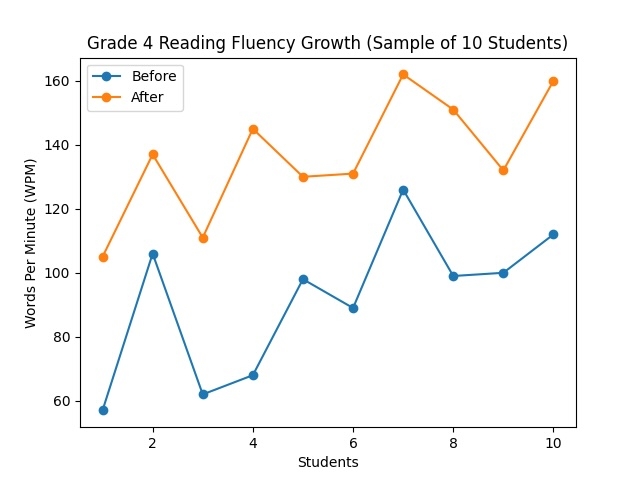

Across both grade groups, students demonstrated clear and consistent growth in reading rate over time.
- All Grade 4 students in the sample increased their words per minute, with several students demonstrating significant gains
- The majority of Grade 7 students also showed measurable improvement in reading rate
- Growth was observed across a range of starting points, indicating that consistent, repeated practice supported diverse learners
In addition to quantitative growth, teachers observed:
- Increased reading confidence and willingness to read aloud
- Improved phrasing and attention to punctuation
- Reduced word-by-word reading
- Greater stamina during sustained reading tasks
STUDENT VOICE:
Student reflections reinforced these observed patterns:
Improved fluency and accuracy: “The one problem I had when I was reading before was, I was skipping over periods. I really wanted to work on that and found I did improve over time. One more thing I noticed is I was able to get words out easier whereas before I stuttered while reading.” - Grade 7 student
Stronger expression and attention to punctuation and increased confidence reading aloud: “I got way better at having more emotion in my reading and I stopped at punctuation more. I feel like in the beginning I was going past punctuation without pausing. Now I’m also better at reading out loud, I was more nervous before and would stumble across my words but I’m more confident after the 6-minute reads.” - Grade 7 student
“I developed more emotion in my reading. I knew there were different ways of reading texts, so I was able to focus on adding more expression.” – Grade 7
Greater reading stamina and improved flow and word recognition: “I noticed that my reading stamina improved and evolved. Before this when I was reading, I was breaking words apart but with practice I could say the full word and flow more. I think it is because I was reading aloud regularly.” - Grade 4 student
“It helped me improve my reading stamina and building up reading more. I also helped me with my understanding because I was reading more in class.” - Grade 4
KEY LEARNING
This inquiry demonstrated that consistent, short fluency practice has a measurable impact on students’ reading rate, expression, and confidence. Structured routines, paired practice, and repeated reading created the conditions for students to build automaticity and develop greater independence as readers. All students benefited from intentional, levelled fluency practice, with particular importance for students who are emerging or developing readers. It built a culture of reading.
At the same time, this work revealed an important insight:
While students improved in fluency, many continued to struggle with comprehension when asked to retell or explain their thinking.
OUR NEXT STEPS
Primary Reading Inquiry:
Based on these results, we will continue strengthening students’ reading skills through systematic phonics instruction with a focus on fluency and accuracy. We will also continue using oral reading fluency (ORF) benchmarks to monitor progress and guide targeted small-group instruction to support ongoing growth.
OUR NEXT STEPS:
- Continue to do use systematic phonics instruction for fluency in reading and accuracy
- Continue to use ORF norms to track and guide targeted small group instruction
- Focus on comprehension strategies for retell
- Model and practice retelling strategies using story maps, sequencing activities, and “Somebody–Wanted–But–So–Then” frameworks.
- Explore Partner Reading Paragraph Shrinking
- Explore GIST statements and “Think Alouds” while reading aloud to children as strategies.
Intermediate Reading Inquiry:
Building on these finding, our next steps are to continue the fluency routines and our next inquiry cycle will focus on reading comprehension while maintaining fluency routines.
As a team, we will:
- Integrate comprehension strategies alongside fluency practice
- Use assessment data (e.g., Acadience retell) to guide instruction
- Provide targeted support for students who require additional scaffolding
- Continue monitoring fluency to ensure sustained growth
This next phase will help us better understand how fluency and comprehension work together to support overall reading success.
Surrey Schools
Formed in 1906, the Surrey School District currently has the largest student enrolment in British Columbia and is one of the few growing districts in the province. It is governed by a publicly elected board of seven trustees.
The district serves the cities of Surrey and White Rock and the rural area of Barnston Island.