Edgewood Elementary 25-26

OUR CONTEXT
Our Context:
Situated on the unceded traditional ancestral territories of the Katzie, Kwantlen, Semiahmoo and other Coast Salish Peoples, Edgewood has the honour and privilege to uphold a diverse learning ecosystem. Our community works collectively in sharing a vision, founded on school as a learning organization with students at our center. The following action-oriented dimensions guide our outcomes:
- Vision: Developing and sharing a vision focused on student learning.
- Continuous Learning: Creating and supporting ongoing learning opportunities for all staff.
- Collaboration: Promoting team learning and collaboration among staff, fostering a culture of inquiry, innovation, and exploration.
- Knowledge Systems: Embedding systems for collecting and exchanging knowledge.
- External Learning: Learning from the external environment and larger learning system.
- Leadership: Modelling and growing learning leadership.


OUR LEARNERS
Our Learners:
At Edgewood, our learners share a vision of culture we call our “P.A.C.K” positive, accepting, community of kindness. In sharing this vision, each student is welcomed as they are, and the gifts they bring into our community. Creating an environment where children feel seen, safe and belong is an integral piece in supporting each child as a learner. It is within this framework that teachers, support staff, parents and community members work together to create a culturally responsive environment, where students are welcomed, take risks, think critically, and engage in powerful learning.

OUR FOCUS
Our Focus:
Over the past two years, our staff has been actively engaged in exploring how literacy can be used as a tool for equity. Collectively, we have been unpacking the question: How can we create equitable learning environments where all students are able to access the resources and supports they need to achieve literacy proficiency? As our inquiry into this question has progressed, another important question emerged: What assessment tools are we using to tell us how our students are progressing as readers and writers?
This year, with the Ministry of Education and Child Care’s Literacy Supports plan coming into effect, we have chosen to focus our Student Learning Plan on tracking the reading development of Edgewood’s Grade 1 learners. To better understand the literacy needs of their learners and guide their instructional planning, our Grade 1 team collectively administered a literacy screener.
A literacy screener is a quick, evidence-based assessment tool that is used to help identify students who may benefit from additional, targeted support as they develop their skills as readers. In the primary grades, literacy screeners assess student progress in key skill areas such as phonemic awareness, letter recognition, decoding, and oral reading fluency.
Term 1
As part of our September Term 1 Screening, our Grade 1 students were assessed using the following measures:
Letter Naming Fluency
This subtest assesses a student’s ability to name the names of letters. While not an essential skills necessary for reading, a student’s ability to accurately and fluently name letters is predictive of future reading success.
Phoneme Segmentation Fluency
This subtest assesses a student’s ability to segment spoken words into its individual sounds (phonemes). It allows us to get a sense of a student’s current phonemic awareness skills.
Nonsense Word Reading Fluency
This subtest assesses a student’s letter-sound knowledge and if they can apply this knowledge to read CVC (consonant-vowel-consonant) and VC (vowel-consonant) nonsense words.
The results of these subtest were then used to calculate our students’ Term 1 Reading Composite Scores. The Reading Composite Score is considered to be the most accurate estimate of a student's current benchmark level. Please see a grade-level overview of our students' Reading Composite Scores below:

After scoring these assessments, the team met, discussed grade-wide instructional needs, and collaborated with our Learning Support Team to decide which students would benefit from additional, targeted small-group support. Based on our initial assessment data, our team identified that our Grade 1 students would benefit from systematic and explicit phonics instruction to develop their phonemic awareness and word reading skills. The development of these skills is not confined to a phonics lesson, and our Grade 1 team works to build opportunities for students to develop and practice these skills throughout the school day in cross-curricular ways.
Term 2
As part of our February Term 2 Screening, our Grade 1 students were assessed using the following measures:
Nonsense Word Reading Fluency
This subtest assesses a student’s letter-sound knowledge, and if they can apply this knowledge to read CVC (consonant-vowel-consonant) and VC (vowel-consonant) nonsense words.
Oral Reading Fluency
This subtest assesses a student’s oral reading fluency rate by measuring how many words they read correctly in a minute, along with an accuracy percentage. Three passages are administered, each of which include a retell measure to give information about a student’s reading comprehension.
The results of these measures were then used to calculate our students' Term 2 Reading Composite Scores. Please see a grade-level overview of our students' Term 2 Reading Composite Scores below:
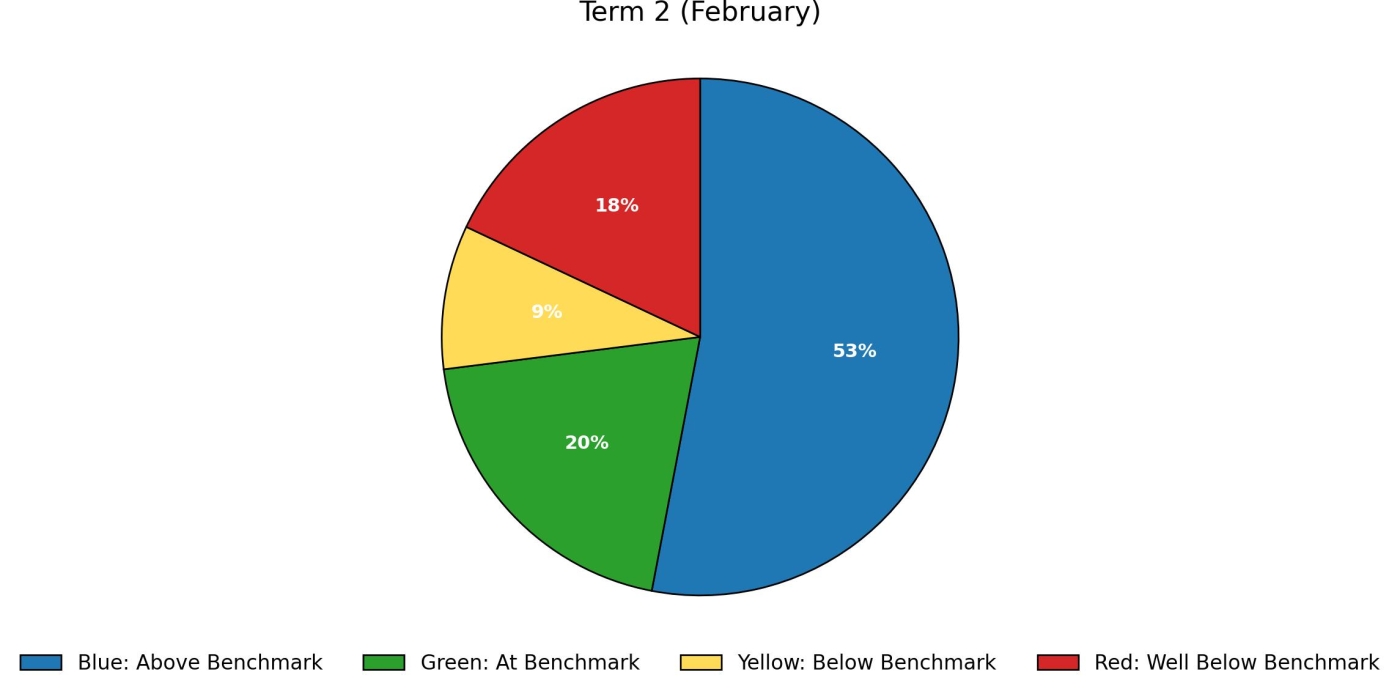
After scoring the Term 2 screening assessments, the team met again to evaluate the impact of our instruction. We also continued collaborating with our Learning Support Team to adjust groups who would be receiving targeted support in Term 3.
Term 3
As part of our final Term 3 Screening, administered in May, our Grade 1 students were assessed using the following measures:
Nonsense Word Reading Fluency
This subtest assesses a student’s letter-sound knowledge, and if they can use this knowledge to read CVC (consonant-vowel-consonant) and VC (vowel-consonant) nonsense words with automaticity.
Oral Reading Fluency
This subtest assesses a student’s oral reading fluency rate by measuring how many words they read correctly in a minute, along with an accuracy percentage. Three passages are administered, each of which include a retell measure to give information about a student’s reading comprehension.
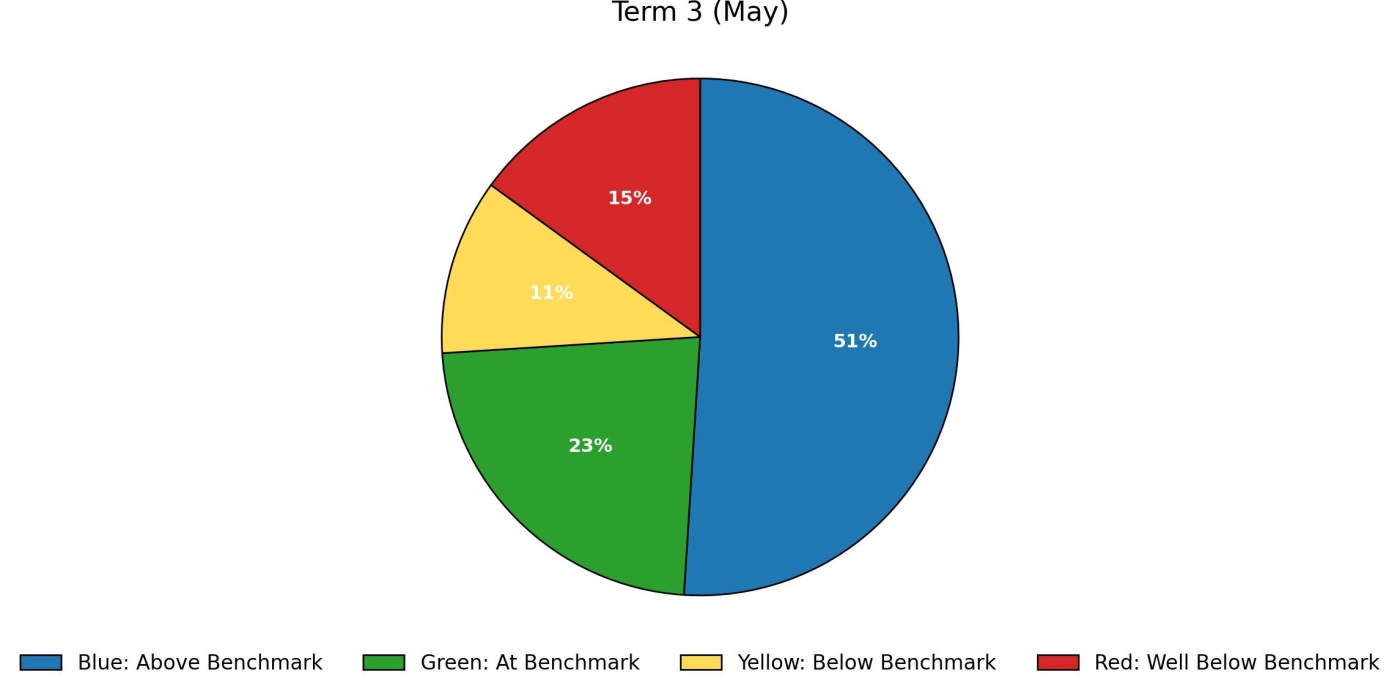
The results of these measures were then used to calculate our students’ Term 3 Reading Composite Scores. Please see a grade-level overview of our students’ Term 3 Reading Composite Scores below:
End of Year Reflections:
As our team reflects on our students’ progress this year, there is a lot to celebrate. At the beginning of the year, 45% of our Grade 1 students were Well-Below Benchmark, and as of the end of May, that percentage was reduced to 15%.
Our Grade 1 team has shared that this data-tracking initiative was a powerful project to be a part of. Not only did our students make significant progress in their reading development, our team was also able to visually see the impact of their instruction.
Below, you will find a graphic that showcases the changes in our Grade 1 students’ Reading Composite Scores as the year progressed:


OUR NEXT STEPS
Our Next Steps:
Our staff is committed to creating equitable and responsive literacy learning environments, but we acknowledge that this is a complex process that requires time, learning, collaboration, resources, and support. To continue to support staff learning, we have been a part of the district’s Responding to Readers initiative to help build our collective knowledge and instructional capacity. Not only have staff been engaging in district literacy initiatives, they have been also collaborating at a school level through grade-group conversations and staff-led Lunch & Learns on Literacy Development.
To help track the impact of our literacy instruction, we will continue to monitor the reading progress of our Grade 1 learners into the 2026/2027 school year. By intentionally tracking the reading development of this group of learners, it will provide us with valuable, multi-year assessment data that can be used to help target our literacy instruction to the needs of our learners.
While we will continue to track this specific cohort of Grade 1 students, we will also be supporting K-3 teachers as they further their learning about the purpose of early literacy instruction. This will help support staff as they work to implement the Ministry of Education and Childcare's early literacy screening initiative, which comes into full effect in the 2026/2027 school year.
Our intermediate staff have shown an interest in exploring morphology and vocabulary routines to support their literacy instruction. We will continue to encourage our team to look at new resources, work collaboratively, and meet to discuss progress and best practices. We are moving forward with training and in-services to help provide instruction and training for the Intermediate staff and the LST team through opportunities such as Lunch & Learns and introducing district-approved literacy resources.
Information from the Grade 3 assessments will also be passed along to the intermediate grades so that they can help inform teachers about student growth, their progress and their stretches once the K-3 screening initiative is in place.
Surrey Schools
Formed in 1906, the Surrey School District currently has the largest student enrolment in British Columbia and is one of the few growing districts in the province. It is governed by a publicly elected board of seven trustees.
The district serves the cities of Surrey and White Rock and the rural area of Barnston Island.