École Simon Cunningham

OUR CONTEXT
École Simon Cunningham is made up of a diverse student body. We have 540 students enrolled in our dual track, French and English, programs as well as our intensive classroom for students with complex medical needs. There are 28 different languages spoken at home including Punjabi, Hindi, and Arabic. Our staff describe our learners as curious, connected, and creative. Students are positive and friendly. They like to express their thinking (especially with digital technology) and they’re beginning to display an understanding of what self-reflection entails. There is a high interest and participation rate in various clubs and sports teams. Learners enthusiastically take part in the sustainability club, comic book club, and the leadership team, and sports such as volleyball, basketball, badminton, rugby, and track and field. We also have an active group of First Nations students who drum during assemblies and announcements throughout the school year.
Our Indigenous learning staff committee continuously plans school wide initiatives that brings together our Indigenous learners and promotes Indigenous culture and learning within the school. For example, this year the committee applied for a grant to bring in an Indigenous artist to paint our large school drum as well as First Nations students participated in a workshop to learn how to create cedar bracelets. Also, the Indigenous Learning committee brought in the district Indigenous learning teacher to develop a greater understanding of the language being used in our daily land acknowledgment.
OUR LEARNERS
Literacy is a fundamental life skill. It is the ability to read, write, speak, and think in a way that lets us communicate effectively and makes sense of the world. Communication - a core competency embedded across all areas of learning in BC's curriculum - is central to supporting our learners develop their literacy skills as they collaborate, problem solve, share ideas, exchange information, and express their individuality. Below, we highlight our learners' strengths and successes in the following areas:
English language arts
Place-based learning
Indigenous learning
Art
Ours learners explore stories and other texts that help them understand themselves and make connections to others and to the world.
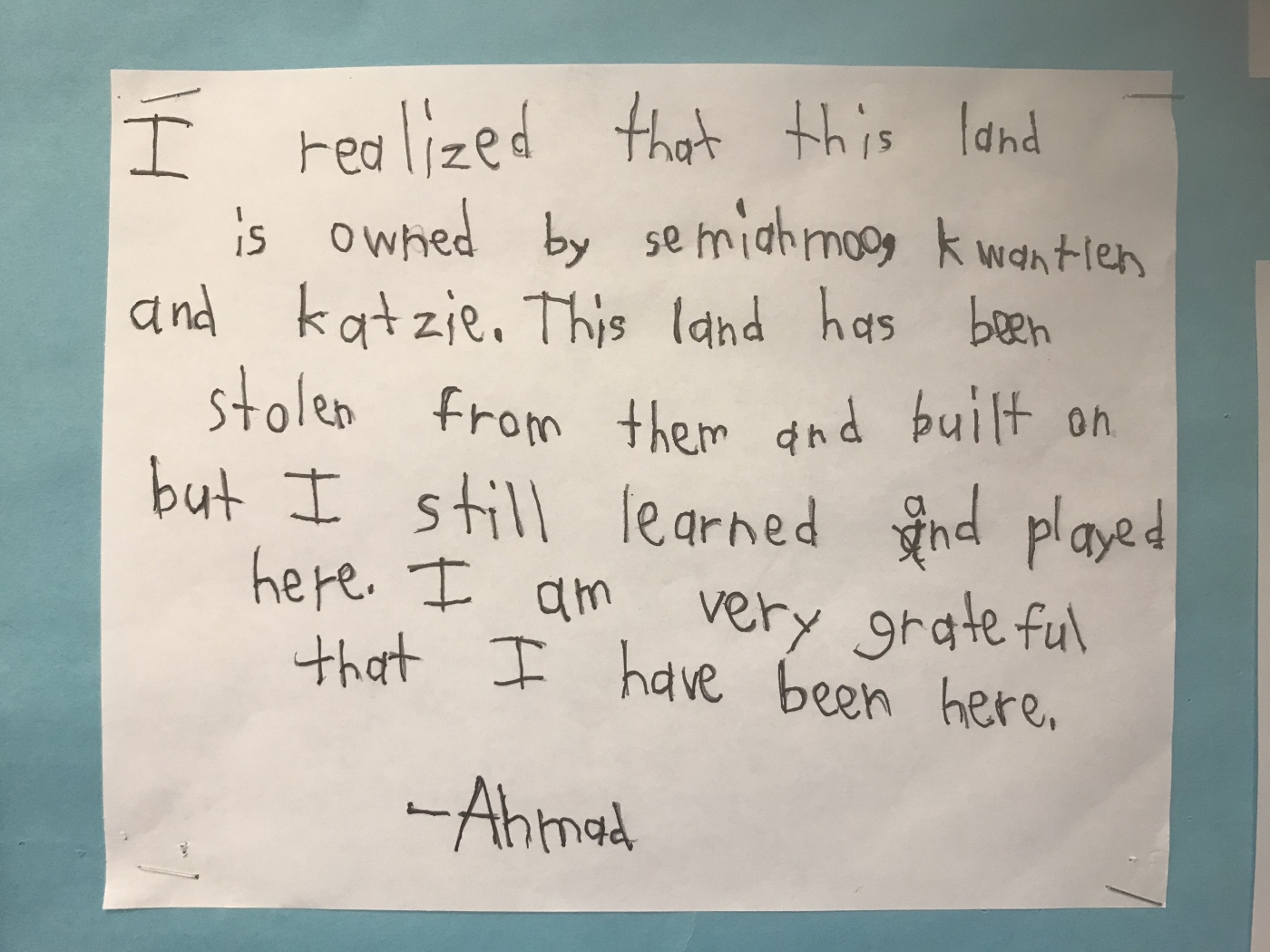
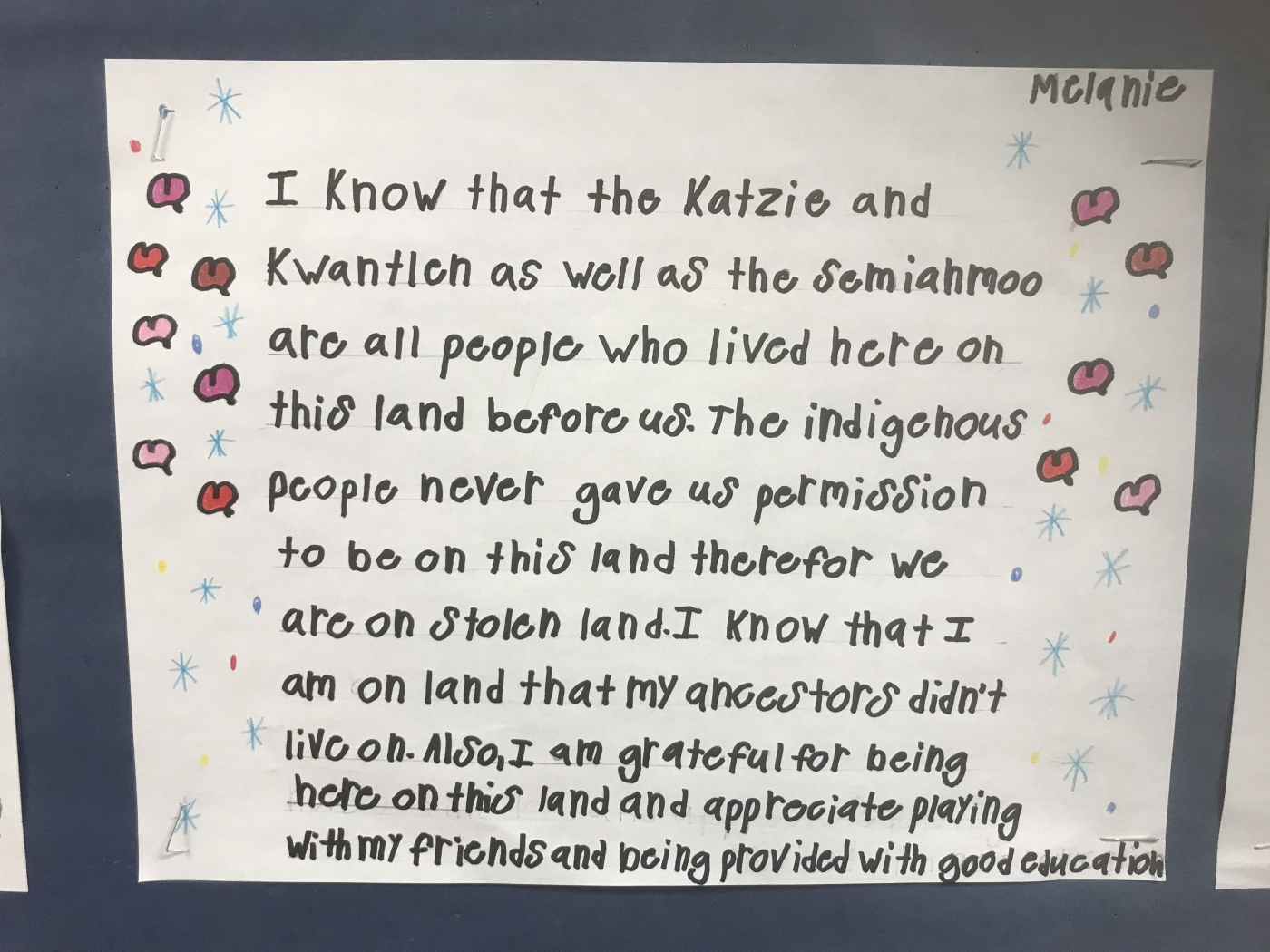
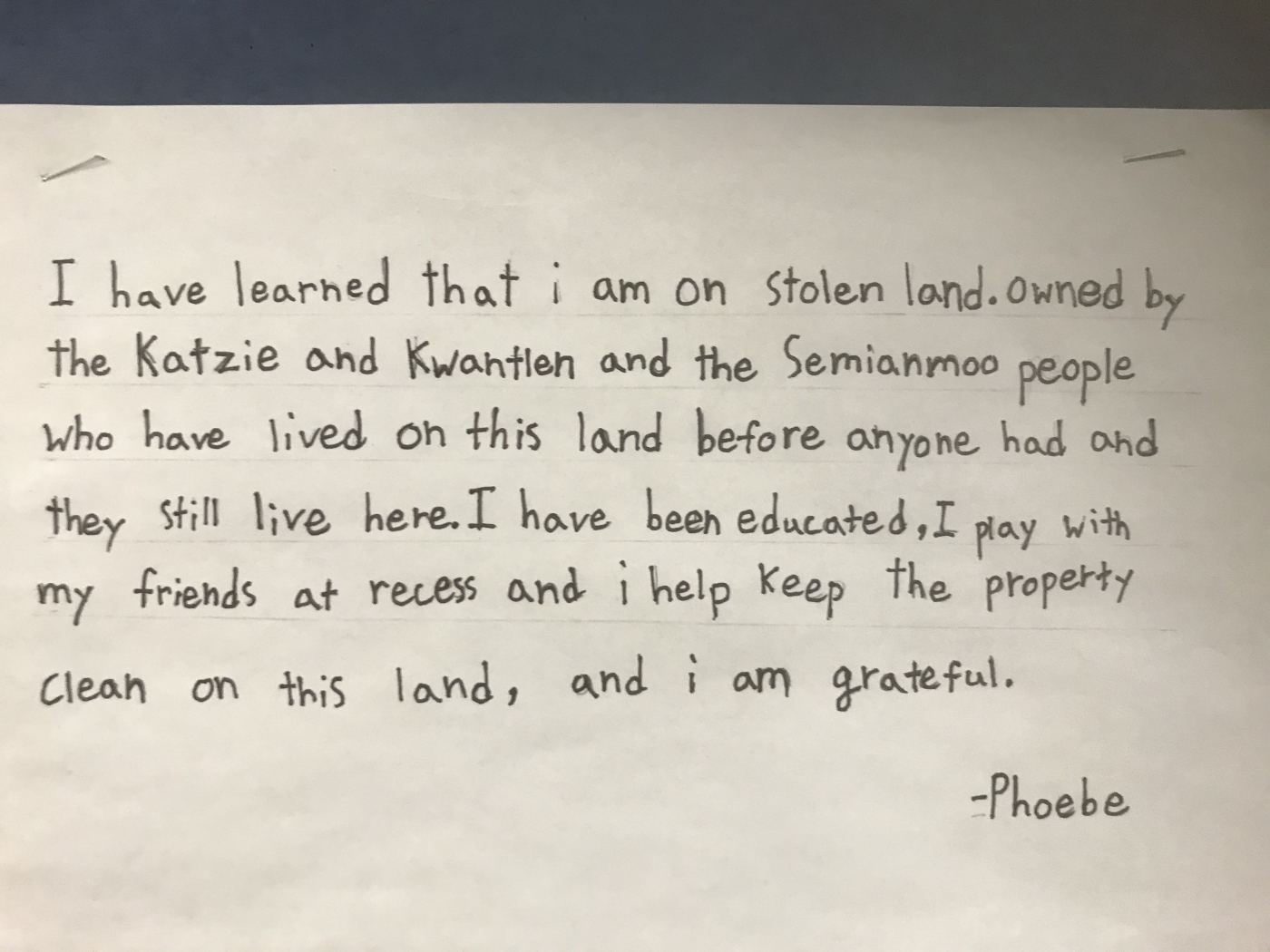
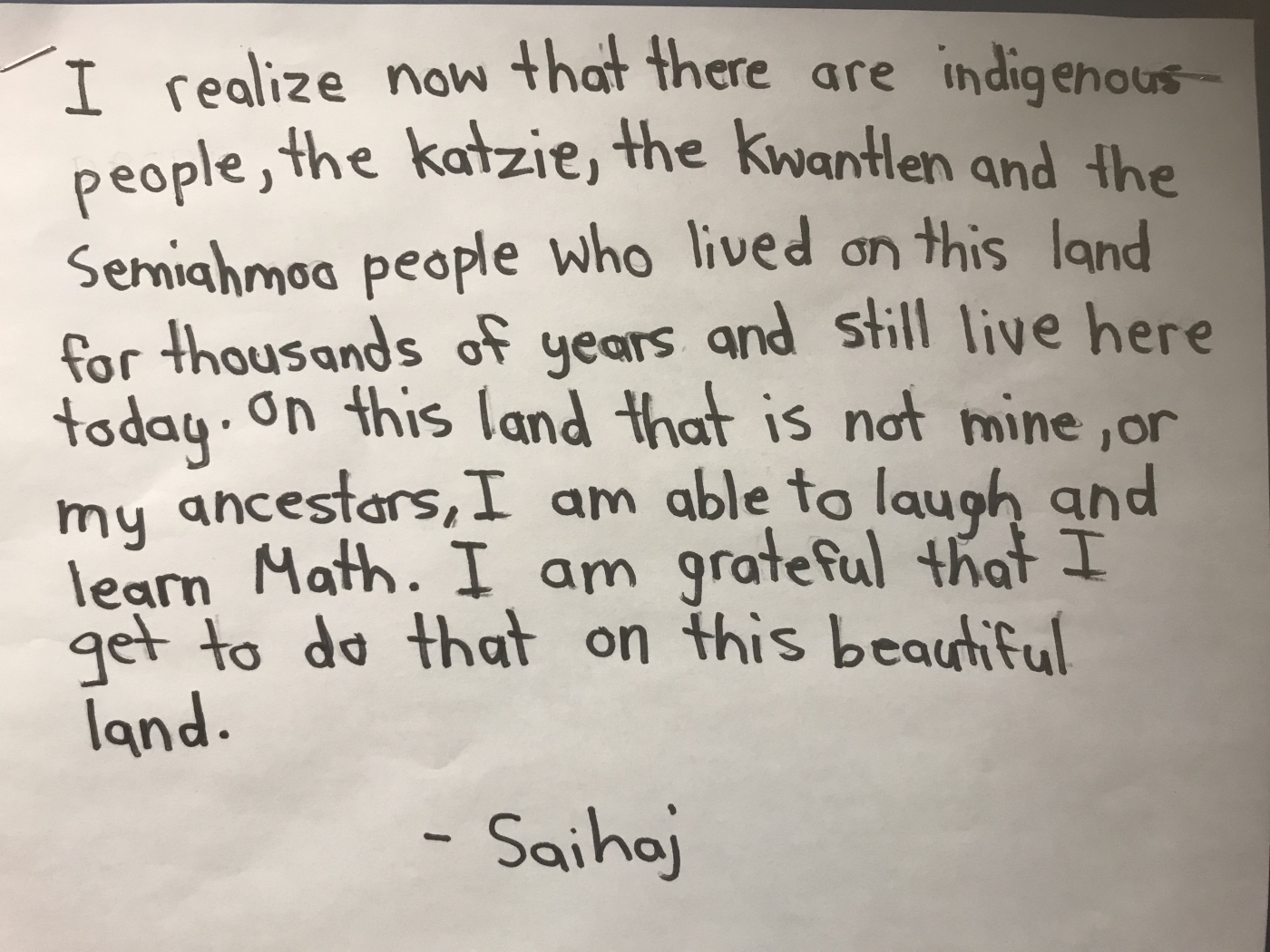
Through class discussions and writing, our learners explored the curriculum through place-based learning. Students took part in class discussions about the purpose of the land acknowledgment shared with our community of learners each morning. Learning about the meaning behind the words, such as "acknowledgment," "unceded," "shared," and "traditional," students in grades 1, 2, 4, 5, 6 developed their own personal land acknowledgements in writing and through drawings. During class discussions, learners made deeper connections to the land acknowledgment by discussing their gratitude and appreciation for the land and how it positively contributes to their daily lives in school and at home.
OUR FOCUS
Each and every day, among the variety of learning experiences presented to our learners, our team of educators focus on thinking, reading, writing, and communicating in all curricular areas. Our aim is to build strong literacy foundations that are fundamental for students' participation in today's world.
All teachers, across all grades, provide students with learning opportunities aimed at increasing the literacy success rates of our learners. To highlight and determine overall successes and gaps, we monitored the progress of two cohorts (grades 1/2 and 4/5/6) across different subject areas.
Our students' learning goals include:
Curricular Competencies: English Language Arts - Grade 6
- Recognizing and identifying the role of personal, social, and cultural contexts, values, and perspectives in texts
- Using writing and design processes to plan, develop, and create engaging and meaningful literary and informational texts for a variety of purposes and audiences.
- Recognizing and appreciating the role of story, narrative, and oral tradition in expressing First Peoples perspectives, values, beliefs, and points of view.
- Recognizing how language constructs personal, social, and cultural identity.
Curricular Competencies: English Language Arts - Grade 2
- Use personal experience and knowledge to connect to stories and other texts to make meaning
- Show awareness of how story in First Peoples cultures connects people to family and community
- Exchange ideas and perspectives to build shared understanding
Writing
Grade 4/5 students personal land acknowledgments:



Grade 6 students personal land acknowledgments:



Speaking
Each morning grade 1/2 French immersion students gather outside and participate in a sharing circle. Together, they acknowledge and recognize the land on which their school resides is the traditional and unceded territory of the Kwantlen, Katzie, Semiahmoo and other Coast Salish peoples. 
Here is an audio/video clip of their land acknowledgment - https://vimeo.com/724956672/a7c353f86e
Art
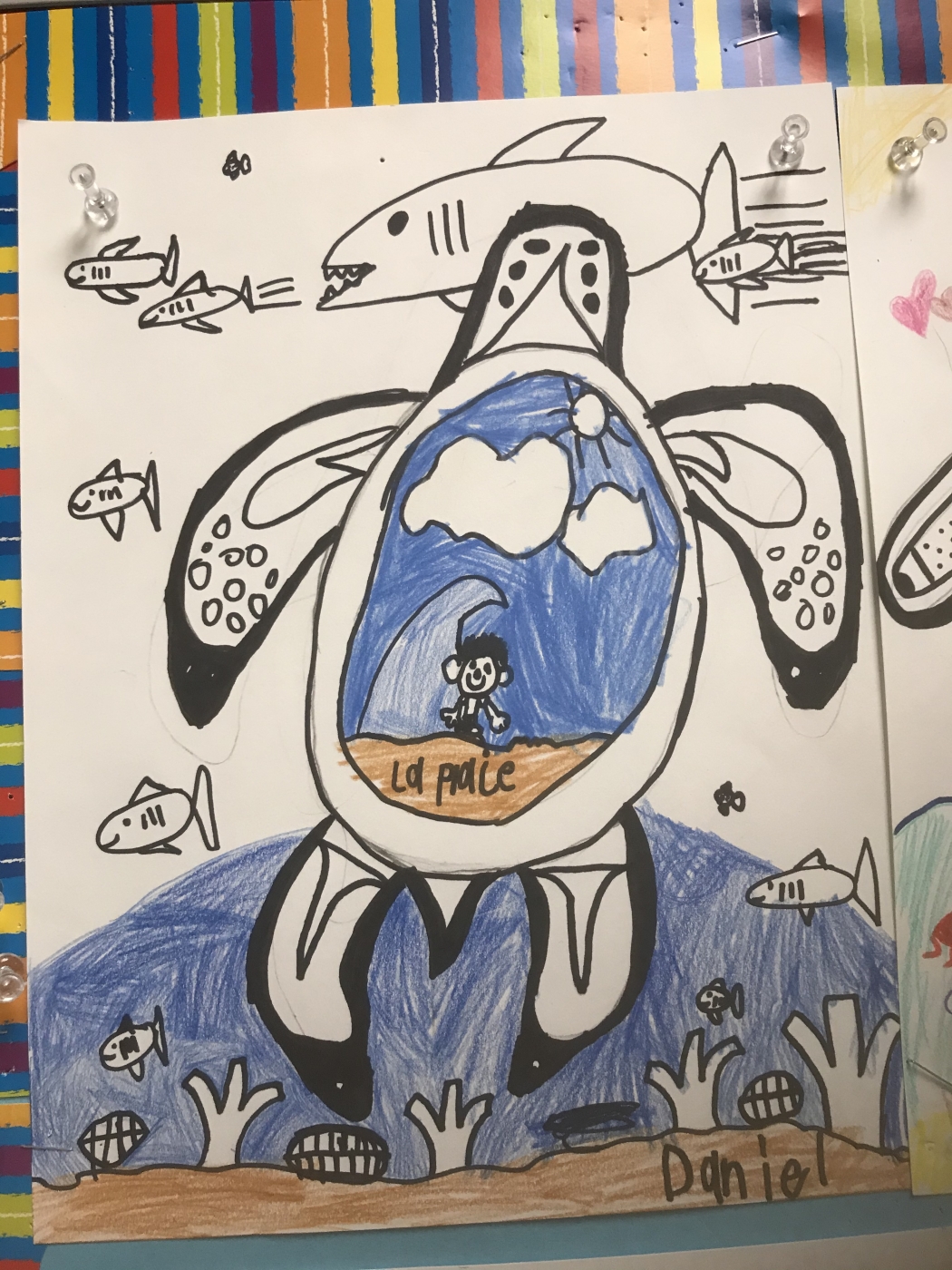
Grade 1/2 Students learned about the Indigenous artist, Michelle Stoney. Using Michelle Stoney's drawing, Turtle Island, students embedded their drawings of their personal connection to the land.


OUR NEXT STEPS
Evidence of our student learning demonstrates that nearly 70% of learners believed that they do not participate in Indigenous celebrations or ongoing Indigenous programs at our school. As well, in conversations and discussions with students prior to the direct learning and teaching of the land acknowledgment, students expressed that they did not understand the purpose of the land acknowledgment and the definitions of specific words used in the land acknowledgment.
Our next steps include continuing to use place-based learning as a way to explore the BC curriculum, including the curricular competencies and the core competencies, with an emphasis in developing learners understanding and appreciation of Indigenous world views. When asked to communicate their students' progress, teachers indicated that all students demonstrated growth in their understanding of the land acknowledgment through oral and written communication, and art.
Moving Forward
Based on evidence of students' progress in relation to our learning goals, our teachers plan to continue to develop students literacy skills and facilitate a deeper understanding of First Nations perspectives. We plan to increase opportunities for students to build connections between the land and themselves and for students to regularly use writing strategies and thinking routines that guide their thought processes and support them in developing deeper understanding of text (oral, print, visual, digital).
Surrey Schools
Formed in 1906, the Surrey School District currently has the largest student enrolment in British Columbia and is one of the few growing districts in the province. It is governed by a publicly elected board of seven trustees.
The district serves the cities of Surrey and White Rock and the rural area of Barnston Island.