Ecole Peace Arch 2025-2026

OUR CONTEXT
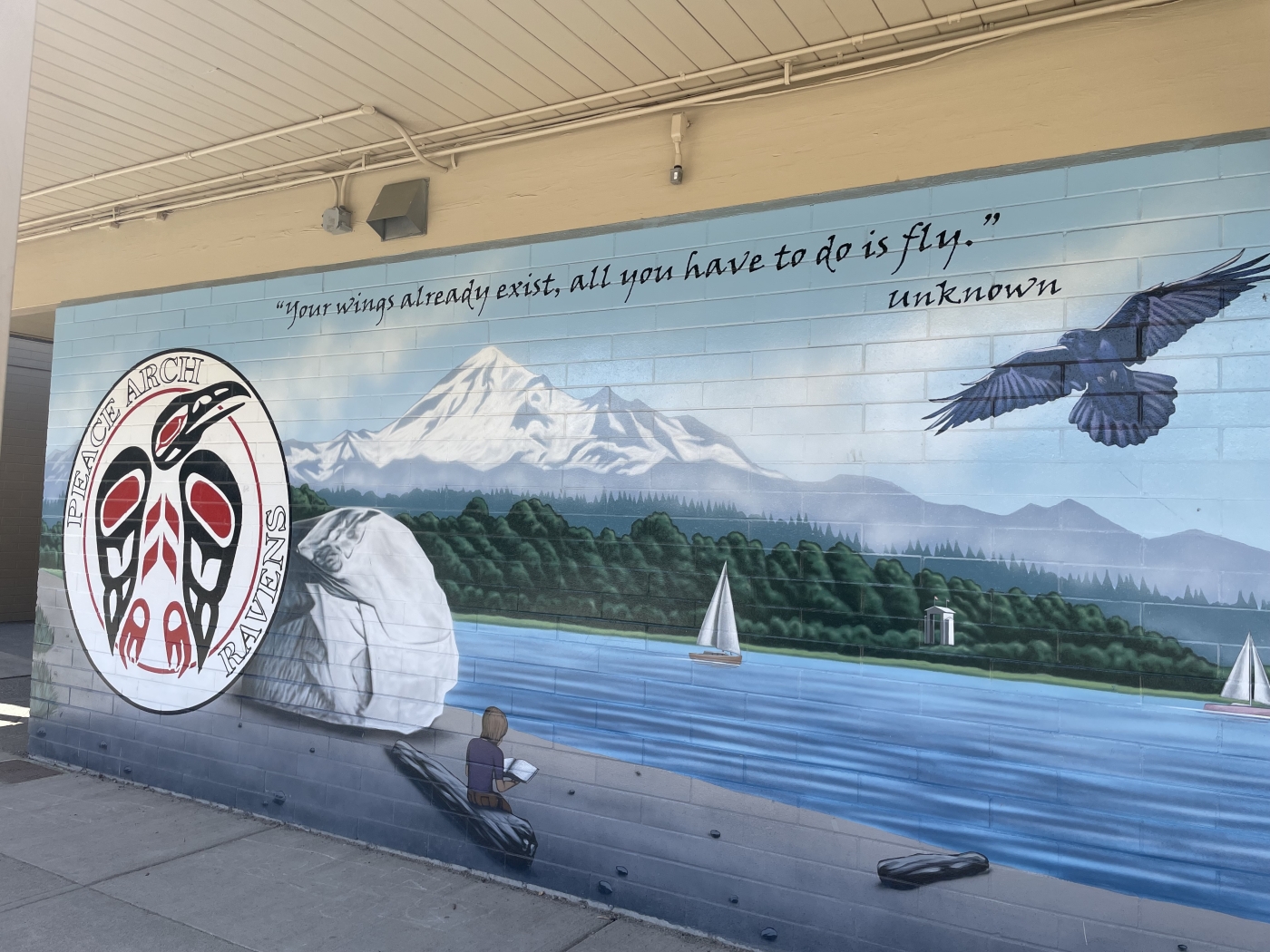
École Élémentaire Peace Arch School is located on the unceded traditional territory of the Semiahmoo Nation who share the remarkable White Rock Coastline and surrounding lands with our school community. Our team of educators take advantage of the many green spaces, parks and beaches that are within walking distance from our school and incorporate experiential learning into their practice that have our students out and connecting to their land and community often throughout the school year. We have a school garden which hosts indigenous plants.
We have a unique campus setting with 5 "Pods" or modular-like buildings, making our hallways primarily outdoors. We have a large outdoor space with two incredible playgrounds, one of which is accessible, undercover play areas, a gravel field, and an outdoor basketball court. We are alongside the grassy Peace Arch Playing Field, that our students are able to access throughout the day.
We are a dual track school where our Neighbourhood Program learners work, learn and play alongside and with our French Immersion learners. Regardless of the language of instruction, together we are the Peace Arch Ravens and we focus on taking care of ourselves, each other and our land!

OUR LEARNERS
Developing our understanding of how language works allows us to use it purposefully.
Writing is a foundational skill for elementary students, playing a crucial role in their overall academic and personal development. Writing develops communication skills, enhances critical thinking and problem-solving, fosters creativity and imagination and reinforces learning across all subject areas.
While reviewing our students' strengths and stretches in Writing, a common goal appears to be the curricular competency: Improving their repertoire of conventions of Canadian spelling, grammar, and punctuation.
Currently, students at Peace Arch, work on the above goal through journal writing, paragraph and essay writing, story writing, and speech writing. Our intermediate French Immersion students participate in the Concours d'art oratoire French Speech Meet each year. Students enjoy writing about their own personal experiences and working through the process of writing to enhance their understanding of the writing process.
OUR FOCUS
As part of our commitment to fostering strong foundational literacy skills, Peace Arch Elementary placed a focused emphasis on grammar and punctuation across all grade levels. This initiative aligns with the BC English Language Arts (ELA) Curriculum, which emphasizes the development of students’ ability to communicate clearly and effectively through both oral and written language.
In accordance to the BC Curriculum, students are expected to:
Use language to communicate meaningfully in a variety of contexts (Curricular Competency)
Understand and apply language conventions, including grammar and punctuation, to enhance clarity and coherence in their writing (Content)
Reflect on and assess their own writing to improve accuracy and effectiveness (Curricular Competency)
Focus Areas by Grade Groupings
Primary (K–3):
Introduction to basic sentence structure (capitalization, periods, question marks)
Use of simple conjunctions (e.g., and, but, because)
Understanding subject-verb agreement in simple sentences
Encouraging oral language development as a foundation for written grammar
Intermediate (Grades 4–7):
Expansion of sentence variety (compound and complex sentences)
Correct use of commas, quotation marks, apostrophes, and other punctuation marks
Application of grammar rules in editing and revising written work
Integration of grammar instruction into cross-curricular writing tasks
Instructional Strategies
Explicit instruction in grammar and punctuation rules within writing workshops
Modelled and shared writing to demonstrate correct usage in context
Daily language routines and editing practice to reinforce skills
Use of mentor texts to highlight effective grammar and punctuation in authentic literature
Data was collected from five classes across Grades 3–7, including students from both the French Immersion Program and the Neighbourhood Program.
Assessment data gathered in November 2025 and June 2026 indicates significant growth in students’ writing skills over the course of the year. This improvement was consistent across all groups, with broad-based gains observed among the majority of students.


Students in our Grade 3/4 focus class used white boards frequently to practice their writing and focus on getting ideas down, and then going back to revise and edit their punctuation, spelling and grammar.


Students in the same class started the year working in sentences and through their focused on work on the editing and revision process produced large, self edited pieces of writing about wisdom from their family.


OUR NEXT STEPS
This year, students were asked to complete a revising activity where they are asked to correct capitalization errors, punctuation and spelling in a grade appropriate text. Students were taught to follow editing checklists and to peer-edit each other's writing. Teachers provided feedback through conferencing with students and marked assignments.
For this upcoming year, our hope is to support students in developing a deeper understanding of writing mechanics and revision skills, while working on authentic writing tasks. We want to focus on ensuring students apply their learning in meaningful ways. We want students to apply what they've learned to their own writing. A new addition will be to assess with clearly defined rubrics to help track growth.
In addition, the thoughtful use of digital tools to support grammar and spelling—paired with explicit instruction on how to critically evaluate automated suggestions—will help build student confidence and independence as writers.
Together, these approaches aim to refine both instructional practices and assessment methods, ensuring that all students continue to develop a strong foundation in written communication.
Surrey Schools
Formed in 1906, the Surrey School District currently has the largest student enrolment in British Columbia and is one of the few growing districts in the province. It is governed by a publicly elected board of seven trustees.
The district serves the cities of Surrey and White Rock and the rural area of Barnston Island.