Ecole Jessie Lee 24-25

OUR CONTEXT
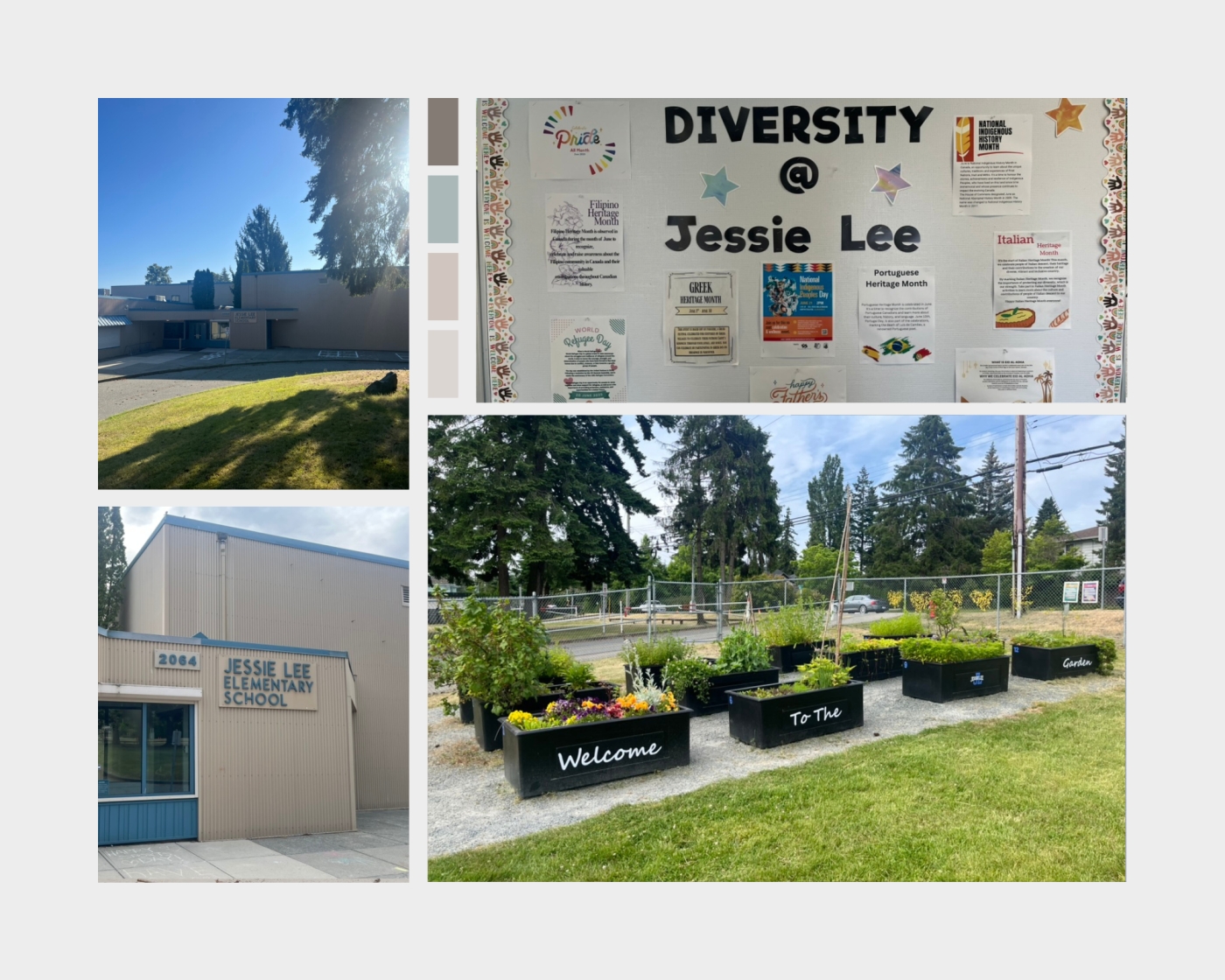
We are located in South Surrey on the traditional shared territory of the Semiahmoo First Nations. Our school is nestled in a beautiful neighbourhood surrounded by nature, blocks from the ocean and yet very close to urban comforts. Our approximately 410 students come from diverse backgrounds that make up our collaborative school community. We also have two late French Immersion classes. Our parent group, teachers and support staff all work together to contribute to a warm, welcoming place of belonging for all.
Our school is community-minded:
We seek opportunities to connect with our local environment (place-based learning) in places like our school garden
Our learning team invites collaboration (school, other schools, district, community)
Our dedicated parent group is active in bringing joy to our school by helping us create a school garden, organizing an annual Spring Fair, supporting school wide events like our Spring Sprint, Summer Fun Fair and of course, our student’s favourite- Hot Lunch!
We are supported by multiple organizations in our community such as Feeding Futures and the Vancouver Sun
We are supported by our district through the Community Schools Partnership (after school programs and a variety of lunch time sports programs for intermediate students)
Our school is inclusive:
We work to create a network of safe, and caring adults to support students
We celebrate and honour diversity at Jessie Lee and have a hard-working student Diversity Club
Our classroom environments work to be differentiated and trauma informed
We are committed to incorporating Indigenous Ways of Knowing and the First Peoples Principles of Learning
- Our students have special opportunities to participate in activities such as Game Ready, Klinik, and Arts Umbrella
At Jessie Lee our school goals are to .... Be Respectful Be Co-operative Be Safe .....This makes Jessie Lee a place where everyone belongs!
Our school is committed to literacy:
Our classrooms use a balanced literacy approach
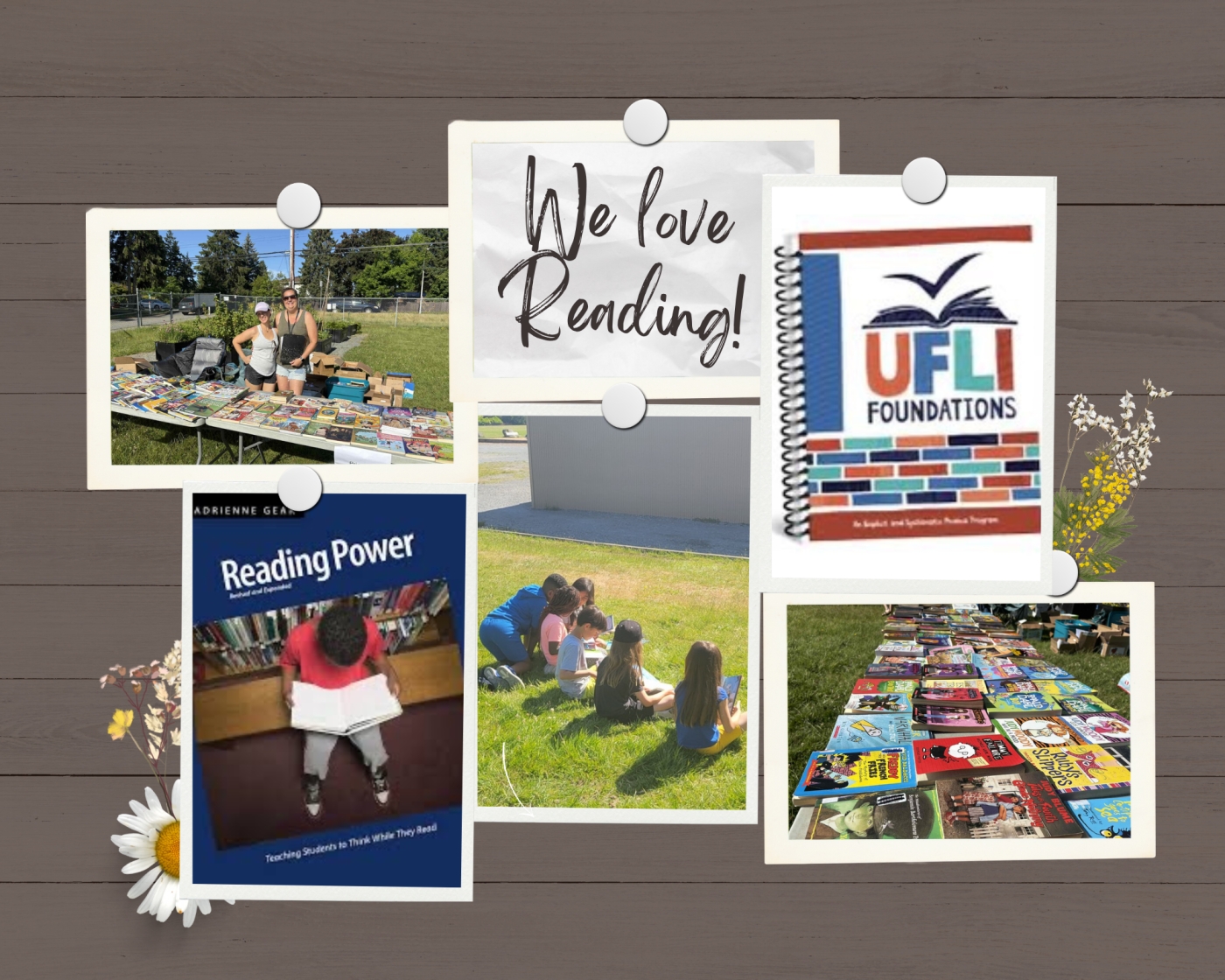
Many of our teachers are involved in the "Responding to Readers" initiative
Our primary teachers use focussed phonics programs, such as UFLI
Many of our teachers are trying new forms of assessment, such as Dibels
OUR LEARNERS
At Jessie Lee we aim to provide substantial literacy exposure and instruction to our early primary students. We partner with our Strong Start Program, that welcomes parents and young children ages 0 to 5 into our school, with literacy experiences around the school. Our school context requires a rich and balanced literacy program to improve our students reading and writing – helping all our students thrive and grow. Using daily repetition to ensure that the lesson focus was the content not the activity, literacy instruction is embedded throughout the day starting with daily levelled guided reading groups, daily high frequency word instruction, daily targeted spelling activities, and daily writing lessons.
Our learning plan is supported in the BIG IDEAS of English Language Arts:
Language and story can be a source of creativity and joy.
Stories and other texts can be shared through pictures and words.
Playing with language helps us discover how language works.
Curricular Competency: Students can use a variety of comprehensions strategies before, during, and after reading, listening, and viewing to guide inquiry and deepen understanding of text.
- using illustrations and prior knowledge to predict meaning; rereading; retelling in own words; locating the main idea and details; using knowledge of language patterns and phonics to decode words; self-correcting errors.
When students learn reading strategies, they learn to make sense of the world presented in text and make greater sense of the world around them. They then learn to share their own stories, translating their literacy skills into written form that can be read by others. Our cohort of intermediate students is focused on developing the literacy skills in both reading and writing.
The video below is an example of how one of our teachers conducts small book clubs, focussed on both reading fluency and comprehension. As part of their Daily 5 routine, students meet in their book clubs with the teacher one a week to read a novel together. The teacher acts as the '"coach," supporting students with strategies like pacing and expression. They use targeted prompts, such as "slower" or "pause" to guide students in real time. The small group format allows the teacher to deliver targeted mini-lessons tailored to individual needs.
OUR FOCUS
Jessie Lee Students are Focused on Literacy!
At Jessie Lee, reading is an important school goal that is a fundamental skill across all grades and all subject areas. Literacy is the ability to understand, critically analyze, and create a variety of forms of communication, including oral, written, visual, digital, and multimedia, in order to accomplish one’s goals. It is the ability to read, write, speak, and think in a way that lets us communicate effectively and engage with the world around us. At Jessie Lee, teachers design literacy experiences and lessons to support our students to achieve their potential.
The inquiry question:
Can students demonstrate growth towards reading at grade level by the end of the current school year?
- Using carefully designed lessons and learning opportunities, can students increase their reading ability to read at grade level by the end of the current school year?
Can students demonstrate growth in their ability to communicate personal narratives in written form?
- Using carefully designed lessons and learning opportunities, can students increase their ability to communicate in a written format?
Our Cohort:
Our cohort is a group of intermediate students. We looked closely at this group to gather evidence of success, ensure access to quality levelled texts and reflect on best strategies to deepen our students literacy skills.
Teachers designed specific units and lessons to target the reading and writing needs of their students. This focus was taught through explicit teaching structures such as the "Daily 5" and Book Clubs, word work focussed on phonetic patterns and word families, and grammar mini-lessons.
In one classroom the teacher took on the role of a “Coach,” supporting students with strategies like pacing and expression.
" I used brief, targeted prompts—such as “slower” or “pause”—to guide students in real time, much like a coach would during practice. This small-group format also allowed me to deliver targeted mini-lessons tailored to individual needs, such as decoding strategies or expressive reading."
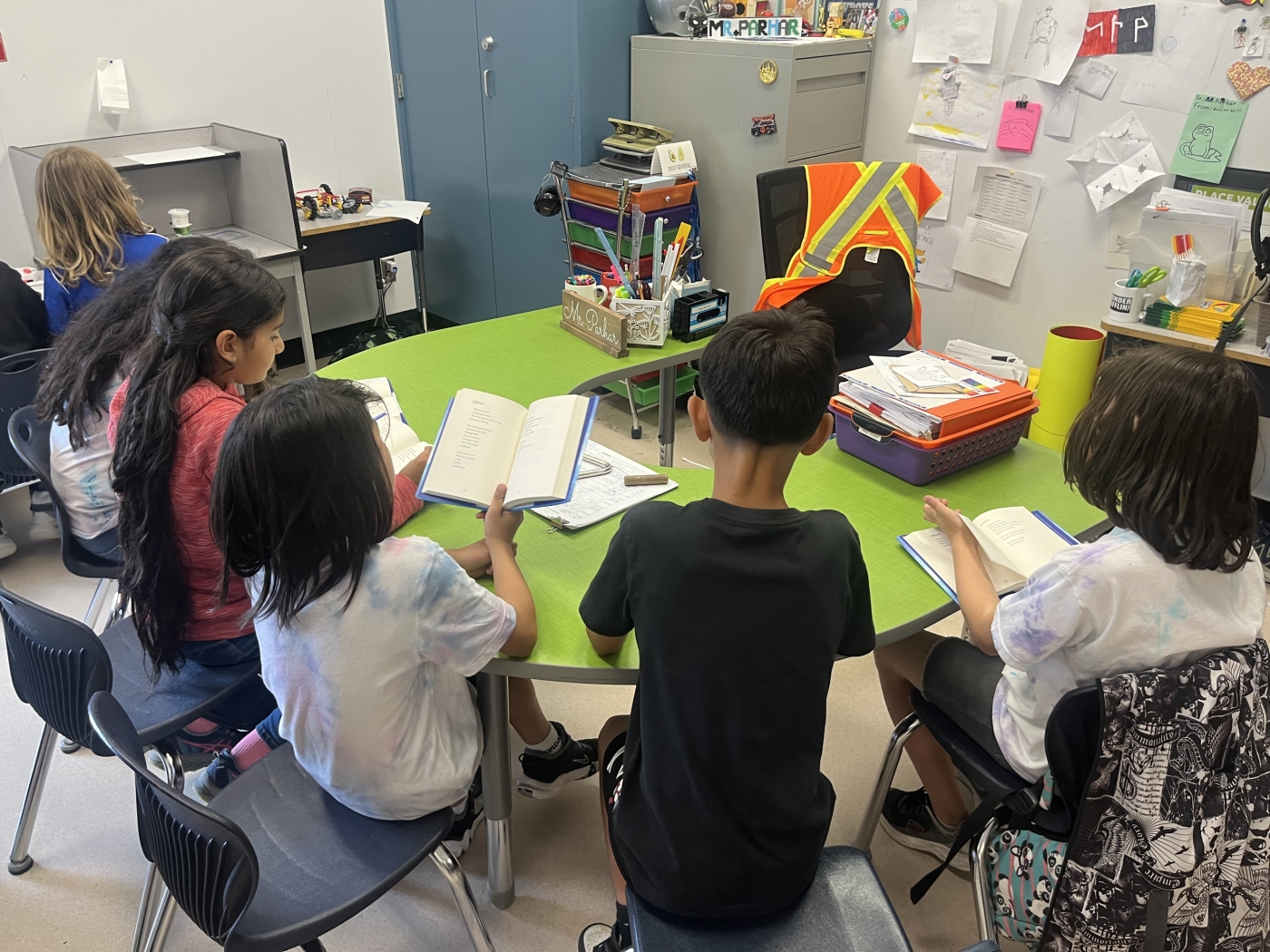
Students in the above photo are meeting with their book club to discuss their thinking.
Another teacher used explicit lessons to teach writing basics. Mini-lessons of writing structures and grammar aimed at improving basic writing skills. The teacher also taught text annotation and analysis. Through an increasing progression of texts (poems, songs, picture books, short stories, novels) students learned to mark the text with details that helped to clarify meaning, categorize content, and highlight key information.
"This progression worked well, Students are now able to work together in book clubs, asking and answering questions developed by their peers."
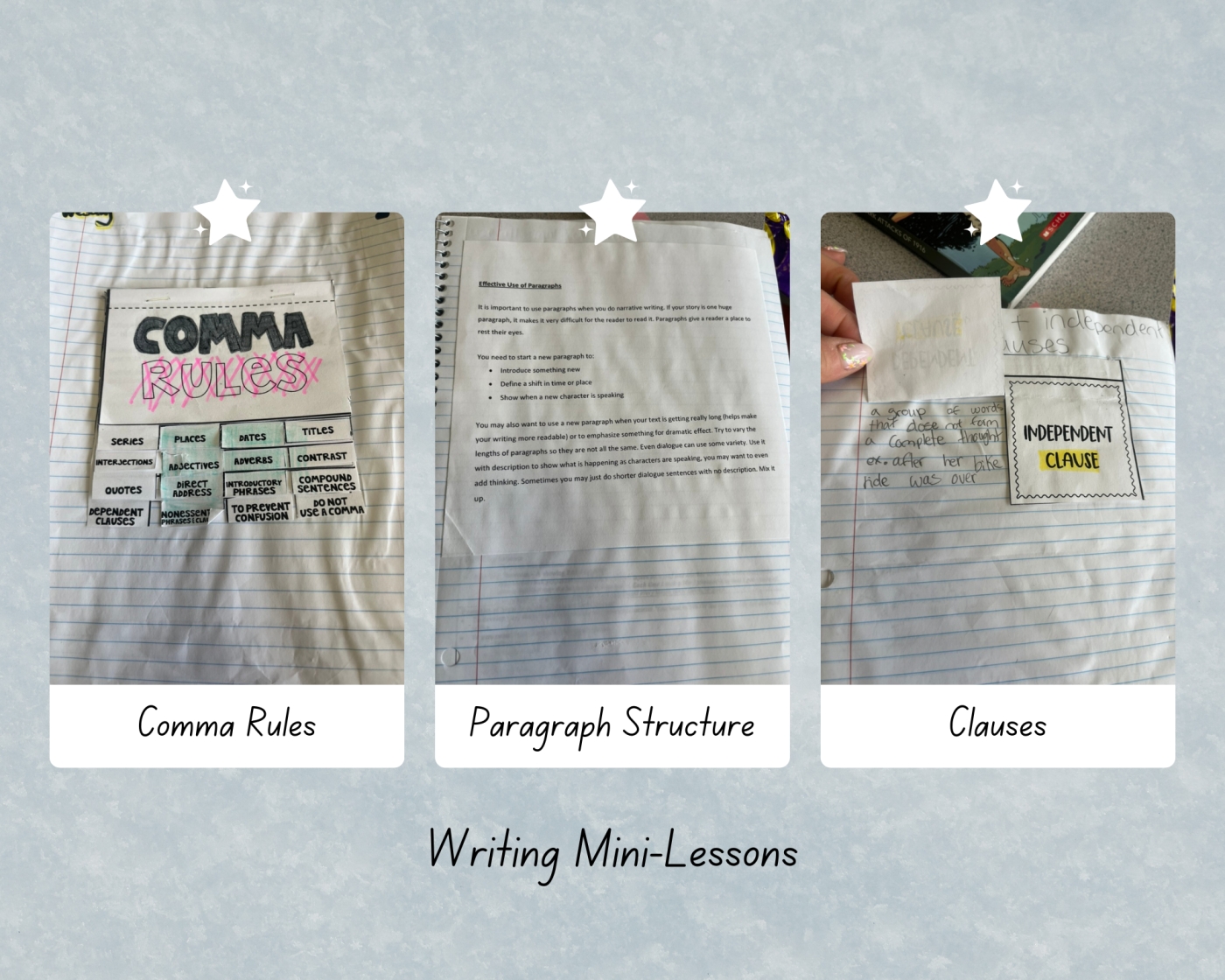
The photo above shows examples from a student's writing notebook. They complete a mini-lesson on a focussed area of writing, insert it into their notebook, and then have a place to refer back to when writing and editing their work.
OUR NEXT STEPS
Teachers followed students at varying levels in literacy so we could document the growth of student learning over time. Learning was recorded through observations during individual and group work, conferencing, individual read alouds, one-on-one assessments, and standardized reading assessment tools.
In the fall of 2024, within this cohort of students, 52% of students were reading at or above grade level.
Over the year students focused on both fluency and comprehension through instruction and practice.
- fluency: the ability to read text accurately, at a good pace, and with proper expressions
- comprehension: the ability to understand, process, and derive meaning from written text
When assessments were completed in May of 2025, approximately 75% of students in the cohort were reading at or above grade level.
We interviewed a few teachers about their experience explicitly teaching literacy this year. We asked them to reflect on their teaching and student learning by answering a few questions.
1. How have your students progressed in reading fluency and comprehension since the beginning of the year?
"Students have made significant progress in reading fluency this year, largely due to the introduction of class “Book Clubs.” As part of our Daily 5 routine, students met with their Book Club group and me each afternoon to read a novel together. I took on the role of a “Coach,” supporting students with strategies like pacing and expression. One student in particular made remarkable progress—moving from below grade level to just a few words shy of the end-of-year Grade level benchmark on the DIBELS scale."
2. In terms of writing, how are students developing their ability to organize ideas, use appropriate vocabulary, and apply conventions like spelling and punctuation?
"Spelling has improved slightly, but punctuation is much better. Students have also got much better at organizing their thoughts, expanding on their ideas, and using evidence from the text to support their thinking. They are able to persevere and write longer stories with details and dialogue, and even short essays."
We also interviewed a few students in the cohort about their progress in reading and writing this year. They were excited to share about their experiences.
1. How do you feel that your reading has improved this year?
"Now I love reading chapter books. Before, I only read graphic novels, but now I can make my own pictures in my head."
"Longer words are easier to read. I use my hands to break words up. I split them into little groups to say the sound and then I put it all together."
2. In writing, what are you most proud of this year?
"Writing a lot more has helped me to improve my spelling. I can also use punctuation properly."
"I now enjoy writing about my day. When we have free, quiet time in class, I often write in my journal about how my day is going."
"I can annotate text now to help me explain my thinking in writing. In the beginning I only highlighted interesting parts. Now I write all over the text."
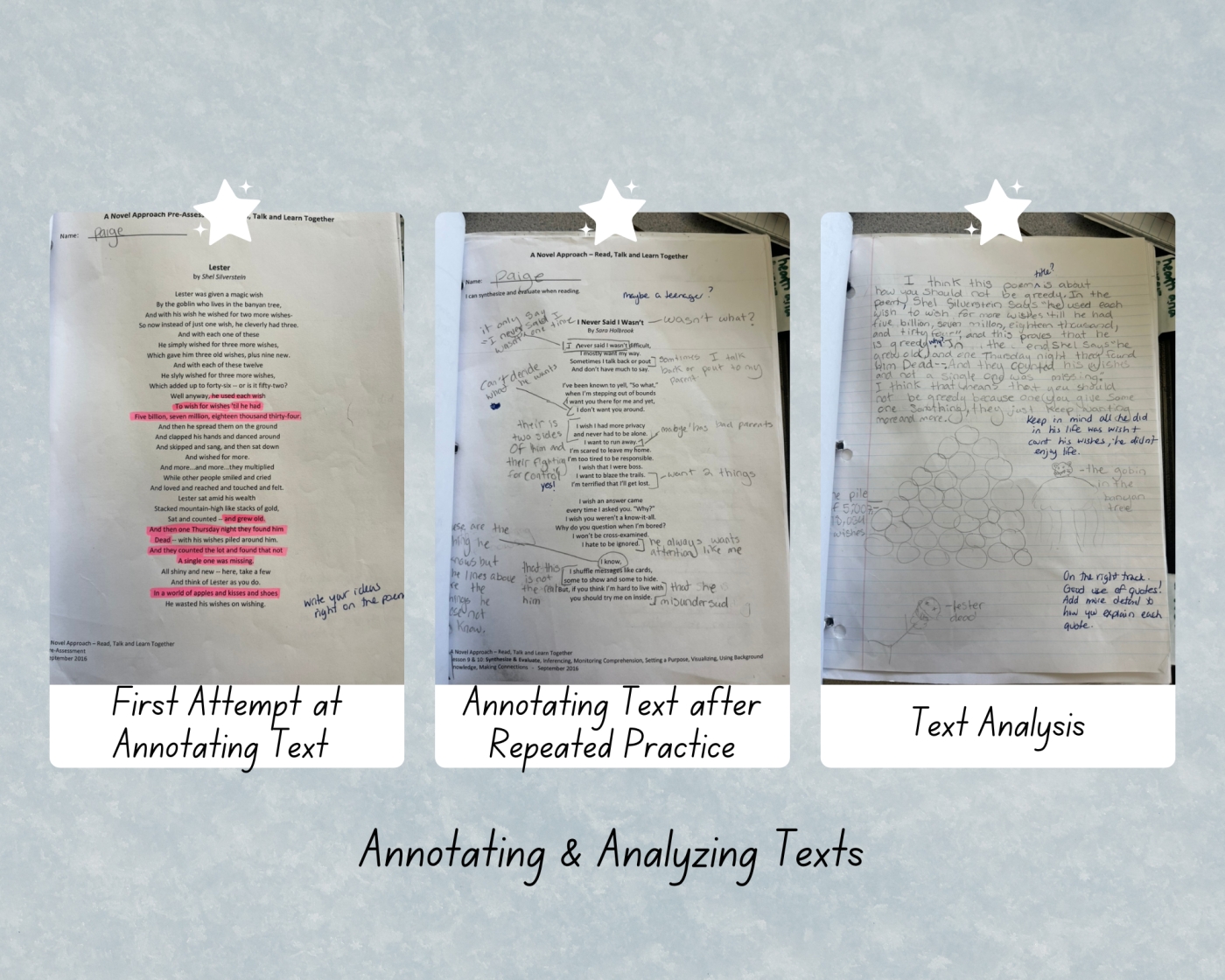
The first photo shows the first time a student annotated a text. You will notice that they were able to highlight important sections and words but were not yet able to write down their thinking. In the middle is a more recent example of text annotation, where the student is now able to really take note of their thinking. Ion the right is an example of analysis writing that is done once the text is annotated.
Moving forward, we plan to continue our focus on literacy with a focus on Social Emotional Learning. We hope to encourage more of our teachers to use a common assessment tool to identify literacy learning needs. Through a school-wide monthly thematic lens, along with explicit literacy instruction, we hope to see our students literacy levels continue to increase.
Surrey Schools
Formed in 1906, the Surrey School District currently has the largest student enrolment in British Columbia and is one of the few growing districts in the province. It is governed by a publicly elected board of seven trustees.
The district serves the cities of Surrey and White Rock and the rural area of Barnston Island.