Dr. F.D. Sinclair Elementary 25-26

OUR CONTEXT

We respectfully acknowledge that our school resides on the traditional, unceded and shared territories of Coast Salish peoples. The Katzie, Kwantlen, Semiahmoo First Nation: the stewards of this land since time immemorial. We highlight this history knowing that relationships and partnerships based on respect with the Indigenous peoples of this land are important for truth and reconciliation.
At Dr. F.D. Sinclair Elementary, learning begins with belonging. Our school is a living reflection of the vibrant, intergenerational community we serve—where stories, languages, and traditions converge to create a rich and inclusive learning environment. For nearly seven decades, Sinclair has stood as a place where relationships are nurtured, voices are honoured, and every learner is seen.

Our students bring with them a wealth of cultural and linguistic knowledge. English and Punjabi are most commonly spoken, alongside Hindi, Urdu, Pashto, and other languages that reflect the global roots of our families. This multilingualism is not just celebrated—it is woven into the fabric of our learning. It fosters empathy, deepens understanding, and prepares our learners to thrive as compassionate global citizens.
The Sinclair values—kindness, honesty, empathy, respect, gratitude, and resilience—are not just words on a wall. They are lived daily in classrooms, hallways, and playgrounds. These values guide how we learn, how we lead, and how we care for one another.

Our school culture is intentionally inclusive and culturally responsive. Learning experiences such as First Peoples in Residence Week, and celebrations of Diwali, Eid, Lunar New Year, and more, are not isolated events—they are expressions of identity and community. These shared moments help our learners see themselves reflected in the curriculum and expand their understanding of others.

Students at Sinclair engage in a wide range of school-wide initiatives that foster creativity, leadership, and connection. Whether through our school wide gatherings focusing on school values, monthly events crews, school athletics, technology teams, or our grade 7 leadership program, students are empowered to make meaningful contributions.

Our staff is a dedicated team of professionals committed to collaboration and continuous learning. Through school-based inquiry and district-supported professional development, we work together to create responsive, engaging learning environments for all students.

At Sinclair, we are united by a shared vision: to nurture confident, compassionate learners who are deeply connected to their community and the world around them. Every day is a step forward in a shared journey—rooted in identity, shaped by community, and driven by possibility.
OUR LEARNERS
At DR. F.D. Sinclair Elementary, our learners engage is Literacy is a fundamental skill, learning process, and life tool that learners continuously develop through their everyday school experiences. As they build vocabulary and connect their personal experiences to shared learning within a community, they grow in confidence as individuals, learners, and readers.

Each learner brings unique experiences that enrich the learning environment. Engaging in diverse learning opportunities further strengthens their literacy skills, reading fluency, and overall confidence in literacy.

Our Learners can use a range of strategies to understand and make meaning from texts before, during, and after reading, listening, or viewing.
This includes activating prior knowledge, asking questions, making predictions, visualizing, and summarizing key ideas. Learners reflect on what they have understood and adjust their thinking to deepen their comprehension across a variety of texts and formats.

Our Learners can apply phonological and phonemic awareness, word patterns, and vocabulary knowledge to read with increasing fluency and accuracy.
Learners recognize sounds in words, decode unfamiliar words using patterns and word families, and build a bank of sight words. As their skills develop, they read more smoothly and expressively, which supports both understanding and enjoyment of reading.
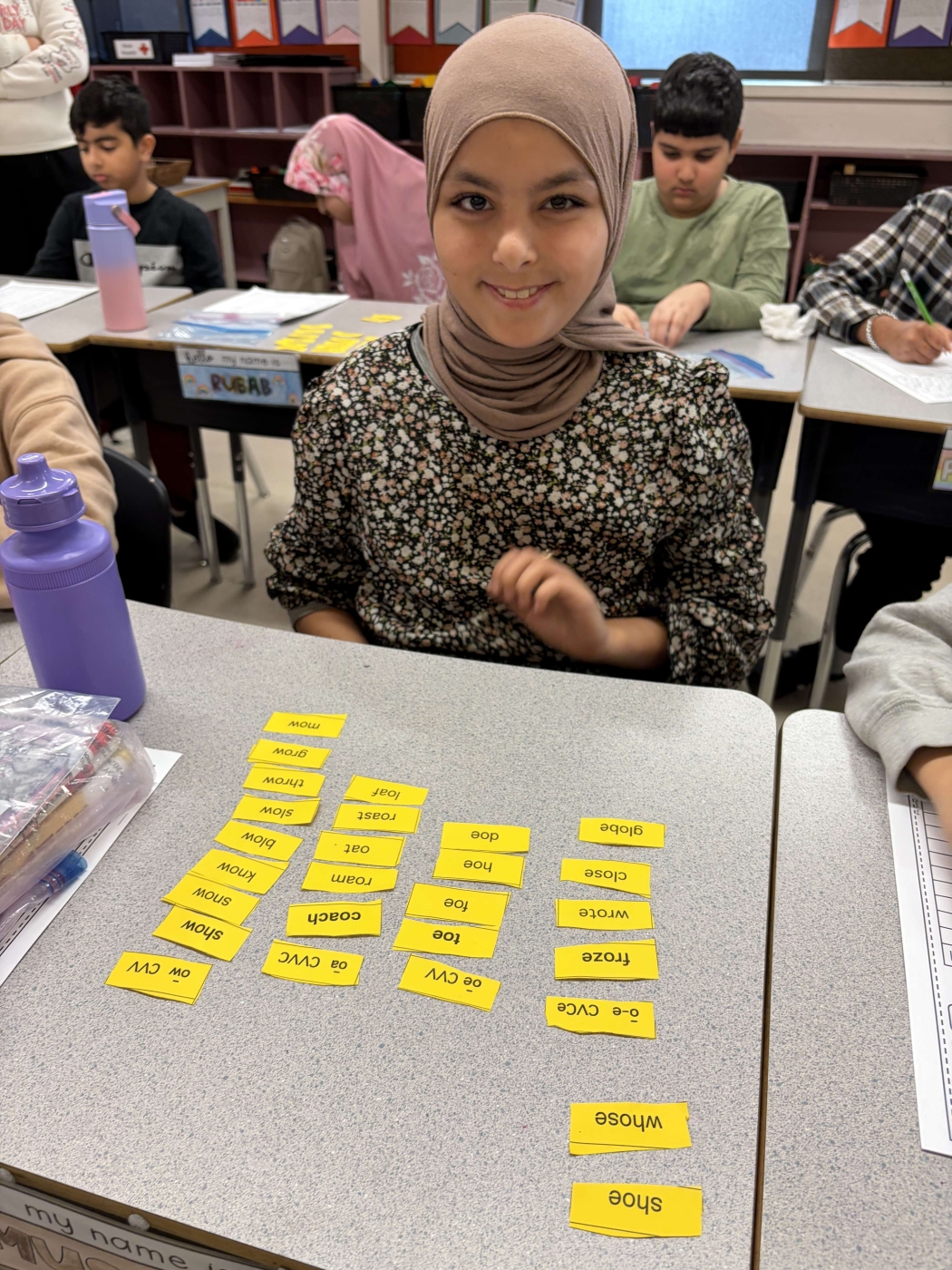
Our Learners can draw on their personal experiences to make connections in their learning and communicate their ideas with growing confidence.
Learners use their own backgrounds and experiences to relate to texts and discussions, making learning more meaningful. As they share their ideas through speaking, writing, and other forms of expression, they develop confidence in themselves as capable learners and communicators.

OUR FOCUS
Each day, our learners come to the classroom with unique experiences that shape how they think, read, write, and communicate across all subject areas. Our aim is to support students in building a rich vocabulary and strong background knowledge, forming a solid literacy foundation that empowers them as lifelong learners. Through these skills, students grow in confidence as they practice and demonstrate their literacy abilities in ways that connect to their own lived experiences.
Our students’ learning goals include:
- Strengthening reading fluency and building proficiency with sight words and vocabulary through the development of phonemic and phonological awareness, as well as an understanding of word patterns and word families.
- Expanding comprehension by using a range of strategies to deepen understanding before, during, and after reading, listening, or viewing a variety of texts.
We know that learning takes patience and time and we embed this practice into our teaching, our learners and our assessment. We also acknowledge that learning is embedded in memory, history and story, so we incorporate multiple opportunities to use story workshop, outdoor education, oral storytelling and historical lessons to encourage our learners to have a holistic approach to learning.

OUR NEXT STEPS
Evidence of Growth
Our literacy data from our K/1 cohort (consisting of 37 students) demonstrates significant growth in student achievement over the course of the year. Reading proficiency increased from approximately 33% of students achieving at the Proficient level in Term 1 to 70% by the end of the year. The percentage of students working within the Emerging and Developing ranges decreased accordingly, indicating positive movement toward grade-level expectations. We recognize that there is work to be done to increase the differential further, and will be focussing on that in the upcoming year.
Additional evidence from ELPATS assessments demonstrates growth in foundational literacy skills. Students progressed from identifying beginning and ending sounds to segmenting and blending increasingly complex phoneme patterns. Many students demonstrated mastery of advanced phonological awareness skills, providing a strong foundation for future reading success.
What We Learned from Our Data
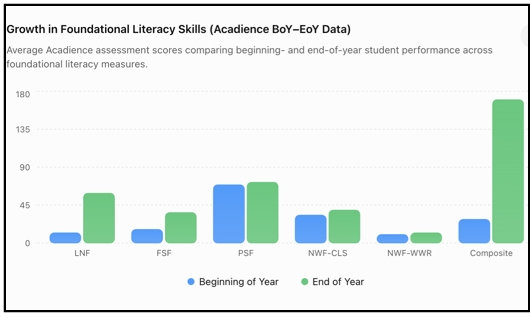
Acadience assessment data indicates strong growth in foundational literacy skills throughout the school year. Students demonstrated significant gains in letter naming, phonological awareness, phoneme segmentation, and early decoding skills. The substantial increase in composite scores suggests that students are developing the foundational skills necessary for reading success. These results support the continued implementation of explicit, systematic literacy instruction and targeted intervention practices.

"44% of students demonstrated mastery of the targeted phonological awareness skill, providing evidence of growth in foundational literacy skills and informing our next instructional steps."


Reading data demonstrates significant growth over the school year. The percentage of students achieving proficiency increased from 41% to 71%, representing a 30-percentage point increase while the percentage of students working within the Developing range decreased from 53% to 29%. Additionally, no students remained in the Emerging category by the final assessment period. These results suggest that students are developing increased confidence and independence as readers.
Writing data indicates growth throughout the year. The percentage of students achieving proficiency increased from 23% to 33%, while the percentage of students working within the Developing range decreased from 71% to 60%. These results suggest that students are becoming more confident in communicating their ideas through writing and are beginning to apply literacy skills with greater independence.
These results suggest that explicit literacy instruction, targeted intervention, guided reading opportunities, and ongoing assessment practices are supporting student growth. The movement of students from Emerging and Developing toward Proficient indicates increased confidence, independence, and competency in reading.
Moving forward, we will continue to strengthen literacy instruction through rich reading experiences, vocabulary development, comprehension strategies, and opportunities for students to engage with a variety of meaningful texts while providing targeted support for students requiring additional intervention.

Student voice data further supports these findings. Students identified practicing reading, reading with others, sounding out words, and receiving support from teachers and peers as factors that helped them become stronger readers.
When asked what helps them become successful readers, students highlighted the importance of practice, perseverance, phonics knowledge, decoding strategies, and comprehension strategies. Many students recognized the value of consistent reading practice, sharing comments such as, “We always practice so we can be good readers,” “Because I practice a lot,” and “If you read more, you get better.” One student noted the importance of classroom reading opportunities, explaining, “The teacher helps us by letting us read books a lot, so we get better.” Students also demonstrated an understanding of foundational literacy skills by sharing, “We learned the alphabet and sounds,” and “We sound it out,” indicating an awareness of how our strategies supports reading development.
Other students demonstrated growing metacognitive awareness by explaining, “My brain just knows what to do,” and “My brain told me that.” Students also described using comprehension and inference strategies, sharing that they “understand what they are talking about” and “imagine what it might be and connect to the reading.” These responses suggest that students are developing confidence in themselves as readers, recognize the importance of regular practice, and are beginning to articulate the strategies they use to decode text, build understanding, and make meaning from what they read.

Our literacy data demonstrates that reading development involves multiple interconnected skills. As illustrated by the Scarborough Reading Rope, skilled reading develops through the combination of word recognition skills (phonological awareness, decoding, and sight word recognition) and language comprehension skills (background knowledge, vocabulary, language structures, verbal reasoning, and literacy knowledge).
Where We Are Now
The evidence suggests that students are developing greater confidence, independence, and competence as readers. A growing number of students are successfully applying foundational literacy skills during classroom reading and writing tasks. Classroom observations, small-group instruction, one-to-one reading conferences, and assessment data all indicate that students are increasingly able to decode, comprehend, and engage with text.
While growth has been substantial, data indicates that some students continue to require support in developing reading fluency, automatic word recognition, vocabulary knowledge, and comprehension strategies.
Impact of Current Strategies
The data suggests that several instructional approaches have positively impacted student learning:
- Explicit and systematic literacy instruction
- Ongoing phonological awareness and phonics instruction
- Small-group and targeted literacy support
- Regular opportunities for guided and independent reading
- Frequent assessment and progress monitoring
- Opportunities for students to discuss, share, and reflect on their reading
These approaches have supported students in developing the foundational skills required for successful reading and writing.

Student Progress Summary
Overall, students demonstrated meaningful growth in literacy throughout the year. Assessment data, classroom observations, and student voice evidence indicates that students are becoming more confident readers and writers.
Next Steps
• Moving forward, we will continue to strengthen a school-wide culture of reading by providing engaging opportunities for students to read with, and learn from, others through initiatives such as reading buddies, read-a louds, shared reading, and independent reading.
• We will deepen students' literacy skills by focusing on reading fluency, vocabulary development, comprehension, and meaningful responses to text across a variety of learning contexts.
• We will strengthen family literacy partnerships by sharing practical strategies and resources that support reading and learning at home.
• Assessment data and student voice will continue to inform instructional decisions, helping us identify student strengths, monitor progress, and provide targeted support where needed.
• Through these efforts, we aim to further increase student confidence, engagement, and achievement in literacy while fostering lifelong readers and learners
Surrey Schools
Formed in 1906, the Surrey School District currently has the largest student enrolment in British Columbia and is one of the few growing districts in the province. It is governed by a publicly elected board of seven trustees.
The district serves the cities of Surrey and White Rock and the rural area of Barnston Island.