Douglas Elementary

OUR LEARNERS
Please click here to learn more about our learners in the areas of numeracy and literacy.
OUR FOCUS
As we began the year, we sought to identify skills that our twenty-first century learners would need for success, not only during their years at school, but beyond. Each group of learners is unique, but as we identified the strengths of our current students, we also began to wonder if there were specific areas of growth and learning that applied to many students within our classrooms. These musings became the focus of two specific inquiry projects throughout the year, focusing on numeracy and writing.
Numeracy:
1. How do number talks increase math fluency and improve student ability to communicate their thinking?
2. How do real-life math tasks improve student flexibility in math thinking? Can students explain their thinking and are they efficient in their answers? Can they answer in more than one way?
Writing:
1. Does using a student-friendly self assessment checklist improve the quality of student writing - use of conventions, use of detail and adjectives, variety of sentence beginnings?
Numeracy
Math is no longer about computations and algorithms. This past year, we implemented a variety of strategies that allowed students to find success in math at their own level. Our goal this year has been to help students become flexible in their thinking and to use a variety of different strategies to solve real world math problems. In order to do this, we implemented two specific numeracy strategies: number talks and real world math tasks. By applying these strategies we are aiming for an intentional shift of focus, transitioning from memorization and one formula to solve a problem to using the most efficient way to solve a problem - recognizing that there are multiple strategies. We flip the traditional pedagogy and start with the problem, see what we know and what we need to figure out, and then along the way introduce the skills and strategies that will help guide students to the best and most efficient solution.
Number Talks:
How do number talks increase math fluency and improve student ability to communicate their thinking?
A number talk takes a relatively simple problem, giving students time to work through it mentally, and then allows time for discussion, reasoning and problem solving. This helps students develop number sense. Number sense is the conceptual understanding of a number and the relationships between numbers. It is more than just knowing what an answer is, but knowing why. Number sense helps students think flexibly about math and gain confidence in their mathematical practices.
In our classroom, this looked like:
Students are presented with a numeracy problem
Students are given 1-3 minutes to silently think through the problem
Students are invited to share HOW they solved the problem (including what strategies they used)
Teacher records what the student says and asks if anyone used a different strategy
Through class discussion, students observe multiple strategies to solve a single problem.

Real Life Math Tasks:
How do real-life math tasks improve student flexibility in math thinking? Can students explain their thinking and are they efficient in their answers? Can they answer in more than one way?
We all use and experience mathematics daily in one way or another. Whether we’re looking at patterns or problem solving, so much of what we do has direct connections to math. By using real life math tasks we explicitly pointed out numeracy concepts to students so they were able to see connections between math and everyday life. Engaging in math tasks showed students why math matters and provided students with a meaningful context for their learning.
Examples of what this looked like in our classroom:
Fractions - Cookie Bake-Off: Students were tasked with researching the best cookie recipe, pricing out the most economical materials and resources (in total and per unit), following the instructions, and doubling/halving a recipe. Curricular Competencies: use reasoning to explore and make connections, estimate reasonably, develop mental math strategies and abilities to make sense of quantities, model mathematics in contextualized experiences.

Measurement - Wooden Snowman Building: Students were given a large piece of wood and tasked with breaking it down to come up with different possible combinations to design and create a snowman. Curricular Competencies: develop, demonstrate, and apply mathematical understanding through play, inquiry, and problem solving, develop and use multiple strategies to engage in problem solving.

Financial Literacy - Stores: Students were tasked with researching, designing, creating, pricing and advertising a product(s) to sell using recycled materials. We made this unit coincide with Earth Day so as to be able to take this conversation further. Curricular Competencies: connect mathematical concepts to each other and to other areas and personal interests, visualize to explore mathematical concepts.


Writing
Does using a student-friendly self assessment checklist improve the quality of student writing - use of conventions, use of detail and adjectives, variety of sentence beginnings?
Throughout any grade level, students practice writing for various purposes and audiences. They work on communicating with proper conventions (spelling, punctuation, etc.) and as grade levels increase, they begin to show growth in their ability to develop ideas, include logical sequencing, add details and increase the complexity of their sentences. Often, teachers use rubrics to assess the learning outcomes within a writing task. While these learning outcomes are communicated to students throughout the writing process, we began to wonder how providing students with their own simplified rubric/checklist of writing expectations would improve their writing - use of conventions, use of detail and adjectives, variety of sentence beginnings.
While various classes may have concentrated on different skills, holistically, students were introduced to criteria that teachers use to assess all written work through discussions and examples of proficient work. Following these discussions, students participated in daily writing activities, working independently on a given topic. The impact that we were hoping to see was that students would be able to recognize what proficient writing looks like and therefore engage in the writing process, as the curriculum outlines. Criteria for expectations generated from class discussions became a checklist which students used to reflect on their writing after each session. For some classes, this checklist listed the proficient expectations for a grade level, for others, a proficiency scale provided students with the ability to recognize what was involved in the next level of challenge.

OUR NEXT STEPS
Numeracy
Number Talks
To explain their understanding of number talks, our grade 6/7 students communicated math ideas and their understanding of these ideas in oral, written, and visual forms. We followed 5 students at varying levels in math so we could document and see the growth of students during number talks. Teachers also recorded observations during group work, conferenced with individual students, and students reflected on their own progress. Students focus was to recognize and use different strategies to solve equations.
We noticed that our students continued to gain confidence in sharing their mathematical thinking and had a better conceptual understanding of numeracy concepts. As they listened to their peers share their own strategies, they were able to broaden their mathematical thinking and were able to determine the most efficient strategy to use. They understood that there is not only one way to solve a problem.
“I’m going to compare this to sports; number talks are like a warm-up for me, it gets me ready to do the harder drills, because I now have all these different strategies that I can use, and I am really fast at them. I can do these equations in my head when we are working on harder problems. I’m not wasting my time writing them down.” - Ben
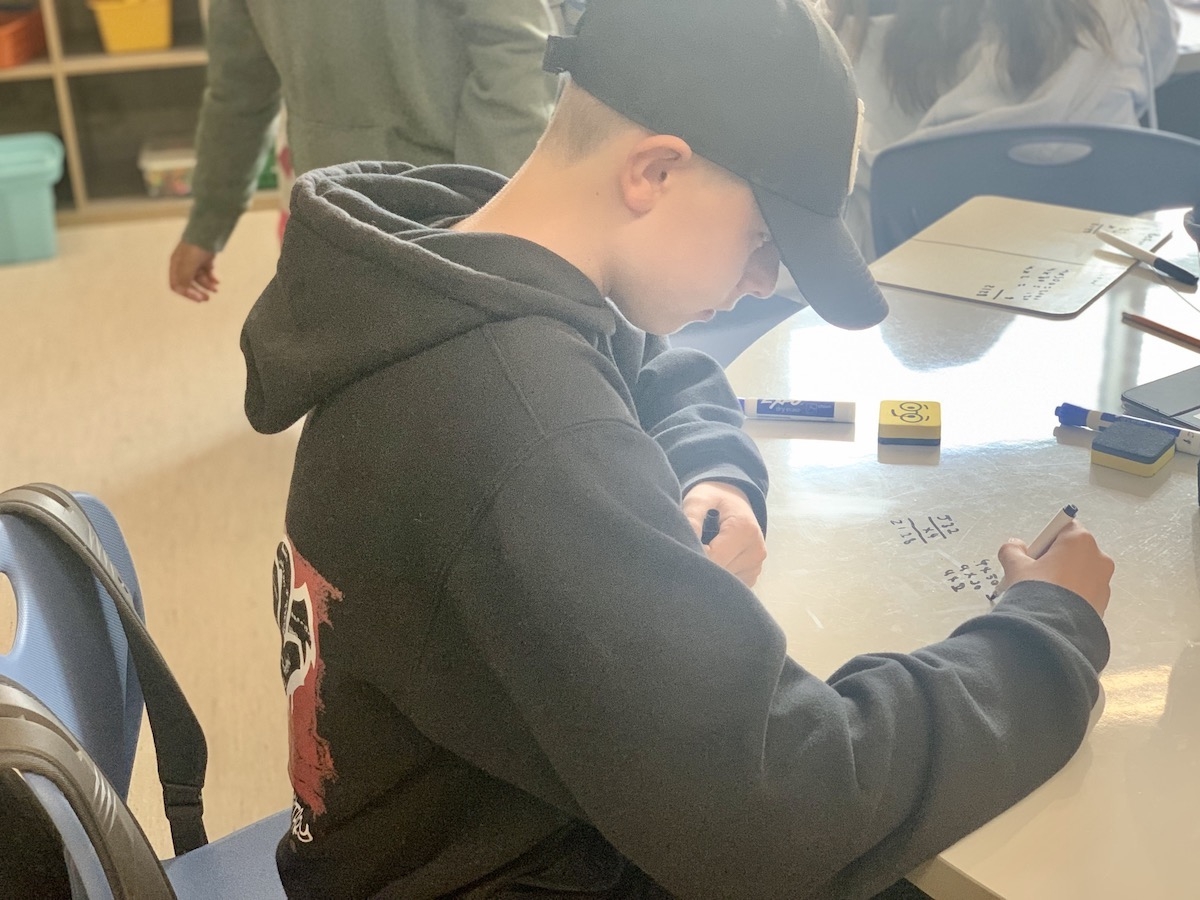
“I feel like I’ve learned more strategies. I can solve the equations faster and more efficiently now. Before I used to use my fingers a lot and then I would lose track because I don’t have enough fingers for the bigger numbers. I would get all jumbled up in my mind and then become frustrated.” - Lexie

Real Life Math Tasks
We noticed a high level of participation and engagement when we connected numeracy skills to real world tasks. The class was very motivated to learn; many students who typically struggle with numeracy tasks in the classroom were able to participate in the hands-on learning tasks with ease. It helped level the field a little and almost everyone felt like they had an entry point. For example, one of the student who finds Math challenging in class was very accurate with the computations needed to build the wooden snowman. He mentioned that he helps his father with projects at home, so this was just an extension of that skill. The project did not feel like Math to him at all. Many did not even realize that there were several mathematical components to our projects until we specifically pointed them out.
Our Bake-Off project helped cement the students’ procedural fluency (carrying out procedures accurately and efficiently). Students knew there would be no cookies to be had if they did not get the recipe right! This was a great motivator. We did have an adult keep a discrete eye on the measurements but each group reported that the students had got their fractions right (halving and doubling recipes; one group even had to change the proportions to 1.5 times the original recipe) and everything was on track.
“At first, I thought math was ‘eh’. It got better when we did the baking. I felt a bit better. Then we did the snowman project and I felt ok. And then when we did the stores I felt really good. It got me feeling really confident. I like to add the money and my attitude got better.” - Eddy
“I felt that this way of doing math was not like any other teachers. I feel like I got better at math not even knowing it. My favourite math project was stores, snowman, and baking. Overall I think more teachers should do math like this and I definitely improved.” - Sunday
Writing

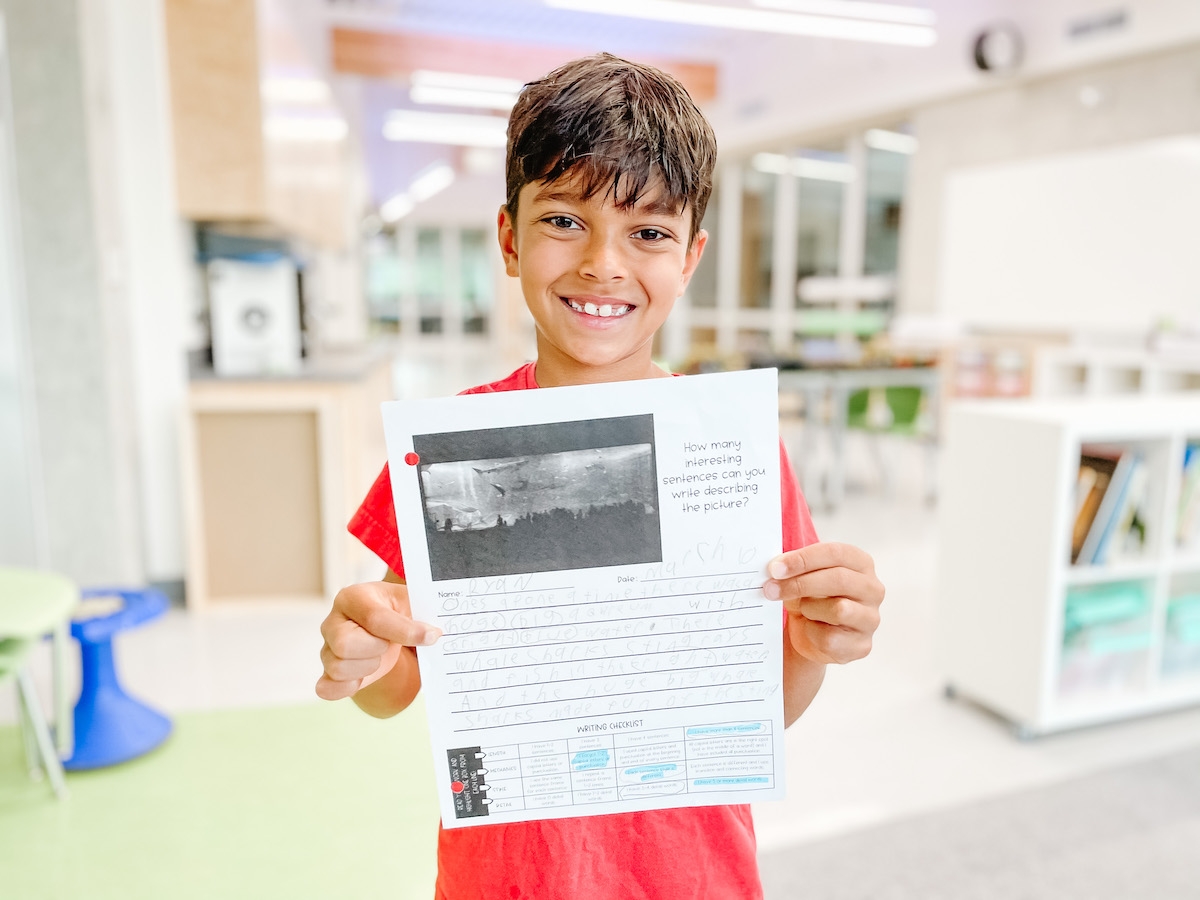
As our students progressed through the year and took part in various “sprints” of writing using a checklist, we were able to make several observations. One of the first things we noticed was an increase in stamina and output. In the beginning, it was a stretch for most students to write for the entire duration of the activity but as time went on, students became increasingly able to write for the whole length of time given (typically 20 minutes), consequently increasing their output as well. This also created an increase in confidence as not only were they able to write more over longer periods of time, but they were increasingly able to recognise their strengths as writers. By reflecting on their writing using the checklist, they began to recognise areas requiring growth. This translated into understanding a need to edit, giving students the tools to go back, refine and add to their writing. As teachers, we noticed an incredible growth in student independence as the "mystery" of what makes a great piece of writing became a little less "mysterious".

"The checklist makes me want to get in the last two columns. I want to make everything right so I go back and fix it." Tris

"The checklist helps a lot. It helps make my writing better. It makes more sense about what I'm supposed to do." Ryan
Surrey Schools
Formed in 1906, the Surrey School District currently has the largest student enrolment in British Columbia and is one of the few growing districts in the province. It is governed by a publicly elected board of seven trustees.
The district serves the cities of Surrey and White Rock and the rural area of Barnston Island.