Coyote Creek Elementary 25-26

OUR CONTEXT
OUR LEARNERS
Literacy is a vital life skill that helps students read, write, speak, listen, and think effectively. Communication, a key competency throughout the BC curriculum, supports the development of these literacy skills and helps learners make sense of the world around them.
As students collaborate, solve problems, share ideas, and express their unique perspectives, they strengthen both their literacy and communication abilities. This presentation highlights how our learners demonstrate their strengths and competencies through a range of literacy practices and thinking strategies.
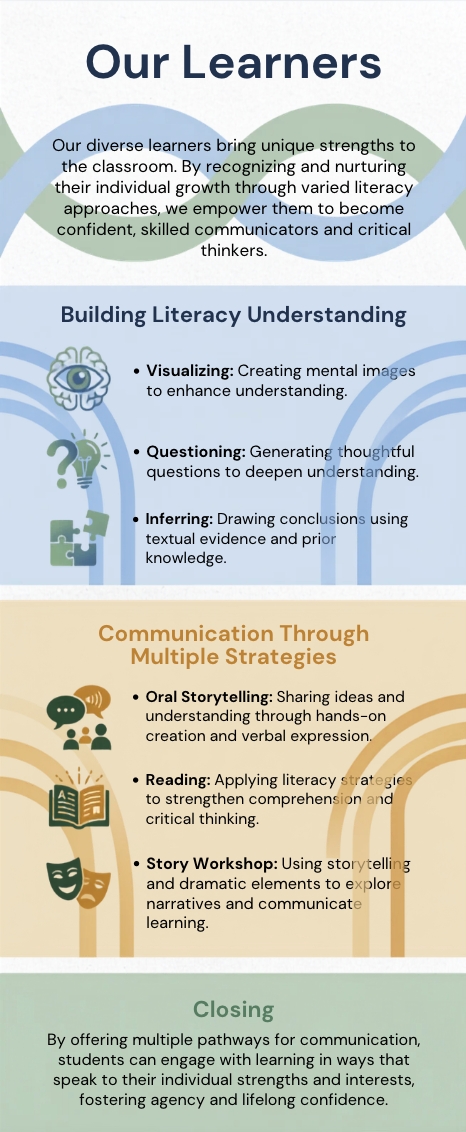
Building Literacy Understanding
Our learners use a variety of strategies to deepen their understanding of texts. They visualize by creating mental images, question by exploring ideas and seeking deeper meaning, and infer by combining clues from the text with their prior knowledge to draw conclusions.
Together, these interconnected strategies help students think critically, build comprehension, and communicate their understanding effectively.
Key Literacy Strategies
- Visualizing: Creating mental images from text.
- Questioning: Generating thoughtful questions to deepen understanding.
- Inferring: Drawing conclusions using textual evidence and prior knowledge.
Communication Through Multiple Strategies
Our learners demonstrate their understanding in different ways, allowing them to communicate ideas confidently and effectively. Through oral storytelling, reading, and dramatic storytelling experiences, students develop literacy skills while exploring creative and meaningful forms of expression.
- Oral Storytelling: Sharing ideas and understanding through hands-on creation and verbal expression.
- Reading: Applying literacy strategies to strengthen comprehension and critical thinking.
- Story Workshop: Using storytelling and dramatic elements to explore narratives and communicate learning.
By offering multiple pathways for communication, students can engage with learning in ways that reflect their strengths and perspectives.
Learning Through Story and Shared Understanding
Story is a powerful tool for learning, connection, and communication. Through stories, students explore diverse perspectives, build cultural understanding, and deepen their literacy skills.
Key understandings include:
- Appreciating the Role of Story: Recognizing how stories shape knowledge and connect communities.
- Honouring First Peoples’ Oral Traditions: Valuing Indigenous storytelling as an important source of wisdom, history, and cultural knowledge.
- Building Shared Understanding: Engaging in discussion and collaboration to interpret ideas and strengthen comprehension.
Through this ongoing cycle of listening, sharing, reflecting, and discussing, learners develop stronger communication skills, deeper understanding, and greater cultural awareness.
OUR FOCUS


Our Instructional Approach
Our literacy program combines targeted instruction, ongoing assessment, and personalized learning. In the primary grades, students strengthen foundational reading skills through small-group instruction, phonemic awareness activities, and decodable texts. In the intermediate grades, student progress is closely monitored to guide instruction and support continued growth. Learning experiences are tailored to individual needs while balancing skill development with authentic reading opportunities.
Building Reading Comprehension
Effective reading comprehension develops through several connected components:
- Word Recognition: Reading words accurately and efficiently.
- Meaning Making: Connecting ideas and understanding text.
- Discussion: Sharing interpretations and learning from others.
- Engagement: Fostering enjoyment and motivation for reading.
Together, these elements help students transform words into meaningful ideas and become confident, thoughtful readers.
Communication Through Multiple Pathways
Students demonstrate their understanding using a variety of communication strategies. Through reading, oral storytelling, discussion, and dramatic storytelling experiences, learners explore ideas, develop comprehension, and express their thinking in meaningful ways. Offering multiple opportunities for communication allows all students to engage with learning and share their understanding effectively.
Building Strong Literacy Foundations
Every day, our learners engage in meaningful reading, writing, speaking, listening, and thinking experiences across all curricular areas. Our goal is to build strong literacy foundations that empower students to communicate effectively, make meaning, and participate confidently in today's world.
Our Literacy Focus
We support literacy development through intentional instruction in three key areas:
- Foundational Skills: Developing phonemic awareness, phonics, word recognition, and reading fluency.
- Making Meaning: Using age-appropriate strategies to understand, connect with, and respond to texts.
- Comprehension: Strengthening understanding through thinking and discussion before, during, and after reading.
Phonemic Awareness: A Foundation for Reading
Phonemic awareness is the ability to hear, identify, and manipulate individual sounds in spoken words. As a critical predictor of reading success, it provides the foundation upon which later reading and writing skills are built.
Through targeted and systematic instruction, learners develop the skills needed to recognize sound patterns, blend and segment words, and build confidence as emerging readers. Intentional intervention and support ensure all students can make meaningful progress.
Kindergarten Focus: Building Foundational Phonemic Awareness
For our Kindergarten learners, developing strong phonemic awareness is a key priority. Through engaging, play-based, and systematic learning experiences, students learn to listen to, identify, and manipulate sounds in spoken language before connecting those sounds to print.
Key Learning Areas
- Recognizing and producing rhymes
- Identifying beginning and ending sounds
- Segmenting words into syllables
- Blending sounds to form words
- Isolating and manipulating individual phonemes
- Building letter-sound knowledge and early decoding skills
Our Approach
Kindergarten students participate in daily, explicit phonemic awareness instruction that is structured, sequential, and responsive to their individual needs. Through songs, oral language games, movement, storytelling, and hands-on activities, learners develop the foundational skills necessary for future reading success.
Expected Outcomes
As students strengthen their phonemic awareness, they become more confident readers and writers, better able to decode words, recognize patterns in language, and communicate their ideas effectively. These foundational skills provide the building blocks for lifelong literacy learning.
Kindergarten Literacy Focus: Building Strong Foundations for Reading
Key Learning Experiences
Our Kindergarten learners participate in structured, engaging learning experiences designed to develop the foundational skills necessary for successful reading and writing.
- Phonemic Awareness
Learning to hear, identify, blend, segment, and manipulate sounds in spoken words. - Letter–Sound Connections
Understanding that letters represent sounds and using this knowledge to decode words. - High-Frequency Word Recognition
Building automatic recognition of common words to support reading fluency. - Oral Language Development
Strengthening vocabulary, listening comprehension, communication, and verbal reasoning skills.
Our Instructional Approach
We use evidence-informed, systematic instruction to ensure all learners build strong early literacy skills.
- Explicit and Sequential Teaching
Phonemic awareness and phonics skills are taught in a clear, predictable sequence that builds upon prior learning. - Small-Group Instruction
Targeted teaching allows students to receive instruction that meets their individual learning needs. - Decodable Texts and Shared Reading
Learners apply newly acquired skills in authentic reading experiences that build confidence and success. - Responsive Intervention
Ongoing assessment helps us monitor growth and provide timely support when needed.
Building Comprehension from the Start
Strong readers need both word-reading skills and meaning-making skills. As students develop automatic word recognition, they also learn to:
- Talk about stories and ideas
- Make connections to their experiences
- Ask questions and share thinking
- Build vocabulary and understanding through discussion
- Develop a love of reading through engaging texts and experiences
By combining systematic phonemic awareness instruction with rich language and literacy experiences, our Kindergarten learners build the confidence, skills, and curiosity needed for lifelong literacy success.
Developing Reading Fluency
Reading fluency is a critical bridge between word recognition and comprehension. As learners develop accuracy, automaticity, and expression, they are able to focus less on decoding and more on understanding what they read.
Building the Foundation
Students develop essential early literacy skills through systematic instruction in phonemic awareness, phonics, and word recognition. These foundational skills support confident and successful reading.
Daily Reading Practice
Regular opportunities to read and interact with text help learners build automaticity, strengthen word recognition, and increase reading confidence. Consistent practice supports steady growth over time.
Fluent Reading
As skills become automatic, students read with greater accuracy, appropriate pace, and expression. Fluent readers can devote more attention to making meaning from text and engaging deeply with their reading.
Our Commitment
Through daily, purposeful literacy experiences, we help learners develop the foundational skills, confidence, and stamina needed to become fluent readers and thoughtful meaning-makers.
OUR NEXT STEPS
School-Wide Trends

Strengths
- Students demonstrated strong literacy growth across all grade levels.
- Many learners progressed from targeted intervention programs to classroom-based support or no longer required additional language support.
- Most intermediate students showed solid decoding skills and increasing reading independence.
- Reading achievement generally increased from the primary years through the intermediate grades.
Areas for Continued Focus
- Supporting newcomers and students in the early stages of English language development.
- Addressing the impact of ongoing attendance challenges on learning.
- Providing targeted support for students with diverse learning, communication, and academic needs.
- Strengthening reading comprehension, critical thinking, and written communication skills, particularly in the intermediate grades.
Overall Conclusion
The school’s literacy and language-learning programs continue to support positive student growth. Most learners made meaningful progress in reading and language development, with many advancing toward greater independence and proficiency. Moving forward, support will remain focused on emerging English language learners, students requiring specialized learning supports, and those who would benefit from additional development in comprehension and written communication.
Strengths
- Strong literacy growth across grades.
- Many students moved from pull-out support to in-class monitoring or exited ELL entirely.
- Upper intermediate students generally demonstrate grade-level decoding skills.
- Reading levels steadily increase from primary grades into intermediate grades.
Areas for Continued Focus
- Newcomer ELL students at Levels 1–2.
- Students with chronic attendance concerns.
- Students requiring LST, SSP, IEP, speech-language, or psych-ed support.
- Reading comprehension and written language development in Grades 4–7.
Overall Conclusion
The data show a strong, comprehensive literacy and ELL support framework. Most students demonstrated positive progress in reading and language acquisition, with a substantial number advancing to ELL Levels 4–5 or exiting ELL support. The primary intervention needs for 2026–27 are concentrated among newcomer students, students with learning support designations, and students whose comprehension and writing skills lag behind their decoding ability.
Surrey Schools
Formed in 1906, the Surrey School District currently has the largest student enrolment in British Columbia and is one of the few growing districts in the province. It is governed by a publicly elected board of seven trustees.
The district serves the cities of Surrey and White Rock and the rural area of Barnston Island.