Cloverdale Traditional 25-26

OUR CONTEXT
Welcome to Cloverdale Traditional School
We acknowledge that Cloverdale Traditional School is located on the unceded traditional territory of the Katzie, Kwantlen, Semiahmoo, and other Coast Salish Peoples. We are honoured to work, learn, and play on these lands.
Cloverdale Traditional School is one of several choice programs within the Surrey School District. Our school code of conduct—“A community of caring, respectful, and responsible learners”—guides how we learn, work, and interact each day.
We are proud to serve approximately 300 students, supported by a dedicated and hardworking staff and a caring, engaged community of families who value traditional education. We also host a District-based Intensive Literacy class, in which students join our school community for one year.
Our school benefits from a highly supportive parent community, led by an active PAC executive. Through events, activities, and fundraising initiatives, they play a vital role in strengthening our school community and enhancing opportunities for students, including support for technology and special events.
We consider ourselves a modern traditional school. While we uphold the structure and expectations of a traditional program—including a uniform dress code—we follow the BC Curriculum and the Surrey School District’s vision for learning, Learning by Design (https://surreylearningbydesign.ca/). Our students come from across the district, and we are committed to welcoming all learners and fostering a strong sense of belonging, well-being, and citizenship.
At CTS, we strive for academic excellence while nurturing a growth mindset that encourages effort, resilience, and persistence. Each month, we focus on a social-emotional learning theme, exploring it through shared reading, class discussions, presentations, and morning announcements. Together, staff and students work to create a kind, caring, and inclusive school community.
OUR LEARNERS
This year, our school is focusing on strengthening student learning through the writing process, grounded in the BC Curriculum’s emphasis on literacy, communication, and critical thinking. This goal is important because writing is a key vehicle for students to develop and demonstrate the Core Competencies of Communication and Thinking, enabling them to articulate ideas, make meaning, and engage deeply with content across all areas of learning. While our previous school's focus on reading has supported strong development in literacy comprehension, current evidence indicates that students need further opportunities to transfer their reading strengths into written expression and critical thinking.
Multiple sources of evidence inform this focus. Foundation Skills Assessment (FSA) data show that in Grade 4, 63% of students are on track and 10% are extending in literacy, while in Grade 7, 88% of students are on track. Through collaborative staff inquiry across Kindergarten to Grade 7, teachers identified that students demonstrate strong reading skills and arrive with well-developed reading readiness, particularly in the early years. However, a consistent pattern across the school is that students experience challenges organizing their ideas, elaborating their thinking, and communicating their understanding through writing. This aligns with the BC Curriculum’s emphasis on creating texts (written, oral, visual, multimodal) as part of literacy development. In response, staff have engaged in professional learning focused on the writing process, including co-developing instructional strategies and using collaborative assessment practices to better understand and support student growth in writing.


Learning in action across the school reflects this shared, inquiry-driven focus on writing as a means of communication and expression. Students are engaging in a variety of authentic writing experiences that integrate the writing process with the Core Competency of Communication. Across grade levels, students prepare and deliver oral presentations, write speeches, and develop short skits to demonstrate their understanding of concepts. Opportunities such as participation in the Science Fair require students to organize and present their thinking through both written and oral formats. Students also collaborate to write scripts for assemblies and share their learning through a range of oral and digital presentations. These experiences support students in planning, drafting, revising, and sharing their ideas, while strengthening their ability to communicate clearly and effectively across contexts and audiences.
At our school, our learners can:
- Use the writing process to plan, develop, and refine their ideas across subject areas
- Communicate their thinking effectively using written, visual, and multimodal forms, as outlined in the BC Curriculum
- Demonstrate critical and creative thinking by expanding and elaborating on their ideas in writing
- Reflect on their learning and use feedback to improve their writing and set goals for growth
- Make meaningful connections between reading, writing, and thinking to deepen their understanding
OUR FOCUS
Our focus is on a Grade 1 cohort of learners who are developing foundational literacy skills and exploring how to communicate their ideas through both pictures and words. Consistent with school-wide data showing strong reading readiness alongside a need to strengthen written expression, these learners are building their understanding of the Big Idea that stories and other texts can be shared through pictures and words.
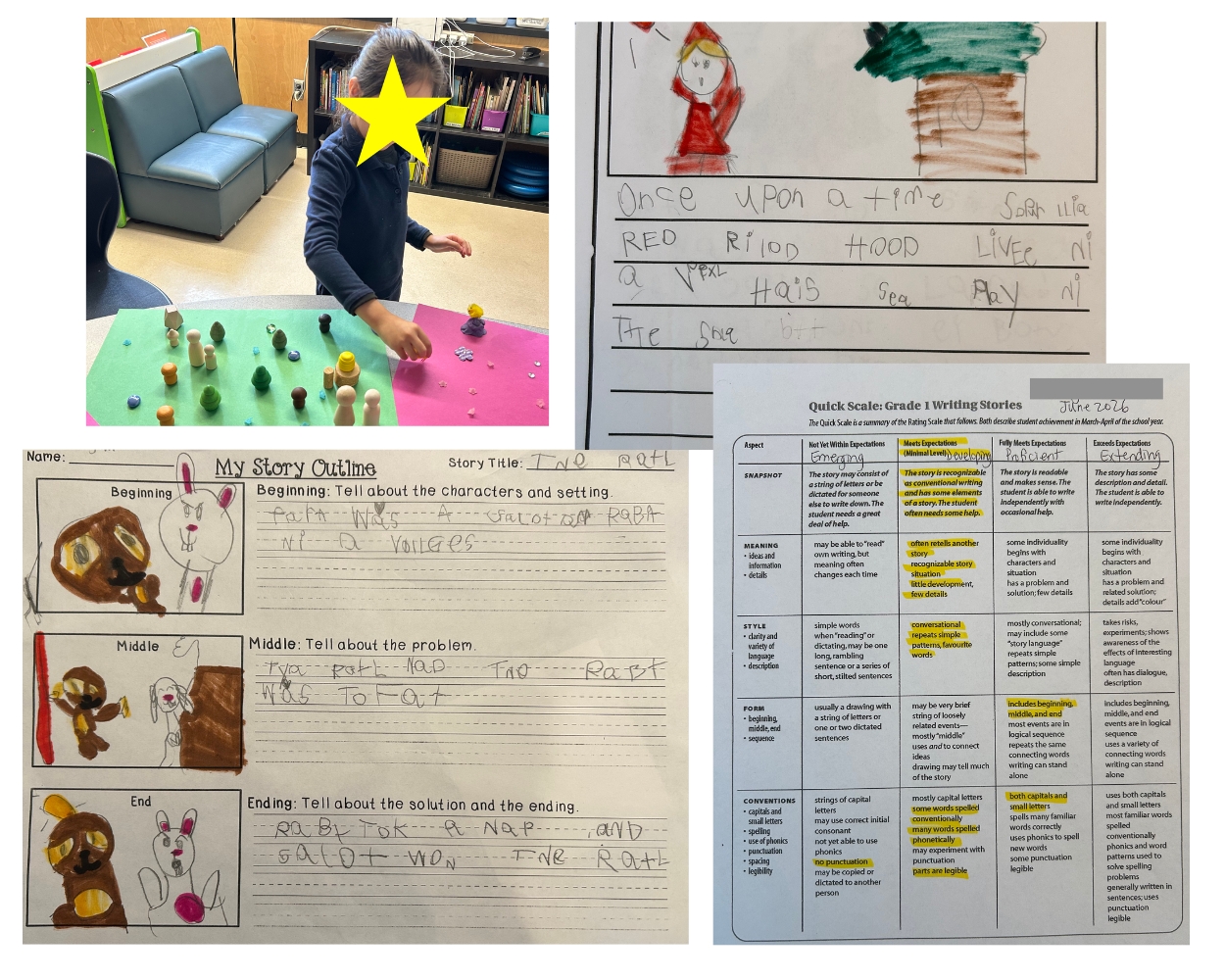
Students in this cohort are engaged in learning experiences where they create, represent, and share their ideas through storytelling. They use drawings, oral language, and emerging writing to communicate meaning, and revisit and refine their work to make their ideas clearer for an audience. This learning directly supports the Grade 1 English Language Arts Curricular Competencies, including:
- Create stories and other texts to deepen awareness of self, family, and community
- Plan and create a variety of communication forms for different purposes and audiences
- Use developmentally appropriate processes to communicate ideas and information (e.g., drawing, talking, writing)
These experiences also foster the development of the Core Competencies:
- Communication: Students share ideas, tell stories, and present their thinking using pictures, words, and oral language
- Thinking (Creative and Critical): Students generate ideas, add detail, and expand their thinking as they develop their stories
- Personal and Social: Students build confidence as they share their work and reflect on their growth as communicators
Our student learning goals are:
- Students will use pictures, oral language, and writing to create and communicate stories for different purposes and audiences
- Students will develop and expand their ideas by adding detail and clarity, demonstrating growth in creative and critical thinking
Students are working toward these goals by planning their ideas, representing them through drawings and words, revisiting and revising their work to improve clarity, and sharing their stories with others. They are learning to reflect on how effectively their ideas are communicated and how they can build on their thinking.
The change we are seeking is for students to move from simple or emerging representations to more intentional, detailed, and clearly communicated ideas, aligning with the progression of Grade 1 curricular competencies. The desired impact is that students will demonstrate increased confidence and independence in communicating their thinking, and will begin to see themselves as capable communicators who can use multiple forms to express and share their ideas.


OUR NEXT STEPS
Evidence collected from this Grade 1 cohort indicates meaningful growth in students’ ability to communicate their ideas through pictures, oral language, and emerging writing.
Quantitative/Direct Evidence:
A comparison of early- and mid-year student work samples shows that most students have progressed from creating simple drawings with little or no accompanying text to producing representations that include labels, short sentences, and additional details. An increasing number of students are independently attempting to add words to match their illustrations and are demonstrating greater organization in how their ideas are presented.
Qualitative Evidence (Student Learning Story):
One learner initially created simple drawings to represent ideas and relied primarily on oral storytelling to explain meaning. Over time, this learner began to intentionally add labels and short phrases to their drawings. By revisiting and revising their work, the learner expanded their story to include more detail and clearer sequencing, and was able to share their ideas independently with peers using both pictures and words. This demonstrates growing confidence and an increased ability to communicate thinking across multiple forms.
Where are we now?
We had hoped to see students move from relying primarily on oral language to using a combination of pictures and writing to communicate their ideas with greater clarity and detail. Evidence shows that this shift is happening for most students in the cohort. Students are increasingly able to represent, expand, and share their thinking, demonstrating growth toward the Grade 1 curricular competencies in creating and communicating.
Impact on Student Learning:
Students are showing increased confidence in sharing their ideas and are beginning to see themselves as writers and communicators. They are more willing to revisit their work to add detail and improve clarity, and are demonstrating stronger connections between their thinking, drawing, and writing.
Summary of Progress:
Overall, students have made progress toward both learning goals. Most students can now use pictures and emerging writing to communicate ideas and are beginning to add detail and clarity to their work, reflecting growth in both communication and thinking competencies.
Next Steps:
Moving forward, students will continue to build on these skills by:
- Expanding their use of written language beyond labels and short phrases toward more complete sentences
- Developing greater independence in revising their work to add detail and improve clarity
- Strengthening their ability to communicate their ideas clearly to an audience using both pictures and writing
Surrey Schools
Formed in 1906, the Surrey School District currently has the largest student enrolment in British Columbia and is one of the few growing districts in the province. It is governed by a publicly elected board of seven trustees.
The district serves the cities of Surrey and White Rock and the rural area of Barnston Island.