Clayton Heights Secondary 25-26

OUR CONTEXT
Clayton Heights Secondary is located on the shared, unceded, traditional territory of the Katzie, Semiahmoo and Kwantlen First Nations. We are a community where all students are encouraged to be inclusive and responsible citizens who participate in intellectual, artistic and athletic pursuits. With the guidance and encouragement of the school community, students are challenged to create, to anticipate and to dream. We as a community believe that our school is for everyone, and that our priority is to encourage students to find their place, based on their passions in that community.
Our students understand and accept their rights and responsibilities as citizens and participate in civic and social groups. They explore social, environmental and technological issues and advancements facing the nation and the world, while developing skills and understandings needed to pursue interests and utilize personal talents. Students are provided the opportunity to investigate career and educational options appropriate to their individual passions. All members of our school community are challenged to better understand the importance of maintaining physical and emotional well-being and develop decision-making, planning and resource management skills needed for their role as critical participants in a democratic society.
Our school is founded on the belief that service learning should be an integral part of all learning experiences. Student leadership programs support all aspects of student leader development, student involvement, and student leadership experiences at school.
OUR LEARNERS
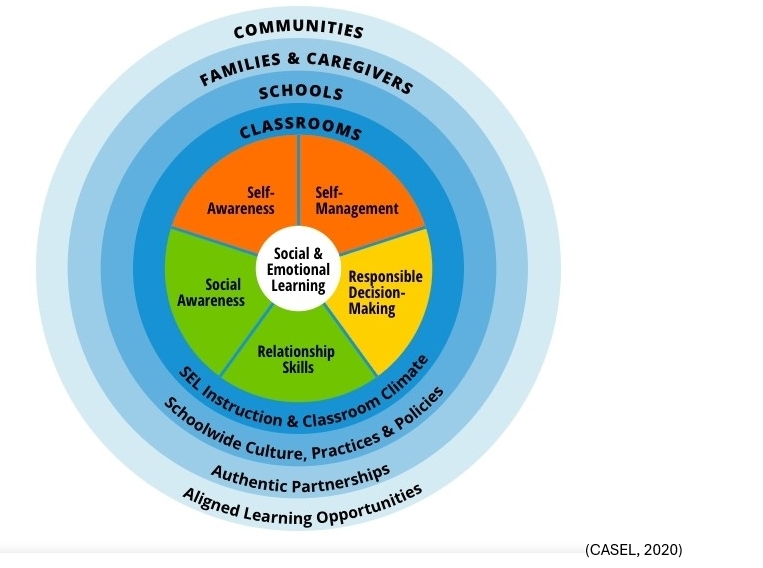
At Clayton Heights, we strive toward creating a school community that is equitable and meets the individual needs of our learners. We believe that positive relationships and connection form the foundation for an environment that is conducive to learning. Students succeed when they feel valued and cared for. Our Student Learning Plan focusses on the development and application of Social-Emotional Learning strategies, which promote student well-being, self-awareness and management, positive relationships, and responsible decision-making. We strive to make sure that our students are the long term beneficiaries of this work done in our school.
“ Students are more successful in school and in their daily life when:”
- They know and can manage themselves
- Understand the perspectives of others and relate effectively with them
- Make sound choices about personal and social decisions
(Durlak et al 2001, Farrington et al 20012, Sklad et al 2012)
“Social and emotional learning (SEL) involves the processes through which children and adults acquire and effectively apply the knowledge, attitudes and skills necessary to understand and manage emotions, set and achieve positive goals, feel and show empathy for others, establish and maintain positive relationships and make responsible decisions.” (CASEL 2013)
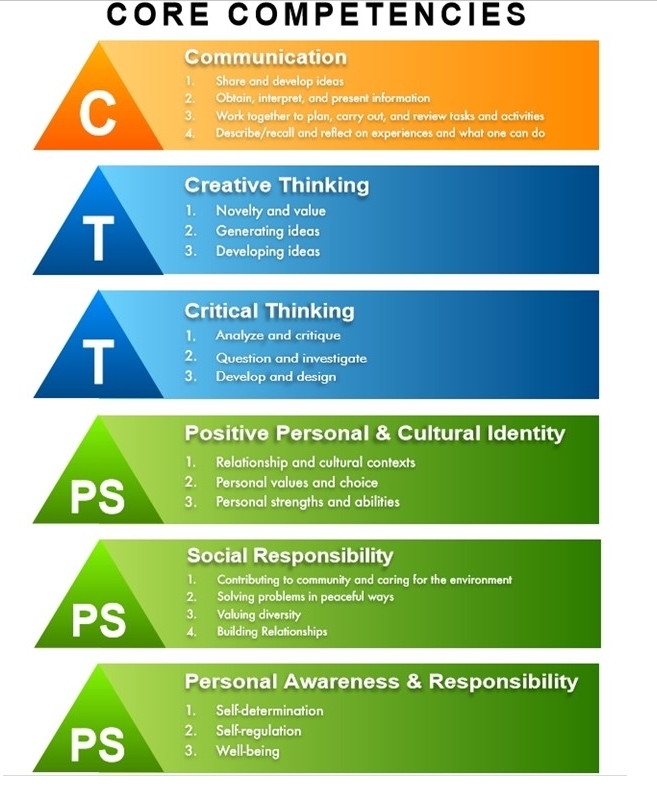
Supporting students so they can successfully graduate means focusing on the skills needed to be proficient across all subject areas, as well as being competent in the Core Competencies of Communication, Critical and Creative Thinking and Personal and Social Responsibility.
Mental Health Action Plan:
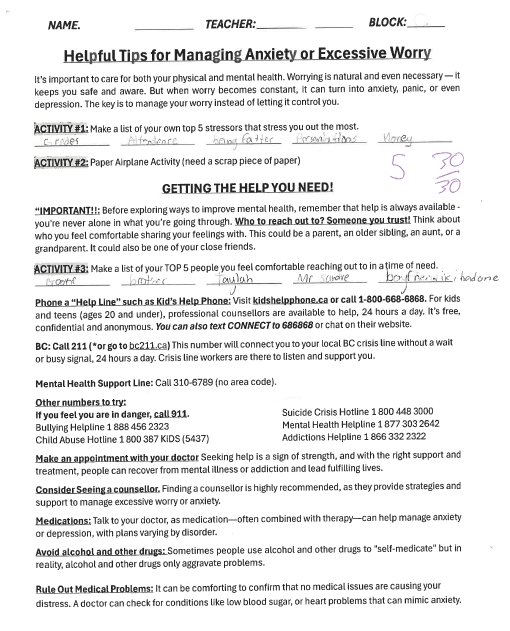
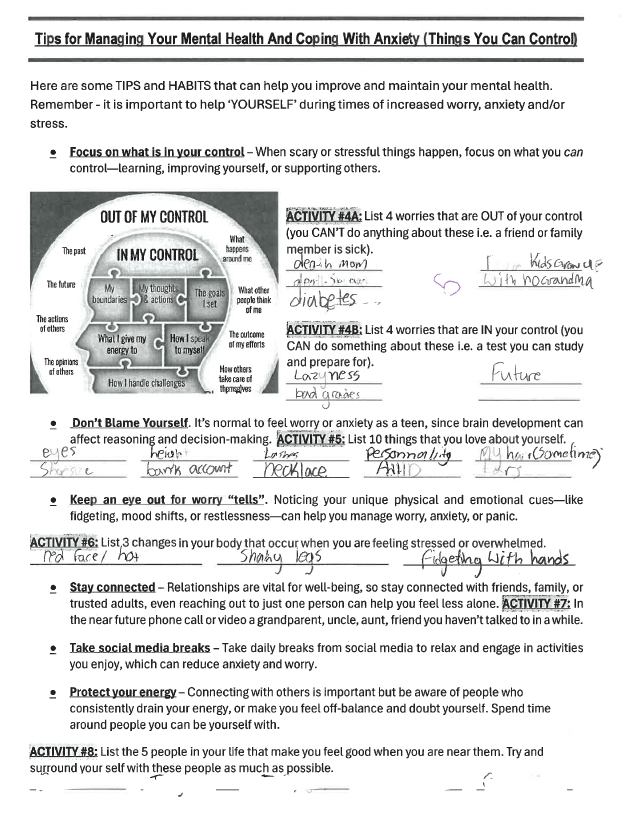
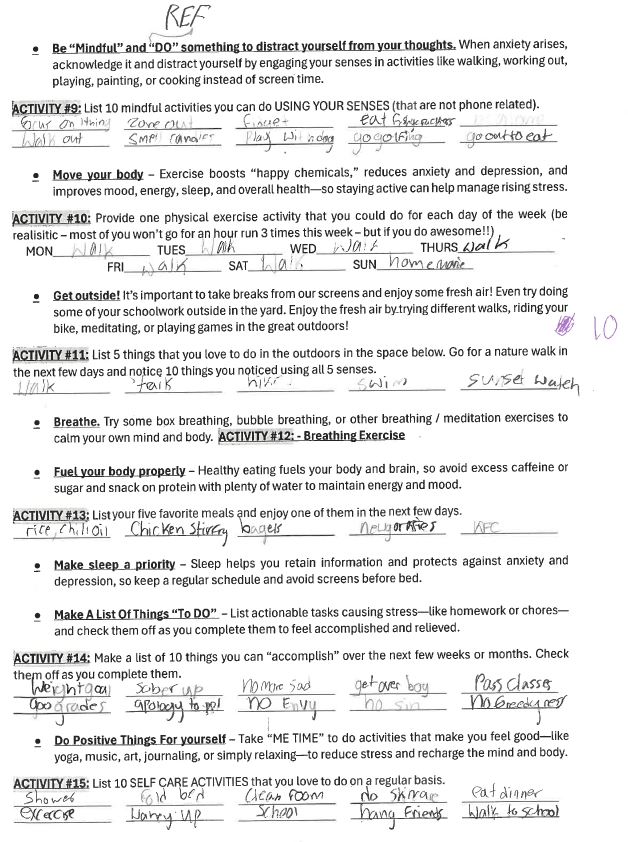
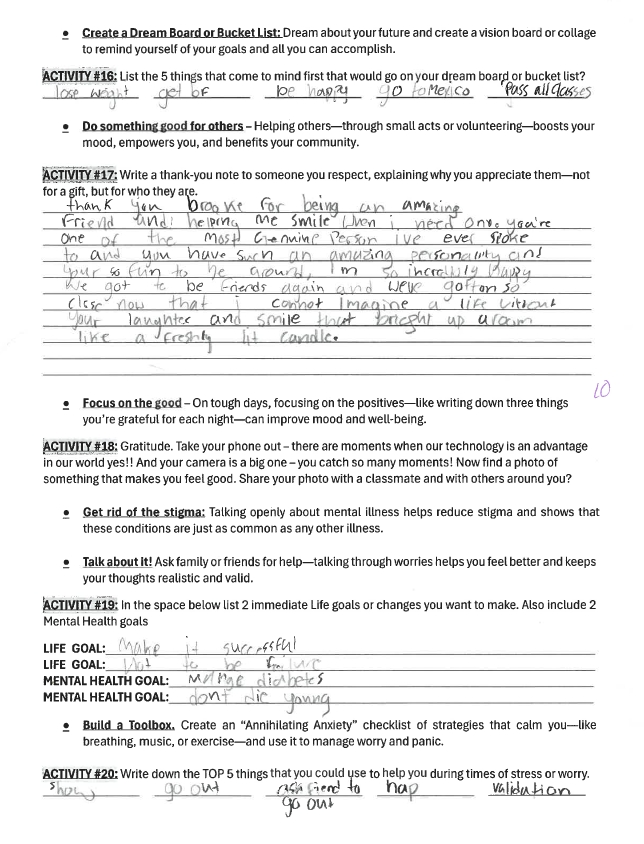
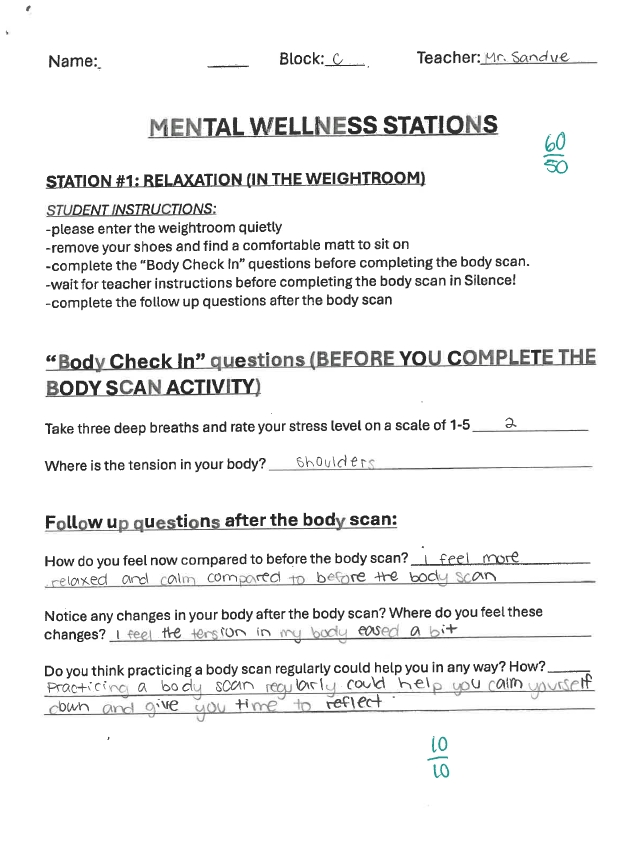
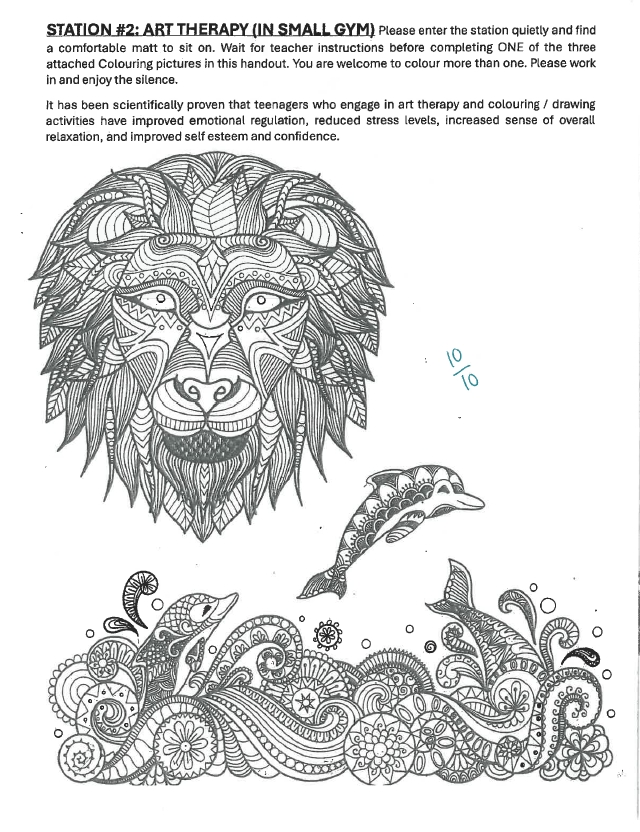
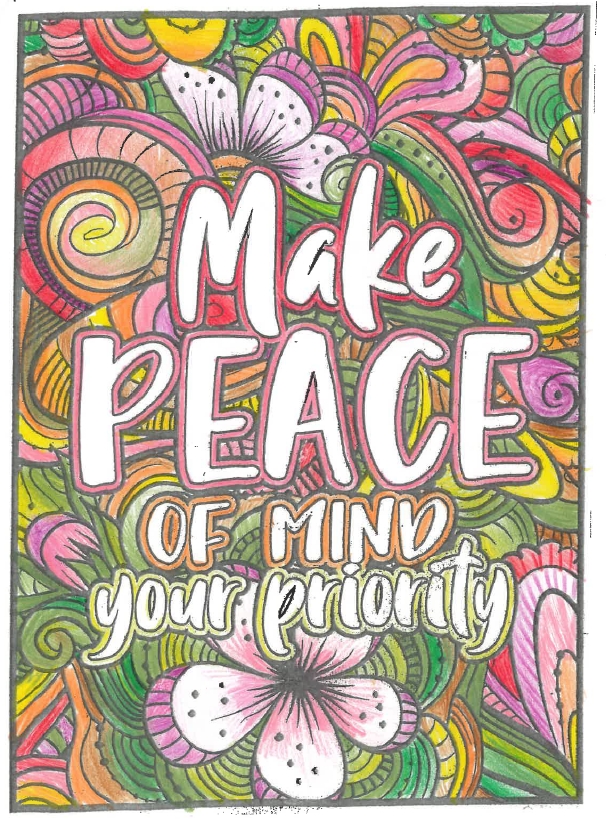
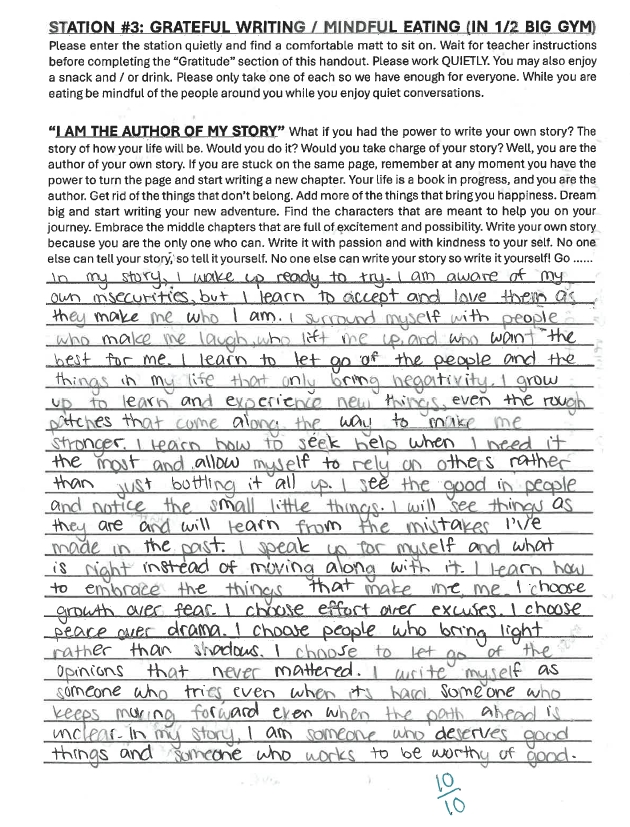
The school incorporated a plan that worked to inform and educate our students on important aspects of learning about mental health and ways to manage the stresses they were feeling. Mental health awareness weeks were developed for both semesters. In both the first and second semesters, our Physical Education department organized a number of direct and related presentations and activities in direct and indirect support of mental health education. These included a presentation on the impact of nutrition on the life of a teen, the importance of positive relationships and setting personal boundaries. One of the presentations also focused on the positive role of technology, including the use of artificial intelligence to be healthy and create a health plan. On the day that was focused on how to be self aware of your own mental health, The students participated in a station activity. These stations included:
Here are some samples of activities that have been completed by the students.
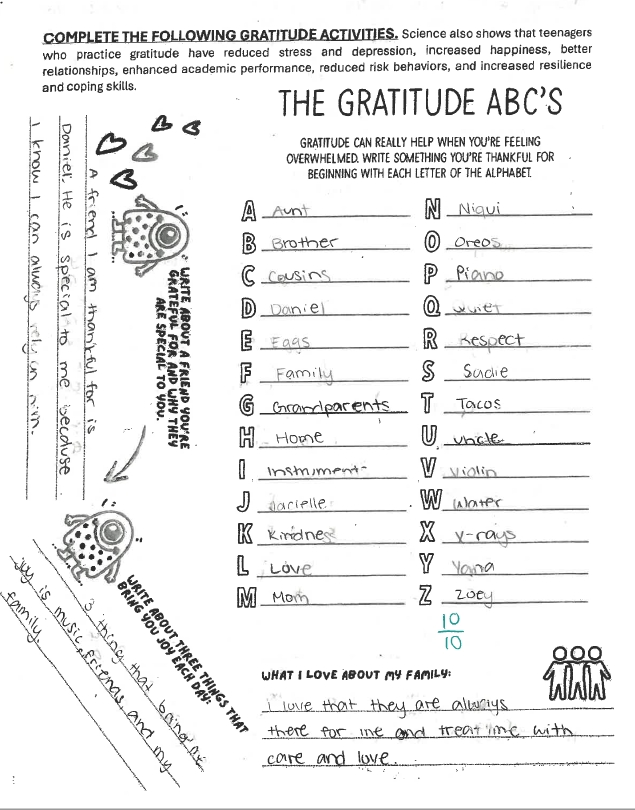
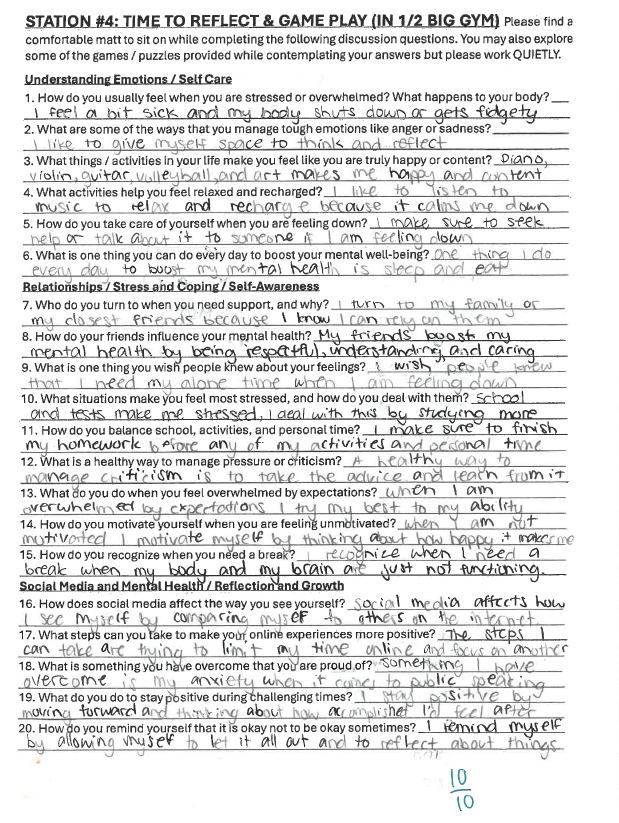
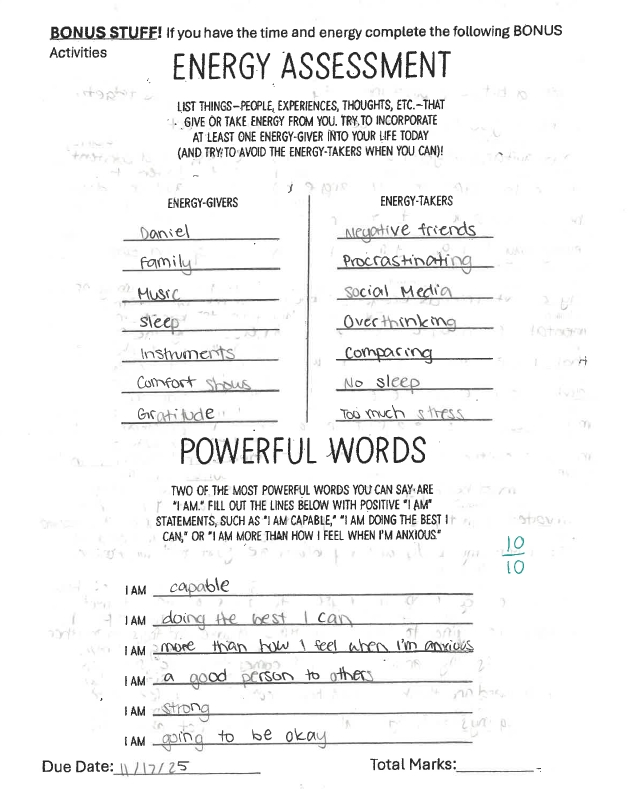
To gain insight into how the program was benefiting our students, the PHE department conducted a survey to seek some feedback to specific questions.
1. At the present stage of your life rate the level of your own mental health with 5 being very good to 1 being very poor.
70% rated their mental health currently at a 4 or 5.
24% rated their mental health a 3.
2. Do you believe you are a resilient person?
83% responded that they did believe they were a resilient person.
3. Do you believe you can be successful in anything you set your mind to?
81% believe this statement to be true about themselves.
4. Reflecting on the mental health week as a whole do you think it is important that we discuss Mental Health at school and participate in these activity. Rate on a scale of 5 being very valuable and 1 being not very valuable.
65% of students rated themselves a 4 or a 5.
18% of students rated themselves a 3.
5. Do you feel you are learning to take care of your own mental health?
83% of students stated that they did agree with this statement.
6. We have discussed having your own 'tools' to help you when you are struggling with your own mental health. The top 5 tools as described by the students are:
1. Sports and exercise
2. Friends
3. Family
4. Talk to someone
5. Music or food
In May our leadership and student council teams organized 3 guest speakers to support our students mental health. Scott Hammell is an entertainer and musician who uses storytelling and live demonstrations like breaking out of a straightjacket to help students understand how to stay in the moment and break overwhelming problems into manageable steps to be overcome.
Kuda Mabiza spoke to our students regarding the link between substance use, addiction and mental health, as well as how to cope and prevent. The focus is to have students be able to recognize the risk factors and explore healthy coping strategies.
Dr. Linda Uyeda spoke with our grade 12 students about the bodies physical response to stress. The focus of the talk became how to 'hack' a solution using their own emotions.
In addition to these guest speakers, the schools mental health club designed a presentation on how journaling techniques and the benefits of reflective writing for our grade 8 students.
OUR FOCUS
Supporting students so they can graduate successfully, develop positive relationships, and nurture their passions and strengths to be positive, caring, inclusive community members is our focus at CHS. We aim for all students to be provided with daily opportunities to develop Social-Emotional learning skills and capabilities, as well as, build competence in the Core Competencies of Communication, Critical and Creative Thinking and Personal and Social Responsibility.
” a pessimist sees the difficulty in every opportunity; and optimist sees the opportunity in every difficulty.” Winston Churchill.
At CHS, our educators support students in developing positive and successful academic, social and emotional transitions in their journey through:
- Grade 7 into grade 8
- The exploration years (grade 8 and 9) into grade 10
- Grade 12 to a successful graduation and beyond
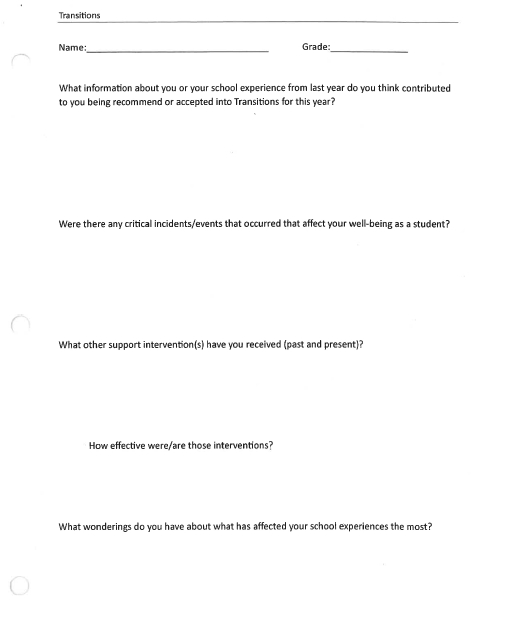
In order to identify our students' strengths and areas of growth, as well as, highlight and assess our supports, we tracked Social-Emotional Learning in a cohort of learners who were recommended for our skills for success program. The CHS skills for success program focuses on academic skill building, student connection, and social-emotional learning. Support is provided so students are able to develop a growth mindset and motivation to achieve their goals for the future.
Student Learning Goals
- Our learners can evaluate and explain Social-Emotional Learning strategies that promote well-being (i.e. self-awareness and reflection, strategies for mental well-being, responsible decision-making)
- Our learners can demonstrate an increased sense of belonging, school engagement and participation
- Our learners can successfully complete their courses and work towards graduation
Skills for Success
For some students, the struggle to meaningfully engage in school has been a greater challenge. Our support team worked this year to identify students in grade 9 through 12 that were at risk of not being successful in their course work, and thus also at risk of not graduating.
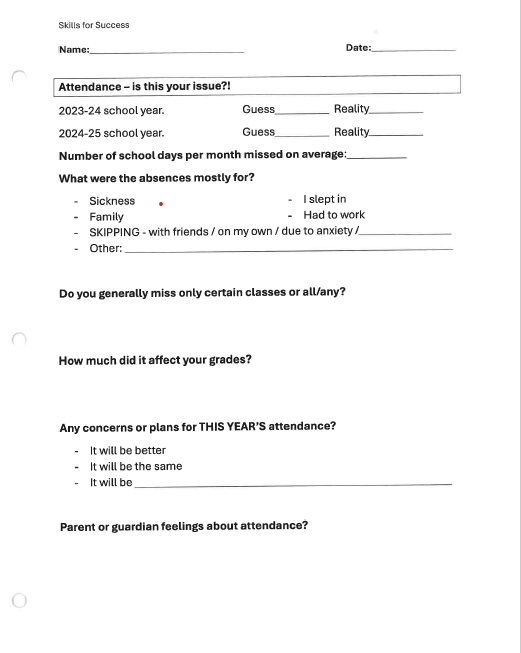
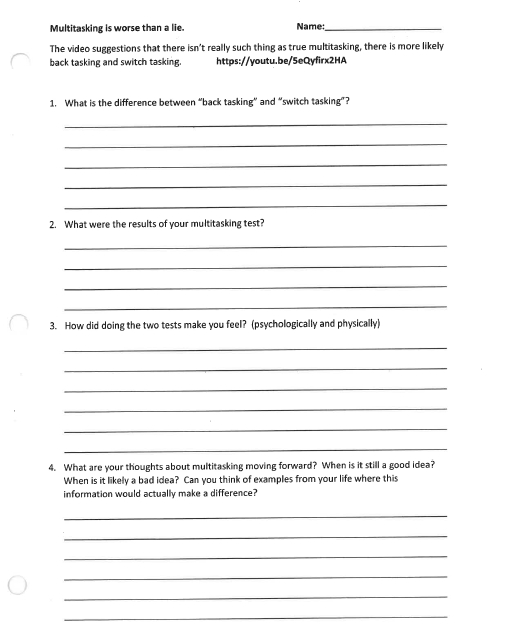
This cohort of students was supported throughout the year by a dedicated skills for success teachers. The students were given one block of time in their schedule, as it was thought that constant and direct support would be preferable to drop in or in-class support models. It was also the firm belief of the teacher in the program that to make the connections and build the relationships with the students, daily contact was required. The approach of the teacher was that of a skill builder, cheerleader and advocate. As different students required different supports, this class was also highly personalized. The teacher ensured that there was no homework, and that the skills being taught could be applied to the students’ other classes. At the beginning of the school year it was determined that the students would need to have an additional course taught during the skills for success time as many of the students had already received credits for the program. In this particular case our teacher decided on psychology 11 and CLC as the course they would teach to their students in addition to this program.
The teacher acted in the capacity of academic support, attendance support, social and emotional support as well as creating the safe space required for these students to succeed. The class engaged in learning in life skills, organization, and how to navigate and be successful in the school experience. A part of the class was also to equip these students with the skills necessary to build resiliency, self-regulation, compassion and engage in self awareness and conflict resolution.
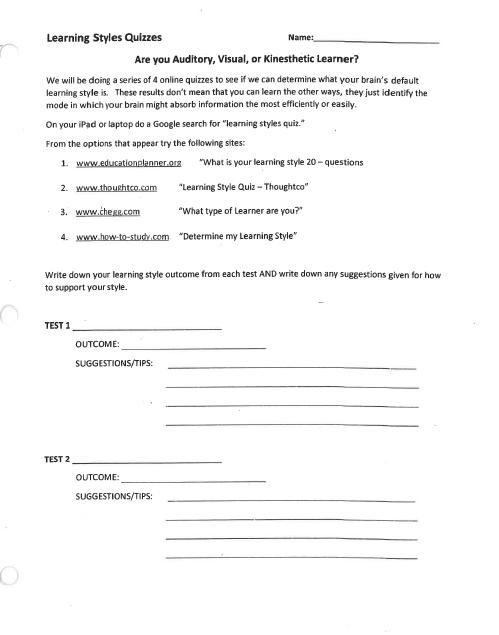
This cohort of students learned about and practiced growth mindset strategies, explored goal setting and approaches to personal organization. In addition, this program monitored the student's academics, providing them with guidance and support so they could see success across all their classes.
There was a significant focus on not being judgmental of each other’s situations. The students were encouraged to try to understand and demonstrate compassion towards what other students were going through personally. It was hoped that by mixing the grades both junior and senior, a type of mentorship would begin. In addition, the teacher and students openly discussed the mental health supports available for anxiety, depression, suicidal ideation and trauma (past or present).
OUR NEXT STEPS
Similar to the 2024/25 school year, it was decided that all of our skills for success classes for the 2025/26 school year would be multi grade and include students from grade 9 – 12.
In addition to the skills for success curriculum and content, the senior class members who were in need of credits to help them graduate were given the option of taking wither a psychology 11 course or a careers 10 or 12 course. This change was necessitated by direction from the ministry of education on BAA courses.
Students were asked to identify why they believed support from this class and this teacher was going to be helpful to them. As a cohort, they identified a number of barriers to their learning:
- Attendance issues
- Academic difficulties
- Lack of support at home
- Lack of focus
- Students who could use a little guidance
- Students who get anxious talking to teaches or asking for extra help.
- Mental Health / Stress
- Lack of support with large classes
- A student who needs a teacher to advocate for them
- Sitting at a desk for too long
- Disconnected or not engaged in school
- Distractions
- Being in uncomfortable situations
- Not feeling connected to our school
We used these survey results to provide a framework for the supports that were offered. Given that so many of the factors listed affected each student differently, the actual supports put in place for students were very personalized. One factor which is not as quantifiable is this level of personalization. While some programs in our school are able to meet specific needs for specific students, this was not the case for skills for success student. Each one of these students has a very different story and thus has a very different list of needs.
The following graphs show the similarities or differences between student who were in the cohort for the 2024/25 school year and those who in the 2025/26 school year.
Academic Success
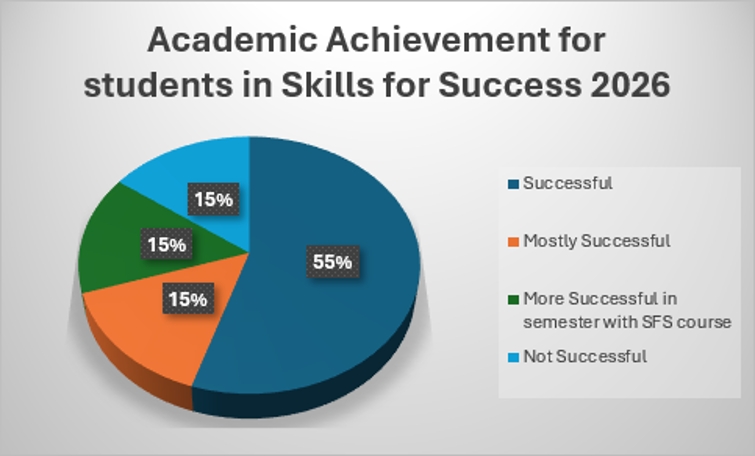
The data taken from the students’ report cards from the 2024/25 school year showed the majority of students were benefiting from the supports of the class. The following graph illustrates this fact.
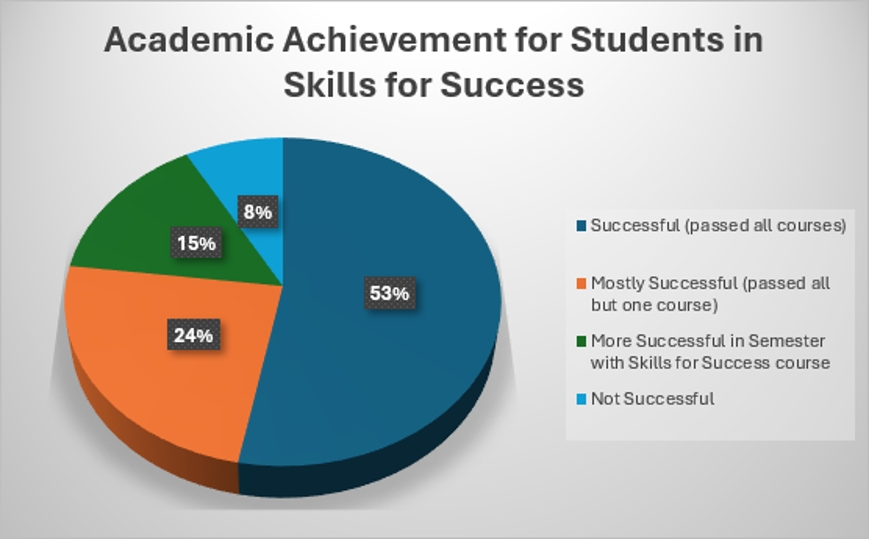
Direct comparison
The data for the 2025/26 school year is similar in the number of students who find success with the support of this class.
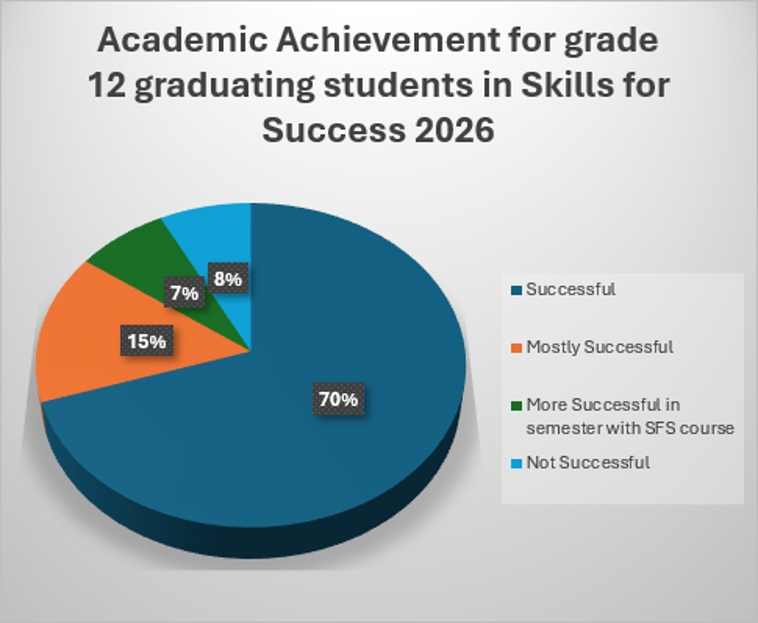
When the data focussed strictly on grade 12 students who had the class in their graduation year, the results are even more positive.
In addition to the report card data, our skills for success students were surveyed on how they felt about their academic performance this school year. For all the survey statements, the first graph represents the 2024/25 data while the next two graphs represent the students in the skills for success classes for the 2025/26 school year.
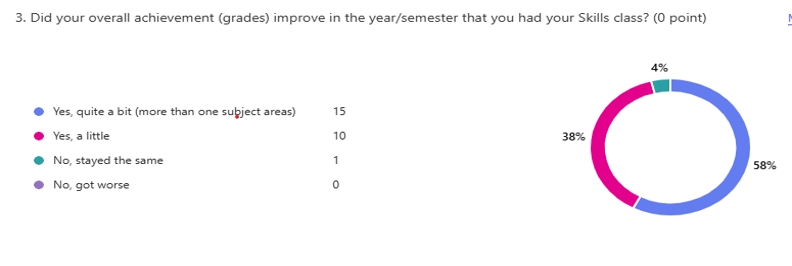
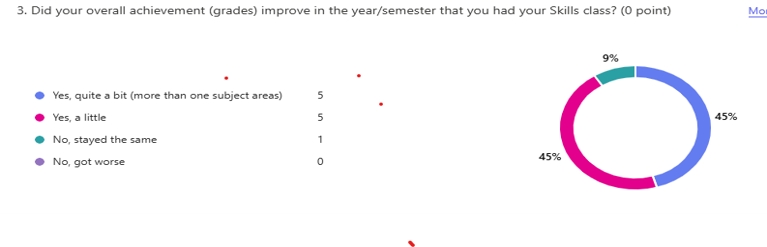
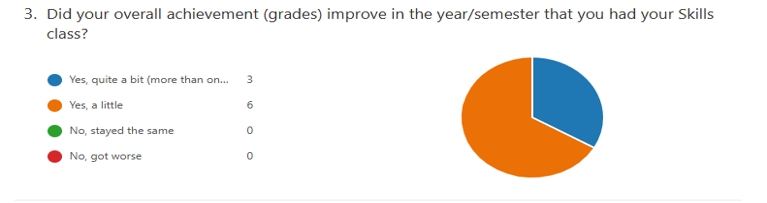
There is no discernable difference in the achievement question from year to year, both both surveyed values in the high 90% range.
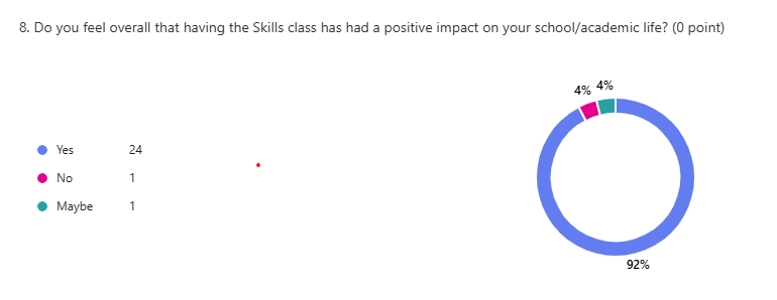
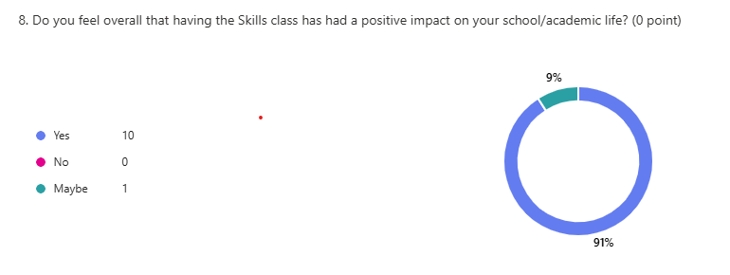
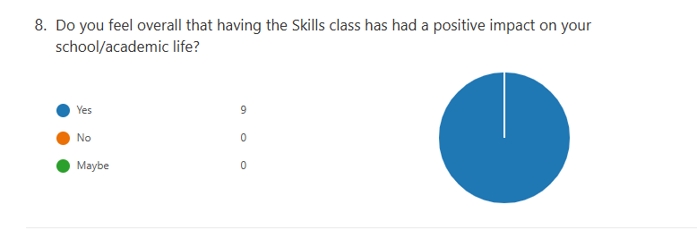
There was a slight increase in the number of students who felt the class had a positive impact on them at school, with all values in the high 90% range.
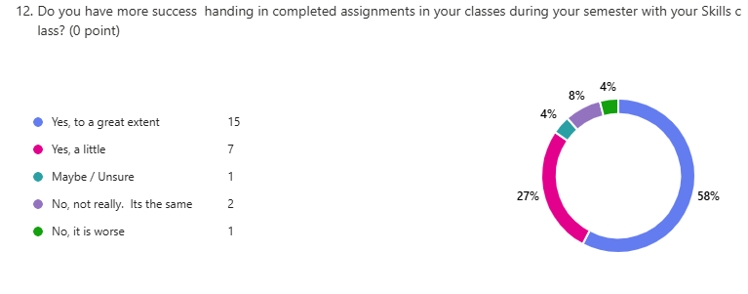
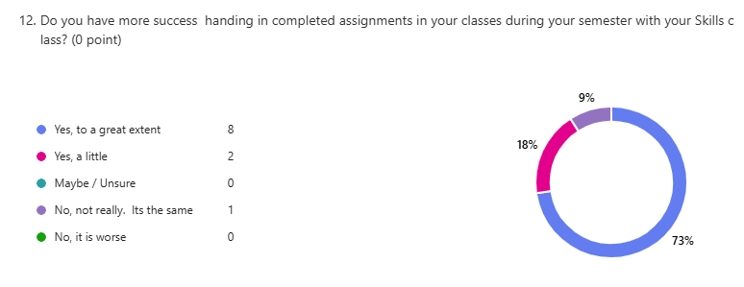
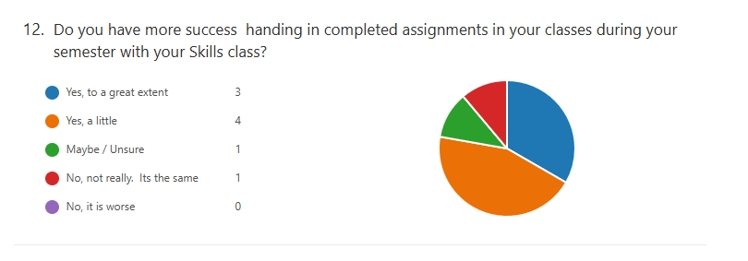
There was no discernible difference between student completing assignments with positive responses in the mid 80% range.
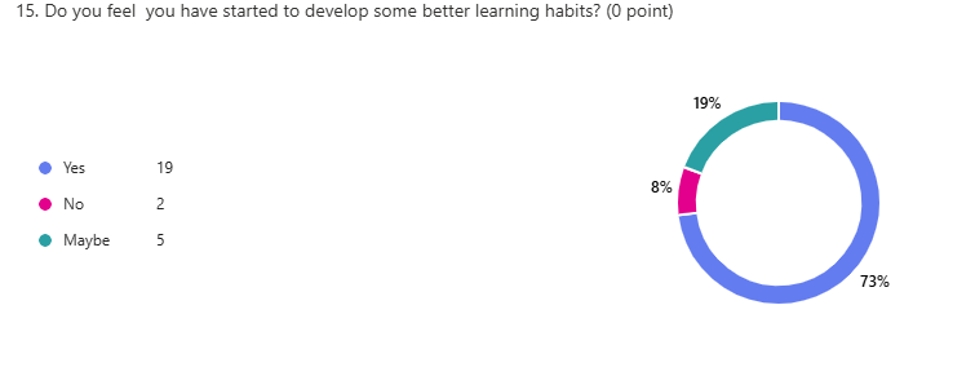
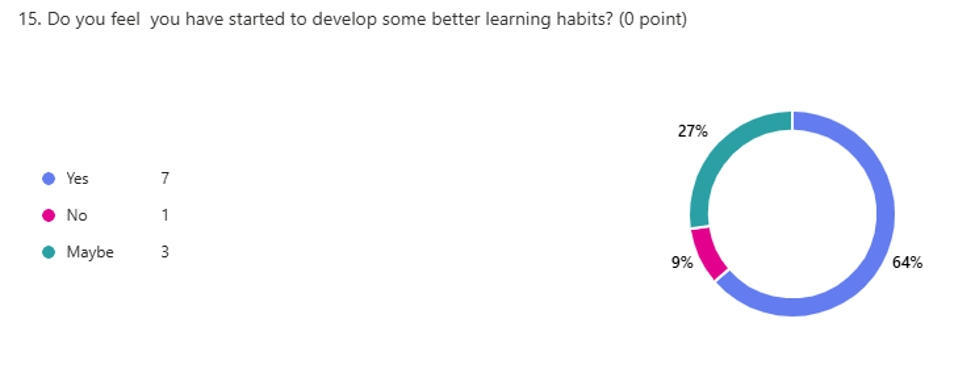
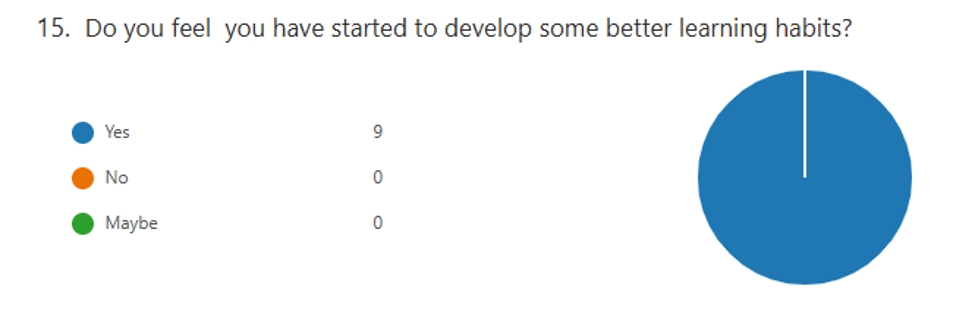
When students were asked if the class helped them develop better learning habits, there was an increase from 81% in 2024/25 to 98% in 2025/26.
In addition, the students provided the following open-ended responses to a writing prompt.
For the 2024/25 school year, students were asked to provide examples of how this class made a direct impact on them this year.
- i was struggling with my math and my teacher sat down with me one on one and talked through it with me
- I am probably would of failed environmental science last semester
- I had a lot of missing assignments that i wouldn’t have been able to complete if i didn’t have a skills class
- I had more 1 on 1 help with the work from my classes, skills class made me feel a lot less stressed with all my classes
- Handed in all my work
- I started doing math homework
- this class has helped me get most of my assignments handed in and overall, without i probably would failed most of my classes.
For the 2025/26 school year, these were the examples submitted by the students.
- When I was near failing my skills teacher talked with my teachers and helped create a plan
- This class helps me get caught up with work I wouldn’t do at home and my skills teacher helps me understand the work, especially math
- The help with homework really helped by stress level
- My skills teacher helped me understand the work for a class I needed to graduate
- This class has made me more organized
- This class gives me the extra time I need to pass
- I needed help applying for a program, which this class provided
- I have the highest mark I have ever had in English because of the supportive teacher in skills
Name and describe any unexpected positive outcomes of this class (2024/25)
- actually, getting work done
- I handed in 3x more assignments on time.
- I finished a lot of English work and that got my grade up to a B
- I’m much more organized and getting my work handed in on time
- i got a lot more work done
- keeping up with all my work
Name and describe any unexpected positive outcomes of this class (2025/26
- I wasn’t expecting my attendance to improve, and it did
- I am more confident as a student and I have learned how to pay attention
- Better homework and attendance habits
- I got better at organizing
- I have been more focused and got extra help from the teacher I needed to get help from
- This class makes me want to come to school, I feel less like a drag, and makes me feel less stressed
Attendance and more importantly developing a connection to our school are also incredibly important factor to track. Our students were surveyed on both attendance and connection to our school and their learning.
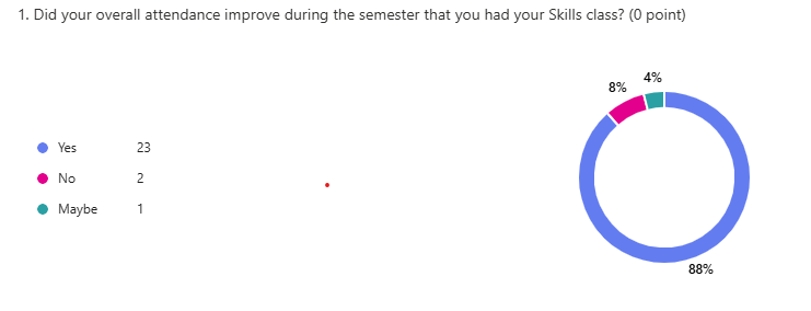
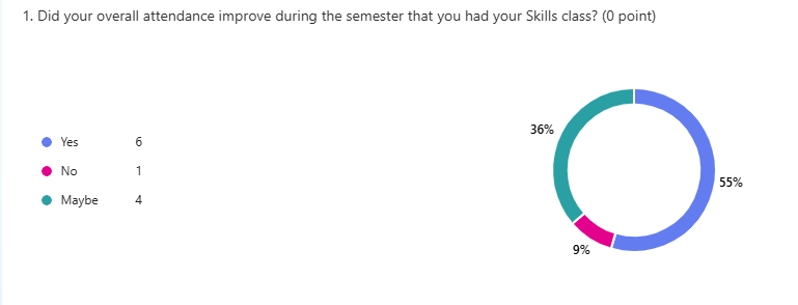
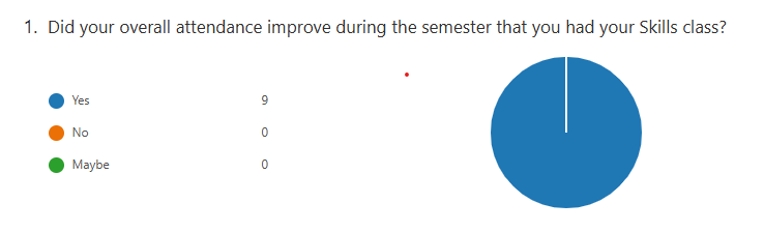
There was no discernible difference in the data from the 2024/25 or 2025/26 school years, with positive responses in the high 80-90%.
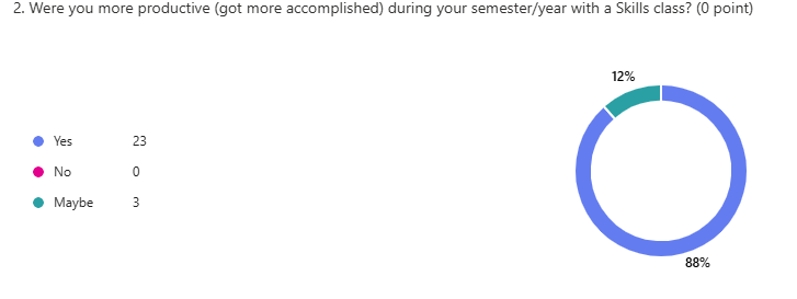
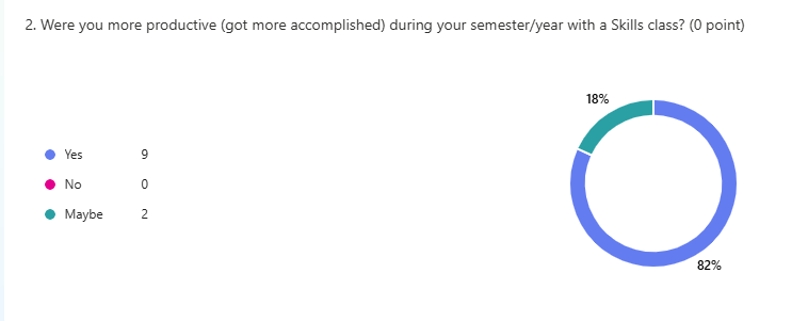
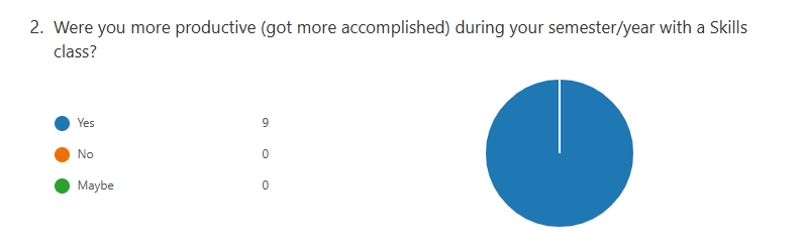
There was no discernible difference in the data from the 2024/25 or 2025/26 school years, with positive responses in the high 80-90%.
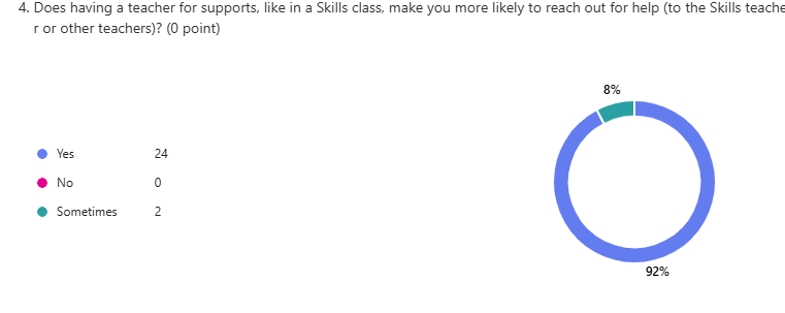
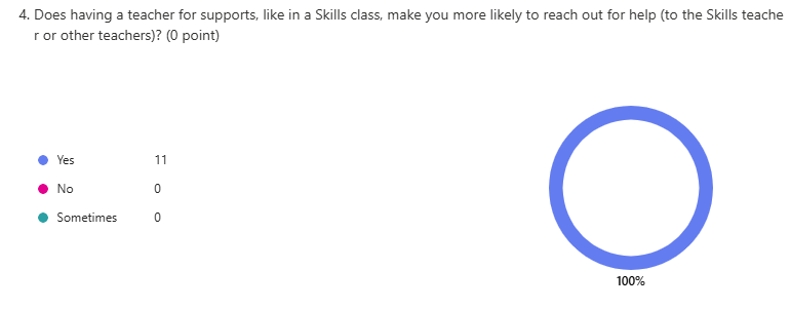
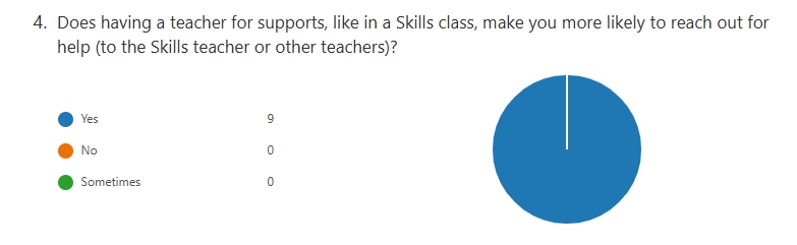
The responses for teacher advocacy having a positive effect on the students is again very strong. We have long held the belief that one of the foundational strengths of the program is students who not only have a teacher who supports them but helps to advocate for them with their teachers. The students who tend to not be able to communicate with their teachers in this fashion see not only the positive effect that communication and advocacy have, but also the modeling of the teacher having collegial conversations with staff on their behalf, which helps to build the students skills in this area.
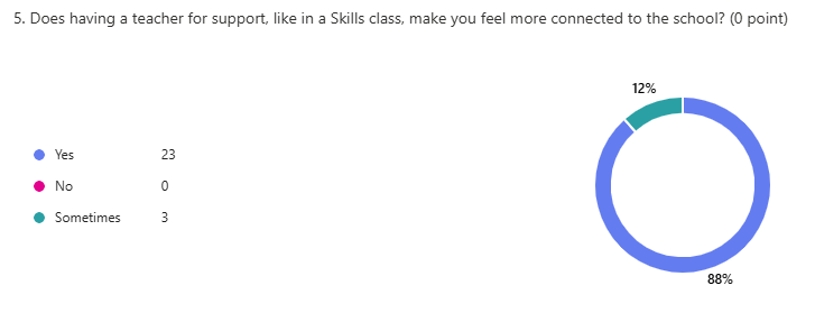
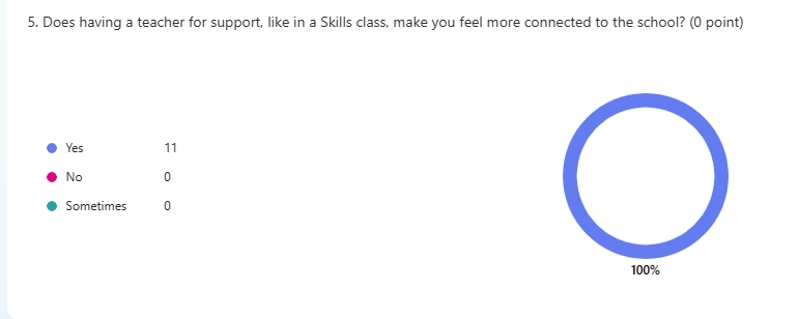
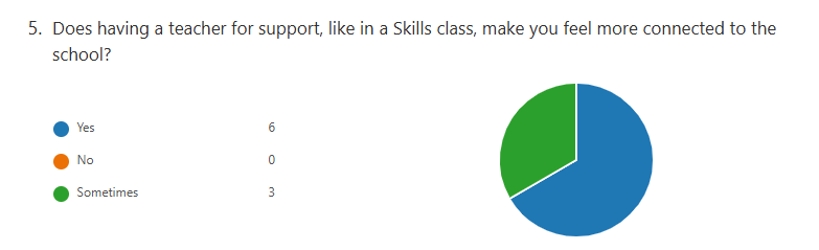
There was no discernible difference in the data from the 2024/25 or 2025/26 school years, with positive responses in the mid 80%.
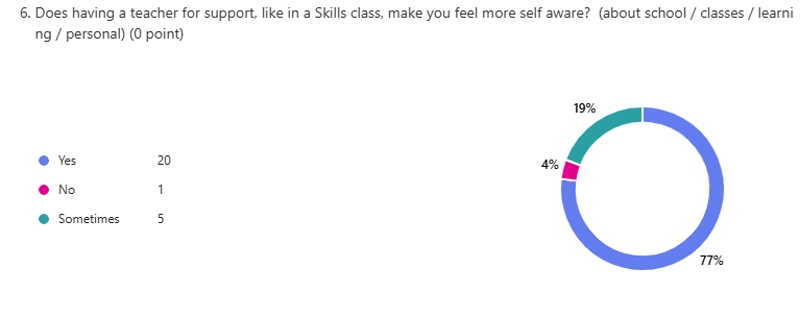
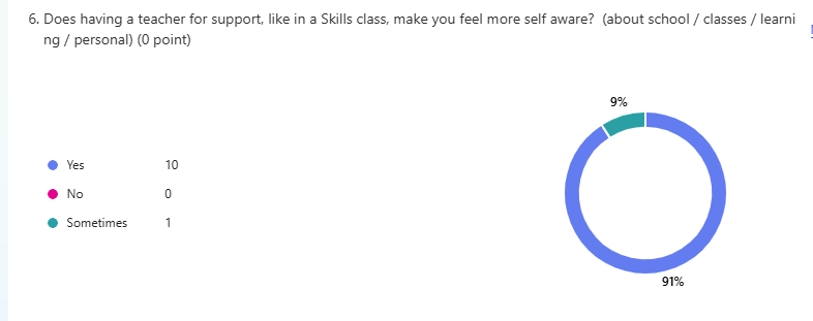
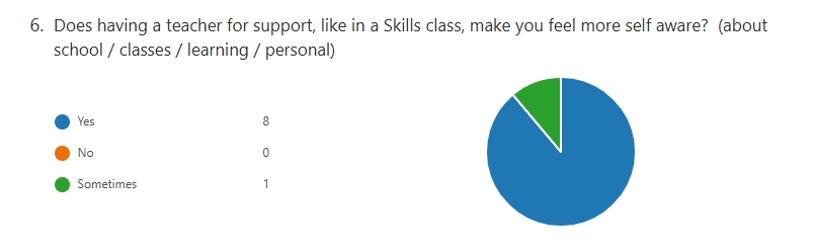
There was a significant impact from one school year to the next on students becoming more self-aware. The percentage of students who felt more self-aware increased from 77% to 89% from the 2024/25 school year to the 2025/26 school year.
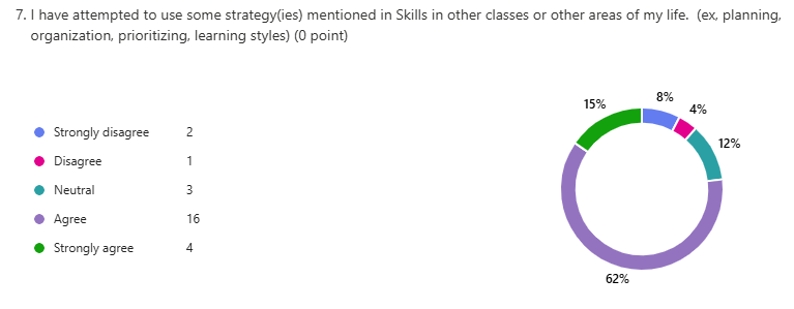
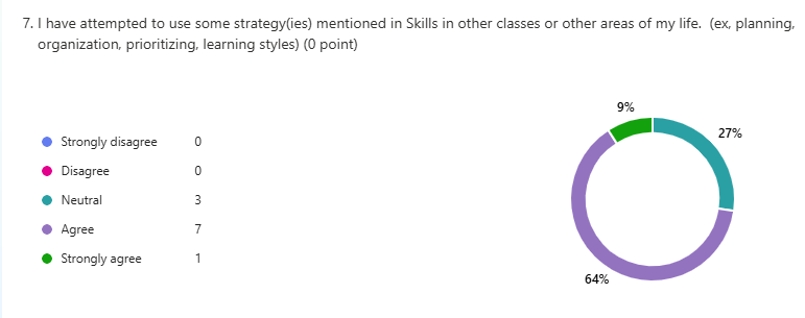
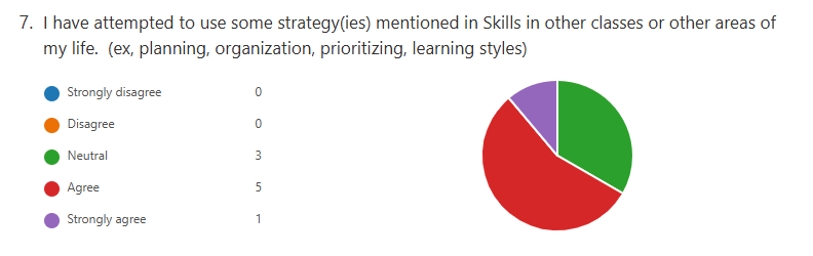
There was a slight drop of 5% for students who were actively using the strategies they learned in the class in other areas of their student and personal life,
Our students also commented on how they felt about both attendance and connection to our school.( Update)
- my grades went up and attendance went up
- helped with every single class in attendance and grades.
- i was going through a lot of family trauma, parents divorced plus school was beating me down even more I fell into deep depression with everything going on also school. Until this skills class gave me a chance to calm down and talk also get the help I need with assignments. I was able to hand in assignments on regularly due date which before i could never do in addition to I was having the best grades on those assignments that I ever have, I had some of the best grades on assignments in my class because of Ms. Braley. I promise if I could have this course again it wouldn’t be a waste. I can guarantee this would help others also a bunch
- The class being multi graded helps because sometimes people from other grades have insight from experience on a project or assignment you're doing.
- the teacher was very supportive and positive and help us and talked us through the full semester and help us a lot with mental health because sometimes we can sit there colour and take a break in the day
Our learners are developing their Social-Emotional skills and capacities.
Some examples of the various tools used when working with these students.
Surrey Schools
Formed in 1906, the Surrey School District currently has the largest student enrolment in British Columbia and is one of the few growing districts in the province. It is governed by a publicly elected board of seven trustees.
The district serves the cities of Surrey and White Rock and the rural area of Barnston Island.