Chimney Hill Elementary 25-26

OUR CONTEXT
Chimney Hill is nestled in a beautiful community in the Newton area of Surrey. Sitting on a hill allows the beauty of the surrounding mountains to be seen from many different parts of the school grounds. They are a reminder of our great history and our connection to the land. Chimney Hill is situated on the unceded, traditional territories of the Kwantlen, Semiahmoo, Katzie, and other Coast Salish Nations.
Chimney Hill is home to about 530 students. The student population has been changing over the past couple of years with an increase in diversity. The school now has 35 languages represented with students arriving from all over the world. This diversity is something to celebrate as staff and students can share and learn so many different perspectives and gain so many different understandings about the world.

The Chimney Hill Dragons love their school. Some of the highlights they look forward to each year are: student leader scavenger hunts, divas for Diwali, Fit Kid stations, Young Entrepreneur Fairs, Sports Day, Choir festival, and more. Most of these events are across classes and grade levels, allowing students to build relationships out of their classroom boundaries and embrace the community of the school.

We love the opportunity for families to celebrate learning and join the fun of learning. This year our families joined us for the spring concert, Zumba presentation (they even danced with us) and annual carnival. At Chimney Hill we understand the importance of family connections and appreciate the way the community shows up with support.

OUR LEARNERS
Chimney Hill Dragons enjoy coming to school to learn and in a community setting. At Chimney Hill we know that our learners are coming from a variety of different backgrounds and that they are proud of where they come from and who they are. We know our learners learn best in a community setting and enjoy working together to problem solve and engage in the learning process. We know they do their best when they have both school and home support, when they have clear expectations, and when they can learn in a way that makes sense for them.
At Chimney Hill we are focused on the core and curricular competencies in the BC curriculum. The Core Competencies of Communicating, Thinking, and Personal/Social Responsibility are highly connected to the work and focus taking place in literacy. Here are two key competencies that guide our practice and are leading our inquiry:
Our learners communicate clearly and purposefully, using a variety of forms appropriately.
We are continually in awe of the many ways our learners communicate, whether through the multiple languages they speak, the expressive words they put on a page, the courage they show when sharing in front of others, the use of PECS symbols to express their needs, or the powerful images they create that reveal a deep understanding. Our learners are eager to share their thoughts and ideas; they are driven to communicate and connect, and they do so every day in many brilliant ways.

Our learners get ideas when they play.
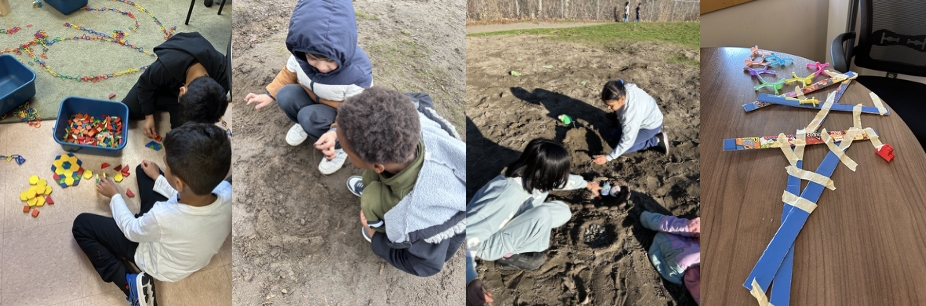
When our learners have the time and space to play, the possibilities of what they become are endless - innovators, creators, problem solvers, engineers, builders, and more. Play is what activates creativity and critical thinking for learners of all ages. Time in nature is also an important element of play. Our learners love to be outside making water path ways, creating stories, and getting their hands a little dirty.
"Play is the foundation of learning, creativity, self-expression, and constructive problem-solving. It’s how children wrestle with life to make it meaningful." ~Susan Linn
OUR FOCUS
At the beginning of the year, staff engaged in conversations about the strengths and stretches of our learners, examining year-end proficiency data and FSA results. Analysis of beginning-of-year writing samples indicated that some learners were experiencing challenges in key writing skills, including paragraph organization, descriptive detail and elaboration, and vocabulary use. These patterns prompted important staff discussions and a shared recognition of the need to better support student writers. In response, we initiated a focused inquiry to improve student writing development.
The cohort consisted of Grade 4 and 5 learners. The teachers intentionally selected a diverse group of students representing a wide range of writing proficiencies. This approach ensured that all learners, regardless of their current skill level, were provided with opportunities to develop and strengthen their writing abilities.
Our student learning goals, as connected to the curriculum were:
- Using language in creative and playful ways helps us understand how language works
- Use language in creative and playful ways to develop style
- Develop and apply expanding word knowledge
- Transform ideas and information to create original texts
To target and guide student's success with the above goals the following learning experiences were used:
- Read stories and use strategies that highlight sensory details
- Use of story workshop, loose parts, and time in nature to use play to engage senses
- Direct instruction to teach ways to expand sentences
- Using CoPilot to play with language and see how the use of detail is used to create an image
Here's an example of a student learning to add details into CoPilot. To create the first picture the student asked CoPilot to create a picture of the beach. The second time, the student asked CoPilot to include a person playing in the water, a child and dad building a sandcastle, seagulls flying in the air, and a soft blanket on the beach. By learning to give descriptive details into CoPilot will help them understand the importance of putting them in their writing.

Loose Parts provides students with opportunities to create, explore, and build in open-ended ways. Through this process, they engage in hands-on, imaginative learning that encourages curiosity and problem-solving. As students construct their creations, they are also invited to reflect on and explain their thinking, considering the sensory elements such as texture, shape, colour, and structure of what they have designed. This process supports the development of oral language skills, descriptive vocabulary, and the ability to communicate ideas with greater clarity and detail. Additionally, it fosters creativity, collaboration, and deeper engagement as students make meaning through both their creations and their explanations.
In April, we engaged in a learning sprint focused on improving the quality of student writing, with particular attention to the development of meaning and detail. A learning sprint is a structured, short-term cycle of inquiry in which educators focus on a specific learning goal, implement targeted instructional strategies, collect evidence of student learning, and collaboratively reflect on progress to inform next steps.
Through targeted instruction, students were supported in enhancing their writing by incorporating sensory details to create more vivid and engaging texts. This focus aligns with the BC Performance Standards for Writing, specifically in strengthening students’ ability to develop ideas with clarity, depth, and descriptive language.
The accompanying graph illustrates student performance using proficiency indicators (Emerging, Developing, Proficient, Extending) and demonstrates growth in students’ ability to meet grade-level expectations in writing prior to the initiation of the learning sprint.

The initial assessment task required students to respond to an image prompt by writing with as much detail as possible. While many students were able to identify and describe what they observed in the image, responses tended to focus on listing visible elements rather than developing rich, descriptive detail. Sensory language was used infrequently, with most writing reflecting surface-level observations rather than deeper description.


During the six week sprint, students worked on engaging with sensory details, building vocabulary of describing words, and understanding how to evoke the senses. Here is one of the samples that show an increase in use of sensory language and description.

"I hear kids crying because the water is too cold." Student
As a result of the six-week learning sprint, which focused on explicit and intentional writing instruction, measurable improvements were observed across all students, regardless of their initial level of ELA writing proficiency.

Growth was evident across several key areas, including:
- Vocabulary development, particularly an increased use of synonyms to enhance word choice
- Sensory detail, with students producing more engaging and descriptive writing that appeals to the reader’s senses
- Use of figurative language, contributing to more vivid and expressive compositions
- Emotional depth, demonstrated through both the inclusion of feelings and the ability to evoke emotion in the reader
Teachers expressed enthusiasm regarding the progress made and noted a marked increase in student engagement and confidence in writing.
OUR NEXT STEPS
Looking ahead, there is a continued commitment to strengthening writing instruction through clear, measurable goals aligned with the BC Performance Standards for Writing. The school will implement school-wide writing samples three times per year (fall, winter, and spring) to gather evidence of student learning and to monitor growth over time.
A key goal is to support students in moving toward Proficient and Extending levels of performance by focusing on the following areas:
- Meaning and detail: Students will incorporate relevant ideas supported by descriptive and sensory details
- Style and voice: Students will demonstrate increased control of vocabulary, including the purposeful use of varied and precise word choice
- Form and organization: Students will develop clear paragraph structure, including topic sentences, supporting details, and logical sequencing
- Conventions: Students will demonstrate increasing accuracy in grammar, punctuation, and spelling appropriate to their grade level
Staff will collaboratively assess writing samples using a common rubric informed by the BC Performance Standards, engaging in collaborative practices to ensure consistency in assessment. The goal is for the majority of students to demonstrate growth of at least one performance level over the course of the year in one or more aspects of writing.
Surrey Schools
Formed in 1906, the Surrey School District currently has the largest student enrolment in British Columbia and is one of the few growing districts in the province. It is governed by a publicly elected board of seven trustees.
The district serves the cities of Surrey and White Rock and the rural area of Barnston Island.