Bothwell Elementary

OUR CONTEXT
ey kw'ese xwe' í mékw'ewát
Welcome to all. It's good that we are all here.
(həṅq̓əmín̓əḿ, the downriver dialect of Halkomelem, is still spoken by Katzie peoples)
Bothwell Elementary is located on the traditional, unceded territories of the Katzie First Peoples. When we gather in community, we remember that acknowledging whose land we work, live and play upon is an essential part of our commitment to reconciliation.

We are a community of just under 300 wonder-filled students, K-7, a staff of just over 40 caring adults, and hundreds of supportive family members. Nearly 60% of our students speak a language other than English at home . In addition to daily learning routines, we also enjoy time spent with buddy classes, having fun on Spirit Days, watching our leadership team lead Sports Day, class baking in one of our two accessible kitchens, making music in grade 7 band, field studies in Tynehead Park, and playing on various sports teams.
We are grateful for the enduring support of our PAC. With their generous efforts, time and fundraising, we enjoy special events such as school-wide Zumba and ArtStarts performances, as well as contributions towards our outdoor classroom, bussing on field studies, classroom materials and Sports Day treats.
We treasure the natural beauty of our grounds, including Salh Tumuxw (our learning circle), located on the front lawn near the school gardens.

We are curious...
about the impact of outdoor play and learning on student well-being.
We value Outdoor Play and Learning (OPAL) and dedicate professional learning, resources and time to enrich students' outdoor experiences. Through research and lived experience, we know there are many benefits to taking learning outdoors. These range from improved emotional well being with a reduction in anxiety, to increased engagement both inside and outside the classroom, to greater experiential learning that lends itself to student-led inquiry, to an increase in divergent thinking and problems solving across our competency-based curriculum (Source: Megan Zeni, professional development August 2021).
Over the last two school years, staff engaged in the following pursuits:
- two days of professional learning with BC researcher and educator, Megan Zeni;
- professional book club using Dirty Teaching: A beginner's guide to learning outdoors by Juliet Robertson;
- two "deep dive" weeks with a whole-school focus on getting outside every day, being curious about what we noticed;
- landscape architect's three-stage plan for our outdoor learning area; the plan includes a safe and secure outdoor learning classroom and pollinator gardens;
- three-year "Wild School" partnership with the Heritage Conservation Trust Fund (HCTF) involves professional learning with an outdoor learning mentor;
- a $2500 grant from Farm to School to expand our school gardens;
- a $3500 grant from the HCTF towards building Salh Tumuxw.
Given many positive outcomes to learning, well-being, relationships with one another and with the land, we remain dedicated and continue our vision of providing more opportunities for OPAL at Bothwell.

We GROW together...
and celebrate each student's progress in all aspects of learning and development.
Staff collaboratively developed an acronym that best captured some of the traits and competencies we value in our community, and want to continue celebrating and developing within students:

We celebrate student learning, achievement, excellence and growth at our monthly GROW assemblies.

We appreciate depth of learning...
and our commitment to curricular "deep dives" leads to increased student engagement and staff professional learning.
Each "deep dive" has a different focus:
- ADST and the school-wide cardboard design challenge;

- First Peoples' Principles of Learning with storytelling by 3 Crows Productions, SD36 Indigenous Artists' in Residence, drummers from the River Spirit Canoe Family, Project of Heart and invitations to each staff member to enter into their own process of reconciliation with their students.

- Numeracy inquiry that focusses on how to build students' safety and confidence to take greater risks and engage more deeply in thinking and problem solving. The remaining sections of our student learning plan dive deep into numeracy: why it matters, what teachers and students are doing to support our goals, what we are noticing, and our next steps.
OUR LEARNERS
Why Numeracy?
Mathematics is integral to every aspect of daily life. Mathematical skills are essential for solving problems in most areas of life and are part of human history.
(Source: BC Curriculum, https://curriculum.gov.bc.ca/curriculum/mathematics)
There are four common pillars of learning in the BC math curriculum, grades K-12. Our students engage in rich learning activities that foster growth in each of these four pillars:
- Reasoning and Analyzing
- Understanding and Solving
- Communicating and Representing
- Connecting and Reflecting
The four sections below provide information and examples that illustrate how all learners are engaged in these competency areas.
1. Reasoning and Analyzing: Our learners develop mental math strategies to make sense of quantities.
Students are working towards developing fluent and flexible thinking about number. Learners are exposed to different methods of developing strategies in every classroom, K-7, and continue to build complexity of understanding throughout their elementary education.
Our learners have opportunities to model mathematics in real-world situations where they make connections between what they are learning and mathematics in everyday life. Students use manipulatives (concrete materials), pictures, graphs, and diagrams to process and show their learning.

In the following example, grade 2 students were tasked with representing their designs using a pictograph. The video demonstrates that with patience and time and a teacher's effective use of questions, students will work through difficult problems developing flexible thinking:
2. Understanding and Solving: Our learners develop, demonstrate, and apply mathematical understanding through play, inquiry, and problem solving
Our learners have opportunities to develop and use multiple strategies to engage in problem solving. This includes visual and oral story-telling using items such as loose parts, dominoes, and pattern blocks, written and symbolic forms, as well as through play. An effective strategy that invites playful thinking is to use vertical surfaces. This process invites students to communicate with one another as they explore their thinking, to get messy while writing on the white board, and to take risks in their thinking as they problem solve.
Problem Solving in Action: 1001 Pennies - The sequence of three videos provides the following information:
i. an explanation of the grade 5/6 students' rich problem solving task;
ii. an example of a grade 6 student explaining the strategies they used to help solve the problem;
iii. the teacher's reflections on how this type of open-ended problem invites flexible thinking, safety to take risks, opportunities to collaborate and communicate thinking.
3. Communicating and Representing: Our learners communicate their thinking in many ways.
As students are provided with multiple ways to understand and problem-solve, they communicate their thinking in various ways: concretely, pictorially, symbolically, and by using spoken or written language to express, describe, explain, justify, and apply mathematical ideas.

4. Connecting and Reflecting: Our learners reflect on mathematical thinking.
Students share their own mathematical thinking with their teacher and with their peers. This includes evaluating their chosen strategies and solutions, extending their thinking to new situations, and posing new problems and questions to one another. Deeper reflection serves to help students develop a sense of how mathematics helps us understand ourselves and the world around us. For example, students work with problems pertaining to comparison shopping, working with money, assessing changes in our environment through data collection, tracking climate and weather patterns, etc.
"Good problem-solving tasks require students to get stuck and then to think, to experiment, to try and to fail, and to apply their knowledge in novel ways in order to get unstuck." (Source: Peter Liljedahl, Building Thinking Classrooms in Mathematics)
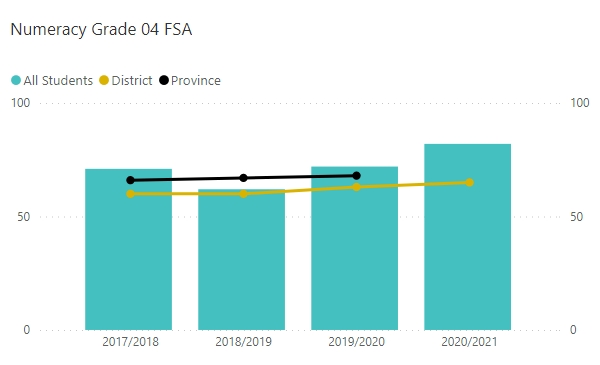
As indicated by Foundation Skills Assessment (FSA) data below, over the past four years, our students in grades 4 and 7 are near to or above the district average in numeracy:
 |
 |
Building Thinking Classrooms...
FSA assessments tell part of students' learning journeys. Classroom assessments are the best indicators for identifying students' strengths, and where they need to develop further understanding and proficiency.
"Our Focus" section provides more in depth information about our specific goals and criteria for success; criteria serve to make success visible so teachers and students know they are making progress toward the goals.
OUR FOCUS
Building Thinking Classrooms...
If we want our students to think, we have to give them something to think about. (Source: Peter Liljedahl, Building Thinking Classrooms in Mathematics)
Establishing Clear Goals and Success Criteria...
In order to know if students are moving forward in their learning, we need to establish clear goals and criteria:
Learning goals:
- Develop, demonstrate, and apply mathematical understanding through play, inquiry, and problem solving;
- Develop and use multiple strategies to engage in problem solving.
Success Criteria
We established the following criteria for what a thinking and problem solving classroom, K-7, would look, feel and sound like:
- All students will have confidence when speaking in small groups;
- Students' mathematical vocabulary will increase;
- Small group conversation will increasingly be on task;
- Students will invite reluctant speakers into conversations;
- Students will take risks in their thinking, focussing more on process and less on what is right;
- Students will need less of the teacher (fewer proximity questions) to prompt their thinking;
- Students grow more playful during math.
Cohorts:
A group of eight teachers across primary and intermediate embarked on a professional inquiry using Peter Liljedahl's book, Building Thinking Classrooms in Mathematics. These teachers met every six weeks to share learning and insights, and set aside intentional time for reading, discussion, peer observation, dedicated math instructional time and reflection to put new strategies into play in the classroom. These 175 learners were increasingly exposed to open-ended, rich thinking tasks such as "Number Talks" and the "Esti-mystery" example below:

(Source: https://stevewyborney.com/2019/09/51-esti-mysteries/)
Esti-mystery starts with an estimation task, but creates suspense through a number of clues, each providing a rich opportunity for discussion and thinking about numbers. Students revise their estimate after each clue and wait for the big reveal. Depending on which Esti-mystery used, clues provide opportunity for thinking and discussion around digit placement, odd/even, prime/composite, factors/multiples, more than/less than. In an Esti-mystery, each clue is revealed one at a time, allowing students time to discuss and problem-solve using various strategies:
Of these 8 classrooms, three (one primary, two intermediate) became the focus for gathering evidence of learning. These observations are shared in "Our Next Steps".
OUR NEXT STEPS
What have we noticed?
Teacher Reflections from the Book Club
Why is teaching for thinking important in Math? Why did teachers sign up for this? What did they notice? It is evident from two sources - teacher reflections and success criteria - that our intentional practices have had a positive impact on student learning. Our learners have grown more playful, resilient, collaborative, and willing to take risks in their thinking, all of which contribute to students' ability to use multiple strategies when engaging in problem solving.
The graph below is a response to an end of year questionnaire completed by six of the eight teachers from the Building Thinking Classrooms in Mathematics book club:

Cohort Observations and Evidence of Learning
Grade 2 Student Voices
January 2022...The teacher asked her 21 students two questions about their math identities:
- Do you like math? 11 students responded "no".
- Do you think you are good at math? 10 students responded "no".
June 2022...The teacher asked the same students the same two questions:
- Do you like math? 3 students responded "no".
- Do you think you are good at math? 3 students responded "no".
(My ah-ha! moment showed me) "...how teaching the importance of process over product helped kids develop resiliency and bravery in learning. They were way more willing to push through challenges, take risks, and spend the necessary time figuring things out when it wasn't just about getting the one right answer. A big win! (Ms. Jordan Moore. grade 2 teacher)
Grade 5/6 and 6/7 student voices
January 2022...Two cohort teachers surveyed 42 students about their math identities and engagement in problem-solving:
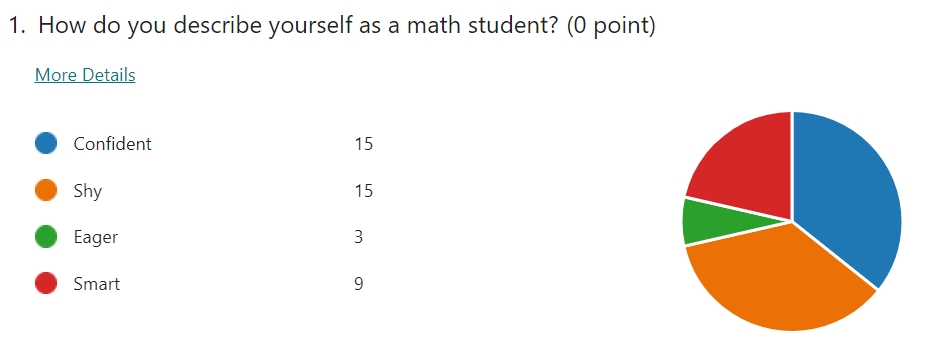


In relation to our two learning goals, teachers took the following key themes from students' feedback and planned accordingly for the remainder of the year:
- Students need increased opportunities to apply mathematical understanding through play;
- Students need to feel increased safety in order to engage in multiple strategies and communicate their thinking.
Teaching for thinking allows students to make deeper connections to not only other math concepts, but to concepts in other academics and in life. Teaching them to think rather than memorize or regurgitate allows them to "flex" that creative and critical thinking competency that is so important. (Ms. Alysha Brennan, grade 6/7 teacher)
When you use vertical surfaces, it allows students to see the math, and students don't have to commit to things. They can erase and try something different when it's not working. This encourages play and inquiry through problem-solving. (Ms. Alex Sabell, grade 5/6 teacher)
Due to various factors, we were unable to survey these same students at year end.
Next Steps
First...
Survey the two cohorts of students in fall 2022 and spring 2023 using the same questions. We will track these students throughout the 2022-23 school year.
Second...
Identify one to two additional classes where the teacher(s) are interested in diving deep and gathering evidence in relation to our two learning goals.
Third...
Continue to work with district helping teachers to develop our own instructional expertise. In consultation with Marc Garneau, district helping teacher, we identified the following question as our school-wide focus for 2022-23:
How can we build confidence in our students' ability to share their mathematical thinking?
Our school collaboration and learning will also include a professional book club using Tracy Johnston Zager's book, Becoming the Math Teacher You Wish You'd Had: Ideas and strategies from vibrant classrooms.

As we build professional capacity, we trust the impact on students' learning and growth will continue. We are committed to fostering safe communities where children increasingly see themselves at mathematicians , build their confidence and resilience to try, fail, and try again while grappling with rich thinking-based problems. Approaching math in this way, we provide all learners accessible entry points into their learning where students will develop, demonstrate, and apply mathematical understanding through play, inquiry, and problem solving using multiple thinking and communication strategies.
Our staff is excited to progress in our learning journey as we continue to build caring, safe learning environments where all voices matter.
Surrey Schools
Formed in 1906, the Surrey School District currently has the largest student enrolment in British Columbia and is one of the few growing districts in the province. It is governed by a publicly elected board of seven trustees.
The district serves the cities of Surrey and White Rock and the rural area of Barnston Island.