Bonaccord Elementary 25-26

OUR CONTEXT
Bonaccord Elementary, located in Surrey’s Guildford area, is a vibrant school with a diverse community of 583 students, where over 48 different languages are spoken. The dedicated team at Bonaccord is committed to fostering equity and inclusion through a strong focus on stewardship, teamwork, academics, respect, and safety (STARS).
At Bonaccord, students actively engage in a wide range of curricular and extracurricular activities that help develop STARS skills and promote effective communication. Examples of these activities include the Reading Link Challenge, collaborative coding projects, building and testing gravity vehicles on a Gravity Track, participating in a diverse music program, and community service clubs such as our Stewardship Club, Free to Be Me Club, and our Arts, Roots, Culture Club. In addition to their academic studies and community service projects, students actively participate in environmental studies. By engaging in activities such as tending to the school garden and exploring ecosystems in Green Timber Forest, students are provided with wonderful opportunities to observe, record, and discuss their observations and experiences. Through these experiences, students gain invaluable knowledge and understanding.
Intermediate students are encouraged to practice and showcase their creative leadership skills by taking on various responsibilities. These responsibilities include delivering morning announcements, monitoring students during lunch, and assisting with various tasks around the school.
Additionally, our intermediate students can take part in a range of athletic team activities that promote a strong mind-body connection. These activities are designed to foster an inclusive environment where every individual's skills are appreciated and valued.
OUR LEARNERS
OUR LEARNERS
At Bonaccord, we believe that literacy is a fundamental skill. Literacy is the ability to read, write, speak, listen, view, and communicate in ways that help us understand and engage with the world around us. It involves making meaning from words, images, and information, and using those skills to think critically, learn, connect with others, and express ideas confidently.
"Writing is thinking on paper. Every child should be given the chance to write, to see what they think." - William Zinsser
Across all grades, our learners have opportunities to create and communicate in all curricular areas.
Our learners can create and communicate their thinking through words, pictures, and print.
Students create and communicate their thinking in many ways, depending on their development. In the recording below, Kindergarten students are orally communicating a story together. They began by creating a scene with concrete materials in a regular classroom activity, called Story Workshop. After they build the scene they tell an oral story with the materials.
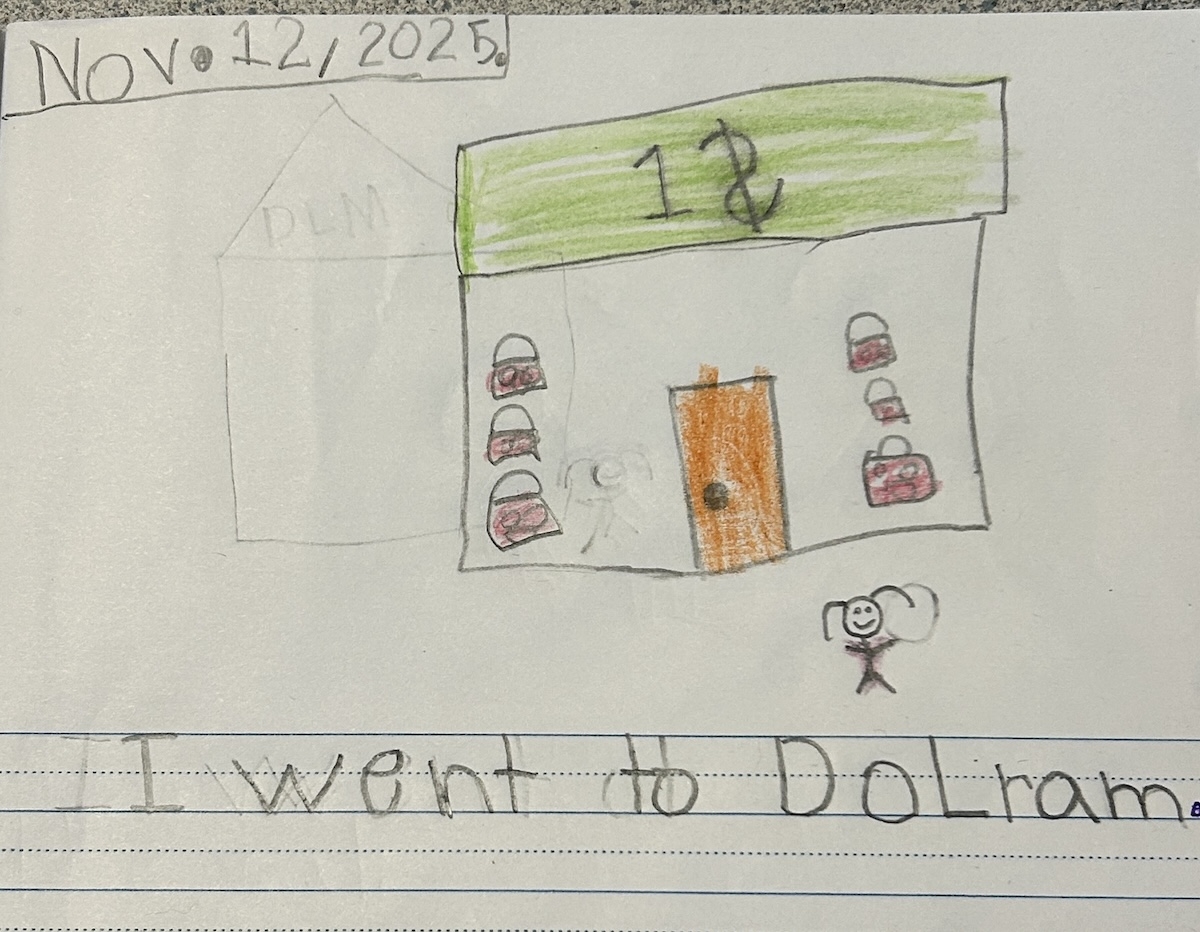
This example shows a Grade One student's writing at the beginning of the year. Often teachers will provide sentence starters and then students phonetically sound out and print the sounds of the word they want to write. In Grade One they are also learning how to use capital and lower case letters appropriately.
Our final two examples show intermediate students who are now able to communicate in paragraphs and take a piece of writing through the writing process, including editing, proofreading and publishing.

OUR FOCUS
OUR FOCUS
Educators at Bonaccord provide daily experiences for learners to develop strong literacy skills that students will use throughout their lives. Students who can create and communicate orally, visually, and in writing are better able to share their thinking, express their ideas clearly, and connect with a wide range of audiences. These skills help students become stronger learners, critical thinkers, collaborators, and problem-solvers, while also building confidence and preparing them for success in school and in life.
In the BC English Language Arts curriculum, “Creating and Communicating” refers to students expressing and sharing their ideas, feelings, information, and understanding through writing, speaking, representing, and other forms of communication. It includes exchanging ideas with others, creating meaningful texts for different audiences and purposes, and using oral, written, visual, and digital forms to communicate effectively. (B.C. Curriculum)
Being able to communicate is a necessary skill in everyday life. For example, being literate is useful for:
- communicating one's thinking and opening doors to learning
- allowing people to fully participate in society, including reading information
- increasing access to higher education and employment
Our students’ learning goal:
In Literacy, students can create AND communicate their thinking orally, through pictures, and using words, including increasing structures and conventions as their understanding develops.
All teachers, across all grades, provide students with learning opportunities aimed at increasing students' ability to create and communicate their thinking. To identify overall strengths and areas of growth, we tracked a cohort of learners, including seven classes. This cohort included a diverse range of learners who are representative of our school's population.
What did this look like for the cohorts?
Creating and Communicating Thinking
Teachers used a range of approaches to support students in developing their writing skills. Some teachers focused on explicit mini writing lessons several times a week to directly teach specific writing strategies and skills. Other teachers taught students how to peer edit and provided opportunities for students to work with peer buddies to assess, revise, and strengthen each other’s writing. In the younger grades, teachers focused on journal writing connected to topics that were meaningful and engaging to students to build confidence and stamina as writers.
Teachers also supported writing development through modelled writing, shared writing, and guided writing activities where students could observe the writing process in action and practise with support. Many teachers used graphic organizers and sentence frames to help students organize their thinking before writing. Some classrooms incorporated opportunities for students to orally rehearse their ideas before writing, while others integrated cross-curricular writing activities connected to science, social studies, or inquiry projects to give students authentic purposes for writing. Teachers also provided regular feedback through conferencing and encouraged students to reflect on and set goals for their own growth as writers.
In the image below, you can see one of our cohort classes engaged in a model write where the class edited sentences together.

In the image below, you'll see groups of students in grade three working together to peer edit each other's writing.

OUR NEXT STEPS
OUR NEXT STEPS
Evidence of our students’ learning demonstrates that our literacy focus positively impacted our cohorts of learners. When surveyed and asked to communicate their students’ progress using the provincial assessment scale, teachers from all the cohort classes indicated that the majority of students demonstrated growth in relation to our numeracy goal. Teachers based their assessments on a triangulation of evidence, including anecdotal comments taken during whole-class writing, digital recordings of students sharing their story workshop stories, written work, and student self-assessment of their writing abilities.

What does this information tell us?
We saw a decrease in the percentage of students who are Emerging (-8%) and a decrease in those who are Developing (-10%). Similarly, we saw an increase in the percentage of students who are Proficient (+17%) and an increase in those who are Extending (+1%).
Communicating:
Students demonstrated their ability to create and communicate their thinking orally, using pictures and words, including structures and conventions.
In the images below you will see two examples of two primary student's growth over time from the fall to the late spring.
STUDENT ONE:
The teacher scribed for the student in Fall 2025

STUDENT TWO:

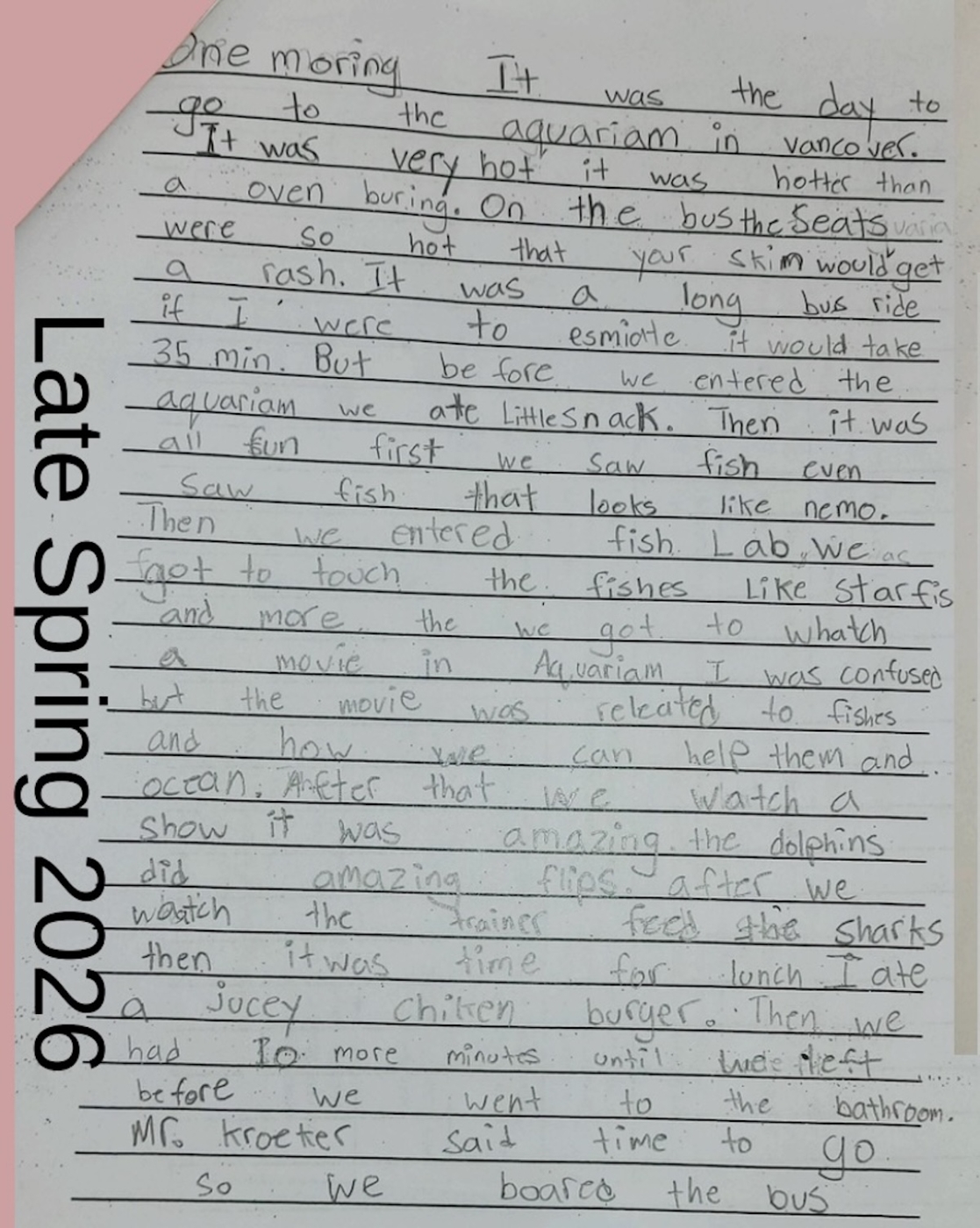
In this example, you will see an intermediate student's spring writing sample. The student's teacher commented:
"One of the biggest shifts we noticed was students becoming more willing to expand on their thinking and share their ideas with greater independence. Their writing began to include more descriptive details, clearer sequencing of events, and stronger storytelling elements that helped the reader stay connected to their thinking. Many students also showed increased perseverance, staying engaged with writing for longer periods of time and taking more creative risks within their work."
Teachers further stated:
"Across the grade, we also saw strong growth in sentence fluency and overall writing conventions. Students became more confident writing complete sentences, connecting ideas together, and revisiting their work through editing routines and self-assessment practices. Their writing reflected growing attention to punctuation, capitals, organization, and clarity.
The dialogue-focused writing samples highlighted especially exciting growth in students’ understanding of conversation within writing. Over time, many students became more consistent using quotation marks, commas, and capitals correctly when writing dialogue. We also noticed students becoming more thoughtful about how dialogue could help show emotions, develop characters, and move a story forward in a more engaging way."
Here is an example of a student's self-assessment.

Moving Forward
Based on evidence of students’ progress in relation to learning goals, our next steps include:
After reviewing school-wide writing trends and the progress of some of our vulnerable learners, we asked ourselves what more could be done to improve outcomes in writing. As a staff, we decided to focus on several key areas:
- We will continue using school-wide writes to help us identify larger patterns and areas of need across grade levels. This allows teachers to collaboratively review student work, discuss instructional strategies, and better understand the developmental progression of writing.
- We will place a stronger emphasis on explicit writing instruction through regular mini-lessons focused on sentence structure, vocabulary development, organization, and written expression. Teachers are committed to increasing opportunities for modelled, shared, and guided writing so that students can see the writing process in action and receive scaffolded support.
- To support vulnerable learners specifically, we discussed the importance of providing additional oral language opportunities before writing, using visual supports and graphic organizers, and allowing students to rehearse ideas verbally with peers or adults. We also recognized the importance of providing high-interest and culturally responsive writing topics to increase engagement and confidence. We will work collaboratively with our Learning Support Teachers and Teacher Librarian in these areas.
- As a school, we also discussed increasing opportunities for small group instruction and targeted intervention in classes, as well as creating more consistent approaches to peer editing, feedback, and goal setting across classrooms.
- Finally, we recognized the importance of celebrating growth in writing over time so that students see themselves as capable and developing writers.
Surrey Schools
Formed in 1906, the Surrey School District currently has the largest student enrolment in British Columbia and is one of the few growing districts in the province. It is governed by a publicly elected board of seven trustees.
The district serves the cities of Surrey and White Rock and the rural area of Barnston Island.