Bear Creek Elementary 25-26

OUR CONTEXT
At Bear Creek Elementary, we are committed to creating a welcoming and inclusive school where staff, families, and community partners work together to support every child. We value the diversity of our students and celebrate the unique experiences and stories they bring to our school. We acknowledge that we live, work, learn, and play on the traditional, ancestral, and unceded territory of the Katzie, Kwantlen, Semiahmoo, and other Coast Salish Peoples.
We strive to provide opportunities that help students feel safe, supported, and inspired to succeed. Through our partnership with Community Schools, students can participate in programs such as Girls in Action (GIA), PAWS After-School Program, and Star Power. These programs help students build confidence, develop leadership skills, and make positive contributions to their school and community.
Students also enjoy hands-on learning experiences through ADST (Applied Design, Skills and Technologies). In our Learning Commons, they explore coding, use 3D printers, and develop creativity, innovation, and problem-solving skills that will support them in the future.
Primary and intermediate students can participate in Choir and Recorder Karate Club, while intermediate students also have opportunities to join sports teams, including soccer, volleyball, basketball, badminton, and track and field.
One of the special traditions at Bear Creek is Adam’s Apples. Students visit the office each day to receive two apples—one for themselves and one to share with a friend. This simple act encourages kindness, strengthens friendships, and helps create a caring school community.
Our students have a strong love of reading and literacy. We support this passion by providing engaging books and learning resources across all subject areas. We are proud to have received the Indigo Love of Reading Grant, which will provide our school with $75,000 in books and literacy resources over three years.
Students also have opportunities to deepen their understanding of Indigenous perspectives and cultures through programs such as Sacred Ties and Windspeaker. These meaningful learning experiences help students build relationships, explore Indigenous histories, traditions, and ways of knowing, and develop a greater appreciation for the diverse cultures that make up our community. Through storytelling, cultural teachings, hands-on activities, and opportunities to learn from Indigenous knowledge keepers and facilitators, students strengthen their sense of belonging, empathy, and respect for others. These programs support our commitment to Truth and Reconciliation and help students become thoughtful, informed, and caring members of their community.
At Bear Creek, our goal is to help students become confident, caring, and resilient learners. We work to provide the knowledge, skills, and values they need to succeed in school and in an ever-changing world.

OUR LEARNERS
Reading fluency and comprehension are fundamental to student success in all areas of learning. When students become strong readers, they are better able to understand, analyze, and think critically about the information they encounter. Reading helps students build knowledge, expand their vocabulary, strengthen communication skills, and develop confidence as learners. It also opens the door to new ideas, perspectives, and experiences, helping students become thoughtful and engaged members of their community.
Developing reading fluency is an important step on the path to becoming a proficient reader. Fluency is built through strong phonological awareness, decoding skills, word recognition, and an understanding of language patterns and structures. As students learn to read accurately, smoothly, and with increasing automaticity, they can devote more of their attention to making meaning from the text rather than decoding individual words. For this reason, reading fluency is often described as the bridge between decoding and comprehension (Rasinski, 2003), allowing students to engage more deeply with what they read and supporting their growth as successful learners.

All learners can develop literacy skills to communicate, understand, and connect with the world around them.
All of our learners are developing their literacy skills in unique ways. We meet each student where they are and support their growth through daily reading and meaningful learning experiences, helping them build the confidence, curiosity, and skills they need to connect with the world through language.
Our learners are growing their independence.
Reading fluency is essential for independent learning. Our learners who read fluently are better equipped to study on their own, conduct research, and engage with various types of written materials independently.
Our learners are building their confidence around reading.
Students experiencing success in reading are more likely to develop a positive attitude towards learning in general. As our learners grow their reading skills and fluency, they are motivated to read more, and the positive cycle continues.
Our learners can use foundational reading strategies and skills to decode words, recognize word patterns, and understand text.
We support this development through daily UFLI instruction. Vowel Valley is one of the tools students use to strengthen their phonics skills and develop a deeper understanding of how words work. Through Vowel Valley, students learn to identify vowel sounds, recognize common spelling patterns, and apply their knowledge when reading and writing. The visual framework helps students understand the relationship between letters and sounds, making it easier for them to decode unfamiliar words and build their spelling skills.


OUR FOCUS
Research highlights the importance of developing fluency early by building strong foundations in accuracy and automaticity (Hudson et al., 2005; Schwanenflugel et al., 2006). In the primary years, these foundational skills help students become confident and capable readers. However, fluency development does not end in the early grades. As students move into the intermediate years, they encounter increasingly complex texts that require stamina, vocabulary knowledge, critical thinking, and the ability to read smoothly and purposefully across disciplines such as science, social studies, and mathematics.
Our school continued to prioritize reading fluency as a key area of learning and growth. Reading fluency is the ability to read accurately, efficiently, and with appropriate expression — is a critical bridge between word recognition and comprehension. When students are able to read fluently, they can focus less on decoding individual words and more on constructing meaning, thinking critically about text, and engaging deeply with learning across all subject areas.
At Bear Creek Elementary, we are proud of the progress our students have made in increasing their fluency skills.
A key focus this year was strengthening reading fluency and comprehension across the school. Specifically, the learning standard we focused on was reading fluently at grade level, with attention on reading with comprehension, phrasing and punctuation. Staff continued to intentionally implement instructional strategies that provided students with regular opportunities to develop and strengthen their fluency skills. Recognizing that students are at different stages in their literacy journey, teachers also provided enrichment opportunities for students who were already demonstrating strong fluency and comprehension skills, helping them deepen their understanding of texts and continue to grow as readers.
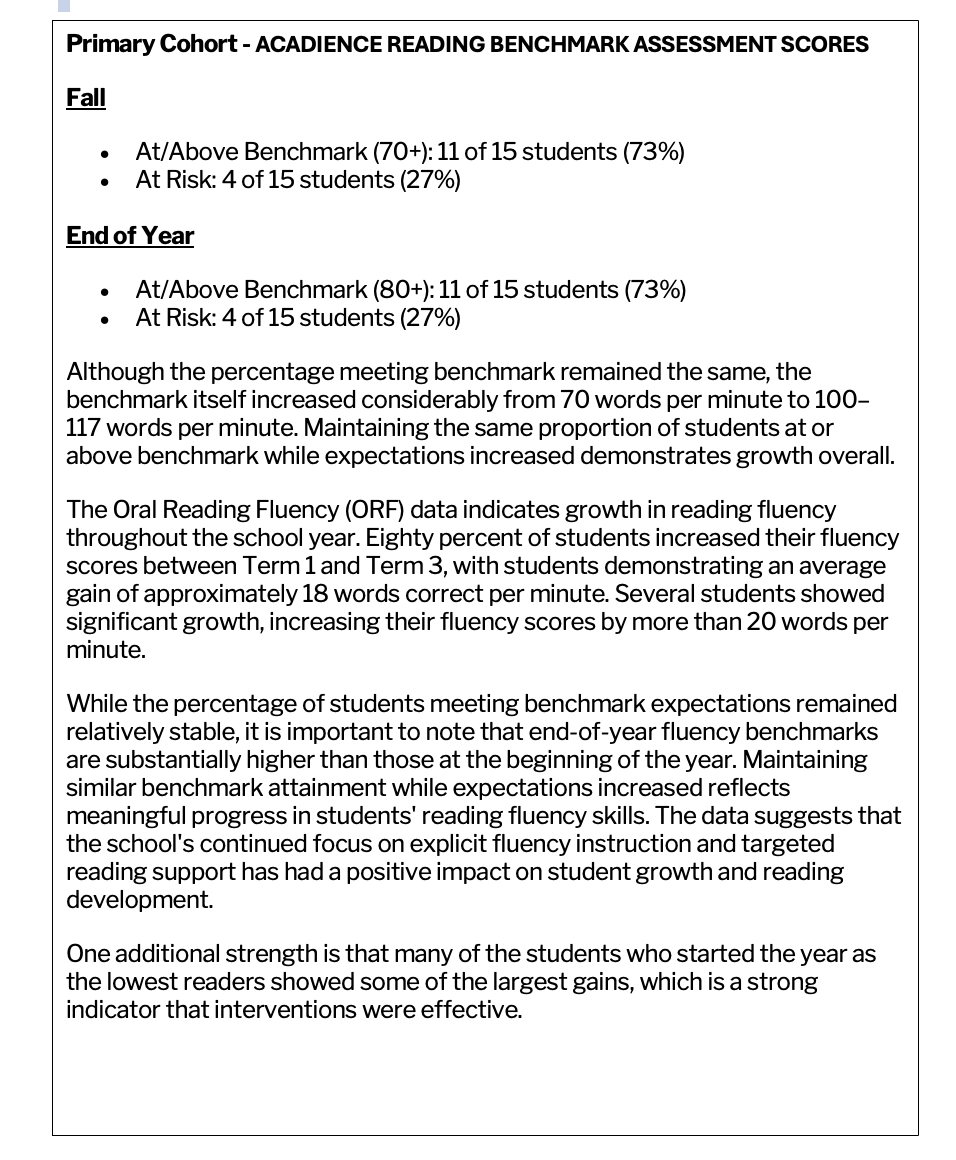
This year, we expanded our literacy cohort to both primary and an intermediate students to help identify students’ strengths, achievements, and areas requiring further support in reading fluency. By examining data across both age groups, the team was able to gain a clearer understanding of how fluency skills develop over time and where targeted instruction was needed most. Our goal was to increase the number of students proficient in reading fluency to over 50%.
Reading fluency data was collected in the fall and again at the end of the school year to measure student growth, monitor progress, and inform instructional next steps. This data allowed staff to analyze trends in accuracy, automaticity, and expression, while also identifying students who required additional intervention or enrichment. Comparing beginning- and end-of-year results provided valuable insight into the effectiveness of instructional practices and helped guide ongoing planning to support student literacy development across the school.
OUR NEXT STEPS

Reading fluency data can provide valuable insight into students’ writing development because reading and writing are closely interconnected literacy processes. When students demonstrate strong fluency skills, they are often better able to transfer those skills into their writing. Conversely, challenges in fluency can sometimes reveal underlying difficulties that may also impact written expression.
Because some of our students demonstrate challenges with reading accuracy and automaticity, teachers will intentionally strengthen explicit phonics and encoding instruction within writing lessons.
Similarly, improvements in fluency over time are often reflected in stronger written communication, increased writing stamina, and greater independence as learners.
Bear Creek's school-wide literacy focus for next year will shift to vocabulary and language development, recognizing that strong oral language and vocabulary knowledge are foundational to both reading comprehension and writing achievement. Specifically, we will focus on the BC Language Arts Curricular Competency "Exchange ideas and perspectives to build shared understanding and extend thinking." By intentionally developing students' academic vocabulary, oral language skills, and ability to engage in meaningful discussions, we aim to strengthen their capacity to communicate ideas clearly, comprehend increasingly complex texts, and express their thinking effectively in writing across all areas of learning. Through rich conversations, explicit vocabulary instruction, and purposeful language experiences, students will be supported in building the language needed for academic success.
Surrey Schools
Formed in 1906, the Surrey School District currently has the largest student enrolment in British Columbia and is one of the few growing districts in the province. It is governed by a publicly elected board of seven trustees.
The district serves the cities of Surrey and White Rock and the rural area of Barnston Island.