Bayridge Elementary

OUR CONTEXT
Thank you for viewing the Bayridge Elementary Student Learning Plan.
OUR LEARNERS
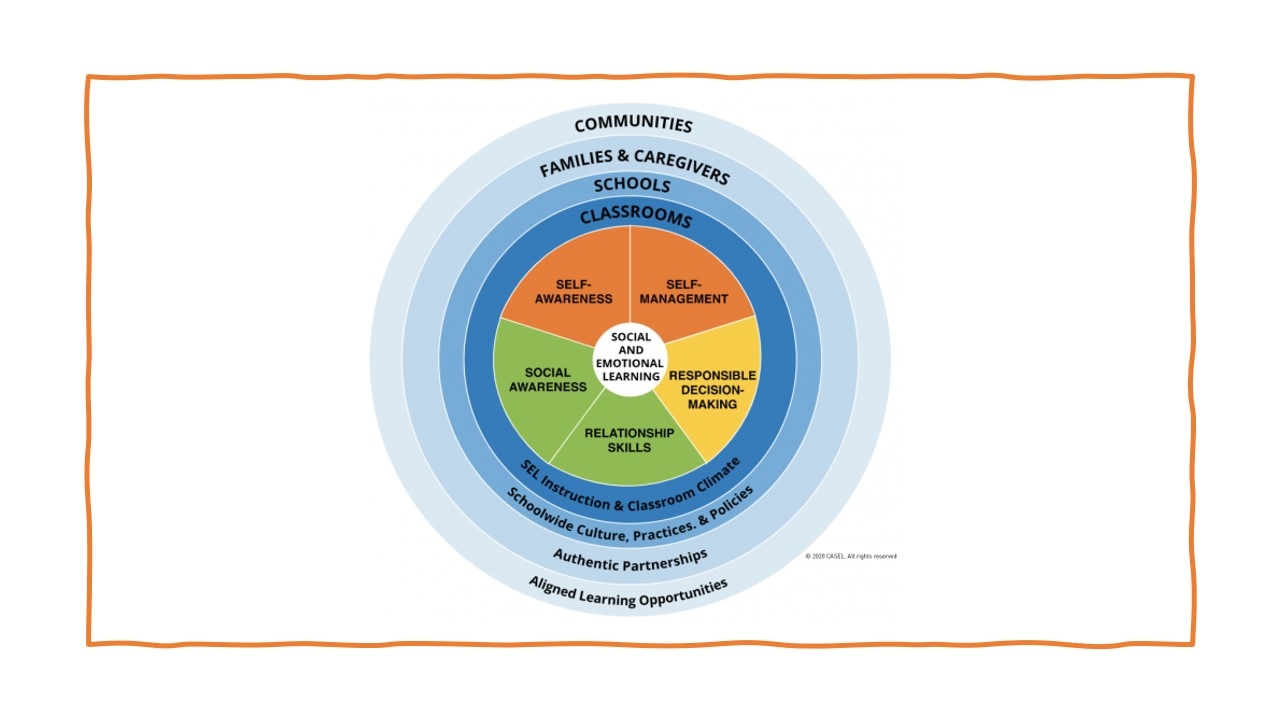
Social and Emotional Learning (SEL) is an integral part of education and human development. SEL is the process through which people acquire and apply the knowledge, skills, and attitudes to develop healthy identities, manage emotions and achieve personal and collective goals, feel and show empathy for others, establish and maintain supportive relationships, and make responsible and caring decisions (CASEL). When students have supportive relationships and opportunities to develop and practice social, emotional, and cognitive skills across many different contexts, academic learning accelerates.
SEL leads to improved academic outcomes and behaviours
At Bayridge, we are focusing on mindsets that help students persevere through challenging materials or problems. Challenges are normalized and mistakes are framed as opportunities to notice and problem solve. Students are learning that their abilities and competence grow with their effort. A "growth mindset" leads to the belief that all of us can improve with effort and new strategies, and that struggle is part of the process. These beliefs encourage students to practice and develop the social and emotional skills to stay motivated, set goals, and reflect on progress. Students demonstrate increased resiliency and a sense of optimism, the ability to foster positive academic mindsets and increased school engagement. Students learn increasingly important skills for our rapidly changing world.
We celebrate our learners' successes and strengths in the areas of:
Personal Awareness & Responsible Decision-Making
I can identify how my challenges can be opportunities for growth.
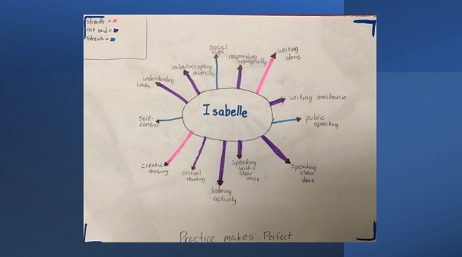
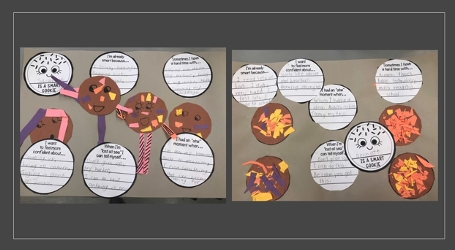
Our students recognize their strengths and they use strategies to focus and accomplish their goals. Below are student reflections recorded after reading the story, "Smart Cookie" by Jory John and Pete Oswald which highlights that there are many ways to be smart. Knowing all the answers isn't the only "ingredient" for intelligence.
This book is a brilliant way to help students realize all of the different ways to be smart, and too persevere to find their passions. We are all talented and intelligent in our own way, and all forms of expression and intelligence should be valued and celebrated!
I can contribute to groups activities that make my classroom, school, community, or natural world a better place.
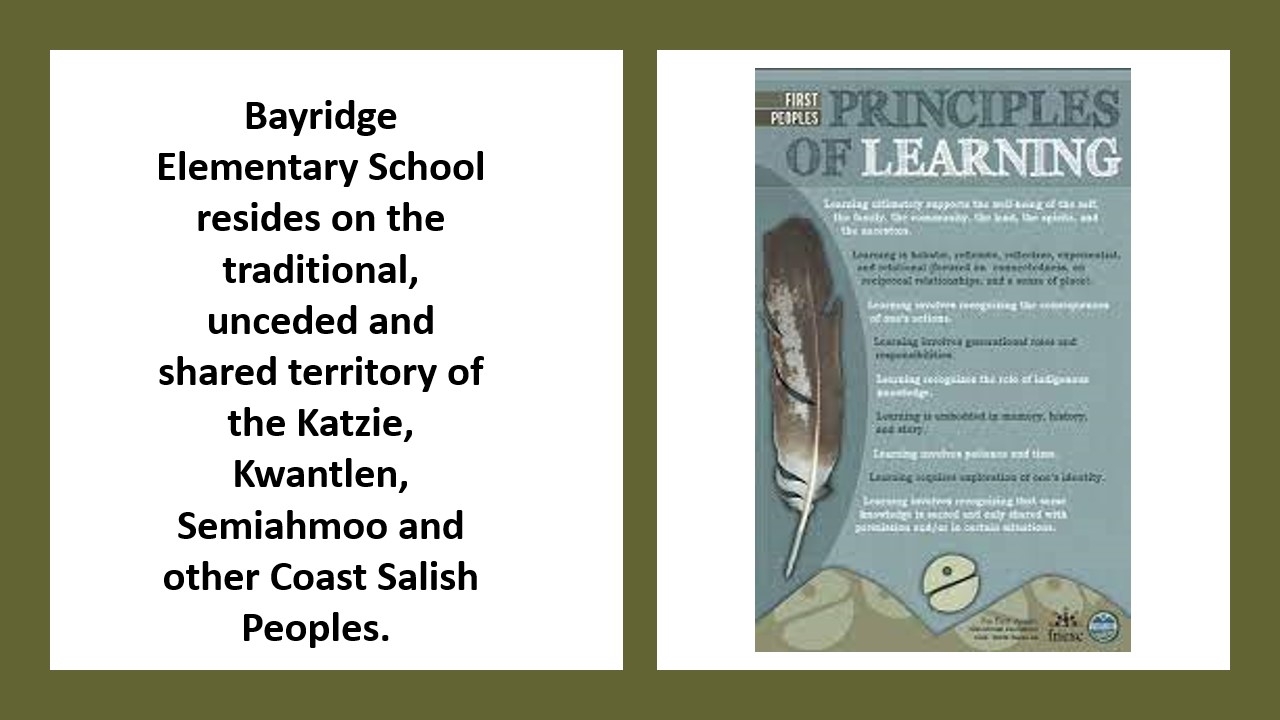
Our students are making a positive change in the environment through our school "green" initiatives such as garden and park stewardship. They are making decisions that align with First People's Principles of Learning as the learning is holistic, reflexive, reflective, experiential and relational (focused on connectedness, on reciprocal relationships and a sense of place). Through this on-going initiative, our school has created gardens, planted trees and is committed to keeping our school and neighbouring forests calm and connected places of learning.

Students are learning and understanding through Indigenous perspectives that everything is inter-connected and that education is not separate from the rest of life. They can make responsible decisions that consider the perspectives, experiences and worldview of others. Here, students are practicing mindfulness (breathing, mindful movement, mindful seeing and mindful listening) while observing the natural wildlife in our Bayridge forest.
OUR FOCUS
In order to foster academic mindsets, Social and Emotional Learning (SEL) is integrated within daily academic instruction. SEL content and objectives are integrated into rigorous instruction through interactive and collaborative pedagogies. This enables ongoing practice of SEL skills and strengthens teaching and learning of academic content.
Every day, our students are presented with opportunities to practice and demonstrate their Social and Emotional learning skills and capabilities. Our team at Bayridge provide students with these essential skills to set them up for success in today's rapidly changing world. To identify students' overall strengths and stretches (areas for growth), we tracked their Self Awareness (self efficacy/self confidence) and Responsible Decision-Making (identifying problems, analyzing solutions, solving problem, evaluating, reflecting) in two cohorts of learners across subject areas and grade levels. These cohorts include a diverse range of leaners that are representative of our school's population.
The SEL competencies we focused on in relation to Self-Awareness and Responsible Decision-Making include:
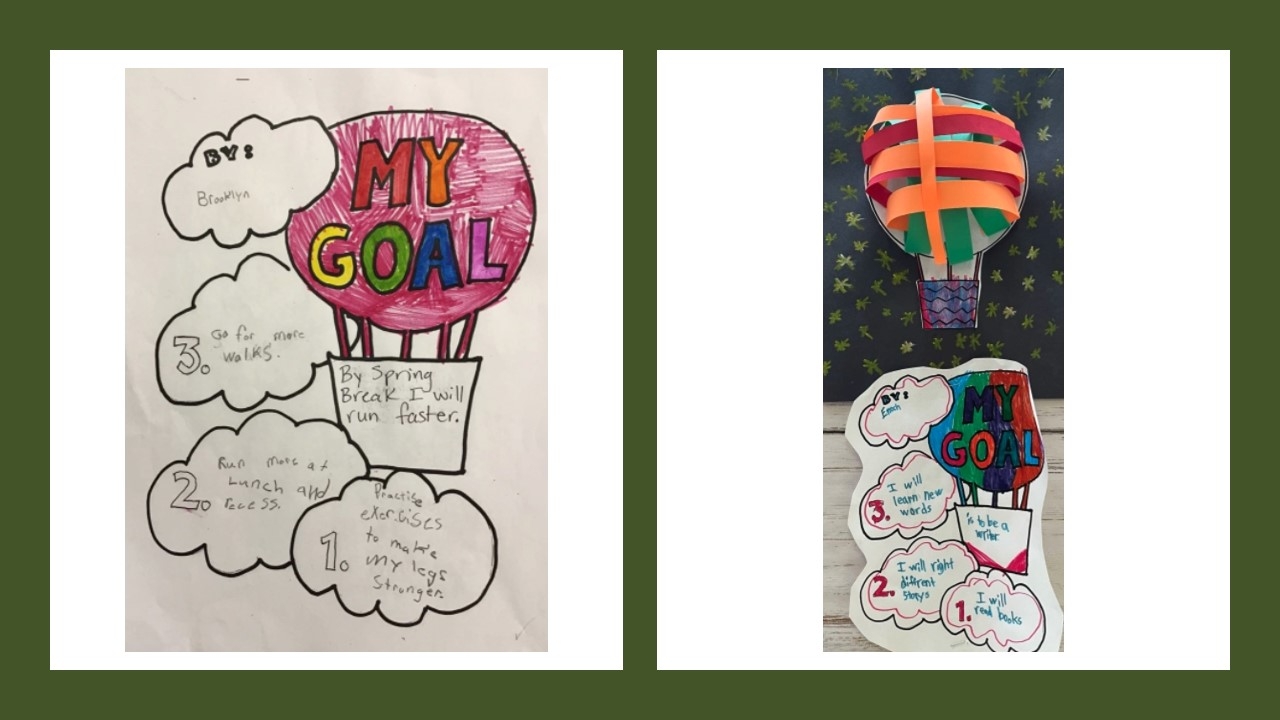
- Recognizing our strengths and taking responsibility for using strategies to focus and accomplish my goals.
- Identifying solutions to personal and social problems and evaluating the consequences of actions.
- Developing an understanding of the role of personal decision making in promoting community wellbeing.
Below are examples of our students' classroom experience as they relate to Self-Awareness and Responsible Decision-Making.
Recognizing our strengths and taking responsibility for using strategies to focus and accomplish my goals.
Students are learning to set goals for themselves. Goals can be strength-based goals and/or challenge goals. Strength-based goals involve both developing and using one's strengths and interests. Challenge goals are set to help develop resiliency and overcome challenges. Utilizing a growth mindset assumes that intelligence and other qualities, abilities and talents can be developed with effort, learning and dedication.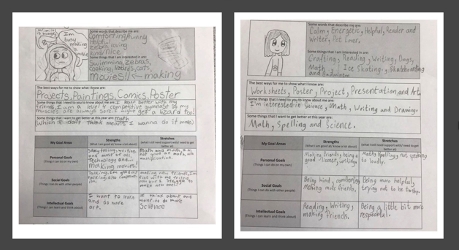
Identifying Solutions to Personal and Social Problems and Evaluating the Consequences of One's Actions
To help our students understand that it is best to consider long-term consequences before taking actions, our learners are presented with grade appropriate opportunities to reflect on the consequences of different actions. Our learners brainstorm and use graphic organizers to outline pros and cons, cause and effect, facts versus opinions, or explain rights and responsibilities.
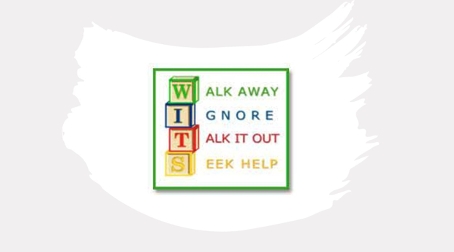
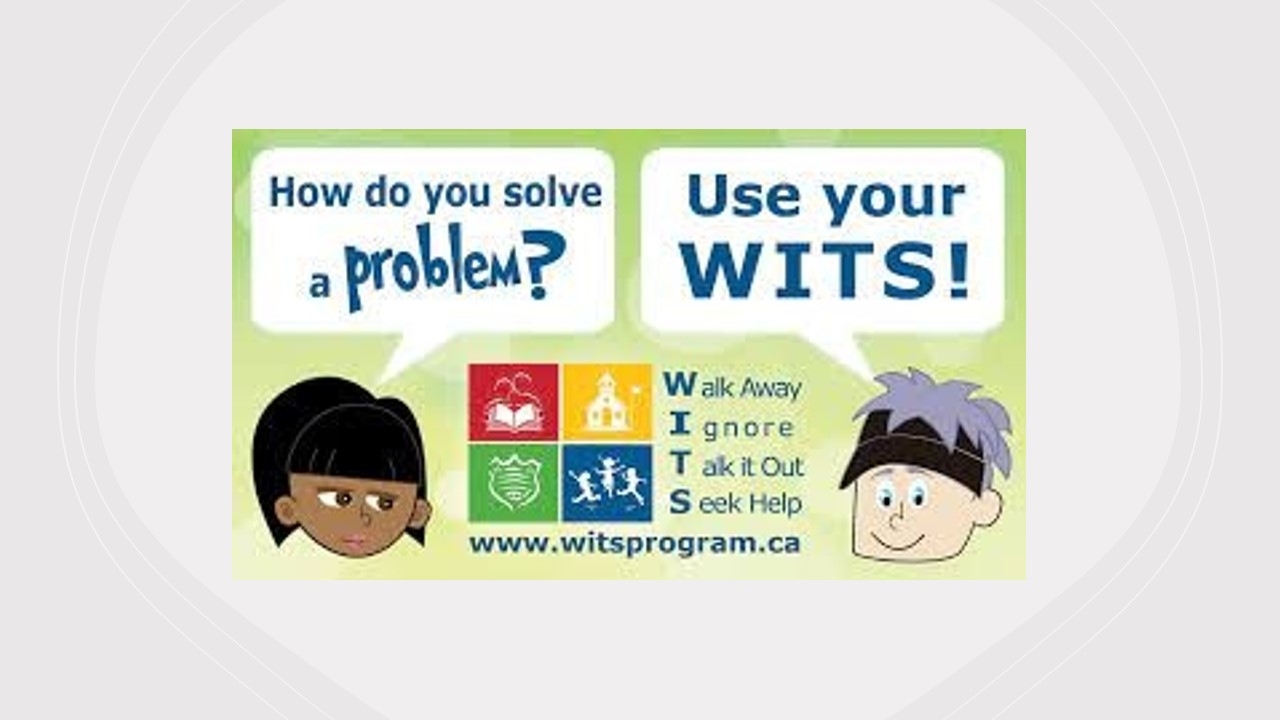
One key tool used by our students is using their "WITS". WITS provides our school community with a common language to discuss, as they engage in positive, pro-social behaviours. WITS is an acronym based on these four strategies (see below). For more information on WITS, click on the "WHAT IS WITS?" video link.
Developing an Understanding of the Role of Personal Decision Making in Promoting Community Wellbeing
At Bayridge, our students use problem solving processes that help them generate solutions to problems by thinking about the possible options and outcomes. Positive verbal and or non-verbal expectations are communicated with evidence that students are able to redo activities and/or social exchanges when they make mistakes. Mistakes are normalized and framed as opportunities.
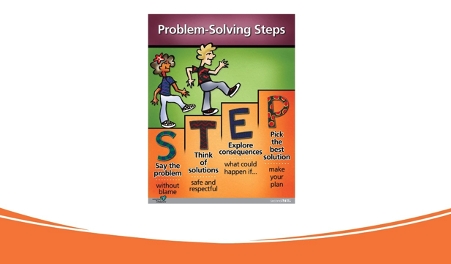
The ability to make positive choices about personal behaviour and social interactions is at the center of responsible decision-making. In all areas of learning, students reflect on and evaluate the benefits and consequences of their different actions.
Our learners are developing their SEL skills, while at the same time building their academic resiliency. In the focus area of responsible decision-making, students demonstrated an increase in their ability to:
- Recognize their strengths/stretches and take responsibility for using strategies to focus and accomplish their goals
- Identifying solutions to personal and social problems and evaluating the consequences of their actions
- Developing an understanding of the role of personal decision making in promoting community wellbeing
OUR NEXT STEPS
Our learners are developing their SEL skills, while at the same time building their academic resiliency. In the focus area of responsible decision-making, students demonstrated an increase in their ability to:
- Recognize their strengths/stretches and take responsibility for using strategies to focus and accomplish their goals
- Identifying solutions to personal and social problems and evaluating the consequences of their actions
- Developing an understanding of the role of personal decision making in promoting community wellbeing
I can identify, apply, and reflect on strategies used to pursue personal healthy-living goals.
Educators at Bayridge utilize their own SEL skillsets and cultural competencies in their teaching practice. They value student's different capacities and cultures/identities and respect their differences, by modelling reflective listening and providing strength based formative feedback. Educators at Bayridge ground instruction in personal relationships by engaging families, exploring identity, fostering individual and collective voices, and by engaging in structured academic and social conversations (ie. morning meetings).
By analyzing student reflections/self-assessments on Personal Awareness and Responsibility Core Competencies, Students' demonstrated examples that reflect their student identity, personal strengths, and personal stretches (learning stories). In addition, school-wide language is becoming evident in classroom based assessment samples where students are demonstrating academic mindsets (ex. perseverance, noticing their own progress, seeing value and purpose in work, and believing that they can succeed).
Educators at Bayridge strive to create trauma-informed learning environments, which are classrooms where students feel safe, develop self worth and have a strong sense of belonging.
"Learning requires the exploration of one's identity".
I can describe factors that positively influence mental well-being and self-identity.
By utilizing school-wide shared language (ex. Second Step, WITS, Ensouling our Schools) our students are demonstrating the development of their SEL skills. This year, students have worked together to brainstorm solutions to a problem in a story that their teacher reads to them. Student work together to generate solutions and work independently to set goals for themselves. Student share their ideas with one another and explore feedback as a class. Later in the year, the students are re-introduced to the same story again to analyze how their problem solving skills have improved. Our learners have been able to practice perspective taking, empathy and increased awareness of self and others. The majority of students in our cohort demonstrated self-awareness and increased empathy with their peers.
"Learning involves recognizing the consequences of one's actions".
I can use personal experience and knowledge to connect to text and deepen understanding of self, community, and world.
At Bayridge, we used confidential student voice surveys to ask random students at various grade levels to give feedback on different aspects of their school experiences, both in and out of school. Community stewardship will be an an area of focus for our Bayridge learners next year based on the data gleamed. We are in the early stages of connecting how our personal decision-making connects to the greater community. What are we responsible for? How do our individual decisions impact those around us? How do our individual decisions impact our environment?

"Learning ultimately supports the well-being of the self, the family, the community, the land, the spirits, and the ancestors".
Moving Forward
Increasing our students skillsets in Personal Awareness and Responsible Decision-Making has been very effective at Bayridge. Our students are progressing in their understanding of themselves, each other and how they connect to their community. As we continue this important work, we will build on the following areas:
-I can describe and apply strategies that promote a safe and caring environment.
-I can demonstrate awareness of the oral tradition in First Peoples cultures and the purposes of First Peoples texts
Personal Awareness
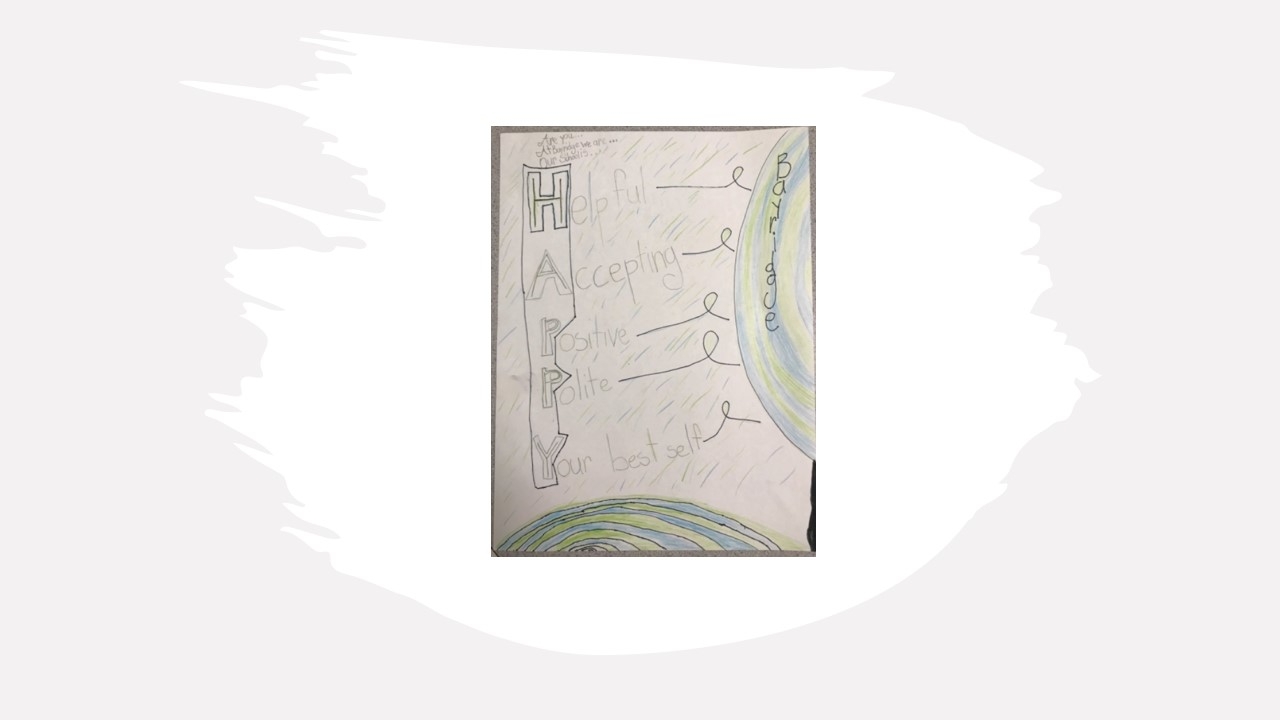
- Increase opportunities for students to reflect on their self awareness and connect how their responses impact their actions and behaviour. We will be using Bayridge's H.A.P.P.Y (see picture below) to help reinforce and generalize these skills to various settings around our school environment.
- Support students in developing and strengthening specific components of self-awareness, social awareness, and respect, self-efficacy, goal setting, emotional resiliency, perspective taking, empathy and valuing diversity.
- Focusing on growth mindset in order to build positive self-worth and academic resiliency.
Responsible Decision-Making
- Further instruction on management skills through teaching explicit SEL skills within other curricular areas (WITS)
- Creating more opportunities for students to take ownership of their learning and practice responsible decision making (Inquiry Learning)
- Coordinated assemblies on growth mindsets and explicit SEL instruction, with intermediate and primary lessons plans to accompany
- Shared language with parent community
- Develop outdoor leaning opportunities with local organizations and local indigenous partners to further develop student understanding of the connections between our actions and our environment
Surrey Schools
Formed in 1906, the Surrey School District currently has the largest student enrolment in British Columbia and is one of the few growing districts in the province. It is governed by a publicly elected board of seven trustees.
The district serves the cities of Surrey and White Rock and the rural area of Barnston Island.