Prince Charles Elementary 23-24

OUR CONTEXT
Learners at Prince Charles are diverse in many ways, from their culture, background, and identity, to their approaches to learning, and how they view themselves as learners. Students at Prince Charles are proud of their school and the learning that happens here.
OUR LEARNERS
OUR LEARNERS
At Prince Charles Elementary, our learners are at the core of our work around reading. As a staff, we are invested in promoting the love of reading with our students. We promote student choice and encourage students to choose books that are of interest to them to build engagement. Reading is also a social activity at Prince Charles, as students are often reading to each other sharing discoveries, new information and their joy from personal connections.
Our school community is a beautiful mosaic made up of 381 learners of which 268 are ELL learners who speak 34 different languages at home. Some strategies that we use to bridge the gap for our ELL learners to promote English language and literacy include, providing technology with reading and language apps to use in the classrooms, providing literature that is engaging, promoting peer interactions and providing small group LST support.

Our school promotes various school-wide events to cultivate excitement in reading by:
- Providing books that have multicultural content
- Taking literacy activities outdoors
- Taking field trips to our community Public Library
- Sharing the love of reading by reading out loud to the class and to each other
- Hosting reading initiatives within the school such as student book clubs, the Reading Link Challenge, Drop Everything and Read...
- Participating in monthly library reading challenges

Building off the work from the previous year, the student cohort of grade 6/7s have continued to engage in a wide variety of reading activities to build on student strengths.
OUR FOCUS
OUR FOCUS
Our district has identified reading fluency as one of its key focus areas and has created an intervention called Responding to Readers. This initiative provides an opportunity for a small cohort of teachers to look closely at their readers and engage with a community of curious professionals exploring reading, quality assessment practices, and responsive instruction. Our teachers committed to this project and began working with district colleagues to further develop their capacity as learners, leaders, and educators, with the goal of improving reading practices for their students.
After conducting initial reading assessments at the beginning of this school year, two of our upper intermediate teachers gleaned from their research that many of their students were not at grade level with regards to reading fluency and comprehension and sought out opportunities to assist their students in bridging this gap.
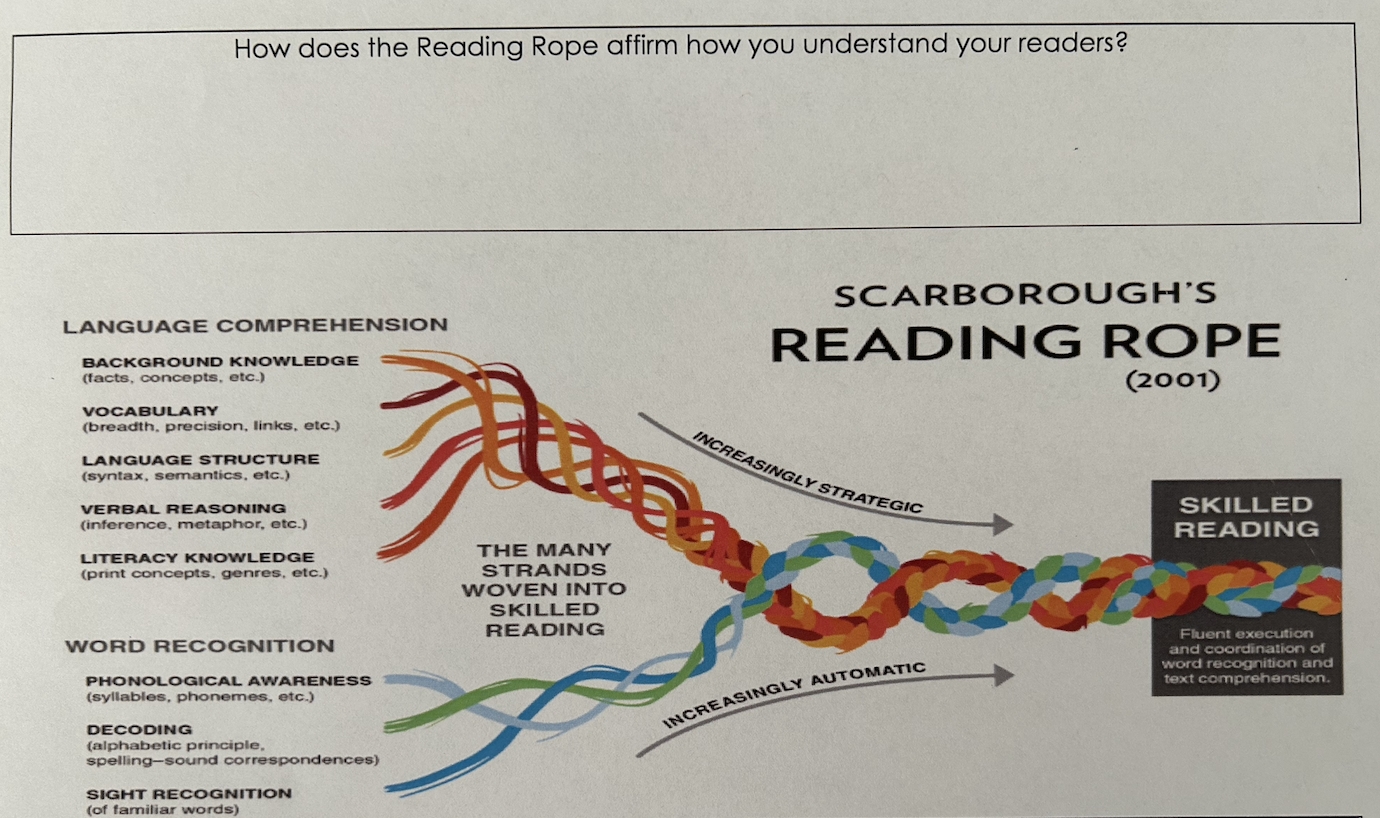
Our team looked at proficient readers based on research (Science of Reading). We specifically focused on:
- Cognitive Model of Reading (McKenna & Stahl 2009)
- Factors Influencing Reading Achievement (Afflerbach 2022)
- Scarborough's Reading Rope
Assessments that the cohort used to guide their practice and to determine where readers were at, included:
- Dibels reading assessment
- Modified RAD (Reading Assessment and Diagnostic Evaluation)
- Running records
- Reading fluency rubrics and WCPM (word count - mistakes made)
- Listening to students read out loud
- Asking questions/interviewing students about their feelings about various aspects of reading
- CORE Phonic Assessment
- Fountas and Pinnell reading levels
The following is data on Fountas and Pinnell reading records for students in two different cohorts.
| Response to Readers Intervention | Non-Intervention Group | ||||||
| Student | Fall 2023 | Spring 2024 | Growth in reading levels | Student | Fall 2023 | Spring 2024 | Growth in reading levels |
| A | no results | W | A | V | W | 3 | |
| B | no results | V | B | no results | V | ||
| C | x | Y | 1 | C | U | Z | 5 |
| D | Pre A | Pre A | 0 | D | R | V | 4 |
| E | Q | V+ | 5 | E | I | K | 2 |
| F | R | T | 2 | F | W | Z | 3 |
| G | U | W | 2 | G | PreA | PreA | 0 |
| H | Pre A | B | 1 | H | E | G | 2 |
| I | R | T | 2 | I | N | O | 1 |
| J | U | W | 2 | J | no results | PreA | |
| K | O | T | 5 | K | R | Z | 8 |
| L | U | W | 2 | L | U | X | 3 |
| M | D | K+ | 7 | M | Q | T | 3 |
| N | T | W+ | 3 | N | G | P | 9 |
| O | I | K+ | 2 | ||||
| P | R | V | 4 | ||||
| Q | T | W+ | 3 | ||||
| R | V | Y+ | 3 | ||||
| S | T | V | 2 | ||||
| T | S | T | 1 | ||||
| U | S | U | 2 | ||||
| V | V | Z+ | 4 | ||||
| W | P | T | 4 | ||||
| X | S | T | 1 | ||||
| Y | U | X+ | 3 | ||||
| Z | T | Y+ | 5 | ||||
| AA | T | U | 1 | ||||
| Average: | 2.68 | Average: | 3.583333333 | ||||
Looking at the information drawn from the assessments, the teachers asked themselves:
What do they know how to do? What areas do they need support in? Where do they need to go next?
What do they know how to do?
It was evident that the students knew how to track their reading and the students had various strategies to help with comprehension such as making connections and inputting words with unknown words.
What areas do they need support in?
It was discovered that the students needed support with fluency and comprehension. What was impeding their fluency was difficulty with decoding and students had difficulty with comprehension because they lacked understanding of various vocabulary.
To improve fluency, the teachers focussed on phonemic awareness and to improve comprehension, they focussed on vocabulary development.
Explicit instruction on phonemic awareness and vocabulary was taught in mini lessons during each Language Arts block throughout each week, and integrating it into other curricular areas. Students had opportunity to practice reading out loud to themselves and to their peers. Reading passages were read chorally, then they were practiced in small groups. A 'cold' reading assessment was completed then after some practice a 'warm' reading assessment was completed to determine progress.
To help monitor progress, the teachers created reading rubrics which were used in peer assessments. Explicit instruction on how to use the rubrics was completed at the beginning of the school year and with practice, the students became competent in using the rubrics by gradually taking ownership of this responsibility.
Reading assessments were completed at the beginning and end of the school year using Fountas and Pinnell.
The following is data for students in two different cohorts.
| Response to Readers Intervention | Non-Intervention Group | ||||||
| Student | Fall 2023 | Spring 2024 | Growth in reading levels | Student | Fall 2023 | Spring 2024 | Growth in reading levels |
| A | no results | W | A | V | W | 3 | |
| B | no results | V | B | no results | V | ||
| C | x | Y | 1 | C | U | Z | 5 |
| D | Pre A | Pre A | 0 | D | R | V | 4 |
| E | Q | V+ | 5 | E | I | K | 2 |
| F | R | T | 2 | F | W | Z | 3 |
| G | U | W | 2 | G | PreA | PreA | 0 |
| H | Pre A | B | 1 | H | E | G | 2 |
| I | R | T | 2 | I | N | O | 1 |
| J | U | W | 2 | J | no results | PreA | |
| K | O | T | 5 | K | R | Z | 8 |
| L | U | W | 2 | L | U | X | 3 |
| M | D | K+ | 7 | M | Q | T | 3 |
| N | T | W+ | 3 | N | G | P | 9 |
| O | I | K+ | 2 | ||||
| P | R | V | 4 | ||||
| Q | T | W+ | 3 | ||||
| R | V | Y+ | 3 | ||||
| S | T | V | 2 | ||||
| T | S | T | 1 | ||||
| U | S | U | 2 | ||||
| V | V | Z+ | 4 | ||||
| W | P | T | 4 | ||||
| X | S | T | 1 | ||||
| Y | U | X+ | 3 | ||||
| Z | T | Y+ | 5 | ||||
| AA | T | U | 1 | ||||
| Average: | 2.68 | Average: | 3.583333333 | ||||
Student Self-Assessments
The key to creating an effective intervention, is to have a partnership and open communication between teachers, their students, and the families. Responding to Readers requires students to be active participants in their learning. Students are required to complete interviews with their teachers at the beginning and end of the year, and to track their progress along the way. The interviews consisted of the following questions and a sample response from a student is listed below:
Thinking about how we have practiced reading out loud:
- How did you feel about reading out loud at the start?
- I felt like it was a good skill to learn so we can read better – reading difficult words and saying them in a loud and clear voice. I felt like it was better reading with the whole class than in small groups.
- How do you feel about reading out loud now?
- I feel more comfortable reading out loud now than in September because doing it often makes it feel less weird.
- How do you feel about your ability to understand what you read?
- I read better now than in September and I feel like I can read harder words now. I think I have been reading a lot like the novel study and I also read online about Ancient Rome. I can also picture the words that the author says and I feel like the vocab activities have helped.
- What are you proud of?
- I feel like I got better at reading out loud and speaking out loud.
- What do you feel you need to improve?
- I want to get my reading level above my grade level. I feel like I had trouble with the “Riding the Tiger” book activities in the second term. Maybe it was the vocabulary.
The staff also looked at their own teaching practice in the same way, asking:
What areas do we feel confident in? What are areas of improvement? What do we need support with in our own learning?
What areas do we feel confident in?
Participating in the Responding to Readers district initiative has helped me synthesize my understanding of all facets of reading (see Scarborough's Reading Rope) and I feel confident in my understanding and ability to use assessment tools such as Dibels and RAD to inform, drive and shape the reading program I provide for my students.
What are areas of improvement?
The partnership between the classroom teachers, LST department, Literacy helping teachers and our Early Learning Teacher has been integral in establishing a literacy program that is individualized to the needs of our students. We look forward to our continued partnership to further develop our students' literacy skills.
What do we need support with, in our own learning?
Continued programs like Responding to Readers which is providing us with time to develop and improve our teaching practices based on current research. Providing opportunities to meet teachers where they are at in their practices and providing the help they need is important and appreciative.
Meaningful in service for teachers about the Science of Reading to ensure continuity of reading instruction from K to 7.
OUR NEXT STEPS
OUR NEXT STEPS
Where do they need to go to next?
Next year, as a staff, we feel that it is important to intentionally collaborate with colleagues in order to focus on developing students' skills in Reading. We will continue to encourage students to name and celebrate their strengths, while at the same time, naming and working on their stretches.
The learning team will be enrolling in year 4 of the Responding to Readers initiative. They have identified the following goals for next year:
- Integrating more of the newly acquired resources into next year's plan
- Adding a reading comprehension assessment
- Adding a quantitative element for fluency - tracking data from September to June
- Continue to conference with students and have them reflect on their growth
- Continue to work closely with district staff
- Invite in one of the district Literacy Helping Teachers to facilitate professional development opportunities for other staff who are interested in the project
- Collaboration with other staff so perhaps instruction and interventions could continue for students from one grade to the next
- Exploration of additional reading intervention programs (building on skills from year-to-year)

Together, we can have a profoundly positive impact on how students view themselves as learners. When students are able to identify their strengths, and acknowledge areas in need of growth, they are more willing to take risks and put effort into academic tasks that are challenging.
Surrey Schools
Formed in 1906, the Surrey School District currently has the largest student enrolment in British Columbia and is one of the few growing districts in the province. It is governed by a publicly elected board of seven trustees.
The district serves the cities of Surrey and White Rock and the rural area of Barnston Island.