Port Kells Elementary 24-25

OUR CONTEXT
Port Kells Elementary School
We are a school with approximately 80 students , and we are located in a rural community in the north east area of Surrey. A big part of our school is the connection to the Port Kells Community. Our student population is quite stable, and includes students from families who have had multi-generations of family members learn and work in our school.
In spite of its small size, our students come from a diverse range of backgrounds. Our students are valued for their differences. Evidence of this is seen in how confident our students are, how respectful, caring and kind they are towards others in our school, but also guests as they enter our building. A very unique aspect of our school community is the interaction of students across all grade levels. This symbiosis allows our older students to take on the role of leaders in our school, and gives our younger students older role models to 'look up to.'
Because of our small size, all staff get to truly know each of our students and take part in the students' learning. As we are comprised entirely of combined classes, teachers and students frequently work together for more than one year. This enables our teachers and students to build a strong connection over multiple years. At Port Kells, we work together collaboratively to ensure that all of our students can reach their full potential and that we can foster a school community where students feel safe to learn and want to take risks, make mistakes and explore. At the forefront of our mindset is the First Nations' principle, "Learning takes patience and time and that learning requires exploration of one’s identity."
At Port Kells, we have a dedicated PAC. Our PAC is hard working, industrious, and provides students with an 'enhanced school experience'. Some examples include, Pancake Breakfasts, Santa visits, family events, Welcome Back Meet and Greet), coordinate Hot Lunch and Treat Days and support class field trips. Our students know the PAC members and enjoy seeing them around our school. A huge bonus of a small school is that our staff know our parent community as well as our students.

OUR LEARNERS
Some things about our learners based upon anecdotal evidence given by the adults that work in our building:
- Our students are comfortable here; they treat our school like it is home
- They are playful and joyful
- They enjoy coming to school
- They want to learn and engage in their learning
- They try really hard - they want to do well
- They look out for one another; they care about each other; everyone knows one another
- They will advocate for themselves, each other and many social justice issues around them
- They are inclusive
Student Voice:
"It's my favourite school because I've been here almost my whole life. Because I have lots of friends and made good friends."
"I Like Port Kells because when I first moved to Port Kells this year I was different and everyone welcomed me and made me feel happy"
"I like being a leader and being part of leadership because I get to make a difference in my school and help the little kids."
"I liked being asked to join Leadership because I can do good things and I made new friends. I like that we can help the community too, like the food bank."
"I Like that we made a Kindness Tree and filled it with ways that we can be kind, are kind and when we saw people doing kind things. Kindness has to start with one person and then it grows."
OUR FOCUS
In the past, our school team have been focused on developing school-wide universal supports for Social Emotional Learning (SEL). That work continues in each class as part of the everyday routines. Looking forward, we know that an area that we must continue to improve upon is reading. We know this, based upon information provided by FSA results, year-end assessments and day-to-day observation . We are also keenly aware of the fact that early intervention is a foundational piece in building student success in later grades.

We are fortunate to have teachers in the primary grades who recognize the importance of phonemic awareness and phonics instruction in developing good readers. Both the Heggerty Phonemic Awareness Curriculum and UFLI Foundations are used extensively in the primary grades at our school. Heggerty is used in the kindergarten and grade 1 class. These materials focus primarily on developing students' ability to hear and manipulate sounds. UFLI Foundations, which is being used in the Grade 2/3 class, builds on those skills by teaching students how to use those sounds when they see letters and print.
We understand that developing student knowledge of phonemes and providing explicit phonics instruction are foundational to being an effective reader.
From the BC School Language Arts Curriculum:
K/1 Learning Standards
-Phonemic awareness is a specific aspect of a learner's phonological awareness: a child's ability to segment broken words into phonemes and to blend phonemes into words indicates a developing phonemic awareness.
-Phonological awareness involves the abilities to hear and create rhyming words, segment the flow of speech into separeate words, and hear syllables as 'chunks' in spoken words.
Gr. 2/3 Learning Standards
-Using knowledge of language patterns and phonics to decode words; identifying familiar and 'sight' words; monitoring (asking: Does it look right? Sound right? Make sense?)
-Recognizing and identifying word patterns/families
Given the importance of these areas, we wondered if daily use of these materials in primary grades would have a significant effect on year-end reading scores. Each of our student's reading is assessed at both the beginning and end of the school year using the Fountas and Pinnel reading assessment. The Fountas and Pinnel materials also come with a Reading Level Evaluation Chart that indicates a range of achievement levels for each grade at the beginning, middle and end of the school year. We compared the year-end student reading assessments from June of 2024 with June of 2025 to look at growth over a twelve month period. We were curious to see if year-end reading levels would surpass expected results indicated in the Fountas and Pinell Reading Level Evaluation Chart.
 Our Learning Cohort:
Two classrooms. One a K/1 with 21 students and a Grade 2/3 with 19 students. These 40 students had 20-30 minutes per day using the Heggerty Phonemic Awareness Curriculum (K/1) or the UFLI Foundations (Grade 2/3) over the duration of the school year. Our test cohort was significantly smaller than that number for a variety of reasons:
-we did not assess the kindergarten students using Fountas and Pinell at the end of the school year.
-we did not have 'baseline' data for a number of the students.
-some students moved part way through the school year.
-other students were away during year-end assessments.
As a result of these factors, our cohort was only comprised of 12 students.
June 2024
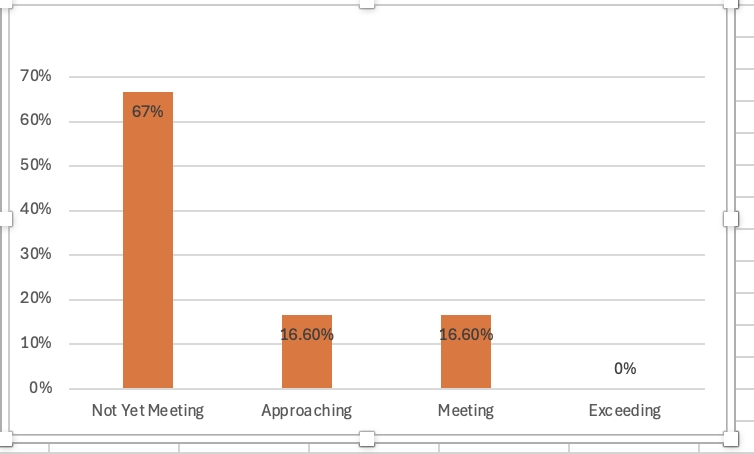
In June 2024, 67% of the cohort were not meeting the expectations outlined in the Reading Level Evaluation Chart. Only 16% were approaching expectations and another 16% were meeting the expectations.
By June 2025, there were significant changes in these students:

The 'Not Yet Meeting' category had decreased from 67% to 25%. Approaching category remained steady at approximately 15%. The meeting category increased from 16% to 25%. In June 2024, none of our subjects exceeded the expectation, by June 2025, 33% of our subjects were exceeding the expectation.
Student voice:
The students were excited to demonstrate their skills. A number of questions were asked of them:
Tell me about a time when you used sounds to figure out a word while reading.
How do you feel when you can hear all the sounds in a word?
Show me how you put sounds together to read a new word.
"When I need to know a word, I look at the letters and I put the sounds together."
"I know that I am right when I put all the sounds together and I get a word!"
"I can make changes to words to make new words with new sounds."
We know that teaching phonics and developing phonological awareness are only part of the puzzle. Reading is a complex process that 'marries' comprehension skills as well as word recognition skills together. However, given that phonics and phonological awareness work comprise a significant portion of literacy instruction in these two classes, we believe that working with resources such as the Heggerty Phonemic Awareness Curriculum and UFLI Foundations have had a significant effect on reading levels in Grades K-3 at Port Kells Elementary.
OUR NEXT STEPS
Reading Goals:
- Reading Fluently at Grade level (K-7)
- Engage actively as listeners, viewers, and readers, as appropriate, to develop understanding of self, identity and community (K-3)
- Access information and ideas from a variety of sources and from prior knowledge to build understanding
Some things that we will continue to do to promote literacy and increase reading fluency and comprehension:
-Celebrate reading and writing in our classrooms
-Provide resources and Professional Development opportunities to support best practices in literacy instruction
-Use data obtained from literacy assessments to inform how we best utilize our resources such as LST time and Learning Resource Budget.
-Focus on providing early intervention.
-Share strategies for supporting literacy with our parent community
-Provide engaging digital resources to promote reading.
Surrey Schools
Formed in 1906, the Surrey School District currently has the largest student enrolment in British Columbia and is one of the few growing districts in the province. It is governed by a publicly elected board of seven trustees.
The district serves the cities of Surrey and White Rock and the rural area of Barnston Island.